
Improvisation · Intermediate
Chord Tones: How to Solo Over Chord Changes
Solo over two chords and hear the changes in your lines, by landing on a chord tone each time the chord changes. Then take the same idea to a ii-V-I.
Summary
- Land on a note of the chord each time the chord changes.
- Play any note in the key in between; aim the phrase at a chord tone on the downbeat of the change.
- Start with one target, the 3rd, over two looping chords.
- Keep it in time with the band.
On this page
You already know a scale, so every note you play over the progression is in the key. But when every chord gets the same notes, the solo can sound like the scale going up and down while the chords change underneath it. Trying to use every note of the scale all the time is a big part of what makes it sound like you're running a scale 17:57Watch at 17:57.
This is where chord tones help. Pick out the notes of the chord you're on, and land on one of them when the chord changes. Chord tones always sound good because they're the notes in the chord.
What a chord tone is
A chord tone is a note that's in the chord you're playing over. The notes in the chord can't sound bad over that chord, because they're the same notes the chord is already playing 1:04Watch at 1:04.
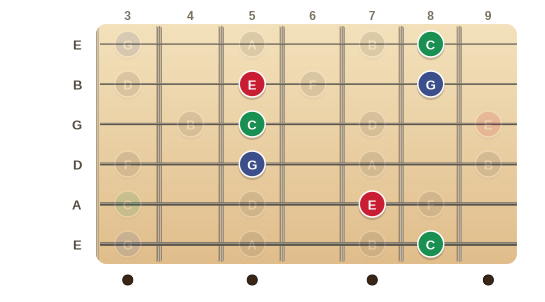
To spell a chord, start on its name and take every other note of the key: start on the root, skip a note, take the next, skip another, take the next 24:13Watch at 24:13. In the key of C:
- C is C, E and G: the root, the 3rd and the 5th.
- G is G, B and D.
- Take one more and you get the 7th. C becomes Cmaj7 (C, E, G, B) and G becomes G7 (G, B, D, F).
Now find those notes inside the scale shape you already know. The point of finding the arpeggio is to pick its notes out of the key, and knowing their names (all the C's, E's and G's) makes them much easier to find in the pattern 1:47Watch at 1:47. You can play any note in the key, but you make sure you land on one of the chord's notes 1:26Watch at 1:26.
The two chords share one note: G is the 5th of C and the root of G. The others move by a step: C goes down to B, and E goes down to D.

Land on a chord tone when the chord changes
That's the whole method in one rule: land on one of the chord's tones on the downbeat when the chord switches 8:44Watch at 8:44. You can step into it or leap into it from anywhere, and the solo still outlines the changes because the phrases end on chord tones when the chord changes 9:05Watch at 9:05.
A note outside the chord only causes trouble when you land on it without knowing how it's going to sound 10:08Watch at 10:08.
George Harrison's solo on Something by The Beatles keeps ending phrases on chord tones. In one spot he plays a chromatic run, a bunch of notes most people would call wrong, and it works because it walks straight down into a chord tone 13:04Watch at 13:04. What matters is where the notes in the middle of a phrase lead and where they land 14:06Watch at 14:06.

The targeting ladder: one target at a time
Doing this in time over a band takes practice, so make the job smaller: aim for one chord tone and nothing else.
Start with the 3rd. It's the strongest target on any chord 9:27Watch at 9:27. The root works too, but it's often the most boring note you could land on 12:21Watch at 12:21. Using only one degree on every chord also teaches you how that degree sounds over each chord 32:53Watch at 32:53.
Use two chords from the key of C, C (the I) and G (the V), four beats each, looping. Take the steps in order, and stay on a step until landing on it feels easy:
- The 3rd.
- The 5th.
- The 3rd or the 5th.
- The 7th.
- The 3rd or the 7th.
- The 5th or the 7th.
- The 3rd, the 5th or the 7th.
Do each step on the C first: every time C comes around, land on the target, and play whatever you like over G. Then do the same steps on G, then on both.
From step 4 the band plays Cmaj7 and G7, so the 7th is part of the chord. Look at what's shared: B is the 7th of Cmaj7 and also the 3rd of G7. And F, the 7th of G7, is a half step above E, the 3rd of C. Land on F over G7, then drop a half step to E when C comes back. Notes are lazy: they'd rather move a half step or a whole step, or not move at all 4:19Watch at 4:19.
Put it in time right away. Work out where the notes are, then play them with the beat; don't spend more than about five minutes on anything out of time 3:32Watch at 3:32. Running the arpeggios straight up and down gets boring fast, so make little patterns out of them 6:55Watch at 6:55.
Rhythm first
"A wrong note with a good rhythm is always better than a right note with a bad rhythm" 4:39Watch at 4:39. So before you add notes, get the landing in time.
- One note, beat one. On step 1, play only the 3rd, once, right on beat one of each chord, and let it ring. Keep part of your attention on the band so you hear each chord arrive.
- Same note, new rhythms. Keep the target and change only the rhythm: a short note and a rest, a few repeated notes leading into beat one. Play the same notes and change the rhythm before you reach for different notes 17:38Watch at 17:38.
- Lead in by step. Add a scale note a step above or below the target and walk into it 6:54Watch at 6:54.
- Move the landing. Once beat one is easy, start the same idea a little earlier or later in the bar. Harrison does this in Something, starting the second phrase earlier than the first 2:39Watch at 2:39. You don't have to hit a chord tone on every change. If you always do, it starts to sound boring, but you need to be able to do it so the choice is yours 10:52Watch at 10:52.
Add the scale back
After the ladder, open it up. Use any note in the C major scale, and still land on a chord tone each time the chord changes 6:32Watch at 6:32. Now you're sorting the scale into chord tones and everything else, and leaning on the chord tones 8:01Watch at 8:01.
A good way to get there is to alternate the whole scale with one chord's arpeggio 7:16Watch at 7:16. Lots of people learn arpeggios and then can't keep the key and the chord in their head at the same time; this trains both 8:39Watch at 8:39. Here it is over C, G, Am and F, the I V vi IV from the video above:
When you solo with the chords' own notes, you stop sounding like you're running scales, because you're playing the chords 30:45Watch at 30:45. One shape per chord in one area of the neck is enough to start landing on the change 27:49Watch at 27:49.
Take it to a ii-V-I
The ii-V-I is the most important progression in jazz 0:00Watch at 0:00. In C, with sevenths, it's Dm7, G7 and Cmaj7 1:24Watch at 1:24:
- Dm7 is D, F, A, C. Its 3rd is F.
- G7 is G, B, D, F. Its 3rd is B.
- Cmaj7 is C, E, G, B. Its 3rd is E.
Land on the 3rd of each chord on the downbeat when the chord changes. That makes the progression obvious to the listener even with no chords behind you 6:58Watch at 6:58.
The 3rds and 7ths are also where the voice leading is. From Dm7 to G7, the C moves down a half step to B and the F stays put 5:26Watch at 5:26. From G7 to Cmaj7, F moves down a half step to E and B stays. Play these chords and listen to the top two notes:
Get comfortable at a bar per chord, then at half a bar per chord. You'll run into both all the time 8:04Watch at 8:04.

Away from the app: sing the 3rd
The best way to know where the chord tones are is to hear where they are, so sing them, and you should be able to sing them without the guitar too 5:50Watch at 5:50.
Put on a song you know the chords to, something with two or three chords. Each time a chord arrives, sing its 3rd and hold it until the next chord. Then sing it and play it, in that order. Singing the note before you play it is how you know you're really hearing it 7:38Watch at 7:38.
In these learning paths
Solo Over the Blues · part 2 of 2
Questions guitarists ask
How do I solo over chord changes?
Land on one of the chord's tones on the downbeat when the chord switches. You can step into it or leap into it from anywhere, and the solo still outlines the changes, because your phrases end on chord tones when the chord changes.
What are chord tones on guitar?
A chord tone is a note that's in the chord you're playing over. To spell a chord, start on its name and take every other note of the key. In C, the C chord is C, E and G, and G is G, B and D. Take one more note and you get the 7th.
Which chord tone should I target first?
Start with the 3rd. It's the strongest target on any chord. The root works too, but it's often the most boring note you could land on. Using one degree on every chord also teaches you how that degree sounds over each chord.
Do I have to land on a chord tone every time the chord changes?
No. If you always do, it starts to sound boring, but you need to be able to do it so the choice is yours. A note outside the chord only causes trouble when you land on it without knowing how it's going to sound.
What notes should I target over a ii-V-I?
Land on the 3rd of each chord on the downbeat. In C, that's F over Dm7, B over G7 and E over Cmaj7. Landing on the 3rds makes the progression obvious to the listener even with no chords behind you.
Keep going
Keep what you open here. A free Jamsville account saves your boards and sequences to your Practice Library and keeps your progress on every device.
Make your free accountMore lessons on this

Where this comes from
This guide is written from these lessons on the Jamsville channel. The timestamps in the text link to the moment each idea is taught.
- The EASIEST Way To Solo With Chord Tones - Guitar Lesson (2026)
- How To Solo Over YOUR OWN Chord Progressions! (2024)
- The Most Important Chord Progression In Jazz (Getting Started With The ii-V-I) (2021)
- How To Play CONFIDENT Solos on Guitar (Over ANY Chords) (2022)
- This Beatles Guitar Solo Is UNBELIEVABLE - Something (2023)
- How To Write A Guitar Melody Over Chords (2022)
- What Makes This Solo Great? Smells Like Teen Spirit (2023)
- BEGINNER Daily Actions To MASTER Guitar Soloing (Part 1 of 3) (2023)
- Learn To PLAY What You're HEARING (For Guitar) (2023)