

After each pass the video waits as long as the loop, so you can play it back.
Start slower with −, and it climbs to 100%.
Keys: Space play · ← → 5 s · [ ] set start and end · − = speed · L loop
Chords and harmony · Intermediate
How To Solo Over YOUR OWN Chord Progressions!
In this lesson
Tap a time to watch that part. loops it, so you can slow it down and play along.
-
Step by step Pick a key, then pick chords from it
To write a progression, first pick a key and list its numbered diatonic chords; because they all come from one key, almost any choice will sound good together. Numbering keeps consistency between keys.
-
Key idea Don't start on the I chord
A common beginner habit is starting every progression on the I chord; to sound more sophisticated, start elsewhere (the vi is a good start), save the I for later, or never play it at all.
-
-
Key idea Build the groove before soloing
Before soloing over your own progression, record it: drum loop, rhythm guitar, bass; get the idea in your head before recording, and when looping play into the next repetition so the loop end isn't cut off.
-
-
Key idea Identify the key from the chords
You know a progression is in E major, even with no E chord, because E major is the only key that contains all of its chords (C#m, B, F#m).
-
Step by step Solo layers: pentatonic, then major scale, then triads
Step one over your own progression is the key's pentatonic (E major = C# minor pentatonic) even while ignoring the chords; then add the 4 and 7 for the full major scale; last, play the triads of each chord, which teaches which notes sound good on each chord.
-
Key idea Note names one string at a time unstick you from the box
Knowing the names of the scale notes lets you move up and down one string to change positions; learning notes one string at a time before (instead of) pentatonic boxes 'instantaneously got me unstuck'.
-
Fix Running the scale by using every note
Classic mistake with the major scale: trying to use all the notes all the time, which makes you sound like you're running a scale. Fix: pick two or three notes and make small, clear musical ideas; use all notes eventually.
-
Exercise Every diatonic bend in the key
Practice all the whole-step bends in the key on one string, playing the target note first so you hear it, then bending to match; do it over the track to hear whether the bend is in tune. It is ear training: you need good ears to bend confidently.
-
-
Key idea Spell triads by skipping notes
Every chord is built in thirds: start on the root in the key's scale, skip a note, take the next, skip, take the next. Spelling triads is like spelling three-letter words in kindergarten (cat, dog). Say the sharps: D natural instead of D# will sound wrong.
-
Key idea One triad per chord, land on the change
Don't try to find every triad on the neck at once; find one triad for each chord so you can pick out its notes and land on them when the chords change. Learning them all over the neck is a longer study.
-
Demo vi to V: move every note back one scale step
Going from the vi chord to the V you just move each triad note back one note in the key on the same string (C#->B, E->D#, G#->F#), so the B triad sits right behind the C#m triad.
-
-
Exercise Solo with three triads in one small area
Use an inversion to keep the third chord's triad in the same spot (F#m with C# on the bottom, at the 2nd fret), then solo over the track using only the C#m, B and F#m triad notes in that tiny area. Triad soloing doesn't sound like running scales because you're not running scales.
-
Practice it
- The C chord's tones (C, E, G) inside the C major scale, with the rest of the key still showing.From the guide: Chord Tones: How to Solo Over Chord Changes Open in Jamsville
- The G chord's tones (G, B, D) in the same part of the neck.From the guide: Chord Tones: How to Solo Over Chord Changes Open in Jamsville
The guide
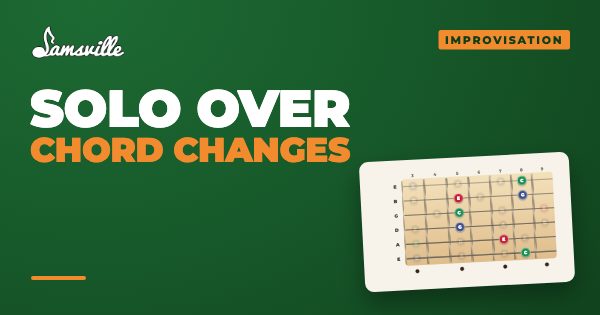
In the learning paths Start Soloing From Zero, Solo Over Chord Changes and Solo Over the Blues.
Transcript
YouTube's automatic captions. Tap a time to watch from there.
- we are going to be going through the whole entire process of writing some cool chord progressions and then soloing
- over them so that you guys can actually see more of the actual writing process that goes into creating music and not just soloing over some random backing track or random song but what if I want to create something from scratch and actually even record it too so we're
- going to be looking a little bit of recording as well here so without further Ado let's get started so first thing first that you need to do if you're going to write a chord progression of course uh people go through this in different ways but what I like to do is I like to pick a key so
- that way I know I can pick a key and pick different chords out of it that I know are all going to sound good together we're going to go ahead and pick the key of E major you need to know the different chords that are in Keys I've talked about this a lot in videos and if you really want to learn it the
- best way possible then make sure you head on over to janesville.wi fretboard fundamentals course that way you can learn how to thoroughly understand and navigate any key that you want I'm going to list out all of the different chords that we can find in E Major and with the knowledge that they're all from the same key okay
- and therefore they're all going to sound good together then I can basically just pick random chords and I know that they're probably going to sound good so in the key of E major the one chord is going to be an E chord of course and for those of you familiar it's good to number the chords this helps us keep consistency between keys so then our two
- chord is going to be F minor our three chord is going to be G Shar minor and then our four chord is going to be a major so then we have B that's going to be our five chord and then we have C sharp minor is our six chord and then our seven chord is going to be D Shar
- diminish that's a little diminished sign there okay so out of all the chords by the way in a major key the one that gets used the least is going to be that seven chord the diminish chord okay and uh that's for a number of reasons we're not really going to get into that right now so I'm just going to go ahead and pick a
- couple of these chords so I'm going to go ahead and start with a C minor okay which is the six chord Okay C minor is a good chord to start on the six chord is always a good chord to start on uh one mistake that people make a lot it's not really a mistake but it's
- just something that everybody does in the beginning is they always go okay I'm going to play a chord progression let me start the one chord don't start on the one chord if you want to make it sound a little bit more sophisticated either save the one chord for later or even more sophisticated in in some ways I
- think is what if you just never play the one chord you have all these other chords in the key you don't have to play an E major chord that happens plenty of plenty of times okay but at the very least uh don't don't put it first okay I know it's number one we think oh it's got to be first is number one and by the way uh we're going to be using bar
- chords mainly for this I know there's lots of different ways to play these different chords but for example this is the C minor bar chord that I'm playing um you would include this but a lot of times I don't include that top note over there so I just want to make that clear so that's a minor bar chord starting from the fifth string okay um and then
- by the way we're also going to be using a few other shapes I'll cover those when we get there but for example the major bar chord shape would be like this but with this note here and you actually have to Bar down these three notes kind of like this so you got to actually bar that with this finger that chord is not going to be in our key right now but I'm just showing you the shapes we're using
- so we got our minor shape and then we have our major shape those are from the fifth string of course if you're not familiar with those if you are familiar with those I'm sorry that I just bored you with that okay so we're going to play C Shar minor and then so uh we just pick another random chord we could play F Shar minor we could play G Shar minor
- we could play a we could play B uh we could play e I'm going to go ahead and actually pick B for the next chord okay this is a very cool chord progression that I like the sound of there's a lot of different ways of thinking about it we're going to try to keep it simple for right now okay so we're just going to go ahead and play the six chord and the
- five chord so actually believe it or not just that alone okay that could be our chord progression we could just go like this C Shar minor B not a bad sound in chord progression at all that happens a ton ton ton of
- times in a lot of songs there's actually a song that I'm currently working on uh releasing in a little bit that uses that chord progression a lot uh and it's just a it's very simple you got to minor chord and then go down a whole step and play that major chord there's so many different ways that we could go about this like for example we could go C
- minor B back to C minor again and then play a different chord after that for example okay uh for example what if we pick C Shar minor B and back to C minor and maybe like F minor that might be interesting let's actually go ahead and do that so we're going to go C minor 6
- B5 back to C minor so even though it's a four chord Loop we don't have to have four different chords okay we can actually repeat one of the chords uh in two different places so we get the six chord again and then let's actually go down to F
- minor which is the two chord let me go ahead and show you by the way just in case you're watching you know know what I'm doing there with the F minor so I'm going to go ahead and play a six string root bar chord here so that's our fshp minor bar chord okay so if we're ever going to play a minor chord starting from the sixth string we're going to use
- that shape and then of course if we're going to play a major chord it would be this shape okay so with that being said let's actually go ahead and lay down this chord progression and then actually uh you can't can't see it right there but I got my base here and we're going to go ahead and also lay down uh some base Parts on this as well okay so those
- of you who are familiar this is a program called logic and this is what I primarily use to actually make these videos and also to record my music that I work on um and uh yeah so we're going to go ahead and record on here so let's go ahead and I have already set up a
- drum Loop here it's this kind of um sloppy sounding drum Loop but I kind of like it so let's listen to it really quick so I'll probably play something like this like nice and
- slow something like that so I just want to kind of get it in my head what's going to be the idea uh before I actually go ahead and record it so let's go ahead we're going to switch to this track this is going to be our rhythm guitar track here all right and uh let's see if I can get this thing recorded
- [09:08] Okay cool so uh whenever I'm recording by the way I'm trying to Loop something I like to just play into the next repetition cuz sometimes the end of a loop can get a little bit messed up if you try to cut it off before the end of the repetition here so and now we're
- actually going to go ahead and lay down a baseline because we need a baseline here so got my trusty old base over here this is going to be the first time that I have played bass on the channel [09:57] okay cool let's uh let's hear that one I think that one felt a lot better [10:27] and now we're ready to start seing over the thing okay so I mean we could do any number of things guys with this now once you got a Groove you got a chord progression going um you could be easily
- writing a song over it I could start thinking of something to sing uh we're not going to get into song writing at the moment we we'll keep it focused on sing if you want me to uh do another stream or video uh where we actually go ahead and start writing the song here in uh in logic make sure you go ahead and uh drop a comment letting me know if that's
- something that you want to see um I definitely think it would be a cool idea so we're going to go ahead and uh go back now and let's talk about soloing over this thing okay so first of all we know it's in the key of E major even though okay there's no E major chord
- remember I talked about that that uh it's really cool sometimes if you don't use an E major chord okay so the reason actually that I would know that this chord progression is in the key of E major if somebody just you know gave this to me or I heard it in a song and I didn't have all this information I
- presented you guys with before I actually wrote this the way that I would know it's in the key of E major is very simple well because this is the only key that I can find all these chords in there's no other key that has C sh minor B and F minor in them we could very easily just say Okay step number one
- would be can I play E major pentatonic C minor pentatonic by the way both of those are literally the exact same things uh if you want to learn these things really really well okay make sure you head on over to jamille. pick up the Jamesville GPS foro fundamental course so you can learn how to figure out
- whatever key you want over the whole entire neck all the cords in the key and where all the notes are so that you can solo over stuff let's just see what uh what kind of stuff I can come up with um if I just play over this thing with a pentatonic scale and I'm not going to think of anything else there's lots of other things that we can think about but
- uh let's just see uh what's possible with just pentatonic scale n [13:18] [13:42] there's a lot of stuff that you can get out of just just pentatonic scale I mean I'm kind of ignoring the chords um there's other things that we're going to talk about in a second but there's your pentatonic scale by the way um if you notice there are some times there where I was playing up and down one string which really really allows you to
- transition between positions and not kind of feel like you're stuck in the same place so it's very very uh useful to know what the actual names of the notes are in the scale that we're playing so that you can actually go ahead and do that go over uh one string so let's just write out here so you know
- so the E major pentatonic scale has e has F sharp it has G sharp it doesn't have a a is normally in a major scale but it has B and then it has C sh so just those notes okay so uh it's very important when you're practicing this stuff to go ahead and be able to go and
- like look at the actual names of the notes so that way you can say oh for example here if we look at the third string the third string we had G Shar and then we have B and then we have C Shar and then e and f and g Shar right so that's so like dude when I learned
- how to play like that it it just like instantaneously got me unstuck from being in the box and that's why in the Jamesville GPS fretboard fundamentals course that's why we actually go ahead and learn the notes on the guitar neck one string at a time so that you're just thinking that way like right off the bat
- instead of thinking okay let's learn our pentatonic first and be stuck in one box by the way there was one thing I played there uh there was a video that I made a couple weeks ago seven awesome pentatonic licks in the key of E major uh I swear I didn't do it on purpose to make them in the key of E major where we're also playing the key of E here
- it's just a cool key to play in um but if you want to get even better at like actually applying this stuff once you've learned all these pentatonic patterns then you got to learn some vocabulary okay so like I played a little idea that I remember was from one of those
- licks like this is super cool because it it's automatically transferring over a whole bunch of positions and it just teaches you new ways of actually combining the same notes right we're going to talk about how would I also uh play some other stuff over this chord
- progression okay so first of all I can use the whole entire E major scale so let's go ahead and write that out so we wrote E major pentatonic before remember uh the formula by the way for major Penton is 1 2 3 five and six so you take any key that you're working in you take
- the one two three the five and the six and then that's going to give you the major pentatonic version basically just cutting out the four and the seven but let's actually add in the four and the seven and uh see what happens with that maybe there's going to be some problems that pop up who knows so now we just
- added a whole bunch of A's and we added a whole bunch of DSHS so if you notice the A's are one/ half step above the G Sharps so they are in the third string one half step above G Shar and remember G Shar is the third so that third note the fourth is a half step above it
- always doesn't matter what key it is and then also the seventh D sh which we didn't have before that one is a half step below the root okay so if you know where your Es are your roots in that key that's very important so let's go ahead now let's see what it sounds like if I go ahead and solo I'm going to try to
- use the whole entire e major scale not all the time okay that's by the way classic mistake that people uh make when they are trying to use the major scale is they think I got to use all the notes in the major scale all the time well guess what that's what actually makes you sound like you're running a scale because you're trying to use all the
- notes all the time instead of like thinking oh well what if I just pick like these three notes Here a C sharp and D or what if I pick two notes and make small musical ideas but I will eventually use all notes and then I'll also allow myself to use the major pentatonic scale okay so let's see uh
- what that going to sound like [19:15] notice I'm just using three notes four notes Here
- notice how I'm trying to make clear musical idea so I'm trying to oh look two notes back and forth Okay cool so now I have access to a few more different sounds I was still
- playing a little bit of pentatonic there at times but adding in those two extra notes gave me access to some other colors by the way one thing I love about playing the full entire major scale is actually going ahead and starting to work on some of these bends here so if
- uh you might have heard that this D sharp here on the second string I bent that up to d uh sorry to e not to d d you can't bend down you have to bend up that's such a cool sound when you bend the seventh of the key up to the
- root cuz that note already kind of wants to go up it wants to go but then if you want to sound really good practice all the bends in the key so say okay I'm going to take this e here I hope you're seeing this on the second string I'm going take that e and I'm going to bend it up to F sharp so you play the E here's the FP so I got to
- make it sound like that and then go to the next note F Shar bend it up to G G sharp bend it up to a notice how I play the two notes before
- why cuz I want to get it in my head I need to make sure that I hear can't I can't sing that high this is a great ear training exercise by way you have to have good ears to be able to uh Bend confidently so a going up to
- B also it helps more when you're actually playing over the track let's actually put the track while I'm doing this uh so cuz they can actually hear if the Bend's in tune [22:13] so this one sounds great the bet the C sh up to the D sh [22:44] so that I mean everybody always just plays like one Bend in the pentatonic scale but it's much more rare for you to see people who know all of their bends in the major scale okay last thing that we're going to talk about is that we're going to now play Triads over the core
- progression so this is the thing that really really really really starts to take you to the next level it teaches us What notes are going to sound good on each chord so Triads are just the three notes
- that basically comprise each of the chords in the progression so remember we had Z minor we had B we had C minor we had F minor so really we only need to find out three different Triads to be able to utterly annihilate this chord
- progression okay so let's write out those chords and then we're going to figure out what the notes in each Triad R and it will pick them out actually from the whole entire E major scale which is listed on the screen there how do we figure out what the notes are in each Triad it's very very simple guys
- every single one of these chords is built in thirds okay so you start on the root note of the chord which is the note that the chord is named after and then you skip a note and you skip another note and that gives you all the notes that are in a chord so for example you see we have all the notes listed above here
- right so C minor first of all we know there's a c in the court that's the root of the court because it's called C okay pretty easy right so we're going to skip dsh we don't want the note that's right next to it and then uh I know that we're at the end here but the whole thing repeats so we're going to skip D Shar
- we're going to take e so we have C sharp we have e and now we're just going to skip one more note and take the next one after that and then that's the whole thing so e we skip FP and we're going to take G sharp and that's the notes that are in a C minor chord uh you know what
- else is three letters that you learned when you're in kindergarden cat and dog those are three letter words you learn how to spell them if you can you can spell those things you can spell all Triads okay so B we're going to do the same thing so I know that we want B let's actually just go ahead and put like a DOT at so we're going to take B
- we're going to skip C Shar we're going to take dsharp and then we're going to skip e we're circling back here we're going to skip e though and we're going to take F so b d f see that we start on the root of chord skip a note take that one and then skip another one take that one so
- B uh sorry D sharp I think I might have said D earlier that would be a mistake and F sharp I'm very I'm a pretty big stickler about you you got to make sure that you say sharp and all that stuff because if I play D natural it's not going to sound good that's G to be a problem if I play D natural so you need
- to pay attention to that stuff okay so we're already 2/3 away is this taking a long time no it it's it's been maybe 2 minutes since we started doing it so let's figure out the F minor chord okay so F minor well we're going to start on F and we're going to skip the note next to it we're going to take
- a and then we're going to skip the note next to that so we skipped this took this one skipped this one and then take this one so if FP A and C sharp that's it guys that is all the information that we need to know in order to now really really really
- really start like destroying this cord progression okay so now first of all we can go to our full scale here and let's find the C minor chord because that's the one that happens twice right the the chord progression C minor uh B back to C minor and then F so here is c e gsh so
- we're not going to go through every single one that exists on the neck cuz that's a whole thing that you have to study it takes a lot of practice uh to be able to actually find every single one of them on the neck but that's okay you don't need to be overwhelmed by that let's just find one Triad for each of the chords okay that's it let's find one
- for right now so that we can least start getting used to the idea of being able to play with Triads and be able to actually pick out these notes and land on them when the chords change that's the thing that lets us sound really cool is that when a c sh minor chord hits I
- mean I actually play any of those notes there's other ones that are in the neck and again that's what I talked about that takes a little bit longer to learn every single last one of them okay if you want to learn every single last one of them you really want to master the board you going to learn all your
- Triads all over the neck so that you can actually do this instantaneously in any key over any chord then the only way to do that not the only way but the best way to do that is to go to jamille. and pick up the janville GPS fretboard fundamentals course where I show you how to do that takes you know takes some time but uh it's super duper worth it if
- you learn how to do that okay so uh let's pick there's our C minor there's our C Shar e energy what about the B chord we figured out that was b d Shar and F well guess what actually this one's easy because let me actually write this next to here so you also do have to keep in mind the chord numberers so that
- C minor was six the B is five and then this is the two chord in the key so automatically whenever I'm going from the six to the five I just know that I go back a step in the key so for example look the root was C before look the note right behind it on the same string is
- B I had E before look I go back one note that's my dsharp I had G Shar before go back one note there's my f so actually right here there's my B major chord so I had this here's my C Shar minor here's my B major so let's actually just forget
- about the F minor for a second let's just see what we can do with that okay I I will actually just not play in the F minor chord for right now not going to play [30:25] there so you see right there like that sounds really cool even just you're not going to come up with that by accident guys that's and and uh you hear the the Eagles you know the end of Hotel California that's all Triads if you don't know your Triads you're not going to play anything like this you're
- just going to continue sounding like you're running scales okay so uh that's the cool thing by the way is when we solo with Triads we don't sound like we're running scales why because well we're not running scales we're quartz so how can you sound like you're running a scale if you're not running a scale anyway okay so let's figure out
- that last one F minor we figured out that was F A and C sh so now let's see where we can find those notes okay so let's actually try to not move like super far away because we could we could actually take if we know this is a minor chord here C well our just Common Sense
- on guitar which tell us we can actually play all the way up here here's an F minor same shape you see that f a c Shar and notice how I'm picking this out of the whole scale right it it's really important to be able to see it in context because then you can see the other notes that are around it and good things happen you can start mixing it in
- with just knowing the scale knowing the pentatonic go anyway so let's go ahead and let's actually see if we can stay in the same area of the fretboard okay so this is going to require us to maybe think slightly differently uh we're actually going to play What's called an inversion it's it sounds crazy but it's not it just means that we're not going
- to start with f okay actually what we're going to do is we'll start with C here so like check this out we had here's our C minor that we figured out here's our B major we figured out look there's a c and then there's an S here right on top of it and then there's actually an a right here on look all in the same
- fret oh and of course by the way if you remember from our F minor by bar chord that's actually just part of that F minor bar chord so that's it by the way if you're really a student you notice there's an a up there too let's add that so now we have these three shapes
- we have this C Shar here boom boom boom we have the uh that's the C minor we have B major here and then we have F minor all in the second fret there's our C minor then we're going to add here's our B major we're just going to leave those all there and then here's our F Miner so now using just those notes I'm
- going to solo over the track that we just made n [33:55] so of course uh you know I'm only sticking in one area of the fretboard not even an area just a little tiny snippet there right like the half of an area of the fretboard I'm not using all of the uh notes that are possible but
- this is why uh you got to practice them all over the entire neck let's go ahead and go uh we'll put back on the thing so if you want to you're watching this you go go ahead and pause pause here and uh see if you can find all of those Triads that we listed out right there in the lower leftand corner see if you can
- actually find them on the next see if you can find all the C shps E's and G's if you can do that uh gee you're going to get a whole heck of a lot better at guitar and a whole heck of a
- lot better at uh soloing so and the best way is g to be again go ahead and pick up the Jamesville GPS fretboard fundamentals course where I show you step by step how to do it in all keys so that you can know all these things and be able to access them every time you
- need the [35:43] [36:04]
- a a [36:51] w
- all right so that's what I'm going to
- leave that's my solo that I'm going to leave there hdden command s and that is it guys make sure you head on over jamille. comom and pick up the Jamesville GPS fretboard fundamental scores that's the best way my opinion to learn all this stuff learn your Triads all over the neck learn your scales all over the neck so that when you go to
- solo you can find all these things very very very quickly also make sure you head on over to Jamille merch store pick yourself up a Jamesville t-shirt I love this freaking t-shirt I wear it all the time it fits super com I I'm obsessed with t-shirts that fit well I don't like things that don't fit well so it fits really well I'm really happy with it
- check out my music uh Al I have a song I have two songs on Spotify working on my third song which should be done with the next couple of months here got a lot of things going on so it's getting tough but uh my song My Divine type in Adam Paul on Spotify it's also in the description of this stream and uh yeah if you have any suggestions for other
- videos or streams that you guys want to see make sure you drop them down in the comments below and just say hi um you guys are awesome and I really uh really appreciate you guys watching the video subscribe to the channel hit that like button by the way and until next time listen learn and jam