

After each pass the video waits as long as the loop, so you can play it back.
Start slower with −, and it climbs to 100%.
Keys: Space play · ← → 5 s · [ ] set start and end · − = speed · L loop
Chords and harmony · Beginner
How To Write A Guitar Melody Over Chords
In this lesson
Tap a time to watch that part. loops it, so you can slow it down and play along.
-
Key idea Rhythm first
When writing a melody, think rhythm first: write the rhythm with a placeholder note before choosing pitches; rhythm is the most important thing in music.
-
-
Exercise Make the first note of each chord a chord tone
Replace the first note of each bar with a chord tone of that chord, the same target note method used in soloing.
-
Exercise Fill the rest with key notes, leading into the next target
Fill the remaining notes with any notes from the key, preferably stepping into the next target (G A -> B), though leaps are fine in a melody.
-
-
Exercise Complex rhythm, few pitches: repeat notes in 16th bursts
With a more complex 16th-note rhythm you do not need many more notes: repeat notes on the fast bursts and keep the same target-note approach.
-
Key idea The root is the most boring target
Landing on the root works but is often the most boring possible note in melodies and solos; prefer other chord tones.
-
-
Key idea Out-of-key notes are fine leading into a chord tone
Wrong (out-of-key) notes are totally fine when leading into a chord tone at a change.
-
-
Step by step Melody recipe: rhythm, targets, then anything between
Solid rhythm first, then target good chord tones at the changes, then anything in between (key notes, even out-of-key notes leading into chord tones); connects to the voice leading of Bach.
-
Practice it
- Step 1: the 3rd. E over C, B over G.From the guide: Chord Tones: How to Solo Over Chord Changes Open in Jamsville
- Step 2: the 5th. G over C, D over G.From the guide: Chord Tones: How to Solo Over Chord Changes Open in Jamsville
- Step 3: the 3rd or the 5th.From the guide: Chord Tones: How to Solo Over Chord Changes Open in Jamsville
- Step 4: the 7th. B over Cmaj7, F over G7.From the guide: Chord Tones: How to Solo Over Chord Changes Open in Jamsville
- Step 5: the 3rd or the 7th.From the guide: Chord Tones: How to Solo Over Chord Changes Open in Jamsville
- Step 6: the 5th or the 7th.From the guide: Chord Tones: How to Solo Over Chord Changes Open in Jamsville
- Step 7: the 3rd, the 5th or the 7th.From the guide: Chord Tones: How to Solo Over Chord Changes Open in Jamsville
- Drill Land on a chord tone ProFor “The root is the most boring target”. You'll land on the note that spells each chord, right on the change. Open
The guide
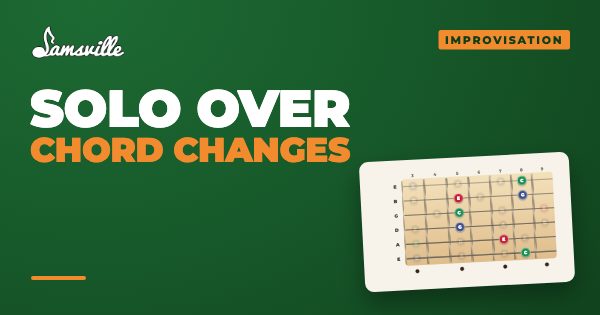
In the learning paths Start Soloing From Zero, Solo Over Chord Changes and Solo Over the Blues.
About this video
FREE E-Books:
Transcript
YouTube's automatic captions. Tap a time to watch from there.
- in today's video i'm going to be showing you how to write melodies over any chord progression and this is a great way to get started especially if you've never written a melody before or just don't really know where to start so let's listen to the chord progression we're going to be working with today
- okay so you can see that it's a fairly simple chord progression over this basic
- backing track they've made and uh the chord progression is going to be d minor to g major to c major to a minor so what we're going to do first is we're going to just work out some of the notes in those chords and the key that it's in
- so what we're going to do is i have on here the screen the notes and the chords listed so d minor is going to have a d f and an a in it g major is going to have g b and d in it c major has c e and g and a minor has a c and e and what we're going to do is we're
- actually going to write this melody on just one string on the guitar the second string so this is in the key of c major and we have all of these notes available to us now on each of the chords we want to know the chord tones but that doesn't necessarily mean we only have to play
- the chord tones that are on each chord we have all the notes in the key available to us and this is just going to be our starting place so let's play through these notes on the second string really quick so first we have b then we have c d e
- f g a b c d e now you should already know these notes by now but if you don't know them and you don't know the notes across the guitar fretboard make sure you head on over to jamswell.com check out the jansville gps fretboard fundamentals
- course but let's keep on going here let's find the notes that are in that d minor chord the d f and the a so we have d here on the third fret and then we have f on the sixth fret then we have a on the tenth fret and then once we go all the way up to
- the 15th fret we have another d so those are all going to be our chord tones then we have g b d so the lowest note in the g chord we can find is this d here again but then we go up to the g on the eighth fret and then we go up to the b on the 12th fret and then we're going to
- find the notes in the c major chord so c e and g we have c here in the first fret e in the fifth fret g on the eighth fret and then c again on the 13th fret and then we can go all the way up to the 17th fret and depending on your guitar you can of course go even higher than this finally a minor the lowest note we
- can find in this chord on that string is going to be c then we have e again notice there's a lot of notes in common between the c and the a minor that's a really important thing to sort of notice there and then we have a on the 10th fret and then c again the 13th fret e on the
- 17th so now that we have that in our head really solid we can of course do this on many different strings but let's stick to one string for right now because it will get way too complicated if we start using multiple strings so now what we're going to do is we're going to actually start writing our
- melody now my favorite thing to do when writing melodies is to actually think rhythm first okay rhythm's the most important thing in music really you can play whatever great notes that you want and if you don't play with a good rhythm this is not going to sound good so here's a simple super duper simple
- rhythm and picked here and uh it there's just some placeholder notes there we're going to change those notes for right now but it's just a half note two quarter notes half note two quarter notes and then two whole notes so actually uh if i just play this over the backing track that we have uh it'll sound like this
- so obviously it's not the most interesting thing in the world it's just one note but now we're going to change the notes that were going with that rhythm to make them sound a lot better so now what we're going to do is for the
- first note on each chord we are going to make sure that note is one of the chord tones that we worked out earlier this is sort of like the way that i approach soloing too if you check out the video called how to solo with confidence that i made a few weeks ago it talks about using this target note method and well
- what do you know this is actually a great method for writing melodies in general this is really kind of what you saw people like bach doing it's just following basic voice leading and things like that so what we're going to do is we're going to apply that to our melody here so
- on the d minor we have our choice of d f or a so i'm going to go ahead and pick this f note here on the sixth fret and that's gonna be our first note on the d minor chord now we're gonna actually skip the next two notes and we're gonna go right to the first note on the g chord
- so the g chord we had uh g b and d so i'm going to go ahead and pick actually b on that chord b in the 12th fret and now we'll go to the c chord which we have c e and g in it and we're going to go ahead and pick g as the note that we're going to play
- in there and that's going to be on the eighth fret of the second string and then we're going to pick one more note here on this a minor and that is going to be let's actually go ahead and stick with c i like c there let's actually move that up an octave though make it sound a little bit more interesting so
- now that we have our sort of target notes already written down now we can actually just do what we want really with these last two notes in each of these measures preferably we would use those two notes to lead into the next chord but we don't have to do that in this case because
- it's writing a melody we don't need to follow a ton of different rules but this just a good way for us to get started so now let's go ahead and allow ourselves really to use any of the notes from the key of c major on these last two notes in the d minor
- measure and in the g major measure so uh let's see we have this so far we have f c c b c so i think actually i am going to go ahead
- and lead these two notes up to that b note because this is going to be really easy so if we go back over here to our fretboard we can see that actually the b there on the 12th fret has g and a right behind it on the 8th and tenth fret respectively so
- let's play g a to b and this is going to give us a really nice stepwise melody so g on the eighth fret and then a on the 10th fret so now our melody is going to sound like this f g a b
- now let's pick two more notes to lead into the c chord so we picked a g on that c chord so i'm going to actually go ahead and leap up into that g i think it would be cool so i'm going to go ahead and pick an e note here actually on the fifth fret
- and then here we're gonna pick another chord tone which is gonna be d on the third fret so now we're gonna have this and then we don't need to change anything else so let's see how this
- melody sounds we technically we might not like it that much yet but we're going to have a melody that is definitely going to sound pretty solid because we're always landing on one of those chord tones when the chords change and uh we're throwing in some extra stuff in there too we're not just playing the chord tone so let's hear how
- that sounds okay so that actually considering the
- rhythm was so simple i thought that that sounded pretty nice now let's go ahead and pick a different little bit more complex rhythm and use this exact same idea to write another melody all right so we got our new more complex rhythm written in there it's mainly based on sixteenth notes so one e and two three e
- and four one e and two three and four and then the second half is actually pretty much the same as the first half of the previous example that we did just to change things up i don't want to have it spammed too much with too many fast rhythms and notes all right so let's get right to work on changing the notes here
- so that's going to sound good over those chords so the cool thing about this is that even though we have a more complex rhythm well guess what we don't actually have to put like a ton more notes in there because similar to the placeholder notes that are already in there we can just repeat notes on those fast 16th note bursts
- so let's sort of follow the same approach the first one in each chord we're going to make a chord tone and then we're going to try to create some more interesting stuff with all the notes that are in the key of c on the notes that are in the middle of the bar so these first three notes here in this
- d minor chord let's pick either a d f or an a uh let's switch up i'm gonna pick d actually all the way up here on the 15th fret so one end that's going to be our first hit so perfect we got that one in there now let's uh go straight to the g chord
- and we're gonna pick which chord tone we'd like to play on there i'm gonna go ahead and say let's say b again so be in the 12th fret i liked that one before it's still kind of high we're gonna go with it perfect and then now we're going to pick the first note on the c chord so there's
- actually c there already but c is the root of the chord and one thing you'll find writing melodies and playing solos too is that playing the root of the chord is often times while it works because it's the root of the chord it's sort of the most boring like possible note that you could pick so anyway let's go ahead and pick uh
- let's pick e on that chord e here on the fifth fret i like that note and then for the a minor chord let's try to make this melody start looping back around sort of so that it sounds it sounds a reasonable when we repeat it over and over so let's start going back
- up because we started with a high note and now it seems like we're going lower and lower so i'm gonna go ahead and pick uh i know i just said the root is boring and no let's not play the root let's play a c there on the 13th fret and then we will deal with those other notes later perfect so we got our target notes in there
- now for the rest of the notes we can sort of just do whatever we want again we can pick any of the notes here from the c major scale and let me pull those up for you again so that you can take a look at them just in case you need your memory refreshed a little bit so let's go over back now
- you've taken a look at that we're going to pick i'm going to say for this current beat let's do let's do a non-chord tone let's actually pick g on the 8th fret see how that sounds over the d minor chord
- again that's not d f or a so it might sound cool might sound a little strange you don't know so then we have this last note and it's going to sort of lead into that bm12 frap so i think it would be cool to go
- let's just jump up into that let's keep going lower from the g let's let's make that one an f actually and now let's start dealing with the notes on this g chord so we have this extra beat here let's make that let's make that a d d down on the third fret
- and then we have an e on the c chord so let's just go ahead and let's jump into that one too we're going to make this note a g on the on the eighth fret and then we have this e written here already and now let's go ahead and uh let's make this
- like a nice line that leads up to a minor so we have a c on the a minor so let's just go ahead and make the two notes before that a and b so we have a b up to c so 10 12 to 13 that's a b to c
- and then we need to loop this back around we don't need to of course uh that's just something i want to do right now um so let's go ahead and take on the a minor chord we can lead up to d on the 15th fret so we can actually just
- repeat the c if we wanted to or we could go even higher um let's go ahead and repeat the c there see and then actually if we wanted to let's try this this will sound really cool so now we're going to use a note that's not in the key of c just to loop this back around
- so we have a d on the 15th fret and whenever we're leading into a chord like that especially we're leading into a chord tone it's actually totally cool to use wrong notes so let's actually make this a c sharp and see how that sounds leading back around to the d minor all right so
- we got our melody written now let's go ahead and play it [17:00] okay so i really really liked how that melody turned out and as you can see this was a really really simple process to go through basically we just want to make sure we have a solid rhythm because that's the most important thing rhythm it's gotta have a good rhythm to it then we want to make sure that we're targeting good chord tones when we
- switch between the chords and then in between there you can basically do whatever you want you can play whatever notes you want from the key obviously you should know what key the chord progression's in and you can even play notes that are not in the key especially if they're leading into good chord tones on the chord switches
- so this video will be super duper long if we go through all the possibilities of course uh well all of humanity has been writing melodies for very long time and people still haven't run out of them so we can't go over all of them but if you learn the guitar fretboard really well you can do this very very very
- easily on your own now all of this stuff that i'm doing is based on my own knowledge of the fretboard and if you want to learn the guitar fretboard really really well so that you can play great solos come up with great sounding melodies and just overall expand your freedom on the guitar then make sure you head on over to jamesville.com
- and pick up the jansville gps fretboard fundamentals course also on jamesville.com i have two free ebooks that you can download that will improve your soloing and your knowledge of chords so no matter who you are you better be going on over to jamesville.com after this video and make sure you're subscribed to the channel
- and also make sure you head on over to jamesville patreon page where you can get access to all backing tracks and examples from every video that i release and until next time listen learn and jam