
Scales · Beginner
The Pentatonic Scale on Guitar
You'll build the minor pentatonic from its five note names, play it across the whole neck with one small repeating shape, and make a short solo with it over a blues shuffle.
Summary
- Five notes: 1 ♭3 4 5 ♭7, the natural minor scale without the 2 and the ♭6.
- A minor pentatonic is A C D E G, the same notes as C major pentatonic.
- Learn it one string at a time.
- Then play one small two-string shape three times to cover the neck.
On this page

Five notes, taken from the minor scale
The pentatonic scale has five notes. That's where the name comes from 2:48Watch at 2:48. To get the minor pentatonic, take the natural minor scale, 1 2 ♭3 4 5 ♭6 ♭7, and drop the 2 and the ♭6. What's left is 1 ♭3 4 5 ♭7 3:10Watch at 3:10.
In A, the natural minor scale is A B C D E F G. Take out B and F and you have A C D E G 3:33Watch at 3:33. Those same five notes are also C major pentatonic, which comes back later 1:45Watch at 1:45.
Only two distances sit between neighboring notes: a whole step (two frets) and a minor third (three frets). From the root it goes minor third, whole step, whole step, minor third, whole step, and you're back on the root 3:53Watch at 3:53.
Here's the box most players learn first. The video treats it as something you already have and moves straight past it 0:41Watch at 0:41.
The box is fine. Solos played only in it just tend to sound stuck in it 0:42Watch at 0:42. Knowing the note names helps you get out of it.
Play it on one string
Learn the scale one string at a time, and to do that you have to know which notes you're playing 1:22Watch at 1:22. Start on the fifth string, because it's tuned to A, the root 2:26Watch at 2:26.
From open A: up a minor third to C, a whole step to D, a whole step to E, a minor third to G, a whole step to A an octave up 4:14Watch at 4:14.
Say the numbers as you play: A is the 1, C is the ♭3, D is the 4, E is the 5 and G is the ♭7 4:54Watch at 4:54. The numbers tell you why each note sounds the way it does 3:53Watch at 3:53.
Then do every string the same way. It's the same pattern on each one, entered at a different spot 5:57Watch at 5:57:
- The low E string starts on E, the 5, then goes up a minor third to G 5:15Watch at 5:15.
- The D string starts on D, the 4 6:17Watch at 6:17.
- The G string starts on G, the ♭7 7:26Watch at 7:26.
- The B string is the odd one. B isn't in the scale, so start one fret up, on C 8:29Watch at 8:29.
- The high E string is the same as the low E 7:26Watch at 7:26.
Playing along one string gets you moving up and down the neck, a different sound from sitting in one box 2:05Watch at 2:05. It's also what ties the positions together 3:08Watch at 3:08.
Connect the positions with one small shape
This is what the video calls the coolest way to play the pentatonic scale 0:00Watch at 0:00. It blends the position patterns with the single strings into one diagonal shape 6:06Watch at 6:06.
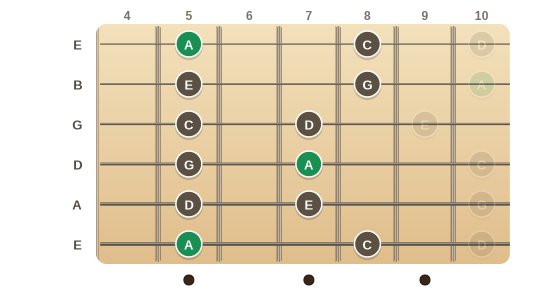
Start on A on the low E string. Play A and C on that string, then D, E and G on the fifth string. That little two-string shape is the whole scale, all five notes 4:15 +14:154:59. Now play the exact same shape from A on the fourth string, and once more from A on the second string. Three copies of one shape take you from the low strings to the top of the neck 5:22 +15:225:44. The video calls this exact repeating pattern 1 3:54Watch at 3:54.
You don't have to remember a big pattern, only the small two-string shape, three times 6:27Watch at 6:27. It also lets you play an idea and then play the same idea an octave higher, which piano players do easily. It's harder on guitar, and this shape makes it easy 7:11 +17:117:53.
Start the same idea from G and you get exact repeating pattern 2: G and A on one string, C, D and E on the next. It's a little square with one extra note. A is still the root, now the second note of the shape 8:17 +18:178:38. This one is made for slides, and slides are something you almost never get when you stay in the positions 9:42Watch at 9:42.
Start from C, the relative major, and you get exact repeating pattern 3: C, D and E on one string, G and A on the next 10:23Watch at 10:23.
If you take nothing else from this page, take these three. Your hand moves around the neck when you play them 11:06Watch at 11:06. And you don't have to play every note. Skip some and you find smaller shapes inside, like C with G, or D with A 12:26 +112:2612:47.
Three notes per string, for later
The same five notes can be laid out with three on every string. The video calls this pretty advanced: the shape is different on every string, so get the single strings solid first 13:49 +113:4914:09. Pattern 1 starts on G on the low E string 14:31Watch at 14:31.
Pattern 2 starts on the open low E 19:45Watch at 19:45. Both end with the same three notes they start with, three octaves higher 20:10Watch at 20:10.
Each string covers a lot of frets. You can stretch, or slide with your first finger or your pinky, whichever fits that string. There's no exact rule; try fingerings and see what works 16:41 +216:4117:2317:44.
Make music with it, rhythm first
Start making music with the notes right away. Jamming with them is how you find combinations and variations 10:21Watch at 10:21. The video does it as call and response: two bars of listening, two bars of playing 10:43Watch at 10:43. And the rhythm always comes first. Right notes with bad rhythm still sound bad, so play simply at first 11:03Watch at 11:03.
Open the A7 shuffle below and try this:
- Play only A on the fifth string. For two bars, give it a short rhythm. For the next two bars, stop and listen to the band.
- When that feels easy and your hand is loose, keep the same rhythm and change one or two notes along the fifth string.
- Answer your own idea: play something, leave space, then play it again with a different ending.
- Then open it up: add the low E string, then move into exact repeating pattern 1 and play an idea in one octave, then the next one up.
If you hit a wrong note, keep the rhythm going.
Major pentatonic: same shapes, new home
Take the minor pentatonic and start it from its second note. That's the major pentatonic. A minor pentatonic started from C is C major pentatonic 13:50Watch at 13:50. Same five notes, same shapes. C is now home. You already played it: the B string starts on C 13:50Watch at 13:50, and so does exact repeating pattern 3 10:23Watch at 10:23.
For any other key, find the root and start the same pattern from it 14:11Watch at 14:11. The open B string gives you B minor pentatonic with the same pattern you played from open A on the fifth string: B, D, E, F♯, A. Those five notes are also D major pentatonic 14:32 +214:3214:5415:16.
When the chords change
A major key holds three of these. In C major they're A minor (C major) pentatonic, D minor (F major) pentatonic and E minor (G major) pentatonic: the minor ones on the ii, iii and vi chords, the major ones on the I, IV and V 13:49 +113:4914:31.
Each one is a single note away from A minor pentatonic. Over an F chord, move every E up a half step to F and you're in D minor pentatonic, D F G A C 3:57 +13:575:03. Over a G chord, move every C down a half step to B and you're in E minor pentatonic, E G A B D 9:06 +19:0611:00. The note that changes is a chord tone, so play it right when the chord arrives 17:10 +117:1017:32. The video is careful not to call this better. It's a different sound that fits each chord more closely 8:01Watch at 8:01.
Break out of the box over a blues
First, get everything you can out of the plain minor pentatonic box. Better players sound better than beginners with the exact same notes, because of phrasing, rhythm and feel 0:22 +10:220:45.
Then add three notes. Over a blues in A, A major pentatonic on its own doesn't sound very bluesy 1:27 +11:272:12. The sound comes from mixing the two, and from thinking of it all as one set of notes 2:32 +12:322:53.
- C♯, the major 3rd. It sits one fret above C, the minor third. Play the C first, then C♯, then down to A 3:14 +13:143:57. On the high E string, bend C up to C♯, then come down to A on the same string 5:45Watch at 5:45.
- F♯, the major 6th. It sits one fret below G. It's the 3rd of D7, the IV chord, so lean on it in bars 5 and 6 of the blues 7:38 +17:387:59. Try E, F♯, A, or a small half-step bend from F♯ up to G 8:20 +18:208:40.
- B, the 2nd (or 9th). It sits one fret below C, so now both neighbors of the minor third are in play 9:49 +19:4910:10. Bend A up to B on the B string, or bend B up into C 10:30 +110:3010:52.
Pair each new note with its buddy note in the box, by sliding or bending into it or out of it 12:39Watch at 12:39. That's about three notes, added to a minor pentatonic you know well 12:39 +112:3913:01. On a minor blues you'd mostly stay with the minor sound 5:25Watch at 5:25. Go back to the A7 shuffle and work in one new note at a time.
Play it without Jamsville
Put on a blues record you like. Slide along the fifth string until you find the note that sounds like home. From that note, build the scale up the string: minor third, whole step, whole step, minor third, whole step. Then play along. When the singer sings, listen. When they leave space, answer with two or three notes from that string. Think of the note names and numbers as you go, not only the shape 13:09Watch at 13:09.
In these learning paths
Start Soloing From Zero · part 2 of 3
Questions guitarists ask
What notes are in the A minor pentatonic scale?
A, C, D, E and G. Take the A natural minor scale, A B C D E F G, and drop B and F, the 2 and the ♭6. Counted from A, the notes are the 1, ♭3, 4, 5 and ♭7.
How do I get out of the pentatonic box?
Learn the scale along one string at a time, starting from open A on the fifth string. Then play one small two-string shape from A on the sixth, fourth and second strings. Your hand moves around the neck, and you can play an idea and then play it an octave higher.
What is the difference between major and minor pentatonic?
Same five notes, same shapes, a different home note. Start the minor pentatonic from its second note and you get the major pentatonic: A minor pentatonic started from C is C major pentatonic. Over a blues in A, mixing A minor and A major pentatonic gives you the bluesy sound.
How do I solo with the pentatonic scale?
Rhythm comes first. Over a blues shuffle, play one note in a short rhythm for two bars, then listen to the band for two bars. Then keep the rhythm and change one or two notes. Answer your own idea with a different ending, and if you hit a wrong note, keep the rhythm going.
What notes can I add to the minor pentatonic for blues?
Over a blues in A, add C♯ (the major 3rd), F♯ (the major 6th) and B (the 2nd). Each sits one fret from a note in the box. Pair each new note with its buddy note by sliding or bending into it or out of it, and work in one at a time.
Keep going
Keep what you open here. A free Jamsville account saves your boards and sequences to your Practice Library and keeps your progress on every device.
Make your free accountMore lessons on this


Where this comes from
This guide is written from these lessons on the Jamsville channel. The timestamps in the text link to the moment each idea is taught.