

After each pass the video waits as long as the loop, so you can play it back.
Start slower with −, and it climbs to 100%.
Keys: Space play · ← → 5 s · [ ] set start and end · − = speed · L loop
Fretboard and scales · Beginner
How To Learn The Pentatonic Scale The RIGHT Way! | Minor Pentatonic Scale Guitar Lesson
In this lesson
Tap a time to watch that part. loops it, so you can slow it down and play along.
-
Key idea Learn the scale one string at a time
The key to learning the pentatonic 'the right way' is learning it on one string at a time, so you can play across the entire neck and in all keys.
-
Key idea Minor pentatonic from natural minor
Minor pentatonic = natural minor (1 2 b3 4 5 b6 b7) minus the 2 and b6, leaving 1 b3 4 5 b7; in A: A C D E G.
-
-
How to practice Name degrees aloud per string
Play through each string while thinking the scale degree of every note (root, b3, 4, 5, b7), not just the shape.
-
-
Key idea Musical alphabet half steps B-C and E-F
All letters are a whole step apart except B-C and E-F, which are half steps; this is how you compute the next scale note on any string.
-
-
Key idea Rhythm always comes first
Even while working on notes, never compromise the rhythm: right notes with bad rhythm sound bad.
-
-
Key idea Relative major pentatonic for free
Start the minor pentatonic from its second note and it is the relative major pentatonic (A minor pent from C = C major pent), so you already know it.
-
-
Key idea Transpose by moving the root
To play in another key, start the same single-string pattern from the new root; once you know one key, move every note up or down a fret for the neighbouring keys.
-
Practice it
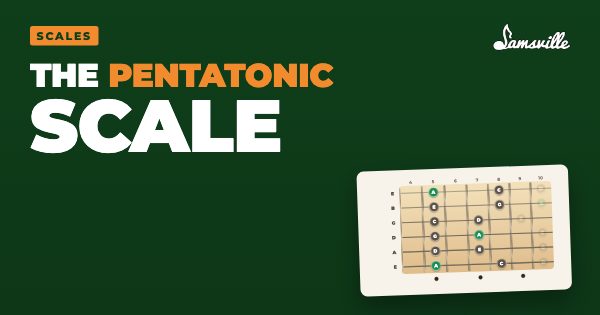
- A minor pentatonic, the box most players learn first. Five note names: A, C, D, E, G.From the guide: The Pentatonic Scale on Guitar Open in Jamsville
- A minor pentatonic on the fifth string alone: 1, ♭3, 4, 5, ♭7 and the 1 again.From the guide: The Pentatonic Scale on Guitar Open in Jamsville
- One A7 chord, looping, with a blues shuffle band. Solo over it with A minor pentatonic.From the guide: The Pentatonic Scale on Guitar Open in Jamsville
- C major pentatonic: the same dots as the A minor box, with C as the 1.From the guide: The Pentatonic Scale on Guitar Open in Jamsville
- C, G, Am, F in the key of C. Try A minor pentatonic over C and Am, E minor over G, D minor over F.From the guide: The Pentatonic Scale on Guitar Open in Jamsville
- Drill One string at a time ProFor “Stuck in pentatonic boxes”. You'll stop living inside one box and see the scale run along each string. Open
- Guide How to Learn the Notes on the Guitar FretboardFor “Musical alphabet half steps B-C and E-F”. Learn the seven natural notes as one pattern, find it on every string, and make up a solo on a single string today. Read it
The guide
In the learning paths Start Soloing From Zero, Solo Over Chord Changes and Solo Over the Blues.
About this video
Most guitar players learn how to play the minor pentatonic scale by using "box patterns." Unfortunately, this way of learning it makes it hard to get out of those pentatonic scale box patterns, and they end up playing the same thing over and over. In this lesson you will learn how to play the minor pentatonic scale the RIGHT way, by learning it on one string at a time. This will guarantee that you never get stuck in the "pentatonic box" ever again, and you will be able to solo all over the guitar neck in no time!
Take Lessons with Adam:
Transcript
YouTube's automatic captions. Tap a time to watch from there.
- what's up everybody my name's adam and welcome to jamsville in this lesson you're going to learn one of the most important things that you need to know on the guitar the pentatonic scale by the end of this video you're going to know how to play across the entire guitar neck so you can start playing great solos so make sure you stick around most people usually learn the pentatonic
- scale in position patterns like this usually starting with the a minor pentatonic scale [00:42] do well this is a good way to learn it the main problem with it is that many players struggle to play solos that aren't stuck in these box patterns sort of like this
- so i'm going to show you how to learn the scale so that you can play solos that sound more like this [01:48] [02:26] the key to learning the pentatonic scale the right way so that you can play more like this is by learning it on one string at a time because it's the a minor pentatonic scale this should be really easy to do on the fifth string because it's tuned to an open a there's two things that you're going to need to know in order to properly understand how to play all over the guitar and how to play it
- in all keys the pentatonic scale has five notes in it that's why it's called pentatonic the minor pentatonic scale is constructed by taking the notes in the natural minor scale which has seven notes in it and removing two of those notes natural minor scales are constructed with a root two flat three four
- five flat six and flat seven we get the minor pentatonic scale by removing the two and the flat six so we end up with one
- flat three four five and flat seven the five notes in this scale are a c d e and g you're going to want to keep these
- numbers in mind as you play through the scale because it's going to help you understand why each note sounds the way that it does the scale is comprised of two intervals whole steps and minor thirds a minor third is a distance of three frets and a whole step is a distance of two frets so the formula for a minor
- pentatonic starting from the root is minor third whole step whole step minor third whole step here's the a minor pentatonic scale on the fifth string a goes up three frets to c which again is a minor third c goes up a
- whole step to d which is two frets d goes up a whole step to e e goes up a minor third to g and then g goes up a whole step back to
- a let's play through it one more time while thinking of the scale degrees because this is really important to keep in mind as you go through each string a is the root c is the flat three d is the four e is the five
- and g is the flat seven and then we're back to the root on a you got that good now we're gonna figure out on the other strings let's start on the low e string since e is the open string we know that if we go up three frets from e we're gonna have g
- just like how we went up three frets from e on the fifth string we got to g then up a whole step to a since we're on a now we're at the root of the scale just like we started with so a goes up a minor third to c
- c goes up a whole step to d and d goes up a whole step to e it's the exact same pattern on every string just starting at a different spot on the pattern let's see if we can go a little
- bit quicker now that you're getting the hang of this now we're gonna go up to the fourth string this string is the d string so we're going to start the same pattern but from d we know that d goes up a whole step to e then e goes up a minor third to g then g goes up a whole step to a
- a goes up a minor third to c and then c goes up a whole step to d let's do that one one more time thinking in terms of scale degrees d is the four e is the five g is the flat seven a is the root
- c is the minor third and back up to d which is the four now we only have two strings left to go and then you're gonna know the a minor pentatonic scale all over the fretboard isn't that cool remember that since we already did the low e string the high e string is gonna be the exact
- same pattern since they're both tuned to the same note and if you're getting value out of this video so far learning something make sure you drop a thumbs up down below and remember to subscribe if you want to see more videos like this all right let's continue to the third string the third string is tuned to g which is the last note in the scale the flat 7.
- so we know that g goes up a whole step to a so a is going to be on the second fret and then we just start the pattern from a same as like on every other string a goes up a minor third to c c goes up a whole step to d
- d goes up a whole step to e and e goes up a whole step to g all right we just have one string left to go the second string now this string is a little bit different than all the other strings since all the other strings were tuned to a note that's already contained
- within the a minor pentatonic scale since the second string is tuned to b we can't start with the open string because there's no b note in the a minor pentatonic scale so on this string we're going to be starting on the first fret which is c in case you didn't know this yet all of the letters in the musical alphabet are whole steps apart from each other
- except for b to c and e to f b to c is a half step so only one fret and e to f is also a half step only one fret but c to d d to e f to g g to a and a to b are all whole step intervals with a note in between so we have c in
- the first fret and you know the drill from here c goes up a whole step to d d goes up whole step to e e up a minor third to g g up a whole step to a
- and a up a whole step to c this time we're ending on the 13th fret since we started on the first fret not the open string so now let's review all the notes in the a minor pentatonic scale starting from the bottom string all the way to the top string
- [10:21] all right now that you know all the notes in the a minor pentatonic scale let's practice them together the fun way the way that we're gonna practice them is by jamming together and improvising the idea here is to start making some music with these notes right away rather than just running through them over and over this
- way you're gonna start thinking of different combinations of the notes and creating variations which is gonna make you learn it a lot better and be able to incorporate it into your actual playing way faster i'll play for two measures while you listen to what i'm playing and then you play for two measures even though we're working on notes here make sure you never compromise the
- rhythm the rhythm always comes first because it doesn't matter how many right notes you play if you play with bad rhythm it's gonna sound bad play simply at first until you get more comfortable doing more complicated things i'm going to do the same thing i'm going to try to keep my ideas simpler and let them get a little bit more complicated as we go along
- do [11:53] do do
- [12:45] do [13:09] you can keep practicing this by rewinding the video back to the beginning of this section and picking a different string or different combinations of strings and remember when you're playing don't just think of the shapes but think of the other information that goes along with the shapes like the names of the notes and the numbers of those notes all that we've covered so far
- is the a minor pentatonic scale but what if you want to play in a different key first let's talk about major keys for every minor pentatonic scale there's a relative major pentatonic i don't want to get into the theory behind it too much but guess what we don't really need to because you already know the major pentatonic scale if you take the minor pentatonic scale
- and start it from the second note that's a major pentatonic scale so with our a minor pentatonic if you start it from c that's a c major pentatonic as you can see we already did that on the second string by learning the a minor pentatonic scale pretty neat huh now to play this in
- other keys that aren't just c major or a minor it would work the same way as any other pattern on guitar if you know where the root note in the scale is you just take the same pattern that you already know and start it from that root note for example let's take b minor pentatonic you take the exact same pattern that started on a but now we're gonna
- start it on b instead this one will be pretty easy since the second string is tuned open to b so the b minor pentatonic pattern starting on the second string will be exactly the same as the a minor pentatonic scale that started on the fifth string so we start on b in the open string go up a minor third to d
- then go up a whole step to e then go up a whole step to f sharp then go up a minor third to a and then go up a whole step to b so the b minor pentatonic scale consists of b d e f sharp and a
- since d is the second known scale we also know that this is d major pentatonic you may be wondering why is there an f sharp in there it goes back to what i said before e to f would be a half step so if you go up a whole step from e you're gonna get f sharp not f same thing as if you went up a whole step from b
- you would go to c sharp that's why up a minor third from b gave us d once you found the notes on one string then you can figure them out for all the other strings in the exact same way we did for a minor pentatonic so if we start in a low e string we have e which is the four in b minor pentatonic then up a whole step to f sharp
- and up a minor third to a then up a whole step to b then once we're on b we go up a minor third to d and then up a whole step to e with the open a string we know that that's the flat seven
- so we go up a whole set to b then up a minor third to the flat three d then up a whole step to the four then up a whole step to the five f sharp and then up a minor third to a
- on the d string we start in d go up a whole step to e another whole step to f sharp minor third to a whole step to b and a minor third to d with the third string there is no g and
- the b minor pentatonic scale so the next note that we have available to us is a so a goes up a whole step to b b goes up a minor third to d d goes up a whole step to e e goes up a whole step to f sharp
- and then f sharp goes up a minor third to a and once you've figured out a key you can figure out all the keys that are right next to that one by just moving the whole pattern either up or down a fret so if you know a minor pentatonic already then you move
- all the notes up a fret to get b minor pentatonic and move them all down a fret to get a flat minor pentatonic do you feel like you have a better understanding of the pentatonic scale now than you did before and have some more freedom to move around the fretboard remember to subscribe to the channel for more free videos on music theory guitar shredding jamming
- all kinds of stuff and until next time listen learn and jam