

After each pass the video waits as long as the loop, so you can play it back.
Start slower with −, and it climbs to 100%.
Keys: Space play · ← → 5 s · [ ] set start and end · − = speed · L loop
Fretboard and scales · Intermediate
You're Not Using ALL Of The Pentatonic Scales!
In this lesson
Tap a time to watch that part. loops it, so you can slow it down and play along.
-
Key idea Three pentatonics per major key (ii, iii, vi)
Every major key contains three minor pentatonics, on ii, iii and vi (equivalently major pentatonics on IV, V, I): in C, D minor/F major, E minor/G major, A minor/C major.
-
On the neck Switch pentatonics by moving one note
Neighbouring pentatonics in a key differ by one note: A minor to D minor pent = move every E up a half step to F; A minor to E minor pent = move every C down to B. You don't change every note, only the one that changes.
-
Exercise Pentatonic per chord over C-G-Am-F
Over C-G-Am-F, play A minor pent on C and Am, E minor pent on G, D minor pent on F; compare with one A minor pent throughout. The chord-fitting choice is a different, more consonant sound, not necessarily better.
-
-
Key idea The changed note is a chord tone: pentatonics meet triads
Each note that changes between the key's pentatonics is a chord tone (B on G, F on F), so emphasizing it right as the chord changes sounds like triad playing; this blends pentatonic thinking with triads and chord awareness.
-
Practice it
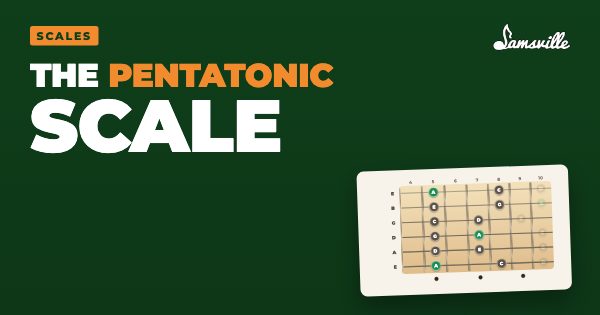
- C, G, Am, F in the key of C. Try A minor pentatonic over C and Am, E minor over G, D minor over F.From the guide: The Pentatonic Scale on Guitar Open in Jamsville
The guide
In the learning paths Start Soloing From Zero, Solo Over Chord Changes and Solo Over the Blues.
Transcript
YouTube's automatic captions. Tap a time to watch from there.
- so those are the two e's I'm playing over them in that F chord so now what if I move both of those E's up to F and now I'm playing my D Minor slf major pentatonic scale over [00:25] that so in today's lesson we're going to be talking about why you're not using all the pentatonic scales and I'm going to be showing you how you can use all the pentatonic scales that are in a given key that you might be soloing so without further Ado uh let's jump right into it let's write out the key of C
- major here so the key of C major has a note C D E F G A and B in it okay so if I extract from there a C major a minor pentatonic scale let's think of it in the minor form for right now we would
- actually have the notes a c d e and G so you can see there that all of those notes were actually extracted from that major scale and it's essentially actually just stripping away the B note and the F note and that gives
- us the exact approach that I was just talking about up here right here's the slight problem with this okay if I play that a minor pentatonic scale over some of the chords that are in a progression in kefc well in my Clash a little bit so for example we're going to be taking a
- look at a c to G to a minor to F chord progression if we look at the C chord well guess what every single one of those notes in the C chord is actually found in that a minor pentatonic scale so c e and G look there's a c e and G
- right there in that a minor pentonic scale fantastic so we know that there aren't going to be any notes that Clash there okay but now if we look at the next chord the G chord the G chord has G B and D in it so G and D are actually both found in that a minor pentatonic
- scale but the third of the chord which is B is actually not found in that pentatonic scale but there is a c there well guess what the notes B and C kind of clash a lot together so if I play a b and a c at the same time that kind of clashes so if I play
- either that c that's on the eighth fret of the sixth string or the eighth fret of the first string or the fifth fret of the third string if I play any of those C notes and I happen to be playing over a G chord well it's going to kind of clash and let me go ahead and actually demonstrate that for you right now so uh
- here's going to be a G chord so there's a G chord just droning there and you hear that it kind of clashes so this is where this idea of
- actually switching the pentatonic scale is going to come in here okay what we're going to be doing is constructing two other pentatonic scales so if we look in the key ofc now let's relist out all those notes there are two other pentatonic scales that we can create so we can actually create the D
- minor pentatonic scale which is also the F major pentatonic scale so that scale would have the notes d f g a and C in it okay d f g a and C
- so if we compare that now to the notes that are in the a minor pentatonic scale we'll actually see that there's only one difference between those two scales so first of all D is in both of those scales so here's D and then up here
- there's the a minor scale D then there's also a g that's found in both of those there's also an a that's found in both of those there's also a c that's also found in both of those the one note that is not found in both of those is there's no e in the D minor pentatonic scale e
- there's no e but there is an F so what that tells us is that all we need to do is actually take all of the e in this a minor pentatonic scale move them up a half step to F and then Bingo look at that we actually just turn this into a D
- minor pentatonic scale with that being said this is incredibly useful cuz now let's say I want to play over The F chord this is going to give me a different sound so let's actually pull up a backing track just for the F chord here for one second first let's
- play the a minor pentatonic scale over it and particularly I'm going to put a focus on that e note cuz that's the note that sounds different so let's let's listen to it so those are the two e I'm playing
- over them in that F chord so now what if I move both of those E's up to F and now I'm playing my D Minor slf major pentatonic scale over that [06:36] I did play an E there for one [06:57] second so you see how now now all of a sudden while the other sound of me just playing the same a minor pentatonic scale over the whole entire thing it wasn't like terrible or anything but the way that this gets perceived is when all I'm doing is using only the a minor
- Panic scale over the whole entire chord progression it gets perceived as you're using the same you're just doing the same thing over the whole entire chord progression so in this case the a minor pentatonic scale works great over the C chord and the a minor chord so let's
- actually list next to each of those chords which pentatonic scale we want to use so let's say we want to use a minor pentatonic over the C chord and we also want to use a minor pentatonic over the a minor chord so so those are perfect chords to use that over but now we just realize it's a little bit of a different
- sound I'm not going to necessarily say it's better okay I want to refrain from saying that but it is a different sound and is a little bit more consonant and fits better with the chord if I use the D minor pentatonic slf major again I'm taking it for granted that you understand that each of those minor pentatonic scales is has a relative
- major to it now would that D minor pentatonic skill work over the G chord there's a lot of chords or a lot of notes that do fit for example there's a g and a d but again we still have that C note there and that C note is a little bit of a problem on the uh G major chord
- we would rather actually have a b note there so we're going to actually look at the last pentatonic scale and the third by the way there's three pentatonic scales that we can find in each key you're going to see and we'll memorize sort of a formula so that you can figure this out in other keys so we're actually
- going to construct an E minor SLG major pentatonic G major like I I'm playing over a G major chord so check this out so there's E minor SLG major pentatonic and this has the notes e g a B and D in it so there's no C note
- now but there is a bote in it yay so now we get to actually play that b note that's on that G chord when we get there so with that being said let's see how do we get there first of all we could get there from this D minor pentatonic scale
- uh but we're not going to do that because if you notice in the chord progession this particular core progression we're going to be playing the a minor pentatonic scale before we get to that G chord so because we're going to be playing over a c chord then we're going to go to the G chord so with that being said if we look at the notes that are in a minor pentatonic okay we
- have a c d e and G well guess what all the notes a d e and G well those are also found in the E minor p T scale there's e there's G There's A and D so the only note that's different is only one note and that's the B note and the C
- note so there's a C note in the a minor pantic scale but there's a b note in the E minor pentatonic scale so that's a kind of cool thing about this is it at first it seems like kind of confusing oh my God I got to change scales all the time but you don't have to it's not like you have to change every note you just have to change one note and you just have to know it well enough to figure
- out which is the note that changes so look check this out we're going to move all of our C notes now down a half step to B so there's C there's C boom and then now we actually have an E minor pentatonic scale there so now if we play over that G chord okay you're going to
- see that this fits a lot better with that G chord than the a minor pentatonic scale fit so here's the G chord sorry let's let's try that again sometimes when I change things it the guitar shuts off so here's the G
- chord there's that b so now that b sounds fantastic because it's in the chord so in a way what we're doing is we're kind of blending in the idea of Triads with our pentatonic scale it's almost like hey I'm playing pentatonics
- but with an awareness of the chord progression and still an awareness of the notes that are in the chord and picking a pentatonic scale that fits with the cord better so by the way what if I just go
- back and play the a minor pentatonic scale we're playing for that's supposed to work over the whole thing cuz the whole entire thing's in the key ofc right well let's see what do you [12:46] think it actually doesn't sound terrible or anything like you really don't want to sit on that c too long but it's it does have a an interesting color to it but this just sounds a lot more resolved playing that b and playing the E minor pentatonic scale
- again so now you know that there are
- actually three different pentatonic scales that you can find in any given major key the way they're going to remember this is all you need to do is think of if you know each of the chords in the key so you should know the one chord is Major the two and three are minor and then the four is Major five is
- Major the six is minor and the Seven is diminished well it's actually each of the minor pentatonic scales based on the two three and the six so the two chord is D Minor well guess what there's also a D minor pentatonic scale in the freaking key uh the three chord is E minor well guess what there's also an E
- minor pentatonic scale again SLG Major D minorf major E minor SLG major and then the six chord is a minor well there's an A minor pentatonic scale SL C major pentatonic by the way if you wanted to you could think of it the other way around you can think the major
- pentatonic side it's actually the major pentatonic of the one four and a five C major pentatonic F major pentatonic and G major pentatonic are all actually found within the same key so now let's just to hammer this home one more time now I'm going to go ahead and actually
- put on the backing track with this whole entire cord progression and let you hear the difference between just playing with the ex exact same a minor pentatonic scale over the whole entire chord progression versus actually changing with the chord progression in the manner that we've listed here so when I'm on
- the C chord I'm going to play a minor pentatonic when I'm on the G chord I'm going to play E minor pentatonic when I'm on the a minor chord I'm going to go back to C major pentaton a minor pentaton and then when I go to the F chord I'm going to play D minor SL F major so let's see what that sounds [15:43] like there was that c on the G chord so by the way if you're not keeping track of c g a a minor f one more time c
- g a minor F now I'm going to change [16:27] scills [16:49] so as you can see there it actually sounds kind of like what if you've been watching me for any amount of time it sounds kind of like some of the examples that we talk about with using Triads over a chord progression so in that that case I was
- not just switching the scale but I was also keeping in mind to emphasize that one particular note that changes in the scale because guess what guys every single one of those one notes that change from uh a minor to the E minor pentatonic scale or a minor to the D
- minor pentatonic scale guess what each of those notes are chord tones so if you actually emphasize those notes right when the chord changes it's actually going to sound quite like you're playing Triads so it's kind of blending these
- two worlds of thinking of a pentatonic scale and imple lenting Triads in your playing so if you want to learn how to master the guitar fretboard so not only can you implement these skills of figuring out the different pentatonic scales that go with different cores and keys but on top of that being
- able to do it every single place on the entire guitar fretboard and in any key on the guitar fretboard and much much more all of the different fundamental skills that you need to know in order to be a really really good guitar soloist and master the fretboard make sure you head on over to Jamesville
- docomo GPS fretboard fundamentals course today also make sure you listen to my new song it's called My Divine it just dropped like a month ago and it's such a good song that's what you're hearing in the background right now make sure you check it out it's on all streaming platforms you can check the description
- below also make sure you check out the Jamesville merch store where you can get an awesome Jamesville t-shirt just like this one that I'm wearing right now it's super comfortable and it fits awesome I absolutely love it and wear it all the time all right everybody until next time listen learn and jam