
Scales · Intermediate
The Major Scale on Guitar
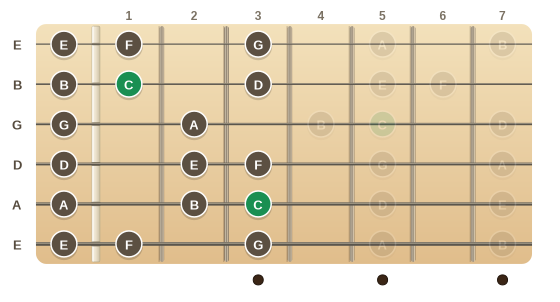
Play the C major scale from the open low E string to the top of the neck in one pattern, built from the note names, and make music with it over a band.
Summary
- Seven notes from one formula: whole, whole, half, whole, whole, whole, half.
- In C: C D E F G A B.
- On guitar, one pattern with four notes on every string takes C major from the open low E to the top of the neck.
On this page
The major scale is seven note names and one formula. Once you can build it from the names, you can play it anywhere on the neck, in any key, without memorizing a pile of shapes.
Start with the note names
C major has seven notes: C D E F G A B. Number them and you have the scale degrees. C is 1, D is 2, E is 3, F is 4, G is 5, A is 6 and B is 7.
The steps between them are the major scale formula: whole step, whole step, half step, whole step, whole step, whole step, half step. It's the same in every key. 1:04Watch at 1:04 A half step is the very next fret. A whole step skips a fret.
Here's how I remember where the half steps go. Split the notes into two groups: C D E is group one and F G A B is group two. Inside each group, everything is a whole step apart. The half steps sit between the groups, at E to F and at B to C. 3:52Watch at 3:52
Learn it on one string first. Start on C on the second string and walk the formula up the string. That way you learn the names of the notes, and you're not stuck in a position. 0:13 +10:130:43
Do the same on every string, starting from the letter of the open string, and you've found every natural note on the guitar. 4:14Watch at 4:14 That's what the next pattern is built from.
One pattern, the bottom of the neck to the top

This is one of my favorite ways to play the major scale: four notes on every string. 0:22 +10:22 · The COOLEST Way To Play The Major Scal15:46 · EVERY Way To Play The Major Scale On G You build it from the lowest note in the key that you can play on the guitar. 0:43Watch at 0:43
In C major, that note is the open low E string. E is the 3rd of the scale. 1:04Watch at 1:04 Play four notes up that string: E F G A. That's all for that string. 1:47Watch at 1:47
The next note in the key after A is B, so find B on the fifth string and play four notes from there: B C D E. 2:08Watch at 2:08 From there, every string is the same two moves: name the next note in the key, then find it on the next string. 2:08Watch at 2:08
- Sixth string: E F G A
- Fifth string: B C D E
- Fourth string: F G A B
- Third string: C D E F
- Second string: G A B C
- First string: D E F G
The steps on each string make it easier to remember.
- The sixth and fifth strings have the same pattern: a half step, then two whole steps. Up one fret, skip a fret, skip another. 2:31Watch at 2:31
- The fourth string, F G A B, is all whole steps. 5:23Watch at 5:23
- The third and second strings are two whole steps, then the half step at the end. 7:30 +17:308:33
- The first string has the half step in the middle: D to E is a whole step, E to F is the half step, F to G is a whole step. 9:13Watch at 9:13
Every half step is E to F or B to C. Same two groups.
You start on E for two reasons. If you start on the root, you run out of neck before you run out of strings. And when you solo, you don't want everything to start from the root anyway, or it all sounds like a scale. 17:12 +117:1217:32 Starting on E doesn't change the key, either. Play these notes over a C chord and you hear C major. 10:09Watch at 10:09
One fingering takes you from the open low E all the way to a high G on the first string. That's why I call it the coolest way to play the major scale. 9:57Watch at 9:57 You do need to know your notes on each string first. Without them this takes too long and gets confusing. 4:42Watch at 4:42
Shift your hand
Four notes on one string means your hand has to move. 3:14Watch at 3:14 There are two ways to do it.
- Shift your first finger. On the fifth string, play B with your first finger, move that finger up to C, then play D with your second finger and E with your pinky. 3:36Watch at 3:36
- Slide your pinky. Play B with your first finger, C with your second, D with your pinky, then slide the pinky up a whole step to E. 3:57Watch at 3:57
The first way is a small shift with a bigger stretch. The second is a smaller stretch with a bigger shift. Try both on every string. Finding the fingerings that work for you is part of practicing this. 4:20Watch at 4:20
The third string has the widest stretch. If it's hard on your hand, shift. You'll get the stretch with time. 8:11Watch at 8:11
Pick it down, up, down, up
Four is an even number, so if you alternate pick, every string starts on a downstroke: down up down up, string after string. 6:29Watch at 6:29 The pattern takes some work to see, but it's easy on the picking hand. 6:50Watch at 6:50 You can also slide into a note and pick less. 5:45Watch at 5:45
Put it in time
As soon as you know where the notes are, put on drums or a metronome. 10:40Watch at 10:40 Playing a scale out of time is fine for the first few minutes while you find it, and that's it. 2:56Watch at 2:56
- Alternate pick it up the neck, then back down. Get comfortable with just that. 11:01 +111:0111:29
- Put a slide on the last note of each string, from the fifth string up. The picking becomes down up down, slide. Then go back down, still sliding at the end of each string. It sounds quite different. 11:29 +111:2912:12
- Change the rhythm. Play it in triplets, or only on the "e and a" of each beat. 7:07 +17:078:18 Practice with interesting rhythms and your solos get interesting rhythms. 8:44Watch at 8:44
Make music with it
You learn a scale so you can pick notes from it for your solos. 13:52Watch at 13:52 So once the pattern is comfortable, improvise with it. 12:55Watch at 12:55
Two strings at a time
Break the pattern into pairs of strings: the sixth and fifth, then the fifth and fourth, and on up the neck. 11:20 +111:2012:25 With four notes per string, each pair holds eight scale notes in a row. On the third and second strings that's C D E F G A B C, a whole octave on two strings. 16:07Watch at 16:07
Inside a pair, play the scale in thirds: C to E, D to F, E to G, F to A, and so on. 9:27Watch at 9:27 Then put the thirds in a rhythm, like triplets. 10:14Watch at 10:14
The band holds a C chord while you play one pair of strings at a time, four bars each. Make up little ideas on the lit strings, then move up with the band.
A melody over the band
Now take the whole pattern over the band. You don't have to use all of it. Grab two notes and make something out of them. 14:56Watch at 14:56 Try a pedal point: keep one note the same and move the other one. 15:45Watch at 15:45 Keep it in time and leave space. When it starts sounding like a scale, use fewer notes.
How it fits with the other ways to play it
Four notes per string is another tool in your arsenal. It connects with the five major scale positions and the pentatonic scale, so you're not stuck in one area of the neck when you solo. 13:42Watch at 13:42 It also ties together the small octave shapes, the five positions and three notes per string, and you start seeing what they have in common. 18:36Watch at 18:36

Start on another note
You can build the same pattern from other notes in the key. Start on F, the next key note up the low E string, and you get F G A B, then C D E F, then G A B C, and so on, until you end on A high up the first string. 19:20Watch at 19:20 Start on the next note each time and you get five of these in C major that fit on the neck.
The five positions
The five major scale positions (a lot of people call them the CAGED system) take the neck in vertical slices. Each one is every note in the key you can find in one small area of the neck. 9:04 +19:049:25 Start with the lowest one, the open position. 9:25Watch at 9:25
Anything you learn with open strings, also learn an octave up, where the open strings become fretted notes. That's the version you can move. 10:50 +110:50 · EVERY Way To Play The Major Scale On G5:45 · Why Practicing Scales SUCKS (And How T
Change keys by changing one note
Learn all of this in C first, then take it to other keys. 15:24Watch at 15:24 Sliding the whole pattern up a fret to get a new key is the typical guitar player's cheat. Go around the circle of fifths. Every step around it changes exactly one note. 4:58 +14:58 · How To ACTUALLY Play In All Keys1:50 · Learn To MASTER Guitar Soloing In All
You can go either direction. I like the flat side. 4:16Watch at 4:16 F major has one flat, so to get from C to F, every B becomes B♭. 4:38 +14:385:19 In the pattern, the Bs on the fifth, fourth and second strings each move down a half step. Everything else stays put, and the pattern still starts on the open low E, because E is in F major too.
Next comes B♭ major, where every E becomes E♭. 6:25Watch at 6:25 Now the open E isn't in the key, so the pattern starts on the lowest note that is: F.
The sharp side works the same way. From C to G, every F becomes F♯. 4:43Watch at 4:43 The same two moves work in every key: name the next note, then find it on the next string. If you're still learning which notes each key sharpens, practice the sharp keys here.
Take it off the screen
Sing the note names while you play the pattern slowly, like I do here. 3:10Watch at 3:10 Then put the guitar down and say the notes of a key out loud: C D E F G A B, then F G A B♭ C D E. Knowing your keys is something you can practice without a guitar, even waiting in line at the grocery store. 33:52Watch at 33:52
Then sing the major scale with solfege, do re mi fa sol la ti do. 2:10Watch at 2:10 Hum a short tune you know, and find it on the pattern starting from any C.
In this learning path
Questions guitarists ask
What is the major scale formula on guitar?
Whole step, whole step, half step, whole step, whole step, whole step, half step. It's the same in every key. On guitar, a half step is the very next fret and a whole step skips a fret. In C major, the half steps fall at E to F and B to C.
How do I play the major scale across the whole neck?
Start on the lowest note in the key you can play. In C, that's the open low E. Play four notes up that string, E F G A, then find the next note, B, on the fifth string and play four from there. Keep naming the next note and finding it on the next string.
What are the five major scale positions?
They take the neck in vertical slices, and a lot of people call them the CAGED system. Each one is every note in the key you can find in one small area of the neck. Start with the open position, and learn anything with open strings an octave up too, so you can move it.
How do I play the major scale in other keys?
Go around the circle of fifths. Every step around it changes exactly one note. To go from C to F, every B becomes B♭. From C to G, every F becomes F♯. The same two moves still build the pattern: name the next note, then find it on the next string.
Why does the four-notes-per-string pattern start on E?
If you start on the root, you run out of neck before you run out of strings. When you solo, you don't want everything to start from the root anyway, or it all sounds like a scale. Starting on E doesn't change the key: play these notes over a C chord and you hear C major.
Keep going
Keep what you open here. A free Jamsville account saves your boards and sequences to your Practice Library and keeps your progress on every device.
Make your free accountSubscribe to Jamsville on YouTube
Where this comes from
This guide is written from these lessons on the Jamsville channel. The timestamps in the text link to the moment each idea is taught.
- The COOLEST Way To Play The Major Scale on Guitar (2023)
- EVERY Way To Play The Major Scale On Guitar (2025)
- Why Practicing Scales SUCKS (And How To Fix It!) (2024)
- How To ACTUALLY Play In All Keys (2026)
- Learn To MASTER Guitar Soloing In All 12 Keys! (2024)
- This Fretboard Exercise Is KILLING Your Playing (2025)
- The BIG Problem With The CAGED System! + LIVE Q&A (2023)
- The Most Valuable Musical Skill: Ear Training 101 - Jamsville LIVE! (2021)