
After each pass the video waits as long as the loop, so you can play it back.
Start slower with −, and it climbs to 100%.
Keys: Space play · ← → 5 s · [ ] set start and end · − = speed · L loop
Fretboard and scales · Beginner
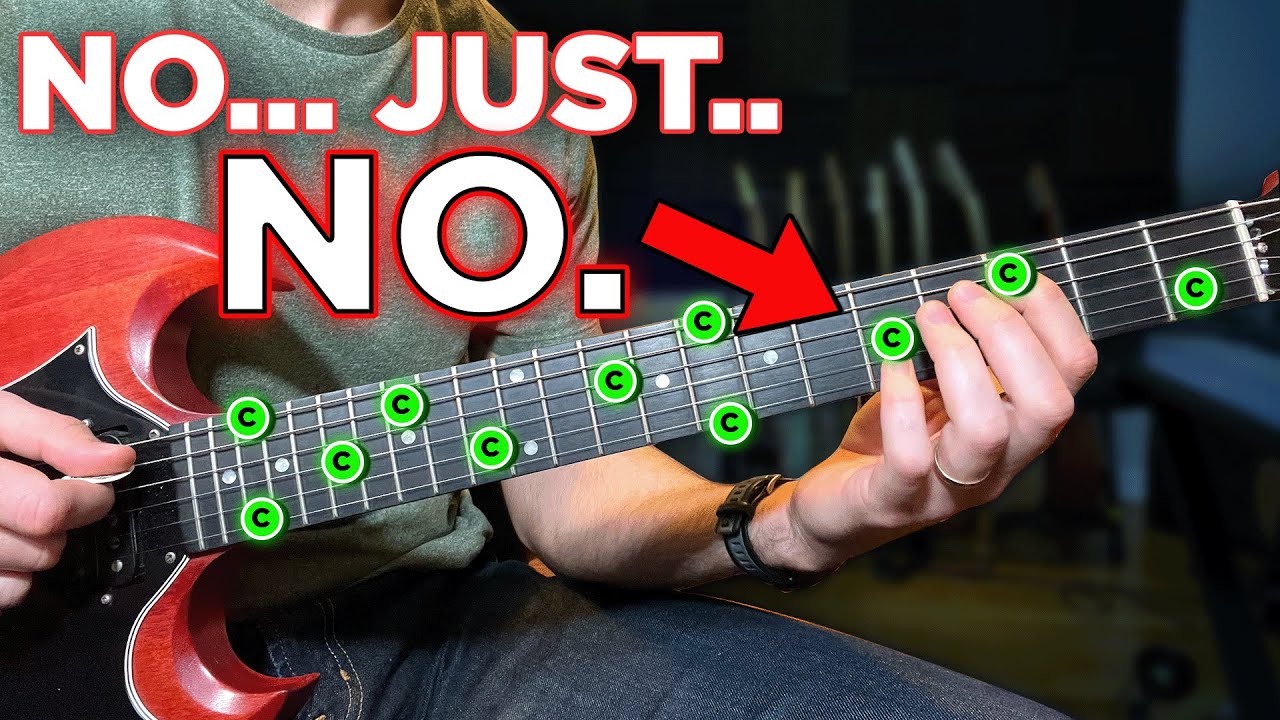
This Fretboard Exercise Is KILLING Your Playing
In this lesson
Tap a time to watch that part. loops it, so you can slow it down and play along.
-
Key idea Half steps E-F and B-C are all you need
Knowing that E-F and B-C are half steps and everything else is whole steps, mapped on one string, is literally all you need to master the fretboard, if you have the creativity to expound on it.
-
Exercise Solo on the one-string scale right away
After playing the one-string C major scale up and down a few times, immediately solo on that string for a couple of minutes over any C major (or A minor) backing track.
-
-
Step by step Sharps and flats exist for keys: learn them by changing one note
The only reason to learn sharps and flats is to play in other keys, so learn them by playing in keys: C to G = F becomes F#; G to D = C becomes C#; C to F = B becomes Bb (the 7th lowered). Each new key adds one note and keeps 6/7 of what you know.
-
Practice it
- The sharp keys, G through C♯: which notes each one sharpens.From the guide: The Major Scale on Guitar Open in Jamsville
- G major: the same natural notes with every F moved up one fret to F♯ (lit).From the guide: How to Learn the Notes on the Guitar Fretboard Open in Jamsville
- Guide The Pentatonic Scale on GuitarFor “Delete 4 and 7 for major pentatonic”. You'll build the minor pentatonic from its five note names, play it across the whole neck with one small repeating shape, and make a short solo with it over a blues shuffle. Read it
- Drill One string at a time ProFor “Delete 4 and 7 for major pentatonic”. You'll stop living inside one box and see the scale run along each string. Open
The guides
 GuideHow to Learn the Notes on the Guitar FretboardLearn the seven natural notes as one pattern, find it on every string, and make up a solo on a single string today.
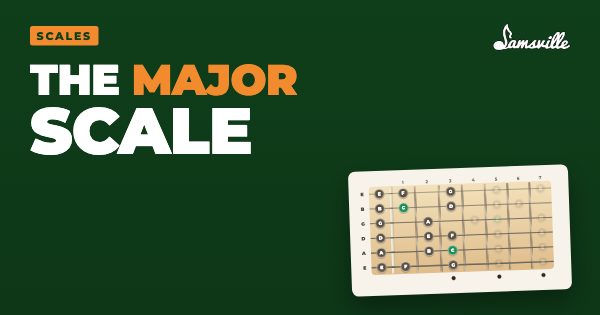 GuideThe Major Scale on GuitarPlay the C major scale from the open low E string to the top of the neck in one pattern, built from the note names, and make music with it over a band.
In the learning paths Know the Fretboard and Every Key, Start Playing Guitar and Start Soloing From Zero.
Transcript
YouTube's automatic captions. Tap a time to watch from there.
- C C. [singing] Please stop practicing the fretboard like this. It's not very useful. And in today's video, I want to show you the right way to start memorizing the fretboard so you can actually have it be useful in your guitar solos and music.
- So, what we're going to do instead of doing that crazy exercise I just showed you, which all of you have probably seen, just pick one note, find it everywhere you can on the fretboard, we're going to actually learn way more notes all at once, and it's going to be way easier. So, what we're going to do is map out the C major scale on one string. And it looks like this. So, you start on C. So, same starting point,
- kind of like what we did, but instead, you're going to go up a whole step to D and then up another whole step to E. And then you're going to go up a half step to F. And then up a whole step to G, up a whole step to A, up a whole step to B. And then finally, [snorts] you're going to go up a half step to C. So you notice that you have a half step between E and F, and you have a half step between B
- and C. And that's it. That's the only thing you literally need to know actually to be able to master the whole entire guitar fretboard. Like, I'm totally serious. if you have the creativity to expound upon this information. That's all you need. So, we now know where every single note is and how they all relate to each other. And
- you just need to learn how to map them out on different strings. But what we're going to do is we're going to actually just memorize this one string right now. If you notice, since G is on the 12th fret here, we can actually have an open G. And then you can continue the pattern. You notice here when we went from G to A, it went up a whole step. And then when we went from A to B, it went up another whole step. But we're going to go from G to A here and then A
- to B here. And now we have that whole entire string covered. But now we can just think of C as being the root note. So we'll change the color of that right now. So now what I want you to do is just play through it really quickly. So let's start on C. C D E F G A B C. And then we can go back down. C B A G F E D C [singing] B A G. Cool.
- So, now that you've got that mapped out, take up as much time as you need. Now, what we want to do is we want to start to solo with it right away. So, I'm going to put on a backing track that I made, but you can just go look up any C major backing track you want on YouTube to do this, or A minor, by the way. And really quick, that's how you learn the relative minor of a major key. You start on the first note. You go up 1 2 3 four
- five to the sixth note. So, the sixth notes A. So, this is also the same notes in the key of A minor. Uh there's some slight exceptions to that like a harmonic minor and melodic minor, but we're not going to worry about that right now. Cool. So now I'm going to solo on this one string for a couple of minutes and just get more comfortable.
- Okay, so now I'm pretty comfortable with playing that scale one string. Now I've just learned seven notes. Okay. And this is really, really useful because I've learned all the letter notes that are in the neck. And I can actually use this for actually playing music. Actually, I'm playing music right away with it as
- opposed to doing kind of a boring exercise that's not really musical. And one more thing really quick, I want to give you something even cooler. If we delete the fourth and seventh note. So C's 1 2 3 four is F. We're going to delete that one. And then we're also going to delete the seventh note. So we're deleting the fourth and the seventh note. So G was the fifth and
- then A is the sixth and B is the seventh. So we're gonna delete the B. So we deleted the B's and the Fs. And guess what? Now we actually have the major pentatonic scale. So that's a good thing for you to memorize, too, because now we're actually working on our fretboard knowledge and we're working on our scale knowledge and we're actually working on our improv. So, let's improv a little bit with just the pentatonic scale so we
- can get used to skipping that B note and that F note. So, you notice the pentatonic scale is really cool because actually skipping those two notes kind of uh gets rid of some weird sounding notes sometimes in some of the chords and it kind of makes us sound more melodic like we're
- actually not just playing everything stepwise all the time. So yeah, memorize the pentatonic scale. And most of you beginners out there definitely aren't going to know how to play it like that. So you're going to have a big advantage over other people if you do that. Okay. So now we got the full C major scale back there. What we're going to do is we're actually going to just learn how to play in a different key. So what's the whole entire point of learning the
- sharps and the flat notes? Because people tell you learn the sharps, learn the flats. Well, the only reason is so that you can actually play in different keys because different keys actually use the sharps and the flats. So the way that you learn where all the sharps and the flats are is basically by just playing in different keys and finding where the notes are. So what we're going to do is we're going to learn how to play in the key of G major. And the key of G major only has one note that's
- different from the key of C major. And that's going to be F sharp instead of F natural. So actually the cool thing is that we actually learned like the whole entire thing already, six7s of it. And we just have to change one note. So now you see actually if I take that F note, move it up a fret. And now that's F# and nothing else changes. And what I'm going to do is just change the color really
- quick so that G is the root is highlighted. So now all of a sudden just by changing that one note F to F# now we're learning where F# is. But more than that we're actually learning where the key of G is. So we're already learning how to play multiple keys. So if you're a beginner who maybe only knew how to play one key, well now all of a sudden you know how to play in two keys. And we're going to learn how to play
- more keys in a second. So what you're going to do is learn that G major scale and then also count delete the fourth and the seventh and learn pentatonic. So 1 2 3 4 C is the fourth. We're going to delete C. Delete both the C's. And then we're going to go up to D is the fifth. E is the sixth. F# is the seventh. Oh, that's kind of funny. The note that we
- actually uh added in or changed from F to F#. We're actually going to delete that note. And now all of a sudden we have G major pentatonic. So, let's go back. Let's solo in G major. And then we're going to solo in G major pentatonic.
- Okay. So, now let's solo in G major pentatonic for a sec. So, in just a span of a few minutes, we've learned two keys. Now, we're going to do a third key. We're going to do the key of D major. And you're going to see
- only one note's going to change again. So, to move to the key of D major, we're just going to move this C note up to C sharp. And move that C note up to C sharp. And now, all of a sudden, we're actually in the key of D major. So, now you can see the D is highlighted because that's the root of the scale. So now in just a few minutes, we've learned three keys. And now we've learned not just all
- the natural notes, but we've also learned two of the different sharp notes. And actually, there's only five of them. So you only got three more to go. We're not going to do all of them in this video, but we'll do one more key after this. So let's solo in D major. And then I'm not going to delete them from the diagram. But if I skip the C sharp and I skip the G, which is the
- fourth note and the seventh note in the key, right? D, right? D, E, F sharp, G is the fourth and A, B, C sharp is the seventh. So if I skip those two notes, I'll be playing D major pentatonic.
- Now I'm getting the pentatonic. I'm not going to play that C sharp there. I'm not going to play this G here. Notice how has a more of a rocky sound with pentatonic. Okay. So now
- let's go back to the key of C and we're going to learn another key which has a flat note in it. The key of F. And we're just going to change one note, which is going to be the seventh note in the key. B, we're going to move that down a half step to B flat. And there you go. As simple as that. Just moving one note down a half step. And now we're in the
- key of F slash the key of D minor, which is again count all the way up to the six to find what the relative minor is. So F, G, A, B flat 4, C is five. D is the sixth note. So, it's actually D minor as well. And now all of a sudden, I've learned four keys in just a few minutes.
- And I've learned several of the sharp notes. And now I've got another flat note. I've got all these different notes I've learned on this string. And more importantly, I've learned the formula to building these different keys. And really, all I got to do is do it on more strings. And then that's it. I'm going to have pretty good freaking mastery over the fretboard. So now I'm going to
- solo for a few seconds in F major and I'm going to play a little bit of pentatonic by skipping the B flat note and skipping the E note which are the fourth and seventh respectively. Also if you want to start getting more advanced try bending a little bit.
- So, after doing all that, doesn't this seem a little bit more fun and effective than sitting here going C [singing] doing all that stuff, right? We're actually making music and just in a few minutes, I just learned how to play in a bunch of keys. So, you just kind of rinse and repeat that for all 12 keys. And now, all of a sudden, you got all 12
- keys down. And that's it. It's pretty simple. If you actually do it the right way, it would actually take most of you maybe less than a week to learn how to play in every single key and then you wouldn't have to deal with it anymore. So, if you're interested in really digging deep and mastering the fretboard the right way, make sure you check out the Jansville GPS fretboard fundamentals course at jamsville.com, which I made
- specifically to help you achieve this. And if you want to learn my top 10 improvisation patterns that you can apply to these scales that you've been working on here, then click on this video. So if you like the video, subscribe to the channel, hit that like button, and until next time, listen, learn, and jam.