
After each pass the video waits as long as the loop, so you can play it back.
Start slower with −, and it climbs to 100%.
Keys: Space play · ← → 5 s · [ ] set start and end · − = speed · L loop
Fretboard and scales · Beginner
The COOLEST Way To Play The Pentatonic Scale On Guitar
In this lesson
Tap a time to watch that part. loops it, so you can slow it down and play along.
-
Key idea Single-string learning applies to everything
Whatever you learn (arpeggios, major scale, pentatonic), learn it one string at a time; to do that you must know the actual notes in the thing.
-
-
Key idea Single-string sound and position connection
Single-string pentatonic gets a different sound (like sitar players moving along one string) and helps you connect each of the position patterns.
-
-
On the neck Exact repeating pentatonic pattern
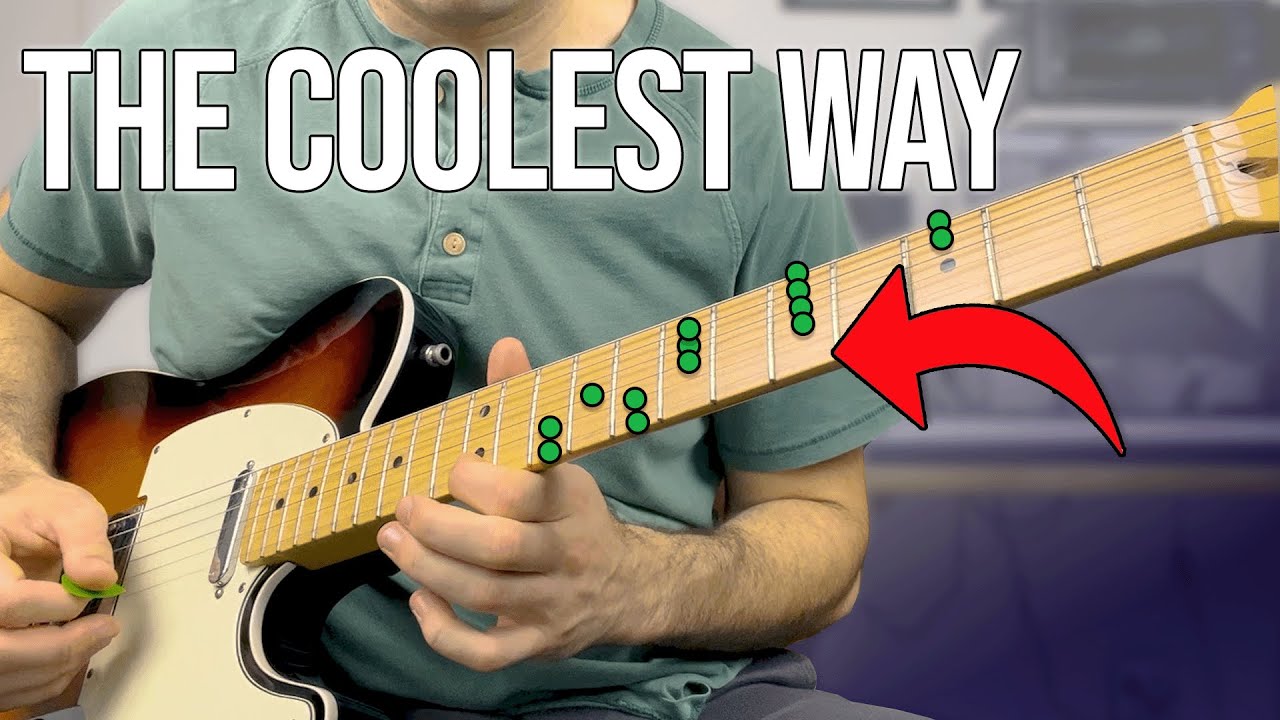
A five-note two-string cell (6th string A 5th fret, C 8th; 5th string D 5th, E 7th, G 10th) is a whole pentatonic scale; repeat the identical cell from the 4th string 7th fret and the 2nd string 10th fret to cross the neck diagonally in one pattern.
-
Key idea Repeat an idea up an octave
The repeating pattern lets you play an idea and then the identical idea an octave higher, something piano players do easily and that always sounds pro.
-
-
Key idea Slides come with diagonal patterns
Diagonal patterns invite slides, which sound more pro than picking or hammering every note; you basically never get slides when stuck in positions.
-
-
On the neck Three-note-per-string pentatonic (advanced)
Laying the pentatonic out with three notes on every string gives giant whole-neck patterns (3rd fret to 20th); the shape differs on every string, so only attempt it after the single-string pentatonics are solid.
-
How to practice Experiment with fingerings like a guitar experimenter
For wide 3NPS pentatonic stretches, try sliding the first finger or the pinky, or stretching; there's no exact science, and willingness to mess around with fingerings is a big part of getting better at improv.
-
Practice it
- One A7 chord, looping, with a blues shuffle band. Solo over it with A minor pentatonic.From the guide: The Pentatonic Scale on Guitar Open in Jamsville
- A major pentatonic in the same area as the A minor box. The glowing notes are the three to add to the box: the 2 (B), the 3 (C♯) and the 6 (F♯).From the guide: The Pentatonic Scale on Guitar Open in Jamsville
- A minor pentatonic, the box most players learn first. Five note names: A, C, D, E, G.From the guide: The Pentatonic Scale on Guitar Open in Jamsville
- A minor pentatonic on the fifth string alone: 1, ♭3, 4, 5, ♭7 and the 1 again.From the guide: The Pentatonic Scale on Guitar Open in Jamsville
- Exact repeating pattern 1: A C on one string, D E G on the next, the same two-string shape three times.From the guide: The Pentatonic Scale on Guitar Open in Jamsville
- Exact repeating pattern 2, starting from G: G A, then C D E. A is still the root.From the guide: The Pentatonic Scale on Guitar Open in Jamsville
- Exact repeating pattern 3, starting from C: C D E, then G A.From the guide: The Pentatonic Scale on Guitar Open in Jamsville
- C major pentatonic: the same dots as the A minor box, with C as the 1.From the guide: The Pentatonic Scale on Guitar Open in Jamsville
- C, G, Am, F in the key of C. Try A minor pentatonic over C and Am, E minor over G, D minor over F.From the guide: The Pentatonic Scale on Guitar Open in Jamsville
- Three notes per string, pattern 1, starting from G on the low E string.From the guide: The Pentatonic Scale on Guitar Open in Jamsville
- Three notes per string, pattern 2, starting from the open low E. It ends on E, G and A on the high E string.From the guide: The Pentatonic Scale on Guitar Open in Jamsville
- Guide How to Learn the Notes on the Guitar FretboardFor “Single-string learning applies to everything”. Learn the seven natural notes as one pattern, find it on every string, and make up a solo on a single string today. Read it
- Drill One string at a time ProFor “Single-string learning applies to everything”. You'll stop living inside one box and see the scale run along each string. Open
- Drill Up one position, down the next ProFor “Experiment with fingerings like a guitar experimenter”. You'll connect every position of the scale into one neck. Open
- PDF The Pentatonic PrimerThe free handout for this lesson. Get it
The guide
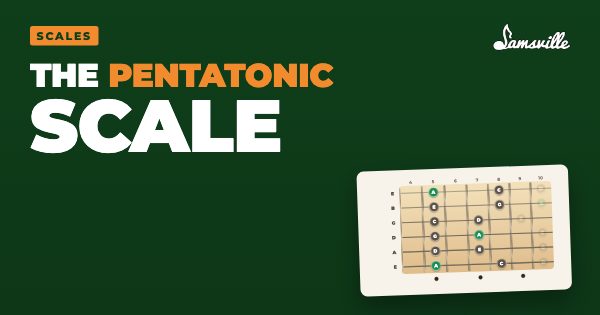
In the learning paths Start Soloing From Zero, Solo Over Chord Changes and Solo Over the Blues.
About this video
FREE GUIDE - Memorize ALL notes on the guitar in 10 Minutes:
Transcript
YouTube's automatic captions. Tap a time to watch from there.
- are going to be going over what I think is the coolest way to play the pentatonic scale so without further Ado let's jump right into it so uh you'll see that actually we're going to be going through this document that you're going to see on the right and it's called the pentatonic primer now if you
- want this document check the comments down below and we will be able to get your own copy of it so most of you probably know actually this first page of the documents is a three-page document and let's actually go up here to the first page so
- this is basically what you find anywhere your basic positions of the pentatonic scale so in this case we're checking out the a minor pentatonic scale so that's the first position second position third position I'm not going to go over that all right now because I'm
- assuming that you already kind of know this again this is something you can find anywhere so we're going to take a look at the next two pages of this document so here in the second page this is a really really important part that I really emphasize with a lot of people no matter what it is that you're trying to learn
- the guitar whether it's arpeggios or anything like that a scale the major scale the pentatonic scale is you gotta learn how to play it on one string at a time so the only way they can really learn how to play anything on one string at a time is well you actually have to know the actual notes that are in the
- thing that you're trying to learn so in this case the a minor pentatonic scale has five notes in it it has the notes a c d e and G okay and then also that's the same thing again as the c major pentatonic so if you just take that skeleton from C that actually gives you
- C major pentatonic scale so uh let's just go over a couple of these really quick not gonna go over all of them because actually I want to get into the mean potatoes which is the third page which I accidentally had up there in the beginning so the again this single string stuff is really cool because it lets us play in a
- very different way from what most people are used to which is being stuck sort of in the box right so instead let's check out actually the fifth string so we have the fifth string we have the open a then we have C in the third fret D on the fifth fret e on the seventh fret G in the
- tenth fret and then a again all the way into 12th fret so this lets you kind of get this this different vibe going when you learn
- on one string at a time actually um if you check out a lot of like kind of Indian music they do the same type of thing where on the sitar actually they play the pentatonic scale and in the sitar it's a really really big thing to just go up and down one string at a time so you can get a lot different sounds uh
- by checking out the pentatonic scale on one string at a time and also last thing is that it's going to help you connect each of those position patterns okay so let's get into my favorite part of this which is going to be this third page here third and final page so on this page these first three
- examples on the top so these three right here these are going to be slightly different than the last two so I'll explain now so this first pattern here in the top is called exact repeating pattern one so why is it called exact repeating pattern
- it kind of looks like a big long pattern that we have to learn but actually if we observe here on the sixth and fifth strings there's actually like a little mini pattern here so let's take a look at that so on the sixth string you got a on the fifth fret
- then you got C on the eighth fret and then again on the fifth fret but of the fifth string you have D and then you have e on the seventh fret and then you have G on the 10th fret so this little pattern right here you just have to remember this again I'll play One More Time
- that's actually an entire pentatonic scale right there by the way it's five notes right there's five notes in the pentatonic scale and there's five notes right there so if you notice now look at this starting from the fifth sorry from the seventh fret of the fourth string we get the exact same shape verbatim you
- get a then you go up three Frets to C then we go over a string to the third string now and then you have d and e and then G is three Frets above e so you can play the exact literal same pattern three different times actually and turn it into one gigantic pattern so
- there's the pattern on the fourth and third strings and then finally you do it again here starting from the tenth fret of the second string now this is why I think that this is the coolest way to play the pentatonic scale because now we're blending
- basically seamlessly the first two approaches that we just talked about so the position patterns the five different position patterns of the pentatonic scale which again you all probably know and then the single string patterns where it's just all the way only going this way left and right on the fretboard
- now we get this kind of diagonal overall shape so just by remembering one simple pattern and actually it's even simpler because again you don't need to remember this whole gigantic pattern this gigantic pattern is just made up of one little teensy-weensy pattern that's only
- over two strings you just repeat it three times but now all of a sudden this pattern is going to take us all the way from the fifth fret of the sixth string all the way to the 15th fret of the first string so if I play the whole thing together it sounds like this foreign foreign
- so we went all the way from here to here to me that's super insane and the added benefit of this is that you can sort of you can play an idea and then repeat that exact same idea up an octave kind of like this like if I want to play
- let's say um d e and then C A D you can do the same thing up and octave oh and that always sounds like super pro when you can take your idea and then
- just move it up and down an octave that's something actually that piano players do very very easily it's not quite as easy on the guitar but as you can see with this approach it is pretty pretty easy to do so let's take a look at the next two exact repeating patterns because these are also really cool so if we start from the instead of the a
- note on the fifth fret of the sixth string we can start it from the G note and this is actually an easy like a little bit of an easier pattern to play actually uh you just have to remember that the root of your pentatonic scale is actually going to be a second note right it's the root of your pentatonic scale is still that a or if you're
- thinking in a major it's going to be the C so look at this we have G on the third fret a on the fifth fret then C in the third fret d m the fifth fret and E on the seventh fret so it's literally like a box that has one extra note it's literally
- like a little tiny square and then we repeat that exact same pattern of an octave and then one more time foreign that's the super duper cool thing again
- is that now we're going all the way from the third fret of the sixth string to the 12th fret of the first string literally in just one pattern also the thing that I really love about
- this is it kind of lends itself to sliding when you're playing and again that sliding approach it always sounds just a little a little more Pro than when you're just stuck and you're picking every note or hammering on and pulling off every note adding in
- those slides is something that you basically never get when you're playing in those positions like that so let's take a look at the last exact repeating pattern this one's actually almost like exactly the same as the second one in terms of the shape so if we start now from the C
- which is again that's the relative major so again like now we're kind of thinking C major pentatonic in a way because we're starting from C so we start from C on the eighth fret of the sixth string then we D on the tenth fret and then e in the 12th fret so those three notes on
- that sixth string and then we get G and a foreign so that's the pattern that we're going to repeat three times [11:06] okay so again this one goes what from the eighth fret all the way up to the 17th fret so whenever you play these things like if you just get if nothing else guys you just get these three patterns that's automatically going to make you look and sound way more Pro uh like when
- you see someone playing with these patterns do you see their hand moving around the guitar neck instead of just being stuck in there so you know before we move on let's just uh see what it sounds like if we play this over a backing track [11:57] there's that thing repeating the idea up or down an octave foreign [12:26] so there you have it it's it's such a cool approach to the pentatonic scale again the sliding and then of course if you don't play all the notes in the pattern you skip over some of them like sometimes I just played that C and the g [12:47] irono there right just that alone you could actually get these two uh cool shapes like this C and the G right there and then also this D and the a so all I'm doing is just playing them in a different order so of course it's up
- to your creativity to be able to see all the different possibilities that you can get out of this and that's the really cool part about practicing it okay so let's start wrapping up this video by taking a look at the next two patterns the last two patterns so now the names of these patterns are a
- little bit different so this first one is called three note per string pattern one and then we got three three note per string pattern two and it's exactly what it sounds like so if you notice actually the exact repeating patterns they had one string in the little mini patterns that we talked about one of those
- strings would have three notes on it and then the other one would have two notes but now what happens if we decide hey let's lay out the pentatonic scale but we have to have three notes on every string this is super duper cool and just a little warning though it is pretty Advanced so you better have practiced
- all those single string pentatonic scales really really well before you try this because yeah let's just say you're not going to be able to just remember the shape okay the shape actually just basically different on every strict so again that's why I left this for last because you need to be careful before you jump
- into this or else you're just going to get overwhelmed and confused so if we look at this three note per string pattern number one again it's just exactly what it sounds like so remember we have a c d e and G in this scale okay so we're gonna see what happens we're gonna start it from G now there's actually more of these
- patterns both the exact repeating ones and the three note per string ones that are on here but I don't want to overwhelm you with too much stuff um the three note per string patterns if you start them from some different notes you'll just kind of run out of space because as you can see these freaking patterns are gigantic look at
- this this first one goes from the third fret of the sixth string all the way up to the 20th fret of the first ring okay so if you start this like let's say from a you're gonna run out of space on the first string you're not going to be able to put three notes per string on that last string and same thing if you start
- even higher up on the sixth string so you can't start super high in a sixth string and still be able to lay three notes per string on every single one so again this is something you gotta mess with a little bit but let's try playing through this so we had G A and then C and then we have d e and G and then you have a c and d
- e g a c d e and then g a c again these are the kinds of things that are really really really cool because we
- can just think sort of in one pattern that's gonna automatically take us all the way across the whole entire guitar neck okay so just uh for practicing purposes a couple things I want you to pay attention to there's two different ways to sort of finger each of these uh strings so first of all you can decide
- to have a slide on each string because this is you can see each string stretches quite a bit so if you have really big hands you can try to stretch sometimes I do that because I'm like six foot four and my my hands aren't gigantic but you know they're not small either
- or sometimes I like to do this just because it sounds cool what I'll do is I'll play my first finger in the first note so let's say that g note right there and then I'll slide it up to the A and then play the C with my pinky and then uh if it doesn't make sense to
- slide the first finger then I'll slide my pinky instead so here it makes more sense on the fourth string to play a and then C with my pinky and then slide up to D so again there's not sort of like an exact science to this you gotta mess
- around with different ways and I think that that's a huge part of getting better improv too is this willingness to be able to sit there and mess around with hey what if I do this fingering what if I do this finger what if I slide with this finger what if I do any number of things you got to think kind of like a guitar experimenter when you're doing this okay
- so let's hear what it sounds like using some of these three note per string scale patterns uh over the back track thank you [18:39] also if you can get that jump and skip the middle note oh that's super cool hit a couple wrong notes there I'm stretching [19:04] all right so as you can see those are really really cool and even me uh I'm still not 100 comfortable with it
- sometimes sometimes it's just like man there's so many different possibilities going on here that when I'm practicing these things and trying to show them to you I'm really really trying to think and stretch my mind and play stuff that I'm not used to when I'm doing this okay so let's check out the last pattern
- really quick just for the sake of completeness so you got three note per string pattern number two so this one actually starts with our open E string again we can take advantage of that so we got open E then G and then a and then C D E on the fifth string and then g a c on the fourth and then d
- e and G on the third and then a c and then D on second and then e g and a on the first string by the way uh if you notice whenever you do these patterns it just so happens that you end up with the exact same notes on the sixth string and
- on the first string but actually three octaves high are the same note so we started with e g and a and then we ended with e g and aim so again there's more and more and more possible ways to do this so the idea behind this whole video was just to show you the concepts behind it the idea here
- is just to make sure that you have the concept down so that you can go ahead and experiment with this yourself and start incorporating it into your playing so everybody I hope that you enjoyed this video again check the comments so that you can get your own copy of this
- pentatonic primer document and I will see you in the next video until next time listen learn and jam