
After each pass the video waits as long as the loop, so you can play it back.
Start slower with −, and it climbs to 100%.
Keys: Space play · ← → 5 s · [ ] set start and end · − = speed · L loop
Fretboard and scales · Beginner
How To ACTUALLY Play In All Keys
In this lesson
Tap a time to watch that part. loops it, so you can slow it down and play along.
-
Key idea What you start on becomes your default
It matters which piece of material you start on: you default toward the root/first-learned position. Start each key from the lowest possible position (including open strings) instead, so all positions even out.
-
-
Exercise Circle of fifths, lowest position, same area
Practice all 12 keys around the flat side of the circle of fifths, always from the lowest position: C, then F (B to Bb), Bb (E to Eb), Eb (A to Ab), Ab (D to Db)... changing one note each time; five keys cover all five positions in the same neck area, and continuing repeats them offset by a fret.
-
-
How to practice Attack from multiple angles: also one string
Attack keys from multiple angles; one super important angle is playing any key one string at a time, which connects all the positions so everything glides.
-
Practice it
- F major, four notes per string. The same pattern as C major with every B lowered to B♭.From the guide: The Major Scale on Guitar Open in Jamsville
- The sharp keys, G through C♯: which notes each one sharpens.From the guide: The Major Scale on Guitar Open in Jamsville
- Guide How to Learn the Notes on the Guitar FretboardFor “Attack from multiple angles: also one string”. Learn the seven natural notes as one pattern, find it on every string, and make up a solo on a single string today. Read it
- Drill One string at a time ProFor “Attack from multiple angles: also one string”. You'll stop living inside one box and see the scale run along each string. Open
The guide
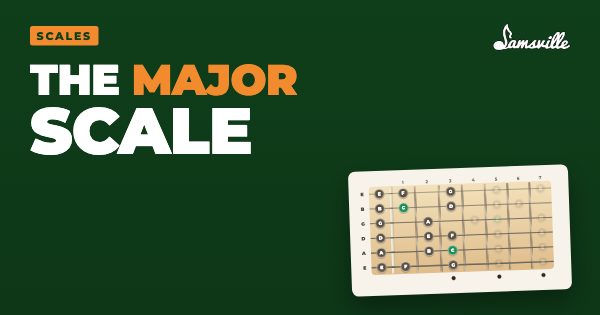
In the learning path Know the Fretboard and Every Key.
About this video
If you always find yourself playing the exact same scale shape in your solos, I'm going to show you how to fix it in this video.
Transcript
YouTube's automatic captions. Tap a time to watch from there.
- So, some people, even if they done a lot of diligent practice on their scales, they've learned how to play the major scale in all five positions, they always kind of default back to the same scale position when they play, this one that starts from the root, which everybody
- kind of learns first. But, we're going to talk about the exact thing that you need to do in order to become equally comfortable with all the positions. And it's not going to be what you think, just practice all the positions. It's a specific way of practicing that I want to show you in this video. So, like I
- said, this would be an example of the pattern that everybody kind of learns when they learn the major scale, and they might learn all of the other five positions, like this one. This one.
- Which can also be subsequently played down here with open strings as well. Then here's the next position. And then we finally end up with this position. And with that, you'd think, "Okay, well, I know all the major scale positions. I
- should be able to play all over the guitar neck." But, it's a little bit more complicated than that because often times we still bias towards that first position that we took a look at. Why? Because that's where the root of the key starts from. Like C, for example. So, then like if you want to play in the key of A, usually you'll think, "Okay, let
- me take this first position, and then just slide it over, for example, here to the key of A, where I'm starting from an A, and then bingo, I have my notes in the key of A, and then I can continue subsequently building all the rest of positions based on that starting point. But, this is super duper limiting because we're going to end up biasing
- towards starting from the same position all the time, and we don't want to do that. We want to be able to be equal as comfortable with all the positions, and that will help us to just navigate the fretboard better, play more interesting and different ideas, and just have more command. So, how do we fix this? What we need to do is not just practice in all
- 12 keys because we can practice in all 12 keys, but do this exact thing I was just talking about, always starting from the same position. Rather, we need to start from the lowest possible position on the guitar that we can find the notes that are in the key we want to play. So, for example, now we're back in the key
- of C, but this would be the absolute lowest position that we can find. So, every time I practice the key of C, if I go I start here, now I'm going to get a lot more comfortable with this other position because of the fact that I'm starting there. I think that this is one
- of the biggest takeaways from this video is it's very important what piece of material you start on. That we're always going to default bias towards starting on the root or whatever is the first position of something that we learned, but if we can get in the habit of starting on a different position, it's
- going to make them all get evened out eventually, which is really going to help our playing. And the easiest way to do this is simply start from the lowest possible position that we can find, and that includes the open strings if they fit in the key. So, I would now play through this position
- and then move to the next position in the major scale and so on and so forth. But even that I think is not as powerful as the next thing I want to show you, which is where actually going to practice in all 12 keys, but starting from the lowest possible position we can
- find. So we could do that and then do that in another key and another key and another key. So by the way, my favorite way to practice in all 12 keys is to go around the circle of fifths in either direction. I typically like to go around the flat side of the circle of fifth. So if I'm practicing my major scales and I'm done with the key of C, I've
- exhausted all of the different combinations I want to play, now I'm going to move to the key of F, which has only one flat in it. And this is going to help you learn the actual names of the notes that are in the keys you're playing, but actually it's really good for guitar because it avoids us getting into this trap of where I'm just going
- to slide something up a fret. Like if I wanted to, I could just slide all this up a fret and say, "Oh, I'm going to practice in the key of C sharp or D flat or something like that." That's the typical guitar player kind of cheating thing. So now I'm going to start in the key of F and in order to get to the key of F, all I have to do is change one
- note and that's going to be B goes down to B flat. So now I'm going to lower this B, which is on an open string, obviously can't lower it anymore in this string, I need to change strings, so I'm going to go here to this B flat on the third string and then this B on the fifth string second fret is going to go down to B flat on the first fret and now
- all of a sudden, actually, guess what? If I just kind of ignore for a second that open E string. That is our actual default starting position we're talking about starting from the root of F. Now, I kind of think of this as the same position. It's just whether or not you want to start it from the root or not or
- you want to start it from the seventh, but it's still the same position. So now all of a sudden, we just practiced two different scale positions, but we practiced them in two different keys, but we practiced them in the same area of the fretboard. And this is how you really get good at playing in all 12 keys. So now if I keep going around the
- circle of fifths, then I'm going to go to the key of B flat. And now I'm going to get rid of actually this E because I need to lower all my E's to E flat in order to get the key of B flat. So that one had to go because there's no lower notes available and this E can be lowered to E flat over here. And this E
- on the fourth string can be lowered to E flat over here. And what do you know? Here is a third different position of the major scale. Same positions we took a look at earlier, but now we're playing in a different key. So I don't want this video to be too
- long and so we're not going to go through all 12 keys, but we'll do a couple more and you see if you go around the circle of fifths, then you're actually going to go through all 12 keys, but every single time you change keys, you're only going to change one note at a time. And by doing this, you're going to actually get through all of your positions. You're actually going
- to get through them multiple times because they're going to be offset by a fret when certain keys come up. So now let's go to the key of E flat. So the key of E flat has to have all of the A's that are in this key go down to A flat. And so this A in the third string is going to go down from the second fret to the first fret. This A, which is the
- open string, well, of course we can't lower that anymore because it's already an open string. So we're going to change strings over to this A flat. And then what do you know? That is a position of the E flat major scale.
- And let's do one more because actually once we get through five keys, that will cover all of our five major scale positions, but in five different keys, all in the same area of the neck. So we're going to go from E flat to the key of A flat, which is the next one on the circle of fifths. And in order to do
- that, we have to lower D down to D flat. So this one's an open string, we got to change strings. You're starting to get the picture by now. And now this D is going to go down to D flat over here. And actually I realized that we could have added that A flat over here earlier. I think I did actually play it, but I did not include it in the diagram.
- So now we actually have our final position of the major scale. So now we're actually playing the key of A flat though. So we could start it from A flat actually. Or we can just start it from the lowest possible note there.
- So I'm not going to spoon-feed all of it to you. I think you kind of get the idea. You need to practice all your keys starting from that lowest position. And then ideally too, this would make the video take even way longer, but you would play every other position subsequently. It's very important to
- attack these things from multiple different angles. Another super important angle is being able to play in whatever key you want to on one string at a time. For example, I want to play the key of C. This really helps to be able to connect all the positions together.
- It makes everything just really glide all over the place and this is just one of the angles of attack that we cover in the JamPlay GPS fretboard fundamentals course, which I made specifically to
- teach guitar players how to be able to master the guitar fretboard and master playing in all 12 keys and master all of different triads and arpeggios that you need to know to really sound like you know what you're doing when you're playing over any chord progression. So, head on over to jamplay.com, check out the course now and I might add it's a
- great deal at only $39. Way less than even one guitar lesson costs. And speaking of guitar lessons, I am actually currently accepting one-to-one students right now and if you want a free consultation for that, then click the link in the description down below, fill out the form with your information and I'll be in touch with
- you. If any of the stuff in this video just kind of went way over your head, then one of the reasons is because you're missing some prerequisite knowledge. It's very, very important for you to be able to deal with playing in all 12 keys and that's why I made this video, which is going to show you how you can actually start to be less
- confused about intervals and the names of notes that are in different keys and so on. So, go ahead and check that video out next. All right, everybody, if you liked this video, subscribe to the channel, hit that thumbs up button, and until next time, listen, learn, and jam.