

After each pass the video waits as long as the loop, so you can play it back.
Start slower with −, and it climbs to 100%.
Keys: Space play · ← → 5 s · [ ] set start and end · − = speed · L loop
Fretboard and scales · Beginner
Why Practicing Scales SUCKS (And How To Fix It!)
In this lesson
Tap a time to watch that part. loops it, so you can slow it down and play along.
-
Fix Out-of-time note-note-note scale practice
The biggest wrong way to practice scales: running a position alone, out of time, rhythm all over the place, concentrating only on notes; it doesn't sound like music, so it isn't fun, and people do it for months.
-
Key idea Out of time only for the first few minutes
Playing a brand-new position slowly out of time is okay only for the 3-5 minutes it takes to find the notes; then immediately practice in time with a metronome or drum track, even just quarter notes.
-
-
How to practice Learn open-string shapes up an octave
Anything learned with open strings must also be learned up the octave (from fret 12), because that is the movable shape.
-
Exercise Scales through rhythm cells
Run scale positions through varied rhythms instead of only straight quarters/eighths/sixteenths: triplets, triplet + quarter, two triplets + quarter, and offbeat sixteenth cells (play 'e-and-a', rest on the beat).
-
-
Exercise Combine interval pattern with rhythm cell
Combine ideas: e.g. the scale in thirds played in triplets.
-
Key idea Chunk patterns into two-string groups
Break a scale pattern into two-string chunks (6+5, 5+4, ...) to practice a concept when the whole pattern is too much; good soloists can break a big pattern into as many small note groups as possible rather than using the whole scale all the time.
-
-
Key idea The point of scales is notes to solo with
As a kid Adam thought scales were a technique exercise; through improvisation and jazz he realized the whole point of learning scales is that they are notes that sound good together to pick from for solos. So whenever you learn a scale, find something to solo over.
-
Exercise Two notes and pedal point inside a position
When improvising in a position you don't need the whole pattern: grab two notes, or use a pedal point (hold one note, change the other).
-
Key idea Improvise with everything as soon as possible
If you aren't improvising when practicing scales you're doing it wrong; every new thing learned on guitar should be improvised with as soon as possible.
-
How to practice Every key on one string, past the 12th fret
Learn every key one string at a time (to connect the five positions), practicing it the same ways: in time, with rhythms, improvising. Go past the 12th fret; the upper register feels different even though it's 'the same'. Top three strings are most useful for soloing.
-
Practice it
- The four-notes-per-string pattern two strings at a time: just the pair you're on, four bars each, over a simple band in C.From the guide: The Major Scale on Guitar Open in Jamsville
- The whole pattern over a simple band holding a C chord. Improvise.From the guide: The Major Scale on Guitar Open in Jamsville
- Drill Scale in groups of 3For “Out-of-time note-note-note scale practice”. You'll hear the scale as little three-note ideas instead of a straight line. Open
- Guide How to Learn the Notes on the Guitar FretboardFor “Every key on one string, past the 12th fret”. Learn the seven natural notes as one pattern, find it on every string, and make up a solo on a single string today. Read it
- Drill One string at a time ProFor “Every key on one string, past the 12th fret”. You'll stop living inside one box and see the scale run along each string. Open
The guide
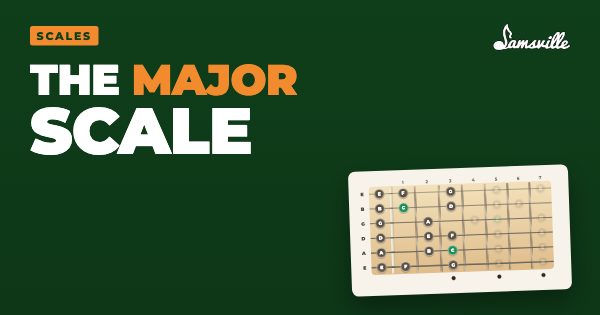
In the learning path Know the Fretboard and Every Key.
Transcript
YouTube's automatic captions. Tap a time to watch from there.
- I'm going to be talking about why practicing scales sucks and is boring and you don't want to do it and how we can fix it so that we can practice scales in a way that's really fun and on top of that is going to actually get us way way way better than the way that
- you've probably been practicing scales if you're somebody who hates practicing your scales on the guitar so without further Ado let's jum jump right into it okay so we're going to be just going over some of you might know this uh the five major scale positions and we're going to be using this as a kind of jumping off point for this video so you
- got position one you got position two you have position three position four and position five and these are all positions of the c major scale okay so let's just take a look at position one so first of all if you are watching this video and you agree with the statement oh practicing scales sucks you're
- probably practicing them in the wrong way so the first biggest wrong way that I always see people practicing their scales and really sucks and it's unbelievably boring is simply going okay uh here's my scale and I'm going to go ahead and practice it and it's going to
- sound pretty much just like this [01:50] okay so what what was wrong with with what I just did there okay there's a ton wrong and I it just bothers me so much cuz I constantly see people doing this okay there was a few problems first of all I wasn't playing in time okay I was just playing by myself and my rhythm was
- all over the place and all I was concentrated on is notes notes notes notes notes okay and as a result that didn't sound like music whatsoever I mean like like if you started playing that in front of people on a stage or something like that you know they would they'd want you to leave right that that that that's not fun to listen to and
- therefore if it's not fun to listen to it's certainly not going to be fun for you to actually play now I will say there's only one exception where doing something like this is kind of okay and that is if for example you've never seen these positions before okay if this is a completely brand new concept to you it
- might be okay to go through each of those positions in that manner maybe a couple of times okay but as soon as you go okay I kind of know where those notes are which for most people should take maybe 3 to five minutes okay at that point you need to immediately start
- practicing it in time okay so whether that's with a metronome or with a drum track you should be able to do both of those things so even if it's just with a metronome and we're just playing quarter notes you need to immediately start practicing them in time so let's throw in a metronome really quick and automatically this is going to
- start to be at least a little bit more fun okay this is not the most fun thing of course but it's much more fun than sitting there by yourself so I won't play through the whole entire thing but you get the idea etc etc you
- should be able to play through that position in time okay because when we're playing real music it's going to be in time so it's forcing you to think quicker and then also on top of that it's actually giving you the Practical skill it doesn't matter what notes you play if they're not in time it's not going to sound good okay so I mean I
- will see people it just bothers me so much I'm sorry if I keep going on about this but I see people who will keep practicing their scales in that way that I just showed you for months on end I there's there's no reason whatsoever to practice a scale out of time for more than the absolute bare minimum couple of
- minutes that it takes you to figure out where that scale is okay then you need to immediately immediately immediately immediately put it in time okay now we're going to get into the first thing we can do to actually make it more fun let's say assuming that you can play through scale and time and you can play
- through let's say quarter notes or eighth notes or even 16th notes okay that is something that you should be able to do then and even before that maybe you can start practicing with different rhythms okay so usually I always see people only practicing with either quarter notes or eighth notes or maybe 16th notes okay and those are all
- very good things to do are they extremely fun to do probably not right that's probably why you're watching this so for example let's go ahead and take that first uh the position and we're going to go ahead and play it up the octave there uh on the uh starting from the 12 fret cuz as you can see the first iteration of that uses the open strings
- and then the next iteration of that starts from the 12 fret it's important to know by the way anything that you learn that has a bunch of open strings in it you're going to have to learn it up an octave because that's going to be the actual shape that you can actually move around okay when you're practicing it so what I would do is actually play this with some different rhythms like
- something like this something like that so you don't hear that very often people practicing with an actual different Rhythm so a
- great resource if you want to figure F out some different rhythms to be able to practice your scales with go ahead and check out my video called the ultimate guitar rhythm exercise because it's going to teach you a whole bunch of different Rhythm cells that you can apply to your improvisation and you can also apply it to practicing scales okay
- let's go ahead and just move into the second position because we're going to kind of turn this into a semi like learning all of the uh the five positions of the c major scale while we're at this okay so uh another Rhythm that you could do is uh triplets okay you don't hear people practicing too much with triplets
- so 1 two 3 1 two 3 1 two 3 1 two 3 and then of course as a subset of that you could go and say I'm going to play A Triplet and then a quarter note something like this
- something like that or any number of combinations thereof maybe two triplets and then a cordin [07:57] not and then finally one thing is just to keep thinking about more more more rhythms I'm not going to go every single possibility but rhythms that do not start on the downbeat so if we go to a 16th note subdivision one of my favorite cells from the ultimate Rhythm exercise is going to be this one
- that goes uh uh uh uh uh uh uh uh uh so it's uh if we're counting 16 notes one E and A 2 e and a three e and a four E and A we're just going to play E and A so e and up e and up e and up e and up that's a great Rhythm to practice through skills with [08:44] too you very very very rarely hear most guitar players actually practicing through their scales like this with different rhythms and of course by the way indirectly that's going to lead to you basically playing Super boring rhythms in your solos if you practice
- the materials that you're working on with more interesting rhythms it's going to automatically make your rhythms more interesting when you actually go ahead and play solos so now let's go ahead and move on to the next position position three by the way this one is of course we're just a reminder we're in C major
- but this is also known as the natural minor scale just cuz it starts from a okay um so now the next thing that we can do to make our scale practice more fun is practice with different interval patterns okay so I've talked about this in a little bit more depth in another video but uh let's say thirds so we play
- from a to c and then B to D and then C to e and then D to F so we kind of go through the whole entire thing like this so that's going to be obviously a little bit more of a challenge on the brain but again it's lending us to be
- able to play more interesting patterns in our actual solos when we play and of course by the way if you're being real creative you can actually combine this idea with the last idea so what if I play an interval pattern of let's say thirds plus I change the Rhythm so
- something like this let's say I play some triplets so one two 3 1 two 3 one two 3 and then I'm actually going to go ahead and play the scale in Thirds with triplets these things keep much more
- interesting and more fun rather than just going oh my God okay today I'm going to practice my scales up and down no no no no no no we don't want to do that um so with that being said one more thing I want to add on to there is actually breaking up each of these scale
- patterns into like little groups of two strings so a lot of times you can get a lot of good work in uh just practicing two strings at a time so let's say like the top two strings here and of course uh I mean I know it's closer to the floor but it's the higher sounding strings okay I always get comments about
- that that's not the top string man this is the top string yeah well I don't want to play bass notes and think of that as the top okay so uh something like this I can even just work that kind of Rhythm and and that interval pattern over a little tiny segment of the pattern cuz sometimes that helps a lot when we're having trouble running through a whole
- entire pattern let's just break it up into like a third so something like that so that will really really help if you're ever having trouble getting through a whole entire scale pattern from top to bottom with whatever concept it is you're practicing make sure you go
- ahead and break it up like these two strings they the sixth string and the fifth string and then what about the fifth string and the fourth string something like that so A lot of times I like to just break it up into different little parts and that's something I've talked about before by the way is that you're going to become a
- better soloist if you know how to take a big pattern like this and break it up into as many different little chunks of notes as you possibly can but because a lot of times people think I need to play the whole entire scale the whole entire time when I'm soling no a lot of times it's a matter of finding these little
- groupings of notes how many different ways can you break that scale up into three notes or two strings or something like that there's a lot of different ways you can break up even one scale pattern like that so now let's go ahead and move on to a position four and we're going to talk about the next way to make scale practicing more fun and this is of
- course going to be my favorite way which is you got to practice improvising with your scales so I remember when I was a kid that I kind of like didn't even know what the heck scales were for like I knew that people told me oh you need to practice your scales you need to know them and I always just thought it's kind of some exercise that you have to do
- like it's just going to make your Technique better I guess but as I started getting more into into improvisation and playing jazz and playing other modern music that requires improvisation that's when I realize oh wait the whole entire point of learning scales is because they are notes that
- sound good together that we can actually use to pick from to play our solos so of course if if you're a classical musician and you don't improvise then practicing scales is more of just a pure exercise like technique type of thing but you and I here over in Jamesville we're playing solos we're improvising and we are using
- it as a basis for our solos so therefore we need to actually practice doing that whenever we learn a new scale or anything we need to find something to be able to actually solo over with okay so we're going to go ahead and play over this little back in track and let's go ahead and improvise a little bit with
- this fourth scale position here does that mean I have to play the whole entire thing by the way no notice look I'll grab two notes Here
- [15:45] that's something I love doing is just using what's called a pedal Point picking one note and then changing the other note so [16:24] so yeah if you are not improvising when you're practicing scales okay you're freaking doing it wrong okay you need to actually improvise stuff or it's not going to make you better at solo we cannot disconnect those two things and just in general My Philosophy is every new thing that we learn on the guitar
- okay at some point as soon as possible ideally we want to actually start improvising with that now the last thing that I want to talk about is that you need to actually learn your scales on one string at a time any key that I
- learn okay if it's C I need to be able to play any key because I need to be able to connect all of those five positions together so any key I learn I want to be able to do it on one string at a time and this is the way that I
- just teach the actual learning of the notes on the guitar fretboard is going through one string at a time so for example the fifth string would be a b c d e f g a b c and all those different ideas we talked about before you should
- practice in that same way when you practice one string at a time so practicing in time practicing with a metronome practicing with different rhythms and practicing improvising cuz practicing improvising on one string at a time is one of the coolest ways for
- you to actually start breaking out of those box patterns and moving all over the guitar neck so for example a great string to practice on is any of actually those top three strings you're going to be using those a lot when you are soloing so like if we take the third string by the way I have another video where I go more in depth with this it's
- called the best way to memorize the notes on the fretboard make sure you check that out so g a b c d e f g a b c d e f make sure you go all the way to the top or all the way to the end of the guitar neck to I know that's the same thing when you pass the 12th fret but
- guess what we still there's a little bit of a disconnect if you don't actually practice playing up in that upper register it's a little bit confusing sometimes everything's closer together it is still something you have to practice even though it's quote the same thing sometimes people just stop at the 12 fret because they think oh well it's
- the same thing I don't need to do it it's the same thing over and over again no you should definitely still go past the 12 fret okay so let's just uh solo a little bit on one string at a time so you can see how the playing that I incorporate sounds a bit different than what I was doing in those [19:52] positions also it's really easy to make like patterns on one string at a time too cuz you can see like oh let me take these three notes that are next to each other and then me take the next three notes and then the next three notes and then the next three [20:29] so you can see there's a lot different stuff going on there and there's more slides going on those slides sound really cool you're not going to hear too
- many slides when you're playing in position and it's just going to be a lot more fun so you should be able to do that in any key as well so if it's a major for example you should be able to go okay here's all the notes in a Major G Shar a b c Shar d e f g Shar a any
- string you should be able to do that and if you use all the techniques we talked about practicing it's going to be a lot more fun and it's going to directly make your soloing actually better every single time you go to improvise so if you want to learn how to Master the guitar fretboard so you can learn all of
- these scales all over the entire guitar neack including on single strings in every single key and I show you exactly how to do it step by step so that you can play a solo over any backing track in any key then make sure you head on over to jamille. comom right now and pick up the Jamesville GPS fretboard
- fundamentals course also make sure you head on over to the Jamesville merch store and pick up an awesome janville t-shirt just like this one that I've been wearing so you can represent the guitar player community and the Jamesville Community cuz if somebody sees you with the Jamesville shirt on they're going to know that you must be good because you're watching the Jamesville YouTube channel also make
- sure you check out my new song it's called My Divine link is in the description below that's what you're listening to right now in the background check out my music on Spotify my artist name is Adam Paul and finally make sure you subscribe to the channel make sure you hit the like button it really really really helps when you subscribe and hit
- that like button and it's free doesn't cost anything whatsoever and until next time listen learn and jam