
Scales · Intermediate
Guitar Modes Explained
Hear what makes each mode sound the way it does, then play Dorian and Mixolydian over a band, leaning on the one note that gives each its sound.
Summary
- A mode is the seven notes of the major scale heard over one bass note.
- The bass note decides the mode: change it and the same notes sound different.
- Each mode has one note that gives it its sound, like the natural 6 in Dorian or the ♭7 in Mixolydian.
On this page

Modes aren't really scales
Most guitarists learn modes this way: take the C major scale and start it on a different note. Start on D and you get D Dorian, D E F G A B C. 1:25Watch at 1:25 Start on E and you get E Phrygian. 1:48Watch at 1:48 That's true to an extent, but it's where people go wrong: they stop there and think of modes purely as scales. 2:10Watch at 2:10
The problems show up fast. If E Phrygian only means the C major scale started on E, it stops being Phrygian the moment your solo starts on another note or you mix the notes up. 2:30Watch at 2:30 And in real music nobody just plays scales up and down. 2:51Watch at 2:51
What people miss is that modes are really chords. 3:34Watch at 3:34 Take all seven notes and think of them as one big giant chord, stacked in thirds. 3:57Watch at 3:57 C Ionian becomes C E G B D F A. Played together, that's the sound of the Ionian mode, and it sounds complex because it's a chord with seven different notes in it. 5:01Watch at 5:01
The bass note decides the mode
It works like any chord. The most important note is the root, the lowest note. 6:27Watch at 6:27 Every note you play gets its sound from the bass note and the chord underneath it.
Take E Phrygian. Phrygian is supposed to sound dark, but play E Phrygian over a C major chord and it doesn't sound Phrygian at all, because that E is the major 3rd of C. 8:37Watch at 8:37 It still sounds happy and bright. Each note relates to the chord underneath, and that's what you hear. 9:20Watch at 9:20 Take the chord away and leave only a C in the bass, and it still sounds major. 10:03Watch at 10:03
Now flip it. Play a plain C major scale over a D minor chord and the C sounds like the ♭7 of the chord. 12:15Watch at 12:15 Same seven notes. Change the bass note and every one of them sounds different. 12:42Watch at 12:42
Because I'm stacking the notes like a chord, I call the extra notes the 9th, 11th and 13th. 7:33Watch at 7:33 Over any chord the notes fall into two groups:
- Chord tones: the root, 3rd, 5th and 7th. These are the stable notes, home base. 13:24Watch at 13:24
- Color tones: the 9th, 11th and 13th. They can sound really nice and sophisticated, and some are tense, so you're taking a little more of a risk when you play them. 13:46Watch at 13:46
The tense ones are usually a half step above a chord tone. 20:42Watch at 20:42 Over C, the F (the 11th) sounds crunchy and wants to drop down to E. 21:02Watch at 21:02 Play it, then let it resolve.
The seven modes from one root
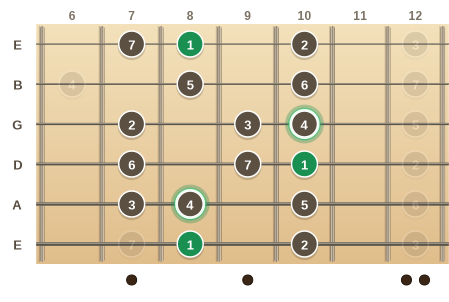
Each 2-minute video builds a mode by starting the major scale on a new note, then spells it from C so you can hear it next to plain major or minor. 1:02Watch at 1:02 Each one points to the note that gives the mode its sound. 0:41Watch at 0:41 That's how these diagrams work: every mode from C, in the same spot on the neck (root on the 6th string, 8th fret), with that note marked. The labels say 2, 4 and 6; over the chord, those are the 9th, 11th and 13th.
Ionian: 1 2 3 4 5 6 7
C D E F G A B, the major scale from its first note. My Ionian chord adds the 4 and the 7 to a major chord, with the 4 right under the 3: C F E B. 0:42Watch at 0:42 That clash between the 3 and the 4 is the distinctive Ionian sound. 1:02Watch at 1:02 It's the same F that sounds very tense over a C chord, 7:54Watch at 7:54 so play it, then let it fall to the 3.

Dorian: 1 2 ♭3 4 5 6 ♭7
C D E♭ F G A B♭. It's my favorite minor mode. 0:00Watch at 0:00 It's almost Aeolian (natural minor), except the 6 is natural, and that has a much different sound than the ♭6. 0:41Watch at 0:41 In the video I stop on the 6 so you can hear how important it is. 1:22Watch at 1:22 Over the minor chord that 6 is the 13th, colorful and a little tense. 11:33Watch at 11:33

Phrygian: 1 ♭2 ♭3 4 5 ♭6 ♭7
C D♭ E♭ F G A♭ B♭. It's very close to Aeolian, with a ♭2 that sounds dissonant and dark. 0:44Watch at 0:44 In the video I play C Aeolian, then C Phrygian, so you hear what the ♭2 changes. 1:04Watch at 1:04 Over the chord the ♭2 is a ♭9, and a ♭9 always sounds tense. 19:35Watch at 19:35

Lydian: 1 2 3 ♯4 5 6 7
C D E F♯ G A B. A major scale with the 4 raised a half step, and that's the only difference. 0:42Watch at 0:42 C Lydian is the G major scale started on C. 1:05Watch at 1:05 In the video I play major, then Lydian, and stop on the ♯4. 1:05Watch at 1:05 Stacked as a chord, that note is the ♯11. 15:36Watch at 15:36

Mixolydian: 1 2 3 4 5 6 ♭7
C D E F G A B♭. A major scale with the 7 lowered a half step, so it "kind of sounds minor and major at the same time". 0:20Watch at 0:20 The ♭7 is the only note that's different from major, so it's the note to target. 0:41Watch at 0:41 The chord tones are 1, 3, 5 and ♭7. The 4 is the 11th here, and it sounds tense over the chord. 16:21Watch at 16:21

Aeolian: 1 2 ♭3 4 5 ♭6 ♭7
C D E♭ F G A♭ B♭, the natural minor scale. 0:00Watch at 0:00 The ♭6 is the note that tells you it's Aeolian, and C Aeolian is the E♭ major scale started on C. 1:02Watch at 1:02 Over the minor chord the ♭6 is a ♭13, and it's very crunchy. I play it and resolve it down to the 5th quickly. I don't sit on it. 18:29Watch at 18:29

Locrian: 1 ♭2 ♭3 4 ♭5 ♭6 ♭7
C D♭ E♭ F G♭ A♭ B♭. A major scale with the 2, 3, 5, 6 and 7 all lowered a half step, and the ♭2 and ♭5 are the notes that tell you it's Locrian. 0:42Watch at 0:42 C Locrian is the D♭ major scale started on C. 1:03Watch at 1:03 It's extremely dark and spooky. 0:21Watch at 0:21 It's the darkest-sounding mode because it's built on the diminished chord: 1, ♭3, ♭5 and ♭7. 18:51Watch at 18:51

Hear it
This is how I practice modes: play over one chord and really sink your teeth into how each note sounds against it. 14:08Watch at 14:08 Over E minor I go note by note. The root sounds like a root, the ♭3 like a ♭3, the 5th like a 5th, and the D is the ♭7. 14:29Watch at 14:29
Open the C drone and pick one mode. Start with two notes, the root and the marked note. Play them in a simple rhythm with plenty of space, and listen to what the marked note does against the drone. Then add the 3rd, 5th and 7th. Then the rest.
Now do the same with a band. Dorian is a minor mode and Mixolydian is a major one, so you'll hear the 6 against a minor chord and the ♭7 against a major chord. Keep the rhythm going through wrong notes and keep listening to the band.
Which mode over which chord
In one key, every chord gets its own mode from the same seven notes. In C major that's Ionian over C, Dorian over D minor, Phrygian over E minor, Lydian over F, Mixolydian over G, Aeolian over A minor and Locrian over B diminished. In the video I walk through all seven in that order. 10:25Watch at 10:25 Phrygian is the vibe when a progression passes the iii chord, 14:08Watch at 14:08 and I think Mixolydian whenever I'm on the V chord. 17:03Watch at 17:03 Every time the chord changes, I reorient where the gravity of the notes is. 17:25Watch at 17:25
It doesn't work the other way. Playing a mode's notes doesn't make the mode: E Phrygian over a C chord is still C major. 8:37Watch at 8:37 The chord decides. You'll never really understand modes until you understand them as chords. 21:23Watch at 21:23
Play the C major scale over this loop and aim for the chord tones on the board. The notes stay the same and the gravity moves with every chord.
Without Jamsville
Pick one of your open strings as the bass note. Spell a mode from that note using its formula, say the notes out loud, then let the string ring and play them against it slowly, naming what each one is: root, ♭3, 13th. A bass note on its own is enough to hear it. 10:03Watch at 10:03 When the string dies out, pick it again and keep going.
In this learning path
Questions guitarists ask
What makes each mode sound different?
Each mode has a note that gives it its sound. From C, it's the 4 against the 3 in Ionian, the natural 6 in Dorian, the ♭2 in Phrygian, the ♯4 in Lydian, the ♭7 in Mixolydian, the ♭6 in Aeolian, and the ♭2 and ♭5 in Locrian.
How do I use the Dorian mode?
Play it over a minor chord and lean on the 6. C Dorian is C D E♭ F G A B♭. It's almost natural minor, except the 6 is natural, and that 6 is what you hear. Over the minor chord it's the 13th, colorful and a little tense.
Which mode do I play over each chord in a key?
In one key, every chord gets its own mode from the same seven notes. In C major that's Ionian over C, Dorian over D minor, Phrygian over E minor, Lydian over F, Mixolydian over G, Aeolian over A minor and Locrian over B diminished.
Why does E Phrygian sound major over a C chord?
Because the chord underneath decides the sound. Over a C major chord, that E is the major 3rd of C, so E Phrygian still sounds bright and major. Playing a mode's notes doesn't make the mode. Change the bass note and the same seven notes sound different.
How should I practice modes on guitar?
Play over one chord or a drone and listen to how each note sounds against it. Pick one mode and start with two notes, the root and the note that gives the mode its sound, in a simple rhythm with plenty of space. Then add the 3rd, 5th and 7th, then the rest.
Keep going
Keep what you open here. A free Jamsville account saves your boards and sequences to your Practice Library and keeps your progress on every device.
Make your free accountSubscribe to Jamsville on YouTube
Where this comes from
This guide is written from these lessons on the Jamsville channel. The timestamps in the text link to the moment each idea is taught.
- What Everyone Gets WRONG About Modes (They're Not Scales) (2023)
- The Ionian Mode Explained In 2 Minutes (The #1 Mode!) (2021)
- The Dorian Mode Explained In 2 Minutes (2021)
- The Phrygian Mode Explained In 2 Minutes! (It Sounds DARK) (2021)
- The Lydian Mode Explained in 2 minutes! (The BRIGHTEST Mode!) (2021)
- The Mixolydian Mode Explained In 2 Minutes (2021)
- The Aeolian Mode Explained In 2 Minutes (2021)
- The Locrian Mode Explained In 2 Minutes (The Scariest Major Mode!) (2021)