

0:00
Each repeat
After each pass the video waits as long as the loop, so you can play it back.
Speed up 5%
Start slower with −, and it climbs to 100%.
Keys: Space play · ← → 5 s · [ ] set start and end · − = speed · L loop
Chords and harmony · Intermediate
The Dorian Mode Explained In 2 Minutes
In this lesson
Tap a time to watch that part. loops it, so you can slow it down and play along.
-
Key idea Dorian = 2nd mode; minor with natural 6
Dorian (his favorite minor mode) starts the major scale on its 2nd note (C major from D); formula 1 2 b3 4 5 6 b7: like Aeolian but with a natural 6.
-
Practice it
- C Ionian (the C major scale), root on the 6th string at the 8th fret. The 4 is marked: it sits a half step above the 3.From the guide: Guitar Modes Explained Open in Jamsville
- C Dorian in the same area of the neck. The natural 6 is marked.From the guide: Guitar Modes Explained Open in Jamsville
- C Phrygian in the same area. The ♭2 is marked, one fret above every root.From the guide: Guitar Modes Explained Open in Jamsville
- C Lydian in the same area. The ♯4 is marked.From the guide: Guitar Modes Explained Open in Jamsville
- C Mixolydian in the same area. The ♭7 is marked.From the guide: Guitar Modes Explained Open in Jamsville
- C Aeolian (the C natural minor scale) in the same area. The ♭6 is marked.From the guide: Guitar Modes Explained Open in Jamsville
- C Locrian in the same area. The ♭2 and the ♭5 are marked.From the guide: Guitar Modes Explained Open in Jamsville
The guide
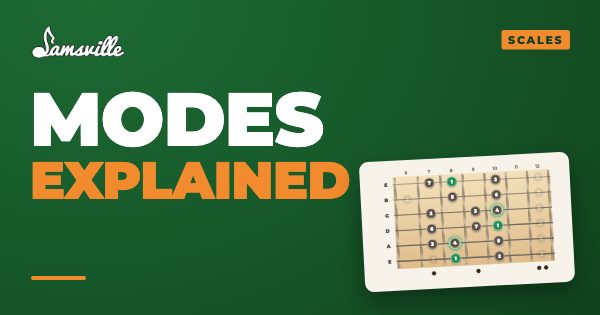
In the learning path Know the Fretboard and Every Key.
About this video
The Dorian mode is my favorite minor mode! In this video we'll cover how the Dorian mode is constructed, how it sounds, and what makes this mode different than other minor modes.
Transcript
YouTube's automatic captions. Tap a time to watch from there.
- the dory mode is my favorite minor mode let's talk about it so the dorian mode is the second mode of the major scale which means that if we take any major scale and start it from the second note that will construct the dorian mode so if we take a c major scale and start it from the d note which is the second note in the c
- major scale we will get the d dorian mode now like with all modes you need to understand the interval structure that is created when we start the major scale from a different node so in this case the dorian mode will give us the intervals 1 which is the root 2 flat 3
- 4 5 six flat seven and then the root again so if you're familiar with the natural minor scale or the aeolian mode the dorian mode is almost just like the aeolian mode except for the sixth note in aeolian we actually get a flat six and in dorian we get a natural
- six which has a much different sound than the flat six so in order for us to really understand the mode we need to understand how to take that interval structure and apply it to other keys so let's take that same interval structure and apply it to c so this c dorian mode would be spelled c d
- e flat f g a and b flat here's what c dorian sounds like and i'm gonna stop on the sixth note so you can really hear that sixth note is really really important in dorian and here's what the dorian mode
- sounds like in a musical context [02:06] do [02:30] if you want to learn about another mode check out this video and if you want to master the guitar fretboard then go to jansville.com