
After each pass the video waits as long as the loop, so you can play it back.
Start slower with −, and it climbs to 100%.
Keys: Space play · ← → 5 s · [ ] set start and end · − = speed · L loop
Chords and harmony · Advanced
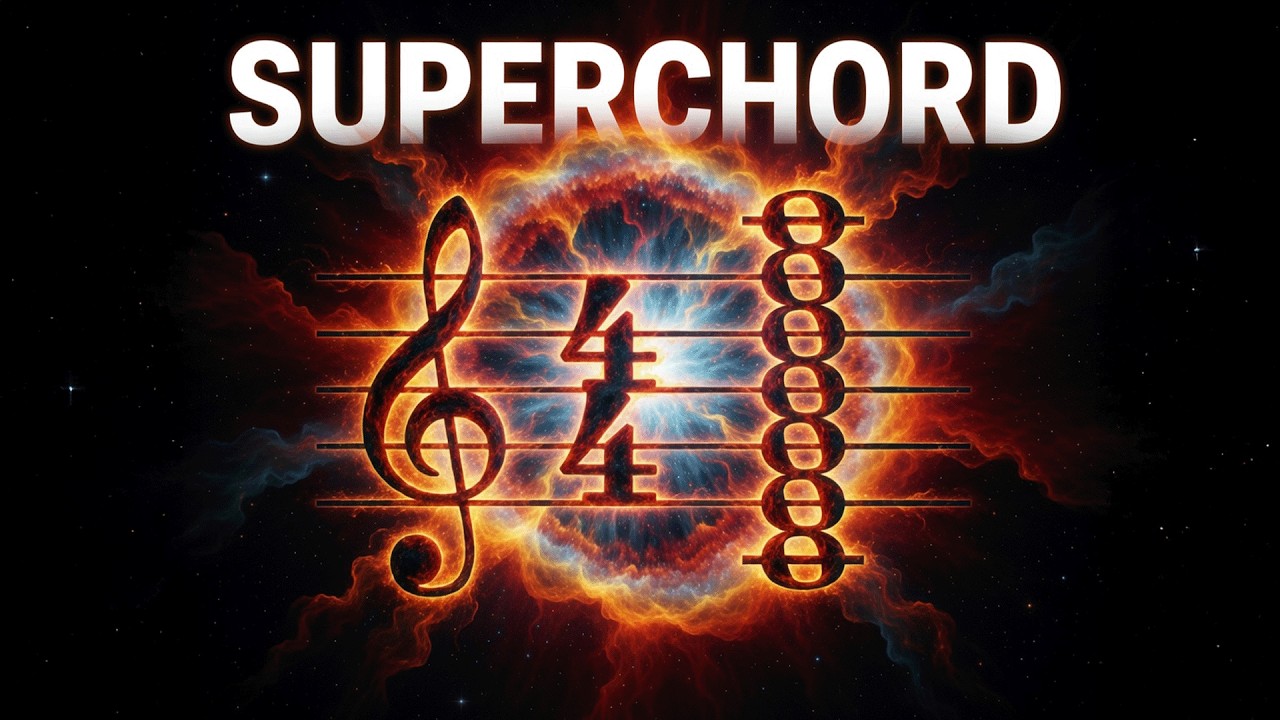
Modes Aren't Scales, They're Superchords
In this lesson
Tap a time to watch that part. loops it, so you can slow it down and play along.
-
Key idea Modes as superchords
Modes are not really scales to run from a different starting note; understand each mode as a seven-note 'super chord' stacked in thirds from its root.
-
-
Key idea Chords are built by stacking thirds
Triads are built by skipping a note (stacking thirds); keep stacking and you reach the full seven-note mode. On piano in C this is just skipping every other white key.
-
-
Key idea The superchord reveals the dissonant notes
Stacking the mode as a chord teaches which notes are dissonant over the bass; not every note of a mode sounds good all the time. Over the I chord in Ionian, the 4th/11th (F) clashes a minor 9th above the 3rd (E), so he may leave it out of solos and melodies.
-
-
How to practice Practice modes from one bass note (parallel), not all in one key
Don't practice modes only within the same key; practice them all from the same root and learn their formulas. Every mode on the same bass note comes from a different parent key.
-
-
Key idea The bass note defines the mode
The starting note of the superchord is the bass note; the same seven white notes sound like G Mixolydian only with G in the bass. Over a C bass they sound like a C chord.
-
-
Demo Mode brightness ladder with dissonance diagnosis
Going bright to dark, he hears each superchord: Lydian and Dorian have no clashing notes (the major and the minor without dissonance); Mixolydian keeps the 11th clash and is dominant-sounding; Aeolian's b13 clashes with the 5th; Phrygian's b2 clashes with the root; Locrian is 'absolute chaos'.
-
-
Key idea Hear every mode note against its bass
You won't understand mode sound by playing them as scales; you need to hear what every note sounds like compared to the bass note it is played over. Knowing note names on the fretboard makes this much easier.
-
Practice it
- Guide Guitar Modes ExplainedFor “Modes as superchords”. Hear what makes each mode sound the way it does, then play Dorian and Mixolydian over a band, leaning on the one note that gives each its sound. Read it
Transcript
YouTube's automatic captions. Tap a time to watch from there.
- So the thing is most people don't really understand modes. They think that their scales like if I play a C major scale and I start from the first note, I get the first mode. And then if I just play that same scale but start from the second note, that gives me the second mode. And that is like the most basic way of understanding
- it. But I'm going to show you the way that you really need to understand modes, which is they're not really scales. They're like super chords that have seven notes in them. So, just to reiterate, like let's draw a C major scale here. That would be like the first mode of the major scale. And then, like, if I got rid of the first note and
- replaced it with a second note up an octave, that would be the second mode, which is Dorian. By the way, I'm going to just assume that you know the modes somewhat already. You know that there's Ionian, Dorian, Friian, Lydian, Mixely Lydian, Aolon, and Lorian. But what we need to do is instead of thinking of it like this, let's think of it as a super
- chord. So let's just remember like all the notes that are here in the C major scale. And instead of arranging them like this, what we're going to do is we're going to delete everything. And we're just going to build a chord from the first note that uses all seven notes. The way that we build chords is,
- of course, by stacking thirds. Like when you learn how to build triads, what do you do? You just add a third. So we skip the second, we went to the third, and then we skip the fourth, go to the fifth, which is a third away from the third. So going from E to G is a third. From C to E is a third. There are different kinds of thirds. C to E is a major third and E to G is a minor third.
- But that's neither here nor there at this moment. Let's map it on the fretboard. So I'm going to go up a third to B. And then now up a third from B is going to give me D. And then up a third from D is going to give me an F. And then up a third from F is going to give me A. And this is what I like to call a super arpeggio.
- And this has every single note of the C major scale, but it's arranged as a chord. And if I played it on the piano, well, it would actually be really easy to visualize if any of you have any experience playing piano whatsoever, the way that you play triads is you just skip a white key, skip a white key. Of
- course, if you're in the key of C. And uh maybe even when I was a kid, I remember doing this like well what if I just keep skipping and skipping and skipping and skipping. This is actually modes and is funny enough this is the way that you should understand them. So like I'll play that on piano right now. So you got C E G B D F A.
- And if you know the formula for a mode, well, you got the root, you got the major 3rd, you got the perfect fifth, you got the major 7th, you got the major 9th, you got the 11th or the natural fourth, and then you also have the A, which is the 13th, or you could also think of it as the sixth. So, this is really what gives you the sound of the
- mode, and it actually teaches you what notes in the mode are dissonant. Because actually just because you have a mode doesn't mean that every note in it is going to sound good all the time. Some of the modes have dissonant sounding notes in them. Really the only ones that don't have dissonant sounding notes in them are Dorian and Lydian which we're
- not going to get into exactly why that is right now. But actually if you notice everything sounds good. C E G B G that sounds great. That actually gives us a C major 9 chord. But then when I play F, oh, that's actually the weird sounding note. So now I know actually when I'm playing over C chord or I'm playing over
- the one chord in the key of C or just when I'm playing over the one chord in general. Oh, the F. Well, that's actually the fourth slash the 11th. That's a nasty sounding note. So I might actually just choose to not include that when I'm soloing or creating melodies and things like that. Like let's just get rid of that F now and see
- what that sounds like. Oh wow. Now all of a sudden that sounds really good. Notice how it sounded kind of crappy with the F in it. Why is that sound that bad? Well, it's because there's an E down here and then an F, a minor 9th above that. And that gives you kind of a nasty sound there. So this is really how
- you have to understand modes. And also, you shouldn't just practice modes in the same key the whole entire time. What you should do is actually well practice them all starting from the same root note and understanding the formulas that are
- going on. So, for example, some of you might know that mixelyian is just a major scale that has a flat 7. And of course, you might also know that mixelyian is the fifth mode. So really the key of C that we're dealing with here has a G mixelyian mode in it. Like if I start putting G in the bass, that's
- also a super important thing by the way is that the starting note is your bass note. In this case, C is our bass note. So if I do the same thing like starting from G now I would get this. So here's my G mixelyian super arpeggio root 3r 5th flat 7 9 11 and 13. And so the
- reason why this is going to sound like G mixelyian is because I have G in the bass. If I play all these notes over a C bass note, it's not really going to sound like G mixelyian because we're going to be hearing as we're playing on some kind of C chord. So that's why if I play a G in the bass and I just start randomly improvising white keys in the
- right hand, it's going to sound like I'm playing over a G chord. And I'm no piano player, but you kind of get the idea. That G being in the bass
- is what really gives us the sound of that mode. And it's all the other notes that are being superimposed over it or rather just imposed over it that it makes it sound like G mixelyian. I hear the G in the bass and then when I hear that flat 7 the F, well it gives away that it's G mixelyian. Okay. So, you
- should actually go through the different mode formulas, but actually starting all from the same bass note because that will really help you understand actually how modes work and understand how it's a different sound over the same bass note. That's the difference between G
- mixelyian or G Ionian or G Lydian or G Dorian or any of these things. They all have G in the bass, but they come from different keys. Actually, every time you change modes of the same bass note, you're actually deriving it from a different parent key. So, let's go over that starting from a C again. All right. So, here's our original C Ionian super
- arpeggio. So, let's work out a couple of different modes from here. So, one of the next modes that you should do actually is a brighter sounding mode is actually Lydian, which is the same thing as the major scale, but you raise the fourth. And actually, remember I told you before that that fourth, that F, it kind of sounds nasty cuz it clashes with
- the E that's way down below. Well, guess what, Lydian I was talking about earlier is one of those modes that doesn't really have any dissonances in it because you're removing that clash. So, actually, funny enough, this F sharp actually uh sounds less dissonant than the F. You could also play this F# here, by the way, instead. So, let's play
- through that. And if I played it on piano, it would sound like this. Notice how that sounds a lot better than Ionian did with the F natural. Here's the F natural. H, but here's F sharp or the sharp 4/1.
- Oof. It sounds very spicy still, but uh it's it's really cool. Let's go back to Ionian. And actually, we're going to get darker and darker and darker as we go. So, if we lower the seventh now, we get mixelyian. So, we get C, E, G, B flat, D, F, and then A. I can't quite reach it
- with that fingering there. So, notice how that actually also sounds kind of dissonant. And it should sound dissonant. Why? Because it's really supposed to be a dominant chord, uh, which is supposed to resolve to a one chord. But guess what? Actually, this F
- here actually still sounds dissonant because it's still clashing with the E down there. So that's really what mixelyian sounds like. It's not just a scale that you play up and down. It's this chord. Okay, let's go. Now we are out of actually major modes. If we
- lower the third E to E flat, we can actually get Dorian now. So we have the flat three, the flat 7. So here's C, E flat, G, B flat, D, F, and then A. Very interesting because you get that minor chord, but then that D, F, and A.
- Actually, that A is kind of constant. And now the F is no problem because now we have an E flat, and it doesn't clash with the E flat. It sounds really nice. And that's why Dorian is one of the coolest sounds that people like to use when you're playing in a minor key because nothing's really dissonant in this. Kind of like Lydian. Lydian's like
- the major that doesn't have dissonance and uh Dorian is like the minor that doesn't have dissonance. So now aolon if we lower the A to a flat the flat 6. Now you'll see that aolon actually starts to become a problem
- because we have root flat 3 5 flat 7 9 11 and then flat 13. Oo that flat 13 is not super pleasant. Why? Because it clashes with the G. G and A flat. Why? Because G, if you go up an octave to A flat,
- it's a minor 9th. in it. Or if you just play G and A flat right next to each other, they're half step apart. And that's a crunchy uh dissonant sounding interval. And now you're going to see it's getting more and more dissonant. So if I lower D, which is the second to D flat, now I actually get a frigian super arpeggio.
- Let's actually put that here instead. That's a bit easier of a fingering to play. So C, E flat, G, B flat, D flat. Ah, that's really dissonant sounding. F, and then A flat. Friian is a very dissonant sounding mode because it's got that flat two. And that
- flat two clashes with the root itself of C in this case. And then we only have one more mode left. And if we lower G, which is the fifth to F sharp/g flat, now we get the low Korean mode. And it's the most distance sounding mode. We got one
- flat 3, flat 5, flat 7, flat 2, 11, and flat 13. It's just absolute chaos. It's just all over the place. Loran is a super dissonant sound and you're not going to
- understand that if you just play them all in scales. Like if you just do you're not going to understand that. You need to hear what every note in the mode sounds like in comparison to the bass note that it needs to be played over. Also, it's way easier to figure this
- stuff out if you actually know the names of the notes on the fretboard. And if you have no idea how to navigate the fretboard, if you've really been struggling, you don't know the names of the notes or anything like that, then head on over to jamsville.com, check out the Jansville GPS fretboard fundamentals course. Also, I teach onetoone lessons. There's a link down below for a free
- consultation with me if you're interested in that. If you enjoyed this video, hit the subscribe button, hit that thumbs up button, watch this next video, which YouTube thinks you're going to enjoy. And until next time, listen, learn, and jam.