
After each pass the video waits as long as the loop, so you can play it back.
Start slower with −, and it climbs to 100%.
Keys: Space play · ← → 5 s · [ ] set start and end · − = speed · L loop
Fretboard and scales · Intermediate
How To BREAK OUT Of The Minor Pentatonic Scale
In this lesson
Tap a time to watch that part. loops it, so you can slow it down and play along.
-
Key idea Maximize the box before adding notes
Before adding notes to minor pentatonic, learn to sound as good as possible with the basic box: advanced players sound better than beginners with the exact same notes through phrasing, patterns, rhythm and feel.
-
Fix Pure major pentatonic doesn't sound bluesy
Switching to pure major pentatonic over a blues, even with decent rhythm, doesn't sound like BB King; the key is mixing major and minor pentatonic as one amalgamation, not two scales.
-
-
Exercise Major 6th (F#) and half-step bend to b7
Add the major 6th (F# in A), the 3rd of the IV chord (D7, bars 5-6): moves like E-F#-A, or a half-step bend F# to G.
-
Exercise Major 2nd: bend into or out of it
Add the 2nd/9th (B in A), the neighbour below the minor third: bend A up to B (good on the V chord) or bend B up to C.
-
-
Key idea Pair added notes with their buddy notes
The three notes (3, 6, 2) are not played straight; pair them with their neighbouring 'buddy notes' in minor pentatonic, bending into or out of them, so it all becomes one vocabulary and gives the bluesy effect.
-
Practice it
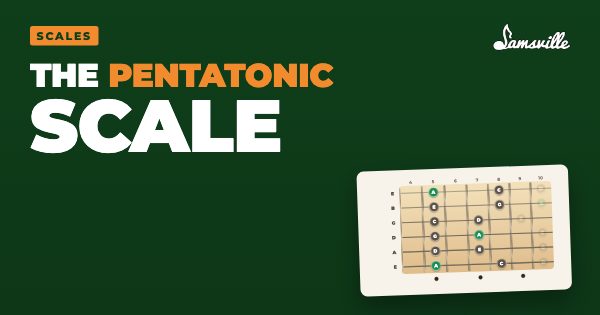
- A major pentatonic in the same area as the A minor box. The glowing notes are the three to add to the box: the 2 (B), the 3 (C♯) and the 6 (F♯).From the guide: The Pentatonic Scale on Guitar Open in Jamsville
The guide
In the learning paths Start Soloing From Zero, Solo Over Chord Changes and Solo Over the Blues.
Transcript
YouTube's automatic captions. Tap a time to watch from there.
- Hey everybody, what's up? My name's Adam and welcome back to the Jamsfield YouTube channel. In today's video, I want to show you how you can break out of the minor pentatonic scale in your
- blues solos so that you can start sounding more interesting and having more fun when you're playing. Okay, so the first thing I want to mention before we even continue on with the lesson and me showing you what other note options you have available besides just the basic minor pentatonic boxes, I think that it's very important to actually just learn how to maximize what you can
- do with the basic minor pentatonic box, not changing any notes. Because when you see more advanced players, they're going to sound better than beginners using the exact same notes. They're going to play with better phrasing. They're going to have better, more interesting patterns that you're using and better rhythms and
- just better feel overall. I think that for a lot of people, it is important to learn how to break out of that minor pentatonic box, but there's a caveat. Whereas, I think that it's still important for you to learn how to actually sound as good as you possibly can without worrying about just adding more notes into the mix and making
- things more confusing. So, now that I've gotten that out of the way, what I want to talk to you about is using the major pentatonic scale as well. And you've probably already heard to use the major pentatonic scale, but the problem is that sometimes if you just use the major pentatonic scale, it doesn't sound as bluesy as you would think it would.
- Like, let me just give you an example of that. So that's me playing with pure major pentatonic scale. And it obviously
- didn't really sound that legit even though I was playing with decent rhythm and so on and so forth, but it just doesn't sound like BB King or the people that we all know and listen to and have that sort of distinctive blues feel to it. So really what the key is is actually mixing major and minor
- pentatonic together at the same time. And you may have heard that concept before, but I want to show you some very simple moves that you need to get into your head that if you memorize them, you will automatically start successfully mixing in some of the key notes from the major pentatonic scale with your minor
- pentatonic vocabulary. And so you're not thinking of it as like two different scales, but you're thinking of it all as one amalgamation together. Okay. So if we look at this minor pentatonic scale, the most important thing I think we need to start off with is adding the major third into the mix. So this C note here
- is actually the minor third of the key, but you want to be able to access this major third, which is a half step above it. Now, that doesn't just mean now I'm going to play a scale like this.
- Or actually, I could add the major third over here as well. I could play a scale technically that sounds like this. And that actually does sound pretty cool admittedly, but it doesn't sound super duper bluesy. The key is actually not using one or the other, but using both of them at the same time. So visualizing
- both of these here and specifically whenever you want to play that major third, having the minor third come before it. So, this is a super important move that I hear all the time, which is the following three notes. C to C sharp to A.
- So, you can either do C to C sharp to A down on the fourth string or you can go. So, that's what I would start off with is just messing around with that a little bit.
- So try playing some phrases where you end with that in the phrase
- And you see all of a sudden now that's starting to sound a lot cooler because it's not sticking with one scale the whole entire time. So to me, that's where I started learning this idea is, oh, wait a second. I need to actually use that major third. And especially when we're playing on a major blues. If
- we're playing in a minor blues, that's a different story al together. On a minor blues, you're really going to use more only the minor scale and the minor pentatonic scale, but you actually can use that major third, and it can sound interesting even on a minor blues. It's just less common. Also, one of my favorite moves to do is bending this
- minor third that's on the first string, the C here, bending it up to the major third and then going down to the A on the same string. So, you can even start a phrase like just doing that and then going down the minor pentatonic scale and then ending on the other one like
- that. Something like that can sound really, really cool. So that's the first pro tip that I would give you is start combining the major third and the minor third at the same time. Again, if I just play that major third and I just play from the major pentatonic scale,
- it doesn't quite have the same bluesy effect. We want to hear those two sounds pretty much at the same time. One more little piece of vocabulary I give you is if you go like this. So you're actually starting on A in the four string and you're going and you're actually rolling your finger up to D and
- then go back down to A. And then you play this. So you actually hold down the C and the E on the third string and second string and then you hammer on with your second finger up the C sharp. So you get this lick.
- You could also do it up here by the way. And that can sound really cool. And you hear this all the time in blues solos. Okay. So now for the sake of focus, let's actually remove that C sharp from the diagram. And now I want to show you
- a very similar move, which is I want you to start incorporating the note that's to the left of this G, which is Fsharp. And you can actually use this basically anywhere in the form, but specifically when you get to the four chord, which is on the fifth and sixth bar of the blues form, that is a super important note to
- use. So that's going to be the third of the four chord, which is D7. You actually see I'm playing that note right there. But that note is also thinking of the whole entire key. That is the major 6th. And that actually is one of the notes from the major pentatonic scale. So if I play for
- example E to F to A, that's a super common move as well. And you can actually combine it with some of the other things. That sounds super duper. So I bent the minor third up to the major third one down to the root and then went fifth six
- back up to the root. But also even cooler than that, I think, is using a bend from the F sharp to the G and going like this. So you do a just a small half step bend. And now you can actually bend that up to the flat 7, the G. So let's see what messing around
- with that sound sounds like. So I'm just going to really put some emphasis on that F sharp in the scale.
- So that F sharp is really cool. So now we've started incorporating the C sharp and the Fsharp or aka the major third and the major 6. But again, we're not trying to think of it as a separate thing like, oh, I'm going to major pentatonic and now I'm going back to minor pentatonic. No, I want to see how
- these notes all fit together. So, I have access to all of them and I'm not thinking of them as separate things. Okay. So now going back to the minor pentatonic scale only. There's one more note that I want to have you incorporate which is the major 2 or the major 9th which is located directly next to the
- minor third but on the left. So if you notice actually we're incorporating both notes on the right and the left of the minor 3rd. We're including the note that's the C sharp, which is to the right of the minor third, and we're also including the second, which is to the left of the minor third. Those two notes are super duper important to start
- sounding more legit in your blues playing. So now, one of my favorite things to do with this B note is not just play it, but either bend into it or bend out of it. So, for example, I could actually going over here. It's kind of hard to bend this A note here. It's a not super common move, but you actually have an A directly located next to this
- G here on the second string. And that A note can be bent up to B. And that's a very good move to play specifically in the five chord, but you can play anywhere. So bending A into B. Or you can also bend B into C. And that
- sounds really cool. There's that B into C bend. So bending the second up to the minor third. So incorporating both those bending into the note and bending out of the note. Now of course you're also getting way more bends than the usual like people
- just bend this. That's like the bend that 99.9% of people do all the time. Now we've got all these extra bends, but we're seeing how we can actually relate those major pentatonic notes back to the minor pentatonic notes. Of course, we can also do this in different positions, but I
- want to just focus on this position for right now.
- So you got those three notes really incorporating the major third C sharp, including the major 6 which is F# and including the major 2 which is B and making sure that not only you incorporating them but you're incorporating them and pairing them with
- the notes that are next to them so you can get more of that bluesy effect and not just playing them straight up, bending into them or bending out of them and pairing them together with their buddy notes in the minor pentatonic scale. So, as you can see, it's really not that difficult. It's a matter of just adding in about three more notes
- that are super duper key and important, and you'll start breaking out of that minor pentatonic rut that you're in. And like I said before, I think it's really, really important to just actually know your minor pentatonic scale really well and know lots of different patterns and variations you can play of it. So, if
- you want to learn what is I think the coolest way to play the minor pentatonic scale all over the whole entire guitar neck, then make sure you check out this video right next to me. And if you enjoyed the video, subscribe to the channel, hit that thumbs up button, and until next time, listen, learn, and jam.