
After each pass the video waits as long as the loop, so you can play it back.
Start slower with −, and it climbs to 100%.
Keys: Space play · ← → 5 s · [ ] set start and end · − = speed · L loop
Chords and harmony · Advanced
The Most Important Chord Progression In Jazz (Getting Started With The ii-V-I)
In this lesson
Tap a time to watch that part. loops it, so you can slow it down and play along.
-
Key idea ii-V-I: chords 2, 5 and 1 of the major scale
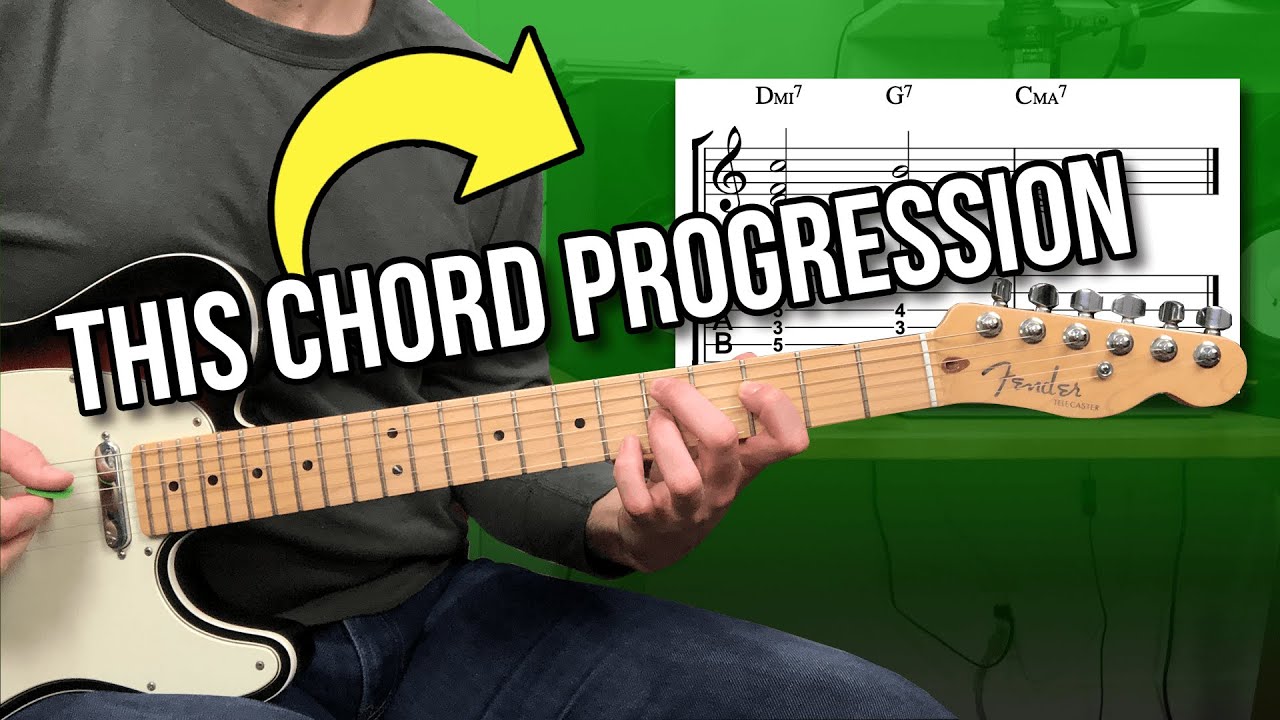
ii-V-I names the 2nd, 5th and 1st chords of a major key: in C, D minor - G major - C major; jazz adds sevenths, giving Dm7 - G7 - Cmaj7.
-
-
Key idea Shell voicings drop the 5th
A shell voicing is a seventh chord with the 5th removed: the 5th carries the least information, while the 3rd, 7th and root define the chord.
-
Exercise Movable shell ii-V-I in any key
Play ii-V-I with 5th-string-root shells and slide the same shapes along the string for any key; then the 6th-string-root version.
-
-
Key idea 3rds and 7ths voice-lead through ii-V-I
Without the bass notes, the shells reveal the voice leading: the 7th of ii moves down a half step to the 3rd of V while the other note stays, and so on into I.
-
-
Key idea Land on the 3rd on the downbeat of each change
The core soloing move over ii-V-I is targeting the 3rd of each chord on the downbeat when the chord changes; it makes the progression obvious even without chords behind you. The 7th is a possible target but the 3rd is the strongest.
-
-
Key idea One bar per chord vs half bar per chord
ii-V-I appears both with a whole measure per chord and with two beats per chord; be comfortable soloing over both.
-
-
Key idea Fretboard knowledge before fluent ii-V-I soloing
To understand and solo fluently over ii-V-I you need a rock-solid knowledge of the fretboard (notes, keys).
-
Practice it
- Dm7, G7, Cmaj7 as drop 2 chords in one area of the neck. The two glowing notes on top of each chord are its 3rd and 7th.From the guide: Chord Tones: How to Solo Over Chord Changes Open in Jamsville
- Dm7, G7, Cmaj7 with each chord's 3rd glowing: F, then B, then E.From the guide: Chord Tones: How to Solo Over Chord Changes Open in Jamsville
- Step 1: the 3rd. E over C, B over G.From the guide: Chord Tones: How to Solo Over Chord Changes Open in Jamsville
- Step 2: the 5th. G over C, D over G.From the guide: Chord Tones: How to Solo Over Chord Changes Open in Jamsville
- Step 3: the 3rd or the 5th.From the guide: Chord Tones: How to Solo Over Chord Changes Open in Jamsville
- Step 4: the 7th. B over Cmaj7, F over G7.From the guide: Chord Tones: How to Solo Over Chord Changes Open in Jamsville
- Step 5: the 3rd or the 7th.From the guide: Chord Tones: How to Solo Over Chord Changes Open in Jamsville
- Step 6: the 5th or the 7th.From the guide: Chord Tones: How to Solo Over Chord Changes Open in Jamsville
- Step 7: the 3rd, the 5th or the 7th.From the guide: Chord Tones: How to Solo Over Chord Changes Open in Jamsville
- Drill Land on a chord tone ProFor “Land on the 3rd on the downbeat of each change”. You'll land on the note that spells each chord, right on the change. Open
The guide
In the learning paths Start Soloing From Zero, Solo Over Chord Changes and Solo Over the Blues.
Transcript
YouTube's automatic captions. Tap a time to watch from there.
- what's up everybody my name is adam and welcome to jamsville today we're going to be talking about the most important chord progression that you can know for playing
- jazz which is the 2-5-1 progression if you're new to the channel make sure you subscribe and hit the bell button so i can help you get better faster at guitar okay so let's begin with what the two five one progression is the numbers two five and one are referring to chords found within the major scale and
- if you're not familiar at all with the chords in a major scale then make sure you check out this video where i explain how chords within keys work so in two five one we're talking about the second chord the fifth chord and the first chord in the major scale so for in the key of c major the 2 5 1 in that key would be
- d minor to g major to c major so if we just play the triads the three note versions of these chords would sound like this now that sounds really basic just because it's only triads
- three notes in each chord so in jazz usually we add a seventh to each chord so when we add sevenths on these chords the names are a little different as well so in this case instead of just d minor g major and c major when we add sevenths the chords turn into d minor seven g seven or g
- dominant seven and then c major seven and that would sound like this now i'm going to show you a really cool trick that's going to allow you to play chord voicings that sound really nice for this 2-5-1 progression
- in any key even if you're not super familiar with all the notes in each key it involves playing something called shell voicings now a shell voicing is when we take a seventh chord and we actually remove the fifth from that chord and the reason we remove the fifth is because the fifth is actually the least important note it
- doesn't give us too much information about that chord the thirds sevenths and roots however give us a lot of information about the chord so we can play a 2-5-1 progression with the shell voicings starting from the fifth string like this
- so if i just take those exact chord shapes i can start them wherever i want by moving them up and down the fifth string like this and play a two five one in any key i want now the most important thing to
- take these chord shapes and being able to play them in any key is super easy so we know that the two chord is one whole step above the one chord so the bass note d is one whole step above c again that's two to one
- so we need to find the root note of the key we want to play in and then move up a whole step from there and then play the chord pattern if we wanted to play in the key of e flat we'd find an e flat note here and then move up a whole step and that's where we'd start our minor
- chord shape for the two chord now there's one other version of the shell voicings that starts on the sixth string and i'll show you that now [04:21] and again this same exact concept for being able to play in different keys applies to these shapes i just find the root note of the key i want to play on so let's say i want to play it in the key of g here's a g note on the sixth string i'm going to go up a whole step from there to a that's going to be our two chord
- so one other thing you need to understand about the two five one progression is something called voice leading now i told you that the thirds and sevenths are super important notes in the chords and that's why we use this concept of shell voicings where we remove the fifth
- now they're not only important for defining what the chord is but they're also super important in this specific progression because they create voice leading between each of the different chords so for example going back to the first shell voicing pattern let's take a look at the voice leading here so we have d
- f and c on the two chord and then on the five chord we have g f and b so if we take the base notes out if we take the d out of the two chord we just get these two notes on top
- and then if we take the g out from the g7 chord we get these two notes on top what happened here is that the c moved down a half step and the f actually stayed the same so we get this and then if we go to the one chord
- and then take out the bass note from that we get this without the base notes this is what the 251 sounds like so there's actually a whole ton of information contained
- within those thirds and sevenths and that's what the next section of this video is going to be based on where i'm going to show you some different lines that you can play in your solos over 2-5-1 progression here's phrase number one one two three four
- so the main thing that's going on in this line and that's going to be happening in the other phrases i'm going to show you is that we're targeting the third of each chord the third again is one of those super important notes and if you can land on that third on the downbeat when the chord changes it really makes it obvious to the
- listener that you're playing over this 2-5-1 progression even if you don't have chords in the background so if i play chords and then play each bar of the line it sounds like this [07:42] so each of those notes that landed on the downbeat fits in that chord perfectly because it's the third here's phrase number two one two three four so you'll notice that this phrase is a lot shorter than the last one in the last one each chord got four
- beats all to itself but in this one the chords only got two beats each like this one two three four the reason for that is that you see this a lot of times in songs where the 251 either gets a whole measure for each
- chord or it gets a half a measure for each chord which is like a much faster two five one but again this is super duper common and you should be comfortable with soloing and playing them whether it's one bar per chord or half bar per chord again though on this line all we're doing is going
- up a d minor seven arpeggio and then the seventh which is c resolves down to the third of the g7 [09:06] and then again we land on the third of the one chord right on the downbeat here's phrase number three one two three four again this is just another variation of that same exact concept targeting the third on each chord you
- can also target the seventh but really the third is going to be the super duper strong target note on each of these chords that's the third right there on the downbeat of the g7 chord [09:49] and that's the third right there and a downbeat of the c major seven chord and here's phrase number four one two three four so in this one all we're doing is going down a d minor seven arpeggio
- and then we're leading straight from the seventh of that d minor seven arpeggio into the third of the five chord and then we're just moving up a g major arpeggio then to the flat seven and then resolving to the third of the one chord
- and then we end off on the seventh of the one chord in order for you to really understand this chord progression and for you to solo it fluently it's critically important that you have a rock-solid foundation and knowledge
- of your guitar fretboard if you're looking for a step-by-step system that's going to help you do exactly that take you from being confused about the fretboard not know what the notes are not know how to play in different keys to being completely comfortable and being a master of the guitar fretboard then make sure you head on over to
- jimsville.com and sign up for the jamesville gps fretboard fundamentals course the guitar performance system is the gps that's going to take you straight from where you are to fretboard mastery and check out this video if you want to learn a bunch of really cool ways to play major 7 chords
- so you can use them in your 2-5-1 progressions until next time listen learn and jam