
Chords · Intermediate
Diminished and Augmented Triads on Guitar
Turn the minor and major triads you already know into diminished and augmented triads by moving one note, then use them with the band to pull into the next chord.
Summary
- Diminished: a minor triad with the 5th lowered a half step. C diminished is C E♭ G♭.
- Augmented: a major triad with the 5th raised a half step. C augmented is C E G♯.
- On guitar, move one note of a shape you already know by one fret.
- Both chords create tension that pulls into the next chord.
On this page
Diminished and augmented are the other two triads, next to major and minor. You don't have to learn them from scratch. Each one is a triad you already know with one note moved by one fret, and both are chords that create tension and pull into the next chord. If you don't have major triads and minor triads around the neck yet, start there, because everything here is built from those shapes 0:22 +10:22 · The Right Way To Learn DIMINISHED TRIA0:22 · How To Learn AUGMENTED Triads The RIGH.

Diminished: lower the 5th of a minor triad
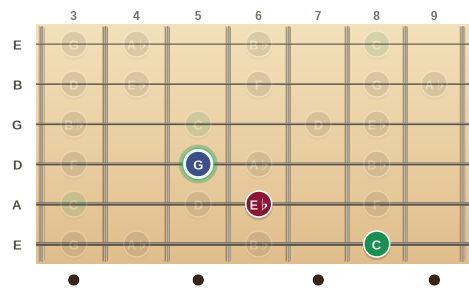
Play a C minor triad with the root on the sixth string, then move the G down one fret and play it again. That's C diminished.
A minor triad is a root, a minor 3rd and a perfect 5th. To make it diminished, you lower the 5th by a half step, which makes it a diminished 5th, also called the flat 5. So the formula is root, minor 3rd, flat 5 0:43 +10:431:05. C minor is C, E♭ and G, and C diminished is C, E♭ and G♭ 1:29Watch at 1:29. The notes stack up in two minor 3rds: C to E♭, then E♭ to G♭ 1:04Watch at 1:04.
That first shape on the low strings is a bit hard to play, and that's fine 1:29Watch at 1:29. The other shapes below are easier, and they're the ones I use more 1:49Watch at 1:49. If the stretch makes your hand tense up, don't force it. Get the sound of the chord in your ears and move on.
Every C diminished shape
You find the rest of the shapes the same way you did for major and minor. Take the lowest note of the chord and move it up an octave. From the root position shape on the sixth, fifth and fourth strings, moving C up gives you a first inversion on the next three strings, with E♭, G♭ and C from bottom to top: the flat 3, the flat 5 and the root 2:10 +12:102:32. Keep going: move E♭ up and you get a second inversion, then move G♭ up and you're back to root position on the top strings 2:54Watch at 2:54.
If the 3rd is on the bottom, it's a first inversion. If the 5th is on the bottom, it's a second inversion. That works for every kind of triad 2:32Watch at 2:32.
To get to the next area of the neck, go back to that first shape and move every note up to the next note of the chord on the same string: C goes up to E♭, E♭ goes up to G♭, and G♭ goes up to C. That gives you another first inversion, and you climb across the strings from there the same way 3:16 +13:163:36. Do the same thing once more, starting from the first inversion on the fifth, fourth and third strings, and you have the last area 5:01Watch at 5:01.
The most important thing is knowing where the root is in every shape. In a lot of these inversions the root isn't on the lowest string. It can be in the middle or on top. Look for the C every time you play a shape 7:08Watch at 7:08. Knowing where the root is lets you take any shape to any key 7:30Watch at 7:30.
You don't need every shape before you use these. One shape of each chord in the same area of the neck is enough to play the progressions below, and you can fill in the rest over time.
Other keys
Move every C diminished shape down one fret and you have B diminished 8:53Watch at 8:53. Don't think of it as C diminished moved down, though. Think of B diminished as its own chord, and notice where the B is in each shape 9:15Watch at 9:15.
B diminished is B, D and F. D is the minor 3rd, and F is the diminished 5th, because a perfect 5th above B would be F♯ 9:36 +19:369:58. A B major triad would be B, D♯ and F♯, so lowering the 3rd and the 5th gets you to the same place 1:24Watch at 1:24. B diminished is the 7 chord in C major 1:04Watch at 1:04, and the 2 chord in A minor 1:46Watch at 1:46.
When you move through the shapes, say the notes. B goes up to D, D goes up to F, F goes up to B, and in each new shape you can name what's there: D, F and B 10:21 +110:2110:42. Running through shapes without knowing what's in them won't help you much 11:07Watch at 11:07. For A diminished, line any B diminished shape up so its root lands on an A, two frets lower 12:30Watch at 12:30.
Using diminished triads
A diminished chord creates tension that resolves to another chord. It resolves to a minor chord a little more often, but going to a major chord is common too 12:52 +112:5213:12. It does the same job as the V chord in a key. A dominant 7th chord has a diminished triad inside it, which is one reason it pulls so well back to the I chord 13:33Watch at 13:33. For example, G7 is G, B, D and F, and B, D and F is a B diminished triad.
The progression at the start of the video is just C minor to B diminished, over and over 13:33 +113:3313:55. Go down a half step from the chord you're on, make that a diminished chord, and it leads you right back. It works the same from C major 14:15Watch at 14:15.
Listen to the band go around a couple of times before you play. Then strum each chord once, let it ring, and listen to the B diminished pulling back to C minor.
You can do this in any key. From G major, go down a half step to F♯ diminished and it wants to go straight back to G 14:36Watch at 14:36. You can also use it to get to a new chord. Say you're on G and you want to go to E minor. D♯ is a half step below E, so play D♯ diminished between them: G, D♯ diminished, E minor 14:58 +114:5815:18.
It even works for a chord that's far away. D♭ major is a tritone away from G, about as far as you can get, but G, C diminished, D♭ sounds like a surprise you were led into, because the diminished chord takes you there 16:02 +216:0216:2316:45.
Solo with the arpeggios
With every triad, practice soloing with its notes one at a time over the chords. Go back to the C minor and B diminished loop and play only the notes of the chord you're on, switching when the chord switches 16:45 +116:4517:07.
Keep it simple at first. Play quarter notes, leave space, and change the rhythm and the order of the notes before you think about adding more of them. Keep your hands loose and keep part of your attention on the band. To get comfortable with this you'll want your diminished, minor and major triads in more places and more keys over time 18:00Watch at 18:00.
Augmented: raise the 5th of a major triad
Play a C major triad with the root on the sixth string, then move the G up one fret. That's C augmented.
A major triad is a root, a major 3rd and a perfect 5th. To make it augmented, you raise the 5th by a half step, which makes it an augmented 5th 0:22 +10:220:43. C major is C, E and G, so C augmented is C, E and G♯ 1:05Watch at 1:05. On its own it sounds a little strange. In the context of other chords it sounds great 1:05Watch at 1:05.

Every note is a major 3rd apart
Look at the distances. C to E is a major 3rd, E to G♯ is a major 3rd, and G♯ up to the next C is another major 3rd. Every note is the same distance from the next one 2:07Watch at 2:07. So every time you invert it, you just get another augmented chord. C augmented, E augmented and G♯ augmented all have the same notes 2:28Watch at 2:28.
You still invert it across the strings the same way as the other triads: move the lowest note up an octave, then the next one 1:46 +11:463:12. Played one after another, those shapes sound dreamy and a bit surreal 3:55Watch at 3:55.
Moving up the same strings is where the symmetry shows. Move each note up to the next note of the chord: C to E, E to G♯, G♯ to C. You get the exact same shape, four frets higher 4:16 +14:164:37. Every augmented shape does this, so the shapes you learn in one area are the shapes everywhere 4:58 +14:587:55.
Only four augmented triads
Because of that symmetry, once you know C augmented you already know E augmented and G♯ augmented, which you can also call A♭ augmented 8:16Watch at 8:16. That leaves only four augmented triads with different notes in them: C, D♭, D and E♭. When you get up to E augmented, you're back to the notes of C augmented 8:36 +18:368:57.
To get D♭ augmented, move every C augmented shape up one fret, or build it from the major triad: D♭ major is D♭, F and A♭, and raising A♭ to A gives you D♭, F and A 9:19 +19:1910:01. The note names in these chords can get awkward in some keys. That's why I call this one D♭ augmented and not C♯ augmented 9:39Watch at 9:39.
Using augmented triads
In my experience, augmented triads mostly stand in for major chords, and most of all for the V chord 11:46Watch at 11:46. Take a ii-V-I in C: D minor, G major, C major. To spice it up, play G augmented in place of G 12:07 +112:0712:31. That's what I play at the start of the video 12:51Watch at 12:51.
The V chord already creates tension that wants to go to the I chord 12:51 +112:5113:12. The augmented chord adds more tension, and it adds one note that wants to move. G major is G, B and D. Raise the D to D♯, and that D♯ wants to go up a half step to E on the next chord 13:33 +113:3313:54. Along with everything else moving from V to I, that gives you even stronger voice leading 14:15Watch at 14:15.
So diminished and augmented triads do a very similar job. They're two different flavors of tension leading into the next chord 14:59Watch at 14:59.
The second common use is on a major chord you're sitting on for a while. Go from C to C augmented to C6 and back. C6 here is C, E and A: the 5th replaced by the 6th. The 5th moves up to the sharp 5, up to the 6, then back down to the sharp 5 15:21 +315:2115:4116:0316:26. The tension there is short. It mostly gives you movement when you want to stay on one chord 16:52Watch at 16:52.
A famous example is Oh Darling by the Beatles. It opens on an E augmented chord with a low E in the bass, and that resolves to A major. The E augmented is standing in for an E7 17:14 +217:1417:3617:56.
Solo with the augmented arpeggio
A lot of the time you won't see an augmented chord written in the progression. You understand what it does and put it in yourself 18:16 +118:1618:38. Over D minor, G, C, I can play off the D minor arpeggio, then the G augmented arpeggio, then the C major arpeggio 19:02Watch at 19:02.
Start smaller than that. Switch between G augmented and the closest C major triad, so you get used to how it resolves. Two of the notes move up a half step, B to C and D♯ to E, and G stays where it is 19:22 +119:2219:43.
Rhythm is still the most important part. Play quarter notes in good time and switch between the two arpeggios, and go slower than feels necessary 20:04 +120:0420:48. Even slow, it sounds interesting, because you can hear the motion between the two chords in a single-note line 21:11Watch at 21:11. Once that's comfortable, start adding other notes from the key, and keep outlining the chords 21:31Watch at 21:31.
A step without Jamsville
Put on Oh Darling and listen to the first chord until you can hear it pull into the A. Then find it on your guitar: take an E major triad you know, raise the B one fret to B♯ (the same note as C), and play it along with the record.
Keep going
In this learning path
Learn Triads the Right Way · part 3 of 3
Questions guitarists ask
How do you make a diminished triad?
Start with a minor triad and lower the 5th a half step. C minor is C, E♭ and G, so C diminished is C, E♭ and G♭. The formula is root, minor 3rd and diminished 5th, which is also called the flat 5.
How do you make an augmented triad?
Start with a major triad and raise the 5th a half step. C major is C, E and G, so C augmented is C, E and G♯. On the guitar that's one note moving up one fret.
Why are there only four augmented triads?
Every note in an augmented triad is a major 3rd from the next one, including the top note back up to the root. So C augmented, E augmented and A♭ augmented have the same three notes. C, D♭, D and E♭ augmented cover all twelve notes, and E augmented starts the cycle over.
Where do diminished chords go in a chord progression?
A common place is a half step below the chord you're going to. B diminished leads into C minor or C major, and D♯ diminished leads into E minor. It does the same job as the V chord: it creates tension that pulls into the next chord.
How do you use an augmented chord on guitar?
Play it in place of the V chord. In a ii-V-I in C, play D minor, G augmented and C. The raised 5th of G augmented, D♯, moves up a half step to E, the 3rd of the C chord. You can also move a major chord's 5th up and back, from C to C augmented to C6.
Keep going
Keep what you open here. A free Jamsville account saves your boards and sequences to your Practice Library and keeps your progress on every device.
Make your free accountSubscribe to Jamsville on YouTube
Where this comes from
This guide is written from these lessons on the Jamsville channel. The timestamps in the text link to the moment each idea is taught.