
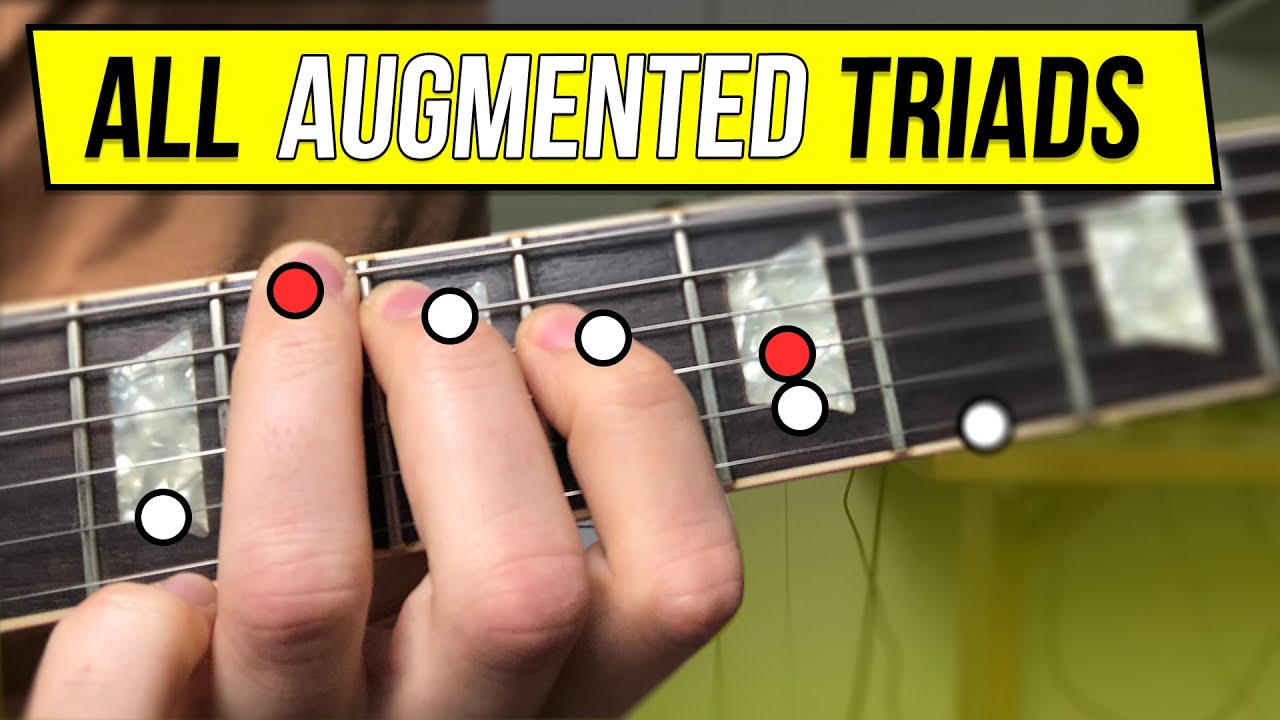
After each pass the video waits as long as the loop, so you can play it back.
Start slower with −, and it climbs to 100%.
Keys: Space play · ← → 5 s · [ ] set start and end · − = speed · L loop
Chords and harmony · Advanced
How To Learn AUGMENTED Triads The RIGHT WAY!
In this lesson
Tap a time to watch that part. loops it, so you can slow it down and play along.
-
Key idea Augmented last: major with a raised 5th
Augmented comes after the other triad videos: take the major triad and raise the 5th a half step (C E G#).
-
-
Key idea Augmented is symmetrical: one shape per string set, four unique chords
Every note in an augmented triad is a major 3rd apart, so every inversion is another augmented triad (C+ = E+ = G#+). Inverting along a string set gives the same shape, so one position teaches them all, and only four augmented triads exist (C, Db, D, Eb) before they repeat.
-
-
Key idea Augmented as a V substitute and a line cliche
Augmented triads mostly substitute for the V chord: in ii-V-I (Dm-G-C) play G+; the raised 5th (D#) resolves up a half step to E, adding voice leading. Second use: line cliche on a major chord (C - C+ - C6 - C+), the 5th moving up and down by half steps to create movement.
-
Exercise Hear the resolution: alternate G+ and the nearest C major arpeggio, slowly, in time
You will rarely see augmented written; substitute it yourself. Practice switching between a G+ triad arpeggio and the closest C major triad in single notes, in quarter notes, even very slowly, so you hear the half-step resolutions (B->C, D#->E). Then gradually add other key notes; the goal is solos that outline the harmony.
-
Practice it
- C augmented on the low three strings, moving each note up to the next note of the chord. Same shape every time, four frets higher. The C is lit so you can see it change strings.From the guide: Diminished and Augmented Triads on Guitar Open in Jamsville
- A ii-V-I in C with G augmented as the V: Dm, G augmented, C. The D♯ (lit) moves up a half step to E.From the guide: Diminished and Augmented Triads on Guitar Open in Jamsville
- G augmented to the closest C. B goes up to C and D♯ goes up to E (lit); G stays where it is.From the guide: Diminished and Augmented Triads on Guitar Open in Jamsville
- Guide Major Triads on Guitar: The Right Way to Learn ThemFor “Augmented last: major with a raised 5th”. Find all twelve shapes of the C major triad by moving one note at a time, move them to any key by the root, and start soloing with them in time today. Read it
The guide
In the learning path Learn Triads the Right Way.
About this video
Augmented triads sound a little strange at first, but they're incredibly useful chords that are super simple, and can really spice up your chord progressions either in your own music, or when you're doing your own version of other songs. There are also famous songs that use the augmented chord, such as Oh Darling! by The Beatles.
In this lesson you're going to learn exactly how the augmented triad is constructed, and immediately be able to play them all over the guitar fretboard. You will also learn how to use the augmented triad in your progressions, and you will learn how to solo using the augmented triad.
Transcript
YouTube's automatic captions. Tap a time to watch from there.
- hey everybody what's up that second chord i just played in that little progression was an augmented triad and in today's video i'm going to show you how to learn augmented triads the right way and how to use them the right way so without further ado let's get started so
- to learn how to construct an augmented triad first we're going to start with the major triad which you should all know by now after watching my other triad videos that a major triad is constructed using a root major third and a perfect fifth the way that we construct an augmented triad is really really simple all we do is we take that major triad we take the fifth and raise
- it up a half step to make it an augmented fifth which gives us the augmented triad so let's play that right now we're going to start with our major triad c major triad it has the notes c e and g g is the fifth and we're going to raise that up a half step or raise it up a fret on the guitar fretboard and it's
- going to look like this so it's a kind of interesting sounding chord and by itself it sounds kind of weird but you'll see that in context of different chords it can sound super duper cool so that's our c augmented triad c e and g sharp instead of g
- natural so that's just one version of the c augmented triad and the right way to learn any triad or any chord is to be able to dissect it and play it all over the guitar fretboard knowing what notes are in the chord and be able to invert it across the guitar fretboard so let's start inverting this c augmented chord
- now what we're going to do is we're going to take the lowest note in the chord which in this case is the root and we're going to raise it up an octave like this so let's talk a little bit more about inverting the augmented chord for just a second if we actually look at the intervals between all the notes in an
- augmented chord they're actually all the exact same distance apart c to e is a major third and e to g sharp is a major third and actually g sharp to c if we go up an octave to the root again is another major third so every single note is a major third apart in this chord they're all the same distance apart
- therefore actually every single time you invert it it's pretty much the same exact thing that all the augmented chords are kind of the same oh the c augmented chord the e augmented chord and the g sharp augmented chord they're all the same chord they all have the same exact notes in it so every time you invert this
- chord you really just get another augmented chord it's it's very easy but at the same time a little confusing when you start looking at it across the fretboard right now we're still going to just think about it as a normal c augmented and we're inverting it and you're going to start to see that afterwards so here we have our c augmented first inversion
- and we're going to move the e up an octave to the second string and we're going to get this c augmented second inversion which again is also the same thing as just a g sharp augmented chord and now finally let's raise that g sharp up an octave to the first string
- and now we're going to get this next root position c augmented triad so let's check out that whole entire position of different c augmentation [03:55] when you hear all those augmented triads being played together kind of sounds really like dreamy and and surreal it sounds very very very interesting so now that we got that position covered the next order of business is to go up to a different position by moving our original c augmented triad up to the next inversion
- on the same set of strings so what we're going to do is we're going to move c up to e we're going to move e up to g sharp and we're going to move g sharp up to c and you're going to see it's actually going to be the exact same shape because of what i just told you earlier so c moves up to e e moves up to g sharp
- and g sharp moves up to c and now we have this technically a c first inversion augmented triad but it's also an e augmentation see it's the exact same shape and now that you see that every single augmented
- triad shape that you learn on the guitar fretboard if you decide to invert it up the same set of strings they're all going to be the exact same shape so you're going to see actually we're gonna be able to go through this video a lot quicker than like the major and minor triads because every single position is actually gonna be the exact same shapes so let's move
- that e up an octave to the third string and now we got c augmented second inversion same exact shapes from before and now let's move that g sharp up an octave to the second string and we have another c augmented root
- position and then let's move that c up an octave to the first string so all the augmented triads in that position look like this [06:00] again all the exact same shapes as before so we're going to be able to get really really quickly through this let's now get the last position of the c augmented shape by moving up every single one of the notes along the same string that there aren't from the original c augmented we started on so we're going
- to move e up to g sharp g sharp moves up to c and c moves up to e and now we have our c augmented second inversion all right let's move that one up invert it up in that position
- we're going to move the g sharp up an octave now we're going to move the c up an octave the second string and now we're moving e up an octave to the first string and back down and we can actually do that position
- all the way down here down an octave starting from this g sharp on the sixth string on the fourth fret so let's review all of our c augmented triads across the fretboard starting
- with the one in the beginning do [07:55] so congratulations that was pretty quick you actually know all of your c augmented triads all over the guitar fretboard because well basically once you learn one position you know all of them they're all the exact same and that brings me to the next part of this video which is we're going to talk about playing this one in different keys and
- because of exactly what i said actually you don't have to memorize all these different keys all different augmented triads because of how symmetrical this augmented triad is so actually once you learn the c augmented tribe now you already know the e and the
- g sharp augmented triads or you could also call it a flat augmented it's the same exact note just a different name for the same note so in reality there's actually only four different augmented triads that you need to know before they start kind of repeating themselves so you need to know c
- augmented you need to know c sharp or d flat augmented and d and e flat augmented because once you get up to e augmented again you go c c sharp d d sharp or e flat and then once you get to e guess what now you're back at just
- an inversion of your c augmented rod so there's actually only four different unique augmented tribes that have unique different notes in each one of them so let's check out a couple of them just for good measure let's actually try that c sharp augmented triad so we can think of it as starting from c sharp and going
- up a major third and another major third or we could just think of taking our c augmented triad and moving it up a half step moving all the shapes up at half step so that's one thing with these kind of chords too these augmented chords and sometimes when you get into diminished chords and fully diminished chords and you play them in different keys the
- naming of the notes can get kind of wacky we're not going to worry too much about that but just let's say that actually we're going to call this instead of c sharp augmented we'll call it d flat augmented that'll make it a little bit easier and the notes in this would be d flat f and a natural
- because a d flat major triad would have d flat f and a flat and we raise the a flat up to a natural now we have the d flat augmented so here would be all the inversions of the d flat augmented [10:44] and then we can start all the way up on f here and we could go all the way down here to a natural and actually play the technically the second inversion but again it's really just an a augmented triad a augmented d flat and c sharp
- augmented f augmented they're all the exact same chord they're all just inversions of each other and we can also do that one up an octave as well [11:26] so you kind of get the idea we don't have to spend too much time transposing the augmented triad all over the place because like i said once you know one of them you actually know three of them and once you know the shapes for one of them well you know the shapes for all of them because that's how the guitar works the shapes no matter what you play the shapes are going to be the same you just
- move them around the guitar fretboard so let's talk a little bit now about how to use augmented triads where you're going to find them in different chord progressions and how to solo with them a little bit so augmented triads are actually in my experience they're generally used as substitutes for major
- chords and specifically they're used for substitutes for the five chord in a progression so one of the most common chord progressions that you can play is called the two five one it sounds like this so that was a two five one in the key of c major with d minor to g major to c
- major d minor is two g major is five and c major is the one chord so a lot of times instead of just playing a g major chord if you want to spice things up you can play a g augmented chord like this
- that's actually exactly what i did in the beginning of the video why does that work so well well the reason is because the five chord in a progression in this case the g chord or you could actually if you put a seventh on it'd be a g dominant seventh chord that five chord is designed specifically
- to create tension that wants to resolve to the one chord so when you play this you just expect to hear that one chord afterwards or one with a major seven some kind of form of the one chord you expect to hear it so because this augmented chord
- has a lot of tension in it you can just hear when we just play it by ourselves like wow that chord is kind of strange but because it's kind of strange it's very very good at increasing the amount of tension on that five chord a bit and it actually adds an extra note that wants to resolve
- from the five chord to the one chord so in this case if we turn that g major chord which has g b and d in it and we raise that fifth up a half step from d to d sharp or e flat that d sharp really really wants to resolve up a half step on the next chord to e like this
- and along with the other kind of resolutions that happen in our five to one progression it just creates even more strong voice leading you could also resolve it different ways if you're using different kinds of more advanced
- voicings you could do something like this that actually is resolving down to a c major nine chord that's a little bit out of the scope of this video but what i want you to know is that the purpose of augmented chords is to create even more tension that resolves to the one chord
- from the five chord and actually if you watch my diminished triads video that's actually pretty much the function of diminished triads diminished strides and augmented triads actually are very very similar in that way in the way that they function but they're two sort of different flavors instead of hearing something like this [15:21] that would be with a diminished chord you get a different flavor of that tension but they still function pretty much the same way and the second most common way that you hear augmented chords being used is a way to kind of spice up actually the one chord or just a major
- chord in a progression with a sort of what we would call line cliche that sounds something like this so what was i doing there i was actually going from a c major chord
- to a c augmented chord to a c6 chord and that's a little bit beyond the scope of this video but a c6 chord is basically a c major triad where we replace the fifth with the six so in this case the notes in it are c e and a so we have this movement of the fifth
- moving up to the sharp five and then the sharp five moves up to the sixth and the six moves back down to the sharp five so we constantly have that movement with the fifth and the chord that kind of sounds a little bit more interesting than just sitting on a regular major chord the whole time [16:52] again it actually creates a little bit of tension but not in the exact same way that you create tension on the five chord it's a very very temporary quick amount of tension that still sounds very tasteful and it just sounds like there's some movement going on more than anything it creates movement when you really want to sit on one chord but
- you're saying uh how can i make this a little bit more interesting than just sitting on the exact same chord of playing that chord verbatim the entire time a really famous example of augmented chords in a song is the song oh darling by the beatles it opens with an e augmented triad that has this low e in the bass actually
- and it resolves to an a major chord and then there's a bunch of chord progression happen in the key of a major but the point is that chord just sounds really really cool go listen to that song and you hear it it's super obvious that e augmented triad that takes us
- right in nicely to that chord progression in the key of a because again that e augmented triad is substituting for an e dominant 7 chord normally you might hear something like this but instead they decided let's spice it up a little bit let's learn e augmented
- tribe and finally let's talk about soloing over augmented ride so a lot of times you're not going to see augmented chords written into the chord progression of a song a lot of times you have to understand the function of that augmented triad and you have to be able
- to basically substitute it in at your discretion so if you were playing over this chord progression d minor to g major to c you might actually just throw in that augmented chord yourself so i might play some kind of line that goes like this [19:02] so i just played off the d minor arpeggio then i played off at g augmented arpeggio and then went to the c major arpeggio on the c major chord so for right now i think it's best to just practice switching between c major
- arpeggios and the g augmented triad so you should be used to how that augmented triad resolves to the one chord not just playing it by itself but seeing how does it resolve so if we just take this little g augment to try it here and then get the closest c major triad which is right here
- you can actually see two of the notes move up and then if we do different inversions the same thing the b and the e flat or the d sharp move up a half step five and one or one and five but substituting in that augmented sound
- whenever you want on any five chord so the most important part of this however is even though we're focusing a little bit on this actual augmented triad the rhythm is still the more most important thing so make sure you're playing with some good time play some quarter notes like one two three four
- and practice switching between those two
- chords you might want to go slower than i just did right now you might want to literally just go like this slow like [21:11] and as you can see actually even though that seems really really easy and really slow that sounds like really really interesting you hear that motion between those two chords in the single note lines i'm playing i'm not playing chords i'm not just going although that actually sounds really
- cool too in my opinion but this is how you start to learn how to create solos where you can actually hear the harmony in your souls by practicing using the arpeggios over a chord progression and soloing with just those arpeggios and then gradually starting to add in more notes like notes that are from the key
- et cetera et cetera et cetera but the whole point is that you're actually outlining the harmony in your solo which makes it sound a lot more interesting so make sure you have your major minor diminished and augmented triads down if you want to check out how to learn those other tribes look at these two videos right here and make sure you go to jensville.com and pick up the jamesville
- gps fretboard fundamentals course you are going to be so glad that you did you're not going to be able to recognize your playing when you're done with that course so until next time listen learn and jam