
Chords · Intermediate
Major Triads on Guitar: The Right Way to Learn Them
Find all twelve shapes of the C major triad by moving one note at a time, move them to any key by the root, and start soloing with them in time today.
Summary
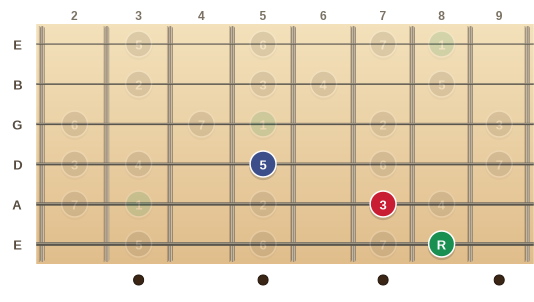
- Three notes: root, major 3rd and perfect 5th. C major is C E G.
- Play it on each group of three neighboring strings.
- Three orders on each group: root position, first inversion (3rd on the bottom), second inversion (5th on the bottom).
- Twelve shapes, moved to any key by the root.
On this page
- What a major triad is
- Start with root position on the low strings
- Inversions: the same three notes in a different order
- Climb the string sets
- Move to the next position: each note goes to the next chord tone
- Know where the root is
- The third position, and the same shapes an octave down
- Move them to any key by the root
- Play them in time and solo with them
- Your assignment
- A step without Jamsville
Most guitarists learn one C chord and one D chord and play them in the same spot every time they come up. Major triads give you every other place to play them. They're one of the most important things you can know on guitar, because they're what you use to solo over a chord progression and make it sound like you know what you're doing 0:01 +10:010:22. This is the way I learn them: one triad, C major, mapped out all over the neck by moving one note at a time.

What a major triad is
A triad is a three-note chord. A major triad has a root, a major 3rd and a perfect 5th 1:04Watch at 1:04. Before you play any chord, know the notes in it. In C major the notes are C, E and G: C is the root, E is the major 3rd and G is the perfect 5th 1:26 +11:26 · The Right Way To Learn MAJOR TRIADS On0:00 · The 4 Types Of Triad Chords You MUST K.
Everything in this guide is those three notes. We're going to find every way to lay out C, E and G across the fretboard 1:47Watch at 1:47. The open chords you already know, like C and D, are built from triads too 0:00Watch at 0:00, and pieces of them show up along the way.
Start with root position on the low strings
Start on the sixth, fifth and fourth strings. Put C on the sixth string, E on the fifth string and G on the fourth string 2:08Watch at 2:08. The root is on the bottom, the 3rd is in the middle and the 5th is on top, so this is called a root position triad. It's the shape almost everyone learns first 2:29Watch at 2:29.
Inversions: the same three notes in a different order
An inversion is what you get when you rearrange C, E and G so that C isn't the bottom note anymore. Sometimes E is on the bottom and sometimes G is 2:51Watch at 2:51. The name tells you which note is on the bottom:
- Root position has the root on the bottom.
- First inversion has the 3rd on the bottom.
- Second inversion has the 5th on the bottom.
That works for any triad, major, minor, diminished or augmented 4:37 +14:377:02. Get those three names solid, because you'll use them every time you play one of these shapes 11:28Watch at 11:28.
Climb the string sets
Here's the first move. Take the bottom note of the shape you're on, move it up an octave to the next string up, and leave the other two notes where they are.
From the root position shape, move the C up an octave to the C on the third string. The E and the G stay exactly where they were 3:12 +13:123:34. Now E is the bottom note, so this is a first inversion, on the fifth, fourth and third strings.
This first inversion doesn't look like much at first, but it sounds more interesting than the plain root position shape. It's great for that Jimi Hendrix and John Frusciante style of playing, where you decorate a chord with notes around it 4:17Watch at 4:17.
Do it again. The E is on the bottom now, so move it up an octave to the second string and keep G and C where they were 5:18Watch at 5:18. That's a second inversion, G C E, and all three notes are on the same fret, so you can play it with one finger 5:59Watch at 5:59. It looks like the open A chord moved up three frets 6:40Watch at 6:40. One more time: move the G up an octave to the first string, keep C and E, and you're back to a root position, one octave higher 7:22Watch at 7:22.
Knowing the notes on the fretboard makes all of this go a lot faster, because you can find the octave of each note without guessing 5:18Watch at 5:18.
That's four shapes in one area of the neck. You can strum them with a pick, fingerpick them, or hybrid pick them, which is what I do in the video: the pick takes the bottom note and my fingers take the rest 7:48Watch at 7:48. Arpeggiate them too, one note at a time 8:08Watch at 8:08. Then play them backwards, and try little patterns like skipping a note and coming back to the one you skipped. Patterns like that turn into melodic ideas you can use in your solos over a C chord, or over any major chord once you move the shapes 8:29 +18:298:55.
Move to the next position: each note goes to the next chord tone
To get to a new area of the neck, invert a different way. Stay on the same three strings and move every note up to the next note in the chord 9:18 +19:189:38. On the sixth, fifth and fourth strings, the C moves up to E, the E moves up to G, and the G moves up to C 9:59 +19:5910:21. It's the same rule I use to invert any chord: the root moves up to the 3rd, the 3rd moves up to the 5th, and from the top it cycles back to the root 0:22Watch at 0:22.
That gives you a first inversion, E G C, on the low strings. It's the same shape as the first inversion you just played on the fifth, fourth and third strings. Any triad shape on the sixth, fifth and fourth strings has the identical shape on the fifth, fourth and third strings 10:21 +110:2110:44.
Now climb the string sets from here, exactly like before. Move the E up an octave to the third string and you get a second inversion, G C E 11:07Watch at 11:07. If you know the open E chord, it's the same finger shape: the core of the open E chord is a small second inversion E triad, and up here it's a C 11:49 +111:4912:12. Move the G up and you have a root position C on the fourth, third and second strings. It's the same notes and the same chord as the one you started on in the first position. The only difference is the tone, because the notes are on different strings 12:34 +112:3412:55. Move the C up to the first string and you have a first inversion on the top three strings 12:55Watch at 12:55. That one is easy to play and a lot of riffs use it 13:16Watch at 13:16.
Know where the root is
As you go through these, know where the root is in every shape. Ideally you'd know where every chord tone is, but at the start that's a lot to think about, so begin with the root 13:57Watch at 13:57. In the last shape the root is on the first string. If you know the notes on the first string, you can move that shape to any chord: line the top note up with A and you have an A major triad, line it up with E and you have E major 14:18 +114:1814:40.
Go through every shape slowly and say to yourself whether each note is the root, the 3rd or the 5th. Don't just run through them. This is like learning the alphabet: you learn it so you can make things with it and put it in your own playing 15:00 +115:0015:20.
The third position, and the same shapes an octave down
One more position covers everything 15:43Watch at 15:43. Invert the low first inversion up the same strings: E moves up to G, G moves up to C, and C moves up to E. That's a second inversion, with the 5th on the sixth string 16:04 +116:0416:47. It's the same finger shape as the second inversion you played on the fifth, fourth and third strings 17:08Watch at 17:08.
Then climb the string sets one last time. Move the G up to the third string and you get the same shape you started this whole guide with, a root position 17:30Watch at 17:30. Move the C up to the second string for a first inversion. This shape is really useful, and it's one you can use to play The Wind Cries Mary by Jimi Hendrix 17:52Watch at 17:52. The 2nd, D, sits a whole step below the 3rd on the same string, so try hammering on from D to E 18:14 +118:1418:34. Finally, move the E up to the first string for a second inversion. That's the same finger shape as the open D chord, and up here it makes a C 18:56 +118:5619:18.
Everything past the 12th fret repeats what's below it, so this whole position also works an octave down. The second inversion that starts at the 15th fret of the sixth string starts again at the 3rd fret 19:46 +119:4620:08. Down here some notes are open strings, so the fingering changes, but the notes are the same distance apart, so it's the same shape 20:50Watch at 20:50. The last one only needs one finger 21:12Watch at 21:12. If you know the open C chord, you'll see you're playing different parts of it. These small triads are what the open C chord is made of 20:08 +120:0820:28.
That's every C major triad on the neck: root position, first inversion and second inversion on each group of three strings 22:25Watch at 22:25.
Move them to any key by the root
Once you know the C major shapes, you know every major triad shape. To play another chord, find the root in each shape and move the shape until the root lines up with the chord you want 22:46 +122:4623:06.
Take D. D is a whole step above C, so every C triad shape you learned moved up two frets is a D triad 23:27 +123:2723:48. The notes in D major are D, F♯ and A: D is the root, F♯ is the major 3rd and A is the perfect 5th 24:30Watch at 24:30. Start from the lowest shapes. Moved up two frets, the last one is the D triad from the open D chord you already know 25:13Watch at 25:13.
Do the same with the other two positions. You can also think of D as its own chord and find D, F♯ and A directly. For now it's easier to start from the C shapes and move them 26:58Watch at 26:58. Either way, the next time a song has a D chord in it, you've got every one of these to choose from 25:33 +125:3328:02.
Play them in time and solo with them
Don't stop at running through the shapes. Play them in time and improvise with the full three-note shapes 28:23Watch at 28:23. Triads are just as important for single-note solos, so put on a metronome or a drum track and play single-note lines using the notes of the triads 28:45Watch at 28:45. Stay in one position at first. When that feels comfortable, play ideas that cross between positions and jump around the neck 29:07Watch at 29:07.
The steady rhythm is what I'm thinking about more than anything when I do this 30:58Watch at 30:58. Big skips, like going from a C on one string to a G several strings away, are hard to hit accurately. Keep the time going anyway. You're working on your technique, your improvising and your triads all at once 30:16 +130:1630:38. Keep your fretting hand light, and keep listening to the band while you play.
When you want to combine two positions, look for a triad note on the same string in both and slide from one position to the other, then keep going in the new position 31:20 +131:2032:12. Slides give your playing a more vocal quality, the way singers slide between notes. It sounds less rigid and more connected 32:33Watch at 32:33.
Your assignment
Learn these triads in every key: C, C♯, D, E♭, E, F, F♯, G, A♭, A, B♭ and B major, all over the neck 33:16 +133:1633:39. It's the same shapes every time. Find the root, and move the shapes so the root lines up with the chord you want to play 34:00Watch at 34:00. As you add each key, improvise with it in time the same way you did with C, so the shapes go into your playing and not only into your hands 32:55Watch at 32:55.
A step without Jamsville
Take a song you already play that has a D chord or a C chord in it. Each time that chord comes around, play one of the other triads you learned here, up the neck, and listen to how it changes the part 25:33Watch at 25:33.
Minor, diminished and augmented triads come from this same major triad by changing one note: lower the 3rd for minor, lower the 3rd and the 5th for diminished, raise the 5th for augmented 0:22 +10:220:44. The same way of building and inverting them carries straight over, and learning all of them lets you make much cooler parts in your songs 0:25Watch at 0:25.
In this learning path
Learn Triads the Right Way · part 1 of 3
Questions guitarists ask
What notes are in a major triad?
A root, a major 3rd and a perfect 5th. In C major that's C, E and G: C is the root, E is the major 3rd and G is the perfect 5th. In D major it's D, F♯ and A.
What is a triad inversion?
The same three notes in a different order. With the root on the bottom it's root position. With the 3rd on the bottom it's first inversion, and with the 5th on the bottom it's second inversion. That's true for major, minor, diminished and augmented triads.
How many major triad shapes are there on guitar?
Using three neighboring strings, there are four string groups (6-5-4, 5-4-3, 4-3-2 and 3-2-1) and three inversions on each, so twelve shapes. Learn them in C, and every other major triad is the same twelve shapes moved so the root lands on the note you need.
How do I play major triads in other keys?
Know where the root is in each shape, then move the shape until the root lines up with the chord you want. D is a whole step above C, so every C major triad shape moved up two frets is a D major triad.
How should I practice triads on guitar?
Go slowly and know whether each note is the root, the 3rd or the 5th. Strum them, arpeggiate them, play them backwards, then put on a drum track or a metronome and improvise with them in time, as chords and as single notes.
Keep going
Keep what you open here. A free Jamsville account saves your boards and sequences to your Practice Library and keeps your progress on every device.
Make your free accountSubscribe to Jamsville on YouTube
Where this comes from
This guide is written from these lessons on the Jamsville channel. The timestamps in the text link to the moment each idea is taught.