

After each pass the video waits as long as the loop, so you can play it back.
Start slower with −, and it climbs to 100%.
Keys: Space play · ← → 5 s · [ ] set start and end · − = speed · L loop
Chords and harmony · Intermediate
The Right Way To Learn MAJOR TRIADS On Guitar
In this lesson
Tap a time to watch that part. loops it, so you can slow it down and play along.
-
Step by step Major triads first, from a C root
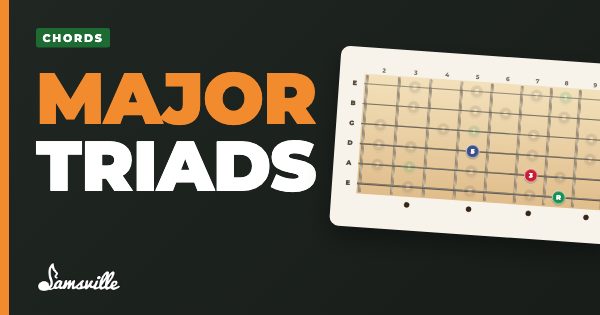
Adam's triad series starts with major triads only, built on a C root: three notes, root / major 3rd / perfect 5th (C E G). The whole lesson is mapping those three notes all over the neck.
-
On the neck Position 1: invert by moving the bottom note up an octave to the next string
Start with a root-position C triad on strings 6-5-4 (C 8th fret 6th string, E, G). Invert by taking the bottom note up an octave to the next higher string while the other two notes stay put; repeat until you run out of strings. This climbs diagonally through the four adjacent string sets in one area of the neck.
-
-
Key idea Inversion named by the bottom note, any quality
Inversion is decided only by which chord tone is lowest: root on the bottom = root position, 3rd on the bottom = 1st inversion, 5th on the bottom = 2nd inversion, whatever the quality (major, minor, diminished, augmented). He repeats this deliberately until it is automatic.
-
Exercise Ways to play each position: block, arpeggio, backwards, skip pattern
Run each position several ways: hybrid-picked block chords (or pick, or fingers), arpeggiated, backwards, and melodic patterns such as skipping a note and coming back to it. These patterns already become soloing material over a major chord.
-
-
On the neck New position: invert along the same string set (each note moves up to the next chord tone)
To get to the next area of the neck, stay on strings 6-5-4 and move every note up to the next chord tone on its own string (C->E, E->G, G->C). That gives the next inversion on the same string set and the starting shape of a new position; then repeat the bottom-note-up-an-octave climb.
-
Key idea Shapes repeat between 6-5-4 and 5-4-3
Any triad shape on strings 6-5-4 is the identical shape on 5-4-3; shapes change only when the B-string tuning gets involved. Many of the 12 shapes are familiar open chords (open A, open E, open D, open C) moved up the neck.
-
How to practice Know where the root is in every shape (then every chord tone)
While running the shapes, know which note is root, 3rd and 5th; at first prioritise the root, because the root is how you move a shape to any other chord. Not mindless shape play: triads are an alphabet for making your own music.
-
-
Step by step C first, then transpose by the root (C -> D = up two frets), then all 12 keys
Once all C shapes are known, every other major triad is the same shapes moved so the root lines up with the new chord. He demonstrates D by moving every C shape up two frets, then assigns all 12 major triads all over the neck.
-
Exercise Improvise single notes with triads in time: one position, then combine positions with slides
Practice triads by improvising in time with a metronome or drum track, both as three-note chords and as single-note lines. Stay in one position first, then combine two positions, alternating and connecting them with slides between chord tones on the same string. Steady rhythm is what he thinks about more than anything.
-
Practice it
- C major in root position on the sixth, fifth and fourth strings: C on the bottom, E in the middle, G on top.From the guide: Major Triads on Guitar: The Right Way to Learn Them Open in Jamsville
- C first inversion on the fifth, fourth and third strings. The E and the G haven't moved; the C (marked) has gone up an octave to the third string.From the guide: Major Triads on Guitar: The Right Way to Learn Them Open in Jamsville
- The first position: root position, first inversion, second inversion, root position, one string set higher each time. The band holds a C chord.From the guide: Major Triads on Guitar: The Right Way to Learn Them Open in Jamsville
- Inverting along the same strings: C moves up to E, E moves up to G, and G moves up to C.From the guide: Major Triads on Guitar: The Right Way to Learn Them Open in Jamsville
- The second position: first inversion, second inversion, root position, first inversion.From the guide: Major Triads on Guitar: The Right Way to Learn Them Open in Jamsville
- One first-inversion shape with its root on the first string, moved to C, A and E. The top note names the chord.From the guide: Major Triads on Guitar: The Right Way to Learn Them Open in Jamsville
- The third position: second inversion, root position, first inversion, second inversion.From the guide: Major Triads on Guitar: The Right Way to Learn Them Open in Jamsville
- The same four shapes an octave lower, using the open strings. Together they're the pieces of the open C chord.From the guide: Major Triads on Guitar: The Right Way to Learn Them Open in Jamsville
- The lowest C shapes moved up two frets: D major, spelled D, F♯, A. The last one is the top of the open D chord.From the guide: Major Triads on Guitar: The Right Way to Learn Them Open in Jamsville
- The first position's C, E and G, with the band holding a C chord. Solo with these notes, then use the arrows in Jamsville to move to the next position.From the guide: Major Triads on Guitar: The Right Way to Learn Them Open in Jamsville
The guide
In the learning path Learn Triads the Right Way.
Transcript
YouTube's automatic captions. Tap a time to watch from there.
- hey everybody what's up what i just played was mainly based on major triads and triads are one of the most important
- things that you need to know as a guitar player to take your playing to the next level and be able to solo over any chord progression and really nail it make it sound like you know what you're doing so in today's video i'm gonna show you my approach to learning triads and today we're just gonna stick with major triads
- because this stuff can take a bit of time to go through and i'm going to show you really thoroughly and in depth the way that i approach learning major triads so that you can learn them the right way and take your playing to the next level so without further ado let's get started so along with almost everything that we learn in music we are
- going to start with using this concept based on the c root note so we're going to be learning a c major triad today now if you don't know the way that triads are constructed trieds are constructed using three notes they're three note chords and the three notes in the chord are going to be a root a major third and
- a perfect fifth and in this case you need to know the notes that are in the chord you need to know the notes that are in any triad or any chord that you learn on the guitar and the notes in the c major triad are going to be c e and g so c is the root e is the major third and g is the perfect fifth so
- we're basically going to spend this video learning all the different ways that we can map out those three basic notes c e and g all over the guitar so we're going to start by learning what i call a root position c major chord so we're going to play
- this shape right here looks like this so we have a c note here on the sixth string then we have an e note on the fifth string and we have a g note on the fourth string so c e and g and this is exactly what i was just
- saying it is a triad with the root on the bottom the third in the middle and then the fifth on top and this is what we call a root position triad now this is the same thing that pretty much everyone learns in the beginning but the cool thing is that now we're going to start diving into something called inversions so what are
- inversions inversions is when we start rearranging those three notes c e and g so in this case c was on the bottom again but now we're going to start to see some chords where c is not going to be on the bottom e is going to be on the bottom or g is going to be on the bottom and these are called the different inversions so
- the next chord we're going to play is going to be a c first inversion triad so we're going to take that exact same shape we just played c e g and now we're going to move that c up an octave we're going to move it up to this c note that's here on the third string
- and we're gonna keep the e and the g exactly where they were so now we have this c first inversion triad looks like this and again notice that that the e and the g are in the exact same spot that they were before we just got rid of the c in the bottom
- and we replaced it with a c up here up in octave for right now you're going to notice that we're actually going to keep repeating this process of taking the bottom note in the triad and moving it up an octave but keeping the two notes that were there the same so this first inversion triad it sounds really really cool and it's
- actually super useful for playing sort of the in this jimi hendrix john frusciante style you can do stuff like this you can kind of embellish with other notes around that that's kind of out of the scope of this video but i just want to show you like this this chord it doesn't seem like much at first but it's
- a really really cool chord this first inversion tried super useful it sounds a bit more interesting than just your basic root position tribe so again first inversion is whenever you have the third of the chord as the bottom note it doesn't matter if this is minor major diminished augmented or anything like that if there's the third
- of the chord is on the bottom it is going to be a first inversion chord okay cool let's keep inverting so we're going to keep inverting up kind of in this position and by the time we're done with this video you're going to know all your major tribes all over the guitar fretboard all your c major triads so we're going to repeat that process one
- more time we're going to take this e note that was on the bottom so we had e g and c now we're going to move that e up an octave to the second string right here and by the way this is going to really really help you if you know the notes on the fretboard super duper well already it's going to make this process go a lot
- easier for you so if you're interested in mastering the fretboard learning the notes super duper well so that you can really master playing in any key playing any chord then go to jamesville.com and check out my course the jamesville gps fretboard fundamentals course so we're going to play this next chord with this
- e here on the second string but we're keeping g and c where they were in the first inversion chord so this next shape looks like this and if you notice you can just play all three of the notes with one finger because they're all in the same fret we have g c and e
- okay so so far we have root position first inversion and second inversion so already three different versions of the same exact c major chord pretty cool right we got a lot more coming though so
- the next one that we're going to play is actually going to be another root position chord but it's going to be up an octave and tell me in the comments down below if you recognize any of these chord shapes because you're going to start to notice actually this one right here the second version we just played kind of reminds me of the open a chord that everyone knows
- but it's just kind of moved up three frets anyway so we're gonna move this g on the bottom of the second inversion by the way the second inversion is with the fifth on the bottom so anytime you have any chord it has the fifth on the bottom you got second inversion root position is the root on the bottom first inversion has the third on the bottom
- and second inversion has the fifth on the bottom so the next chord we're going to play is another root position so we're going to move this g up an octave here to the first string and we're keeping the c and the e where they were so we get this shape so all of the triads that we have in this position right here look like this
- so you should be able to play through them by the way a lot of people ask me about this in lessons i'm using something called hybrid picking here which is basically i'm just picking the bottom note of the chord and then i'm using these two fingers to play the other three notes but you can just strum them all with your pick or do whatever
- feels comfortable to you you could just use nothing but actual finger picking you could play it through like this with just a pick you can also arpeggiate the chords these are all really really important things that you should practice when you're going through any triads but
- especially these triads and you should try doing them backwards as well in this position and maybe even try figuring out some little patterns like what happens if i skip the note and then come back to the note that i skipped and then repeat that process sort of like this
- those can come up with actually some cool melodic patterns already that you can start to use in your solos when you play on a c major chord or any other major chord because you're going to see we can actually move these shapes anywhere on the guitar fretboard pretty awesome okay so what we're gonna do now to move up to another position is actually we are going to invert in a
- slightly different way so the way that we've been inverting is by taking the bottom note in the chord and moving it up an octave to another string like this but now we're gonna invert along the same string set so right now this root position chord we started on is laying
- over the sixth fifth and fourth string but we're gonna stay on the sixth fifth and fourth string and we're gonna find a first inversion which is the next inversion up from root position so the way that we're going to do this is we're actually just going to take each of the notes in this chord and move it up to the next note in the chord
- you'll see what i mean in a second so this c note that's on the bottom we're gonna move this up to an e note so now we have this e note here on the sixth string and then we're gonna take the e note that was here on the fifth string before and we're gonna move it up to g and then we're going to take what was g
- before and we're going to move it up to c so now we have this chord shape first inversion c major tribe and if you notice it's the exact same chord shape they played over here for first inversion so any triad shape of any kind that lays
- over the sixth fifth and fourth strings is going to have the exact same identical shape if you start it from the fifth string and lay it out over the fifth fourth and third strings so we have this now our new starting point of this c major triad first inversion which is spelled e g c
- so now that we're in a new position we're going to repeat the exact same process we did before we're going to move this e up an octave to the third string and we're going to keep g and c where they were and we're going to get this second inversion c major shape which is spelled gce
- again the fifth is on the bottom fifth on the bottom is second inversion i'm gonna keep repeating this over and over because you really really gotta have that in your head solid which inversion is which the first first inversion root position and second inversion root position has the root on the bottom first inversion is the third and second inversion has the fifth and
- the bottom so can you think of another chord they might know already that has the same shape as this actually i can think of one it's your open e major chord it's actually the exact same finger shape but you can include all these other open strings but the actual
- sort of core of that chord is this small three note shape that's actually an e major second inversion tribe but now if we move it all the way up here it's a c major second inversion tribe so now that we have that second inversion let's do the same process again we're going to move that bottom note g the fifth up an octave
- and guess what now we have a root position c major chord again so this reposition c major chord is exactly the same notes and the same sound as this one back here that you learned the only difference in the sound is that since it's on different strings the timbre of the string sounds a little bit
- different there's a little bit more low end a little less high end so far we have this and finally we only have one more shape in this position and that's going to be if we move this c up an octave to the first string keep the e and the g where they were
- tell me what inversion that is it has an e in the bottom the third it's first inversion right now this specific first inversion shape is super super useful because it's very easy to play and a lot of cool riffs use it like for example this song tell me if you recognize this
- song in the comments yeah that is basically a bunch of first inversion triads there's two really obvious first inversion triads that are based on these top three
- strings the third second and first string one thing that's really really important for you to also think about when you're going through these triads is you need to know where the root is in each of these chords now ideally you should know where each of the chord tones is just as equally but in the beginning stage is going to be hard to think about all that
- stuff so you really need to just pay attention to where the root note is in each of these chords so for example in this one the root is on the first string so that can be really easy so that you can move this around so if you know the notes on the first string and you know this shape you can move it to whatever chord you need to play so for example if
- i want to play like an a major chord well i just make sure that i take this shape and align it with the top string of a and then now i have an a major chord or if i want to play an e major chord i make sure the top note is e and i have an e major chord so let's review all the shapes in that position
- one more time again make sure you go through each of these really really slowly make sure you're paying attention to all of the notes and the chords and paying
- attention to whether it's the root third or the fifth you really want to understand these and not just play through them mindlessly this is not just some exercise for you to do and say oh look i play i can play this thing no no this is a basically like the alphabet you're learning this so that you can use it to
- make stuff and put in your own playing not just to play it for its own sick okay so guess what we actually only have one more position to cover and that will actually give you all of the triad shapes that you need to know to play any major triad that you want all over the guitar fretboard pretty freaking cool
- right so what we're going to do is we're going to do the same thing we did before we're going to invert this first inversion triad up this same group of strings we're going to find a new inversion which is going to be if you haven't guessed that already it's going to be a second inversion triad we're going to find a second inversion triad uh starting from the sixth string with
- the fifth on the sixth string so this one you're actually going to see we can play it in two different places but it's going to essentially be the same shape so let's start off with playing it in the higher version so if we move this e we're going to move the e bottom note of this first inversion we're going to move it up to g
- then we're going to move this g that was on the fifth string up to c and now we're going to move this c that was on the fourth string up to e now we have this shape and again that's your c second inversion triad and look that's
- the exact same shape as the second inversion triad that was here exact same finger shape pretty freaking cool right okay now you already know the drill we're gonna take this g and we're gonna move it up an octave to the third string to the next available string we have
- and we're leaving c and e there so we have this triad shape and guess what look that's the exact same fingering and shape as the first chord that i showed you in this video pretty awesome huh so we have this so far second inversion root position
- now we're going to move that root of c up an octave to here on the second string and we have this new first inversion triad shape this one is super duper useful and you can actually use it to play a few different songs like have you ever heard the win cries marry by jimi hendrix
- you can actually play that using a couple different versions you could also play like this but this shape is really nice because actually you have another note that's directly to the left of the third which is actually the second i know that
- we're getting a little bit out of topic of the triads but it's just really cool to point this stuff out along the way so you know what you're getting into you know how you can use this stuff it's not just something you're learning for its own sake you can actually use this to make really cool sounds you can do that little embellishment you try that hammering on from d to the e
- which was the third okay cool so now we're gonna do one more inversion so we're gonna move this e up an octave and then we have this c second inversion and can you tell me anywhere else you seen a shape like that that's right it's your open d chord that
- you probably learned like in your first guitar lesson or first time you ever play guitar the exact same finger shape but the only difference is all the way up here it actually makes a c tribe so all our triads in that position are going to look like this [19:46] so remember i said actually with that specific inversion we can actually do that in a different spot on guitar fretboard so we can actually do it all down an octave because remember everything once we get past the 12th fret on the guitar repeats exactly like it was down here so we can actually take that shape that
- starts on the 15th fret of the sixth ring and we can start it all the way down on the third fret of the sixth string so there's our exact same second inversion and you're going to notice if you already know your open c chord we're basically just playing different
- parts of that open c chord so you can really see all the different smaller triad shapes that go into that open c chord that you already know so we have the second inversion triad then we're gonna move that fifth up an octave and you're gonna notice the fingering's a little bit different because now some
- of the notes are gonna be on open strings so you don't actually put your fingers down but it's still the same fundamental shape all of the notes are still the same distance apart from each other so there's our just root position it's c e and then g in the open g string and then we can have our first inversion
- we're going to move that c up an octave and we have egc first inversion again using that open g string and then finally we're going to move that e up an octave to the open e string so now we actually play this c chord it's super easy we only need one finger to play that triad
- so that whole position looks like this so let's review now all over c major triad shapes and they're going to be up there on the screen for you to practice
- [22:25] okay cool congratulations you actually just learned all of your c major triads all over the entire guitar fretboard that's a lot of different stuff and already just with that information you have you can do so much with this first of all now that you know those c major triad shapes you literally know
- every single other triad shape at least major triad because you all you need to do is just move these shapes around the guitar fretboard and you can play any other triad any major triad that you want so let's actually uh mess with that a little bit so again the most important
- part for you to be able to do this easily is that you at least have a basic knowledge of the notes on each string of the fretboard so you can identify where those root notes are on the chord and then you can change the shapes over to be able to line them up with a different root note to play a different chord that you want to play so we're going to do
- this in one more key and we're just going to do a nice easy one that we don't have to move around so much to find so we're going to try playing a d major triad so if you know the note c and the note d are a whole step apart [23:48] particularly d is exactly a whole step up from c so by that logic it's pretty safe to assume that we can actually take every single one of those c triad shapes that you just learned and all we have to do is just move them up two frets and then
- boom we have all our d major triad shapes all over the guitar so let's actually try doing that let's start from the lowest possible inversion that we can find of this chord which is going to be this uh c major second inversion so let's just take that and we're going
- to move it up two frets we moved it up two frets and boom now we have a d major second inversion triad and the notes in this triad are going to be d f-sharp and a that's a root position d f-sharp in a and the second inversion is
- going to be a d and f-sharp so d is the root f-sharp is the third the major third and then a is the perfect fifth so now let's go through and it's just gonna be basically thinking exactly the same as you did on the c major chord but just think two frets higher on the fretboard
- and you can actually see right there look we played that exact triad from your open d chord that everyone knows but now anytime you see a song that has
- a d chord in it you can say oh i don't just have to play this d chord right here no i can play this one or i can play this one or i can play this one [25:54] pretty cool right so now let's try doing the same thing with our other position so here's our c major triad root position that we started on in the first in the beginning of the video and now we're going to move that up two frets boom now we got our d major triad you can see that's our d note right there
- and we're just gonna play all the exact same shapes that we played before on the c chord so now you have all these other options again if you see a d chord in a song you
- can go like this okay so we're moving right along we're going to go to the last position of the d chord which is going to be we're gonna have a first inversion starting on the sixth string
- so we're gonna take our we can think of this in multiple ways by the way we can actually just know the notes in the d chord and just think of it as a d chord in and of itself but i think for right now it's a little bit easier if we just start back at our c chord find those shapes and move them up two frets so we're gonna have our c first inversion from before
- move it up two frets and now play the exact same shapes that you learned before on the c chord so d first inversion second inversion root position first inversion and back down [27:42] so here's all your d triads all over the guitar fretboard and if you wanted to you could even go really high and do the same one that we started with up an octave
- that's a super high up d core right now you have all these different options and you don't need to play the same boring old g chord or the same boring old c chord every time you see these chords in a song so the last part of this video is i'm going to give you some practice tips
- on how to actually practice them i know i gave you a few practice tips before but i want to make one point which is that you need to try to play these in time and try to improvise using these full chord shapes like playing three notes at a time [28:45] but also these triads are just as important for playing single note solos so you should actually practice playing in time get a beat going play with a metronome or play with a drum track i'm just gonna play by myself and keep a nice steady beat going so i'm gonna count one two three four and then i'm
- gonna start playing some single note stuff with these triads so we're gonna just stay in one position at first but then the really cool thing is if you can start to try to play ideas that go across the different positions and maybe even jump around the fretboard that's a little bit more advanced but i know that
- you can do it you just need to keep doing it over and over and over until you get really really comfortable with these shapes and you will be able to master these triad shapes so here's a little bit of practicing of single note ideas with one position we're gonna go back to c major for this one so one two three four
- [30:16] so as you can see sometimes i was trying to do some like really big skips and sometimes that that's hard and it wasn't like the most accurate thing to go like all the way from this c to this g on the sixth string from the first string or on the first string from the sixth string that can be really challenging but again this is actually so good for you to practice because it's
- actually killing multiple birds with one stone so you're working on your technique a little bit you're working on your improvising and you're working on your triads it's super super duper cool and now if i take another position like this one i'll improvise a little bit with this highest position of the c major chord
- so i feel pretty comfortable with that one and remember keeping that steady rhythm that's actually what i'm thinking about more than anything is keeping that steady rhythm i'm not going like
- no no no no no that's that's bad no keeping a nice steady rhythm so now i'm going to try to combine this lower position and that higher position i'm going to try to play some ideas and use both of them
- at sort of the same time or alternating between them [32:12] ah so what was something you saw me doing there using some slides in between the position that can be super duper useful if you can find the triad note that's on the same string and be able to slide up to a different position and be able to continue off in that position after the slide it sounds
- really really really cool when you incorporate slides into your improvising because it just gives you more of a vocal quality that's something that you hear people do a lot when they're singing you hear them sliding in between notes it makes it sound less rigid and more just flowing and smooth and connected so those are some ideas for
- now taking all that information that i just gave you and not just playing it in this boring exercise way but i want you to actually practice improvising using these major triads now we can get even way more advanced than this and i can make this into a freaking two or three hour long video but we're not
- going to do that we're going to leave it off there so i really hope that you enjoyed this learned something got something out of this video and i hope that after you watch this video you never ever again stay stuck playing the same exact c chord and d chord now what i want you to do in your assignment is learn these triads in every single key
- so you should know c c sharp d e flat e f f sharp g a flat a b flat and b major triads all over the guitar fretboard it's literally just a matter of taking these exact same shapes you already know and identifying where the root note is
- and then moving the shapes over so that the root note lines up with the chord that you want to play if you do that you are going to be just blowing away where you are right now if you don't know these triads yet and you go through that process you are going to be so happy that you did and you are
- going to be impressing yourself with your playing every single day so make sure that you subscribe to this channel if you want to see more videos like this and go to jamesville.com so that you can master the fretboard this is only a little taste of the kinds of stuff that you're going to find in the jamesville gps fretboard fundamentals
- course when you go through that course you are going to have mastered the fretboard you're going to know all the notes like in your sleep you're going to know all your triads major minor diminished you're going to know all the different scales that you need to know how to use them and how to play them on different keys and the best part about it is you're going to learn how to do
- things like i was just showing you sliding up and down the fretboard so that you never feel stuck in the same spot on the fretboard that's a huge problem a lot of guitarists have and i had in the past and i really hated it and i was trying for so long to figure out how to get out of that feeling stuck in the box so go ahead and check out that course
- jamshill gps fretboard fundamentals course on jamesville.com and until next time listen learn and jam