
Chords · Intermediate
Minor Triads on Guitar
Build the minor triad from the major one by changing one note, find all twelve C minor shapes, move them to other keys and solo with them over a band.
Summary
- A major triad with the 3rd lowered a half step, one fret.
- C major is C E G, so C minor is C E♭ G.
- Invert it by moving the bottom note up an octave.
- Know where the root is in each shape so you can move it to any minor chord.
On this page
Minor triads are very close to major triads. Only one note is different, and almost everything you learned about major triads carries straight over 1:03Watch at 1:03. If you haven't worked through major triads yet, start there, because this guide builds every minor shape out of a major one 0:42Watch at 0:42.

Key moments
- 0:00 What Song Is This?
- 0:12 Intro
- 0:56 Minor Triad Construction
- 2:29 Minor Triad Inversion
- 6:20 1st Inversion 6th String
- 11:16 2nd Inversion 6th String
- 16:14 All C Minor Triads
- 17:22 Different Keys
- 18:39 B Minor Triads
- 23:21 A Minor Triads
- 26:01 Musical Practicing
- 33:47 Your Assignment
- 34:57 Master The Fretboard
Change only the 3rd
A major triad has three notes: a root, a major 3rd and a perfect 5th 1:03Watch at 1:03. A minor triad keeps the root and the 5th and changes the 3rd, so it's a root, a minor 3rd and a perfect 5th 1:25Watch at 1:25. A minor 3rd is a major 3rd lowered by a half step, and on the guitar that means moving it down one fret 1:25Watch at 1:25.
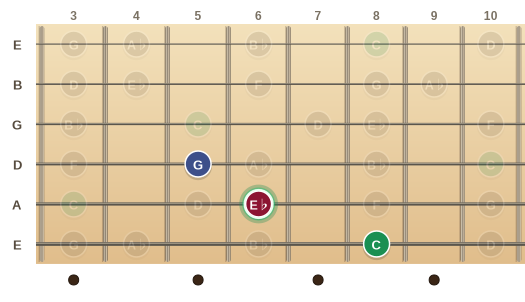
Start with the C major triad in root position on the sixth, fifth and fourth strings. Its notes are C, E and G 1:47Watch at 1:47. Move the E down one fret to E♭ and leave the other two notes where they are. That's a C minor triad: C, E♭ and G 2:07Watch at 2:07.
Play the major shape, then the minor one, a few times each, and listen to what that one fret does to the chord. Everything else in this guide is those same three notes, C, E♭ and G, moved around the neck.
Invert it in one position
Inverting a chord just means rearranging its notes 2:29Watch at 2:29. The note to pay attention to is the bottom one 2:51Watch at 2:51:
- Root position: the root is on the bottom.
- First inversion: the 3rd is on the bottom. It doesn't matter if it's a major 3rd or a minor 3rd. Any triad with its 3rd on the bottom is in first inversion 2:51Watch at 2:51.
- Second inversion: the 5th is on the bottom 2:51Watch at 2:51.
To get from one to the next, move the bottom note up an octave, onto the string just above the shape, and leave the other two notes exactly where they are 3:13Watch at 3:13.
Start from C minor in root position on the sixth, fifth and fourth strings. Move the C up an octave and you have a first inversion on the fifth, fourth and third strings. Listen to it next to the root position, because it sounds very different 3:34Watch at 3:34. Move the E♭ up an octave and you get a second inversion on the fourth, third and second strings 3:56Watch at 3:56. That one is the same shape as the open A minor chord most people learn early on, played on just the three strings you're fretting 4:16Watch at 4:16. Move the G up an octave and you're back in root position, this time on the top three strings and an octave higher 4:37Watch at 4:37.
That's four C minor triads in one area of the neck already 5:21Watch at 5:21.
Know where the root is
As you learn each shape, know where its root is 5:21Watch at 5:21. In the first shape the root is the bottom note, under your pinky. In the second it's the top note, on the third string. In the third it's still on the third string, but now it's the middle note. In the fourth it's on the bottom again 5:42Watch at 5:42. You want to know where the 3rd and the 5th are as well, but get the roots first. The root is what lets you move a shape anywhere on the neck and play D minor, F♯ minor or E minor with the exact same shapes 6:03Watch at 6:03.
Climb the same strings to a new position
The next way to invert keeps the chord on the same strings and moves it up the neck 6:24Watch at 6:24. Take the root position on the sixth, fifth and fourth strings and move each note up its own string to the next chord tone. C moves up to E♭, E♭ moves up to G, and G moves up to C 6:47 +16:477:08.
Now you have a first inversion starting on the sixth string, and it's exactly the same shape as the first inversion that started on the fifth string. Shapes starting on those two strings always look the same, so you can move them across string sets as well as up and down the neck 7:30 +17:307:51.
From here, invert across the strings the same way you did in the first position. Move the E♭ up an octave onto the third string for a second inversion. It looks a little different from the second inversion in the first position, and that's only because of how the guitar is tuned 8:12Watch at 8:12. Move the G up for a root position on the fourth, third and second strings. It has exactly the same pitches as the root position on the top three strings in the first position, in a slightly different shape because it's on different strings 8:33 +18:338:53. Move the C up and you get the easiest shape in this guide: a first inversion on the top three strings with every note on the same fret, so one finger plays the whole chord 9:15Watch at 9:15.
In that shape the root is on the first string. Every first inversion triad on the top three strings has its root on the first string, major or minor. For G minor, find G on the first string and play the same shape there. For E minor, find E 9:36Watch at 9:36.
A chart online can show you these shapes, but it won't show you how they work, so take the extra time to know which chord tone is on each string 10:27 +110:2710:48.
The third position, and down by the open strings
Do the same climb once more from the first inversion on the sixth string: E♭ moves up to G, G moves up to C, and C moves up to E♭. That's a second inversion high up the neck, and it's the same shape as the second inversion you played from the fifth string in the second position 11:09 +111:0911:31.
Then invert across the strings again. The G goes up an octave to the third string for a root position that looks like the very first C minor shape, an octave higher 11:52 +111:5212:14. The C goes up to the second string, and then the E♭ goes up to the first string 12:35Watch at 12:35. In the video I play that last shape as D minor. Its root is on the second string, so if you know the notes on the second string you can find D there and play the same shape 12:58Watch at 12:58.
That's every inversion on every set of three neighboring strings: three inversions on four string sets, twelve shapes in all. Past this point the positions start repeating 3:56 +13:5624:25.
Some of these shapes also work an octave lower, by the open strings. With C major you get every inversion there, because the open strings line up with C, E and G, but C minor needs E♭, so you only get some of them 13:47 +113:4714:07. Start with the low, dark-sounding second inversion on the bottom three strings 14:07Watch at 14:07. Move its G up to the open G string for a root position, then its C up to the second string for a first inversion 14:27Watch at 14:27. That's as far as it goes, because the next move needs an E♭ on the first string, and the open first string is already E 14:48Watch at 14:48.
With any chord you learn, try to find it in as many places as you can. Knowing the notes on every string is what makes that possible 15:10 +115:1015:30, and the notes on the fretboard guide shows how I teach them.
Move them to B minor and A minor
When an A minor comes along in a song, you want more options than the same A minor chord every time, so you can come up with cooler parts and improvise over it 17:44 +117:4418:09. The root tells you where each shape goes. Pay attention to the 3rd and the 5th too, but the root is the most important part 18:09 +118:0918:30.
B minor is an easy one to start with. B and C are a half step apart, one fret, so every C minor shape moved down one fret becomes B minor 18:50 +118:5019:13. The notes change with it. B minor is B, D and F♯: B is the root, D is the minor 3rd and F♯ is the 5th. B major would have D♯ as its 3rd, and in B minor that D♯ comes down to D 19:34 +119:3419:56. You can lean on the shapes you already know, but it's still better to know the actual notes, because that's what lets you invert the chord around the neck 19:56Watch at 19:56.
A is a whole step below B, so every A minor shape sits two frets below the matching B minor shape 20:38 +120:3823:19. A minor is A, C and E: A is the root, C is the minor 3rd and E is the 5th 23:40Watch at 23:40. The shapes are always the same. The notes tell you where to put them 24:01Watch at 24:01.
That's how you move into new keys: start from the one you know, go to chords a fret or two away, and move a little further each time 20:59Watch at 20:59. Pay attention to the note names as you go. Each B minor shape puts B, D and F♯ on three different strings, so you're learning the fretboard at the same time 22:56Watch at 22:56.
Solo with one position
Running the inversions up and down is a step you need so the shapes get into your head, but it isn't the most fun or musical way to practice them 16:32 +116:3226:15. Triads are just as important for solos as they are for rhythm guitar parts 26:36 +126:3626:58, so the next step is to improvise with them.
Go back to C minor, since that's where you've spent the most time, and pick one position 26:15Watch at 26:15. Set a steady tempo and play quarter notes, one note at a time, picking notes out of the C minor shapes in that position in any order 26:36 +126:3626:58. Keeping the rhythm going is the most important part. If you hit some wrong notes, that's fine 26:58 +126:5827:18. Try staying on one note for a while and pedaling off it, then switch to eighth notes 27:41Watch at 27:41. Keep your hands loose and listen to the band while you play.
Once that feels comfortable, let in some notes that aren't in the triad, like a note one fret below a chord tone, and then come right back to the chord tones 28:10 +128:1028:32. In the video some of the notes I played weren't in the key at all. I even played an E natural, which belongs to C major, and it still sounded pretty good when it went back to the C minor shape 29:17Watch at 29:17. That works because you keep coming home to the root, the minor 3rd and the 5th, and those always sound good over the chord 29:39Watch at 29:39. It also depends on the rhythm. If a note outside the triad slips in, even by accident, keep the rhythm steady and you can always come right back 28:55Watch at 28:55.
Slide between positions
Don't get stuck in one position 29:39Watch at 29:39. Take two positions next to each other and solo across both. Look for chord tones on the same string in each position and slide between them 30:00Watch at 30:00. Sliding up and down a string gives your lines a vocal quality, and you can't get those big, wide slides while you stay in one position 31:11 +231:1131:3131:54.
Then skip a position and solo between the first and third positions 31:54Watch at 31:54. This takes real fretboard visualization, and it's where knowing the notes helps the most. I don't think about which fret a shape starts on. I know there's an E♭ here, a C here and a G there, so I know where the shape is 32:15 +132:1532:36. The slides and the big interval jumps you get this way make your playing less predictable 33:49Watch at 33:49.
Don't spend too long only running through the shapes. Do that until you're comfortable, then start improvising with them as soon as you can, over a metronome or a drum track with solid rhythm 34:11 +134:1134:31. After that, try soloing over chord progressions using only triads 34:31Watch at 34:31.
A step without Jamsville
Pick a song you know that has a minor chord in it. Find that chord as a triad in two different places on the neck and say its three notes out loud. Then play along with the recording and, whenever that chord comes around, use only those three notes.
Keep going
The next part of this series is diminished and augmented triads. Each of those is also one changed note away from a triad you already know.
In this learning path
Questions guitarists ask
What's the difference between a major and a minor triad?
Only the 3rd. A major triad is a root, a major 3rd and a perfect 5th. A minor triad lowers the 3rd by a half step, which is one fret on the guitar. C major is C, E and G, and C minor is C, E♭ and G.
How many minor triad shapes are there on guitar?
Each set of three neighboring strings has three inversions: root position, first inversion and second inversion. Four string sets with three inversions each gives you twelve shapes. In C minor they fall into three positions up the neck, and some of them repeat an octave lower by the open strings.
How do you invert a minor triad on guitar?
Move the bottom note up an octave, onto the string just above the shape, and leave the other two notes where they are. To stay on the same strings and move up the neck, move each note up its own string to the next chord tone.
How do I play minor triads in other keys?
Know where the root is in each shape, then move the shape so the root lands on the new note. B is one fret below C, so every C minor shape moved down one fret is B minor. A is a whole step below B, so every A minor shape is two frets below the matching B minor shape.
How do I use minor triads in a solo?
Pick one position, set a steady tempo and play the chord's notes one at a time in quarter notes, then eighth notes. Keep the rhythm going, let in a few notes outside the triad and come back to the chord tones, then solo across two positions and slide between chord tones on the same string.
Keep going
Keep what you open here. A free Jamsville account saves your boards and sequences to your Practice Library and keeps your progress on every device.
Make your free accountSubscribe to Jamsville on YouTube
Where this comes from
This guide is written from these lessons on the Jamsville channel. The timestamps in the text link to the moment each idea is taught.