

After each pass the video waits as long as the loop, so you can play it back.
Start slower with −, and it climbs to 100%.
Keys: Space play · ← → 5 s · [ ] set start and end · − = speed · L loop
Chords and harmony · Intermediate
What Are DIMINISHED Chords? Building and Using Them In Music
In this lesson
Tap a time to watch that part. loops it, so you can slow it down and play along.
-
Key idea Triad qualities come from moving the 3rd and 5th
Triads are root, 3rd, 5th; the qualities are formed by raising or lowering the 3rd and 5th by half steps while the root stays. Diminished = major triad with 3rd and 5th lowered; it is symmetrical (all minor thirds).
-
-
Key idea Where the diminished triad lives
The diminished triad is the vii chord in a major key and the ii chord in the relative minor.
-
Key idea Half-diminished = m7b5
A half-diminished seventh is a major seventh chord with 3rd, 5th and 7th lowered a half step (also called minor 7 flat 5); its b7 breaks the minor-third symmetry. It is vii in major and ii in minor.
-
-
Key idea Fully diminished 7th: double-flat 7, from harmonic minor, only three exist
The fully diminished seventh lowers the 7th by two half steps (bb7). It is not in the major scale but is the vii chord of harmonic minor (natural minor with raised 7th). Being all minor thirds, there are only three unique dim7 chords.
-
Key idea The 7th (chord tone) vs the 7 chord (in the key)
Distinguish "the seventh" as a chord tone inside one chord from "the 7 chord" as the chord built on the 7th degree of a key.
-
-
Key idea Half-diminished as ii of a minor ii-V-i
The most common use of half-diminished is the ii in a minor ii-V-i, where natural and harmonic minor sounds mix; with enough tunes the ear starts expecting V-i after a half-diminished chord.
-
-
Key idea Dim7 as a substitute for V
A fully diminished seventh can replace the V chord in a minor ii-V-i (or any V-I motion) because it shares three notes and the same tension wanting to resolve to I.
-
-
Key idea Passing diminished chords between chords a whole step apart
A dim7 placed between two chords a whole step apart pulls up (or down) into the second chord; use it to write your own progressions by inserting passing diminished chords between diatonic chords.
-
Practice it
- C diminished in one area of the neck: root position, 1st inversion, 2nd inversion, root position. The root, C, is lit in each shape.From the guide: Diminished and Augmented Triads on Guitar Open in Jamsville
- Guide Minor Triads on GuitarFor “Triad qualities come from moving the 3rd and 5th”. Build the minor triad from the major one by changing one note, find all twelve C minor shapes, move them to other keys and solo with them over a band. Read it
The guide
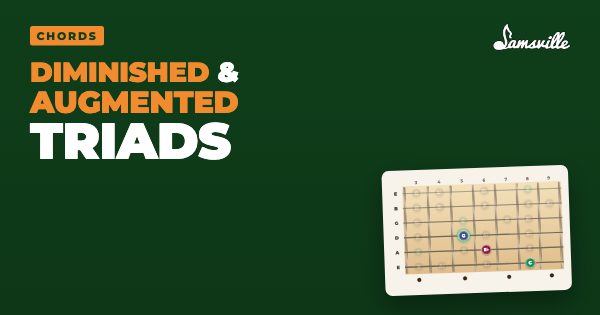
In the learning path Learn Triads the Right Way.
About this video
Learn what diminished chords are, and how you can use them to make your progressions sound pro! The diminished chord is one of the most intriguing, yet confusing chords there is. If you listen to the diminished chord by itself it sounds very tense. This tension that the diminished chord creates can be really useful to us in writing and playing music.
Once you learn how diminished chords are constructed, the different types that exist, and where they come from, you will have a much better understanding of how and why to use them in your music!
Transcript
YouTube's automatic captions. Tap a time to watch from there.
- we're gonna be talking about what diminished chords are and how to use them there's three basic types of diminished chords that you need to know the first one is the diminished triad essentially triads are chords that have three notes in them the basic triads all have some sort of root note third and a fifth and the way that we form the different triad qualities is by
- manipulating the thirds and fifths raising them or lowering them by half steps while the root remains constant to form a diminished triad we take a major triad and lower the third and the fifth by a half step here's what that sounds like on the guitar so we start with the notes c e and g the root third and fifth of
- our major triad and we lower e and g to e flat and g flat respectively this gives us our c diminished triad one thing that's extremely extremely important to note about this chord is that it's symmetrical meaning that
- all the notes are the same interval away from each other they're all minor thirds apart this is going to be extremely important later on in this video so make sure you're paying attention in any major key the diminished triad can be found as the 7 chord in the key in the key of c major this would give us a b diminished triad
- with the notes b d and f the reason we know this is a b diminished chord is because a b major chord would give us the notes b d sharp and f sharp d and f are half step lower than d sharp and f sharp respectively thus we have b diminished the diminished triad is also the two
- chord in minor keys in the key of a minor for example which is the relative minor of c major b diminished is the ii chord the second type of diminished chord you need to know is the half diminished chord now we're venturing away from the world of triads and into the world of seventh chords a seventh chord is a triad root third
- and fifth that has a fourth note added on the top the seventh all of the different types of seventh chords are derived by manipulating the thirds fifths and sevenths while the root always remains constant a half diminished seventh chord is formed by taking a major seventh chord and lowering the third fifth and seventh
- by half step here's what that sounds like so we start with a c major seven chord c e g and b we lower the third fifth and seventh by half step respectively to e flat g flat and b flat
- the reason this chord is labeled half diminished has to do with the type of seventh it contains this c half diminished has a b flat note as its seventh which makes it a minor 7th interval away from the root note of c if we decided to go up from that b flat to the c an
- octave higher it's actually a whole step away this b flat note is also a major third away from the fifth of the chord g flat so as you can see this note breaks the symmetry of the diminished triad containing only minor third intervals also another extremely common way to name the half
- diminished chord is to call it a minor 7 flat 5 chord because that also accurately describes its construction just like the diminished triad the half diminished chord is found as a 7 chord in any major key in the key of c major the 7 chord is b half diminished the same thing applies to minor keys and
- this is probably the most common use for half diminished chords which we'll cover in a few minutes in the key of a minor again the relative minor of c major the two chord is b half diminished and the third type of diminished chord you need to know is the fully diminished seventh chord this chord can be extremely confusing
- for people but it's much less complicated than it seems at first the fully diminished seventh chord is formed by taking a major seventh chord and lowering the third and the fifth by a half step and unlike the half diminished chord we lower the seventh by two half steps giving us a diminished or double flat seven here's what that
- sounds like by the way these voicings that i'm playing are actually not the ones that guitarists usually play they usually play other kinds of voicings that are easier much less stretchy but these are the ones where we stack straight up the root third fifth and seventh and
- it's easier to conceptualize in that way so again the only difference between the fully diminished chord and the half diminished chord is that seventh the half diminished chord just has a normal flat seven and the fully diminished chord has a double flat seven the fully diminished seventh chord is not found in the major scale
- however it is found in other scales and the most common scale it can be found in is the harmonic minor scale and the way we construct a harmonic minor scale is by taking a natural minor scale and raising the seventh scale degree a half step for example c natural minor has the notes c d e flat f g
- a flat and b flat in it c harmonic minor takes to b flat and raises it to b natural giving us the notes c d e flat f g a flat and b in this scale we can see that there is a b fully diminished seven chord that can be derived from the notes b d f and a flat and this
- is the seven chord in that scale i know there's a lot of the number seven going on here seven this and seven that but it's important to make the distinction between the seventh when we're talking about a chord tone in a specific chord and the seven chord in a key one final thing to notice about the fully diminished
- seventh chord is that it is again perfectly symmetrical each of the notes are exactly a minor third apart because of this there are actually only three unique diminished seventh chords for example b diminished seven is the same as d diminished seven is the same as f diminished seven is the same as a flat slash g flat
- diminished seven they all share the exact same notes and the only difference is what note is on the bottom and sometimes the spelling which can get kind of annoying by the way if you're enjoying this video so far and getting value make sure you drop a like down below and if you want me to help you get better faster guitar then make sure you
- freaking subscribe to the channel how we can use diminished chords for this section of the video we're gonna focus mainly on half diminished seven chords and fully diminished seventh chords and what the most common uses for each of those are now there's tons and tons and tons and tons of advanced different uses for all these
- chords that would take several videos that are hours and hours and hours long each so we're just gonna focus on the most common practical uses for these chords let me know in the comments down below if you want to see a part two to this video where i get into those more advanced ways of using these chords
- the half diminished chord is most commonly used as the two chord in a minor two five one progression one thing you need to keep in mind here is that in minor chord progressions the sounds of natural minor and harmonic minor are often used in conjunction with each other in order to create harmonic motion for
- example in the key of a minor a 2-5-1 progression would look and sound like this b half diminished to e7 to a minor now when you play through tons and tons of tunes that contain this progression
- i for one almost start hearing automatically the five and the one chord whenever i hear some kind of half diminished chord being played after that i always just hear bo bo i know i'm really good at singing let me know in the comments
- how good i am at singing the fully diminished seventh chord is most commonly used in two ways the first way is as a substitute for the five chord in a minor two five one progression or in any other progression that contains a five to one motion and the second way is as a passing chord so if we take that same two five one
- progression in a minor we can swap out the e7 for a g sharp fully diminished seven chord the reason is because there are three common notes between those two chords the e7 has e g sharp b and d and the g sharp diminished chord has g sharp b
- d and f in it this is what that sounds like the diminished seven chord functions in exactly the same way that the five chord functions because the five chord functions to create tension that wants to resolve to the one
- and again the diminished seven chord being a very dissonant tense sounding chord creates the exact same tension and it has the same notes almost as the v chord that wants to resolve to the one chord the other extremely common way that fully diminished seventh chords are used is as a passing chord between two chords
- that are a whole step apart from each other let's check out this chord progression or something like this
- we can hear that the diminished seven chord is functioning to create tension but in a slightly different way than when we use it as a substitute for the v chord so between the g chord and the a minor chord the g sharp diminished seventh chord is functioning to pull us up to that a minor chord
- and between the e minor and the d minor chord the e flat diminished is functioning to pull us down to d minor a lot of times you see diminished seven
- chords used to pull you from the four chord to the five chord or the five to the sixth or the 3 to the 2 or any of those in reverse that's what happened in that second progression so in the second one we could think of this being in the key of c even though there's no c major chord in the progression so we have f which is the four chord
- f sharp diminished which is going to pull us up to the five chord then the five chord then g sharp diminished which is going to pull us up to the sixth chord and then the sixth chord so you can use this as a really really
- cool tool to write your own chord progressions by messing with all the different chords in the major scale and throwing passing diminished chords in between those chords of the major scale in order to really get the most out of this concept of diminished chords it's really really important that you know your guitar fretboard super well
- and if you're confused at all about the guitar fretboard and you're looking for a step-by-step system that lays it all out a hundred percent clear so you can master the guitar fretboard make sure you head on over to jamesville.com and check out the jamsville gps fretboard fundamentals course and until next time
- listen learn and jam