
After each pass the video waits as long as the loop, so you can play it back.
Start slower with −, and it climbs to 100%.
Keys: Space play · ← → 5 s · [ ] set start and end · − = speed · L loop
Chords and harmony · Intermediate
You Can Play This ONE Shape On ANY Chord!
In this lesson
Tap a time to watch that part. loops it, so you can slow it down and play along.
-
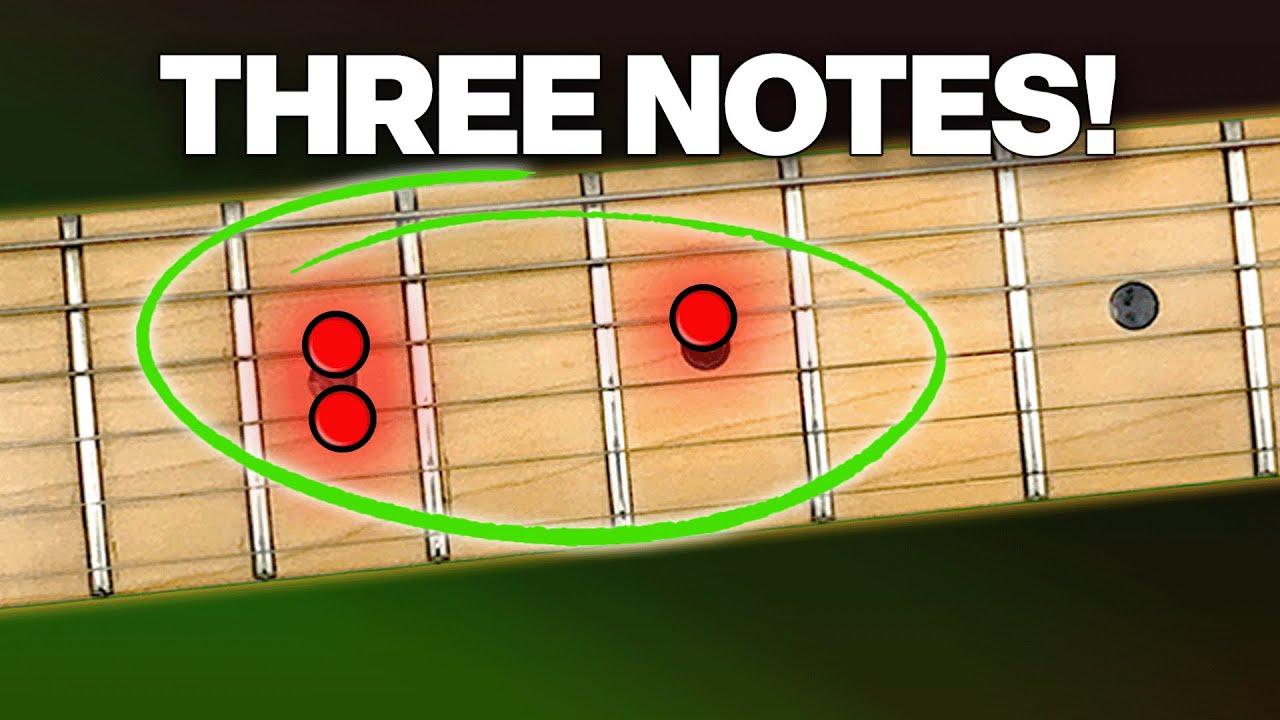
Key idea Sus2 triad: 1 2 5
A sus2 triad replaces the third with the second (1-2-5), so it is neither major nor minor and works over both major and minor chords.
-
-
Exercise Same sus2 shape on each chord root
Over Dm-G7-C, play one sus2 shape from each chord's root (Dsus2, Gsus2, Csus2), keeping the same string set; then blend it into normal soloing.
-
How to practice Break the shape into two notes
You don't have to play every note of the triad; break it into two notes (e.g. D and G, or C and D).
-
-
Fix Finger roll without letting notes ring
When barring two notes (finger roll) on the higher string sets, make sure each note is distinct and the previous one is cut off; two ringing notes sound sloppy.
-
Key idea Know the notes one string at a time
Finding sus2 triads through the whole key depends on knowing notes one string at a time and the notes across the fretboard.
-
-
On the neck Sus2 triads in a key start on 1, 2, 4, 5, 6
In any major key, diatonic sus2 triads exist from scale degrees 1, 2, 4, 5 and 6 (C, D, F, G, A in C); 3 and 7 give other structures. Any of them works over any chord of the key.
-
Key idea Spam a new concept, then blend it in
To integrate a new concept, overuse it at first ('spam' it) while practicing; it won't make a great solo, but then it starts to come out naturally in your playing; then blend it with your normal soloing.
-
Practice it
- Guide Diminished and Augmented Triads on GuitarFor “Sus2 triad: 1 2 5”. Turn the minor and major triads you already know into diminished and augmented triads by moving one note, then use them with the band to pull into the next chord. Read it
- Guide Minor Triads on GuitarFor “Sus2 triad: 1 2 5”. Build the minor triad from the major one by changing one note, find all twelve C minor shapes, move them to other keys and solo with them over a band. Read it
- Guide How to Learn the Notes on the Guitar FretboardFor “Know the notes one string at a time”. Learn the seven natural notes as one pattern, find it on every string, and make up a solo on a single string today. Read it
- Drill One string at a time ProFor “Know the notes one string at a time”. You'll stop living inside one box and see the scale run along each string. Open
Transcript
YouTube's automatic captions. Tap a time to watch from there.
- so in today's lesson we're going to be going over a freaking awesome arpeggio that you can literally play over any chord in any chord progression that you encounter and not only can you play it
- over any chord but it's going to make you sound really really modern and awesome so without further Ado let's get started it's actually a Triad that we're going to be taking a look at and it's called the sus 2 Triad okay so some of you may have heard of the concept of a sus 2 Triad before but you may not have
- actually used it in guitar solos so with that being said we're going to go over this Triad and we're going to go over some different ways to play it and then we're going to show you how it is that you can actually use it over literally any chord in a chord progression that's the cool thing about it is just this kind of one shape that we can move
- around and it sounds awesome so a sus 2 Triad is different than a regular Triad so in a regular Triad we have a one three and a five so if you watch any of my videos about Triads you know that there's different ways of making that 1 three and five like you could have a one flat three and a five that makes a Minor
- triad or you could have a one three and a sharp five that makes an augmented Triad there's different kinds of Triads then the basic ones that we use most of the time are going to be major and minor and maybe diminished every once in a while so with a sus two Triad what we do is we actually get rid of the third in the Triad and instead we have a one two
- and a five so that gives us the sus two so we're kind of suspending the third almost like bad get out of there third we're suspending you and we're going to replace the second the third's not doing a good job we want to get the second in there so if you see on screen we actually have written out there a d sus2
- Triad so it has the notes d e and a and right off the bat this is a hugely important shape that you're going to learn we're going to learn in a couple other string sets as well because there's a slightly different fingering when you play a different string set but you can see this thing is really really easy to remember and you can play it
- fast pretty easily too like or and if you've ever listened to any of my playing videos you probably heard me rattling that off a few times here and there so I can actually play this instead of let's say there's a D minor chord in my chord progression I can
- actually play this D sus 2 Triad so one more time just so you really understand how it works Works let's go ahead and analyze the notes that are going on here so normally if we had a D Minor triad which by the way we're going to be playing over a backing track in the key of C and we're going to go over that chord progression in a second but the first chord is actually going to be a D
- minor in that chord progression so D Minor would actually have the notes d f and a in it so if you notice there there's a d e and an A so we had the one the flat three would be F and then a would be the five but D sus 2 has d e
- and a so D is one e is two and a is five so that e is the sus to so literally it's only one note different from a Minor triad and also by the way it's only one note different from a major Triad so for example uh when we play over this track we're also going to be
- playing over a C major chord okay and over that c major chord first of all we can actually play you'll see we can play this sus two tried from several different places over the chords too we don't have to just play it based on the route but we're going to have a c sus to tribe so if we had a c normally we would have a C major chord happening like as
- the one chord in the key of C major but instead what we're going to do is we're going to play CS to so normally a C major chord would be uh this following chord here it would be c e and G that' be the one the major third and the fifth so again if you understand tries a little bit you know that the major third
- is in a major chord and a minor third is in a minor chord it doesn't matter so I can play this sus two chord over either a minor or a major Tri it doesn't matter because we're getting rid of the third we're getting rid of the thing that makes it major or minor so C sus 2 would be C D and G so one two and five
- okay so that's how the sus two Triad kind of works and now we're going to go over some different ways to play it okay so what we're going to do is we're going to take a look at this chord progression and this backing track that we're going to be playing over so the chord progression is going to be D minor G 7
- or you could just think of it as G major the five chord it's going to be D Minor G7 and then C major with that being said how can we apply this sus 2 Triad idea to this chord progression over the D Minor we're going to play D sus 2 and
- we're just going to go ahead and move this shape around okay so we're not even going to change string sets we're just going to move the shape on so we're going to play this DS to so we're going to make sure that first note there is a d okay and then what do you think we're going to play over G7 again G7 is just a dominant chord which is a major triy that has a flat seven on it so we can
- still play that sus two so we're going to play a g sus 2 and then finally over the C we're going to play a C sus 2 so we can actually play literally that exact same Triad shape over all the stuff so move this up here boom there's G sus to cuz that first note there is G
- and then I'm going to move it down and we're going to have C sus2 so d sus2 g sus2 and then C sus two so let's go ahead and play over the backing
- track so you see right there that it works very very well over all of those chords there's certainly nothing that's clashing whenever you work in a concept okay you want to kind of blend that Concept in with your normal playing so now that I just kind of spammed only
- that sus two Triad I'm going to go ahead and seal a little bit more of that and I'm going to play the a little bit of sside and maybe play some other stuff over it so I'm not gonna put all the diagrams of every C major scale and all that if you're working on this you should probably already know your notes across the fretboard and you should know
- the c major scale or the a minor pentatonic scale something you could play in the kefc but I'm just going to do some my normal soloing but then I'm going to throw in that sus to Triad just a little bit here [08:03] [08:29] so you can see there too that uh you don't always have to play all the notes in the trial like sometimes I like to just go between two this kind of thing where I just break it up into maybe two notes the D and G or the C and the D so you don't have to always play the
- whole entire thing all the way through so now that we went over that sort of uh concept that we can play the Susu Tri it over any major Corder or any minor chord now I want to show you something which is going to be even cooler which is that you can go through the whole entire key that you're playing in and you can find
- these sus two Triads there's a whole bunch more that we can find in the key that we can actually still play over any of these chords the only thing is that at some points we want to be careful that there aren't any clashes okay and you don't have to worry about it too much because there's not really too many spots where it's going to clash so for
- what we'll do right now is actually switch string sets so that we can simultaneously cover a different shape of playing so this is our sus2 Tri as you can see on the third and second strings but what about in the second and first strs this is actually going to be really good to cover because guess what it's going to be the same shape on every other set of strings except for the third and second strings so actually if
- I take this same exact C sus2 tride I can play it over here boom so now you can see that shape is very very similar you still have two notes on the lower string that we're playing and then you have one note on the higher string that we're
- playing and in a way this one's almost easier to play fast because you have this opportunity to Bar these two notes now some of you might not be comfortable with this idea of a finger roll but if you want to play this like this and you want to play it fast like when I come back down you want to make sure you don't let
- both of these ring out at the same time that kind of makes it sound a bit sloppier you want to make sure that every single one of those notes has a distinctive uh sound to it and that the previous note gets cut off before we play it so guess what if we go through
- the whole entire ire key of C this is by the way why it's so important to know the notes on one string at a time because if not you're not going to be able to do this anywhere near as easily we're going to go through the kefc and find all of the sus two Triads that we can possibly play and then we're going
- to see how we can actually use some other ones over different chords like for example I'll just tell you right off the bat you can actually play this C sus Triad the C sus2 Triad over the D minor chord as well you don't just have to play D sus Triad over the D minor chord you can play a DS Triad over many other
- chords in the progression it's going to give you some really cool sounds so we can actually have this C Triad C sus2 Triad and then if I move everything up we have the D sus2 Triad same thing as before now if we move every single note up in the key we're going to get something that's not a sus two tried so
- if we start from E and we have e f and then B that is not a sus two Triad okay that's something different um you could call this I guess a sus flat 2 Triad uh we're not going to get into that but let's just see hey that's not a sus two Triad so it doesn't really work if we start it from the key of or
- if we start it from an E note because if we play this note here sharp well that's not in the key okay now we're going to actually try from F so what about F oh look we can actually have an F sus two Triad all those notes are in the key of C F G and C so we have right
- here we had C sus D sus and an F sus and then guess what you should remember from before that we can do G Su so we move everything up a whole step and then boom we have G sus to so then we have that and then we have
- if we move everything up another whole step we have Asus 2 which also works so we can play Asus to and then finally the last one actually we cannot do as a sus two Tri so if we start from B and then go like this that's not a sus two Tri that's a
- cool structure that you can totally play but it is not a sus two triy it okay and the whole point of this is we want to just use the same shape over and over again so let's uh write at that down actually see all of the different places that we can play in the key so we
- can play seus we can play D sus we can play F sus we can play G sus and we can play as suus so if you just remember that that's going to really really give you a ton of
- stuff to work with when you're soloing and by the way if you want to transpose this to other Keys you should remember actually what note it starts in the key so basically you can start it from the one you can play it on the one chord from the one chord doesn't mean that you can't play it anywhere else over any
- other chord you can play it over any of the chords but I'm talking about finding that actual suspended structure starting it from the first note we can also start it from the second note we can also start it from the fourth we can start it from the fifth and we can start it from the sixth so one 2 four five and six so
- if you take any key that you're working on and you start from the second note or the first note or the fourth note or the fifth note or the sixth note all of those sus two Triads are going to work perfectly in that key okay so with that being said now we already figured out by the way you could go up here this is the
- octave higher of that c sus2 Triad that we were that we were working on before now I can just go through and actually try to just randomly play any of those okay so now I'm going to actually solo over the track and I'm going to be indiscriminately using either of those five different sus
- two Tri it options we have we have again C sus D sus F sus G sus and as sus so C sus D sus F sus G sus and a sus so I'm just thinking of the first finger this is C start to shave from there and D start to shave from there F start to shave from there G start to shape from
- there a start to shape from there okay so any of those are going to work absolutely perfectly let's see what that sounds like [16:22] so you can see right there it it like really worked really well okay would I actually play only those Susu Triads like just like that in SLO probably not
- maybe for uh second or two you know just to expand upon a musical idea but again we're not trying to play a great solo here we're just trying to actually learn a new concept and integrate it into our solos Okay so in order to do that we need to kind of spam that concept A lot and then it will start to come out when
- we're actually naturally playing so just really quick I said that before this is the exact same shape that you're going to find on the other sets of strings so look this C sustr on the middle four strings or sorry the middle two strings you have the four string and the third string boom that's the same shape so I can play from seus here's uh D sus would
- actually be here or you could go here of course uh F sus would be here G sus would be here a sus so any of those shapes you got to remember the Frets and the notes that they start from again if you don't know the notes in the guitar fretboard I don't know how much more convincing you need to to start to learn
- it also same exact shape on these two strings here so C sus D sus f suus g and Asus same exact shapes so that's the really cool thing is that you literally just need to know two shapes um and then you can even do it on the lower strings you're not going to be doing too much on
- the lower strings just because of how low the sound is but here's f suus g sus as suus C sus and D sus and you can use that shape any anywhere you want it's so freaking cool so with that being said uh I'm going to go ahead and solo over this
- track and just incorporate the Susu Triad into my normal playing as well so I'm not going to be only spamming the sus2 Triad I'm going to go ahead and actually make sure that I'm doing some other things as well [18:58] a [19:26] sounds really cool if you actually take out the fifth it just go if you take out the second I mean
- so if you want to learn how to master
- the guitar fretboard so that you feel absolutely 100% comfortable navigating the fretboard in any key so you can take this idea and be able to apply it to any key effortlessly and not have to think about the notes on the neck and just know them really well then make sure you
- head on over to jamille. comom right now and get the Jamesville GPS fretboard fundamentals course if you want to learn how to master the guitar fretboard also make sure you head on over to the gemville merch store and pick up a Jamesville t-shirt just like this one that I'm wearing they're super comfortable they fit great they're one
- of my favorite shirts to wear of any shirt that I have so make sure you check them out over we also got mugs we got sweaters all kinds of awesome stuff so that you can show the world that you are a member of the Jamesville Community also make sure you check out my new song it's called My Divine that's what you're listening to in the background right now
- it's available on all major streaming services so click the link in the description below to listen to it and your favorite service make sure you like the video and subscribe to the channel and until next time listen learn and jam feel