
After each pass the video waits as long as the loop, so you can play it back.
Start slower with −, and it climbs to 100%.
Keys: Space play · ← → 5 s · [ ] set start and end · − = speed · L loop
Chords and harmony · Advanced
The MOST IMPORTANT Minor Chord Progression! (Guitar Solo Guide)
In this lesson
Tap a time to watch that part. loops it, so you can slow it down and play along.
-
Key idea Minor ii-V-i
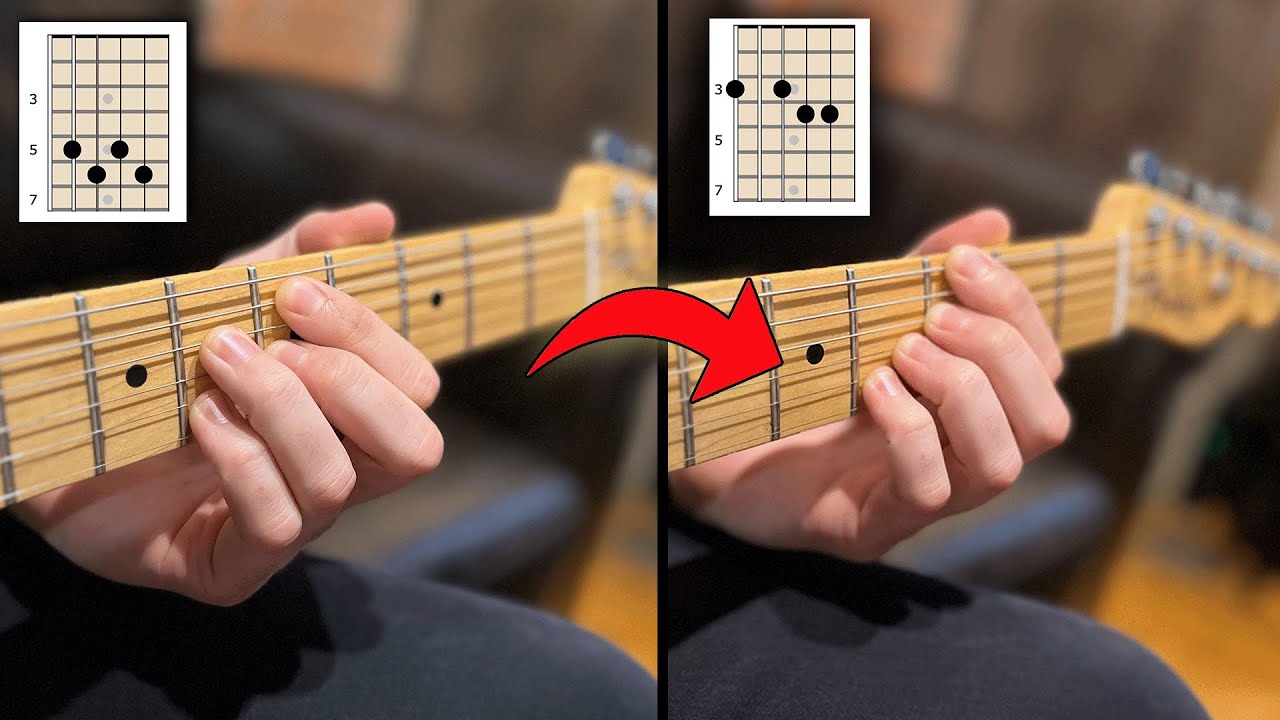
The most important minor progression: iiø7 - V7 - i (Dm7b5 - G7(b13) - Cm7), with C minor for two bars.
-
Key idea Hear the progression before the theory
Before analyzing, listen to what the progression sounds like rather than only talking about notes and theory.
-
-
Key idea Understand the chords to target the best notes
Don't randomly run one scale over progressions; understand the chords you are playing over so you can target the best notes on each.
-
Key idea V7 in minor comes from harmonic minor
Natural minor gives Gm7, not G7. Raising the 7th (Bb to B) gives harmonic minor and the G7; the B is the leading tone begging to resolve up to C, creating the tension the V chord is supposed to create.
-
-
Exercise One-note change over the V
Play C natural minor over Dm7b5, harmonic minor over G7, back to natural minor over Cm7; first play very simply so the B natural on the G7 is audible, then add more variation.
-
Key idea Never playing B natural on V reveals scale-running
Bb over G7 isn't wrong, but someone who never plays the B natural there doesn't really understand how to play over the progression; they're just running natural minor or pentatonic.
-
-
Key idea Use the leading tone over i but resolve it
Harmonic minor can also color the i chord, but don't sit on the B; resolve it up to C unless you're very comfortable with that sound.
-
Practice it
- Guide Chord Tones: How to Solo Over Chord ChangesFor “Understand the chords to target the best notes”. Solo over two chords and hear the changes in your lines, by landing on a chord tone each time the chord changes. Then take the same idea to a ii-V-I. Read it
- Drill Land on a chord tone ProFor “Understand the chords to target the best notes”. You'll land on the note that spells each chord, right on the change. Open
Transcript
YouTube's automatic captions. Tap a time to watch from there.
- so in today's lesson we're going to be talking about the most important minor chord progression that you need to understand and be able to solo over and once you do understand this chord progression how to solo over it you are going to become a much much better guitarist and soloist guaranteed so
- without further Ado let's jump right into it listed on the chord diagrams above you will see the chord progression that we are going to be learning today we're going to learn how to play the chords for and we will also learn how to solo over this chord progression so it is actually very simple it's only three
- chords but you're going to see there's uh some interesting little caveats that we have to take into account that we don't usually have when it comes to major chord progressions so the first chord is going to be D half diminished and this is a way that you can write D half dimin as well with that little circle with a slash through it
- then it's going to be G7 so if you see there in the chord diagram it says G7 flat 13 that flat 13's optional and we're going to get into a little bit of that but just keep in mind it's G7 okay and then finally we we're going to end on a C Minor 7 and this is going to be
- in a minor key A 2 5 1 progression so those of you you might have heard of a 251 progression in a major key but maybe not a 251 progression in a minor key so how does this differ and what makes this actually
- a little bit more complicated than a simple chord progression in a major key that's what we're going to be discussing today so those of you who understand how to construct a minor key we will write out the notes first that are in a C minor scale C natural minor scale so
- those of you might have heard this just a quick refresher if you take any major scale and you start it from the sixth note you will get the relative minor of that major scale which is essentially the minor version of those same notes how ever it still doesn't actually provide us with everything we need to be
- able to play over this chord progression by the way before I even continue let's go ahead and just play it so you can hear what it sounds like and actually here I'll just play a little sample from track that I've made for this
- lesson so that's what the chord progression sounds like we should probably understand what it sounds like and not just talk about the uh notes and all this kind of theory nonsense Theory it's all nonsense anyway so let's go ahead and write out the notes for a C minor scale so we have C D E flat F G A
- flat B flat and and C so actually if I switch over here you're going to see these are the notes in a C minor scale on the guitar neck okay that's just one place to play Okay so let's go back here for a second we'll get there so if we actually build chords on this scale here
- this what we call the C natural minor scale you'll notice that we actually do not get this G7 chord here so that's going of be the little tricky part that we need to figure out in order to be able to play over this Cor progression okay because we want to be able to not just randomly run scales over chord
- progressions but one common theme that you'll see in my videos if you watch any of the other ones I've done is that we want to understand the actual chords that we're playing over so we can Target the best notes on those chords so if we built seventh chords those would be all the chords that we would get okay so we get C Minor 7 D half diminished E flat
- major 7 F minor 7 G minor 7 a flat major 7 and B flat 7 so one problem that you see there is that well there's no G7 chord like is in this chord progression so that means that there's kind of something missing from these chords that isn't going to fully allow us to master
- soloing over this chord progression now some of you might have learned in the past that the five chord its purpose is to create tension that resolves to the one chord and this is something you usually hear with a major chord progression so for example if I play
- this this G7 might resolve to a C major chord it would be the five chord actually in the key of C major but now what we're doing here in this chord progression is we're actually using a dominant chord to create tension that resolves to a minor chord which sounds
- really cool cuz again the whole entire purpose of dominant chords most of the time except for in a blues when it's the one chord in the four chord is to create tension that takes us somewhere okay so how the heck did we get this freaking G7 chord here because if you notice there's a G minor 7 chord if we figure out all
- the chords in the key of C minor so how is G7 how does that how do we square that Circle how does G7 just appear out of thin air well first of all actually it kind of does just appear out of thin air through something called the harmonic minor scale so everything we just talked about here was actually based on the C
- natural minor scale but those of you may be familiar with minor scales and watch my other video on the harmonic minor scale we actually artificially raise the seventh note of the scale up a half step so actually if we took this B flat here and we just
- raised it up a half step now all of a sudden we actually get the note required to turn this G minor 7 chord that's right here into a G7 chord which is right here in this chord progression that we're talking about so you see that we actually have if we built a chord off
- of G we'd have g b natural now D and an F that would be our G7 chord so now instead of G minor 7 something like this we would have this a raise B up to b a raise B flat up to B my
- apologies now we have a G7 chord okay so essentially that five chord in this 251 progression all you need to know is that it actually comes from the harmonic minor scale okay the harmonic minor scale so now with that being said that's actually going to be the key
- thing that we have to do when we solo over this chord progression is we want to actually turn this B flat here into B but only when we play over that G7 chord so now let's go ahead and switch the diagram here so that you have the C
- natural minor scale so here would be the C natural minor scale this is all the stuff that we had written down them before so we have C D E flat F G A flat B flat and C okay so now in the harmonic minor scale what we're going to do is
- we're gonna raise this B flat up to B and now all of a sudden there's our harmonic minor scale so it's actually quite easy all we have to do is just change one note so let's see what that sounds like so C D E flat F G A flat B C
- you notice that b it sounds really interesting it's begging to resolve up a half step to C and that's exactly what the function of this G seven chord in the chord progression is you hear
- this it's dying to resolve to that C minor chord so that b natural creates the tension that the five chord is supposed to create and it resolves us to the one chord so that's the thing about minor chord progressions and that's why this particular chord progression is so
- important important because you have to understand that a lot of times in minor Keys you can't just play one quote unquote scale over the whole entire thing a lot of times you're going to get that five chord that's resolving to a minor chord and you have to understand where that five chord comes from and
- then you have to understand to Target actually that b natural note on that five chord okay so is essentially it's going to be super duper simple so we're going to start soloing over now all I'm going to do is over this D half diminus chord I'm going to
- play natural minor so let's write that down natural minor then over the G7 chord I'm going to play harmonic minor and then over the C minor chord I'm going to go back to playing natural minor so let's try it out now we're going to go ahead and actually play over this
- backing track a little bit and first I'm just going to make play really really simple stuff so that you can hear exactly what's going on so here's D half to minus now there's the G7 and there's the C Minor 7 so we got C minor for two bars let's try it again [10:56] so I'm making sure I'm playing that be natural over the G7 chord so let's try again so here's D half to minist and then there's G7 so all I'm doing is I'm playing my C natural minor scale the whole entire
- time but I'm going to Target that b natural note and I'm going to have this moving up the B flat moving up to B natural on the G7 chord so now I'll go ahead and play a little bit more stuff and see if you can hear when I hit that b natural note okay by the way here's an
- extra little tip is that if you want to you still can play that B flat note over the G7 chord it's not like a wrong note or anything it's not going to sound bad it's actually going to sound pretty good but if I hear somebody who never ever plays the B natural over that chord then
- that kind of tells me that they don't really really understand how to play over that core progression and they're probably just running natural minor scale or maybe they're even running minor pentatonic scale by the way you could play minor pentatonic scale over the Z minor chord as well those of you who don't remember minor pentatonic scale would actually be our natural
- minor scale minus the a flat and the D so that's actually a little mini uh pentatonic scale pattern right there but let's go ahead and put all the notes back so that you can understand so we're going to be moving this B flat up to B on the G7 chord and now I'm going to allow myself to play a little bit more
- variation of different things [13:06] there's that b natural oh I played it there on the C minor chord but I didn't sit on [13:28] it d [13:56] so as you can see there it sounds really really cool and it sounds like oh I'm not just running the same scale over and over cuz I'm not eat but at the same
- time it's not like I'm changing everything right I'm just moving literally one note we can go and add some more notes to this so I was playing a little bit of these here uh you also have a d here you have to be able to learn all of your natural minor scales across the neck and then all you
- got to do to figure out your harmonic minor scales just take the seventh note of the scale in this case in the key of C it would be B flat and you just got to move them out to B that's it it's pretty simple by the way over here as well we' have a B flat and then sometimes I was playing this B natural that's right below this C here so let's go ahead and
- play one more time and now I'm going to do something else which is I'm going to actually play the harmonic minor scale as well over the C minor chord so I actually did that one time for a second but here's the trick is that I'm not going to sit on that b note for a long
- time I'm going to make sure I resolve that b up to C cuz remember you can hear that it it's begging to resolve up to C so even if I'm playing the C minor chord I can use that cool exotic sound
- of that harmonic minor scale but I just have to make sure I don't really like sit on that note for too long unless I'm very comfortable with that sound in that particular context sometimes you can do it but for the most part be careful with that note so let's hear what that sounds sounds like we're going to expand a little
- bit see there I played it over the C minor chord
- [16:47] so if you want to learn how to master the guitar fretboard so that you can figure out your natural minor skills and armod minor skills and everything else that you need to know in order to be able to solo over any chord progression in any key then make sure you head on over to jamille. right now and pick up the Jamesville GPS fretboard
- fundamentals course also make sure you head on over to Jamesville merch store and pick up an awesome Jamesville t-shirt just like this one they fit absolutely great you also have Jamesville coffee mugs I was just enjoying some coffee out of my Jamesville coffee mug make sure you check out the Jamesville merch store
- also make sure you check out my new song it's called My Divine that's what you're listening to in the background right now it is available on all streaming platforms check the link in the description below to stream it on your favorite platform make sure you subscribe to the channel and drop a like on the video it really really helps support the channel and I really
- appreciate the support from all of you and until next time listen learn and jam