
After each pass the video waits as long as the loop, so you can play it back.
Start slower with −, and it climbs to 100%.
Keys: Space play · ← → 5 s · [ ] set start and end · − = speed · L loop
Songs and solos · Intermediate
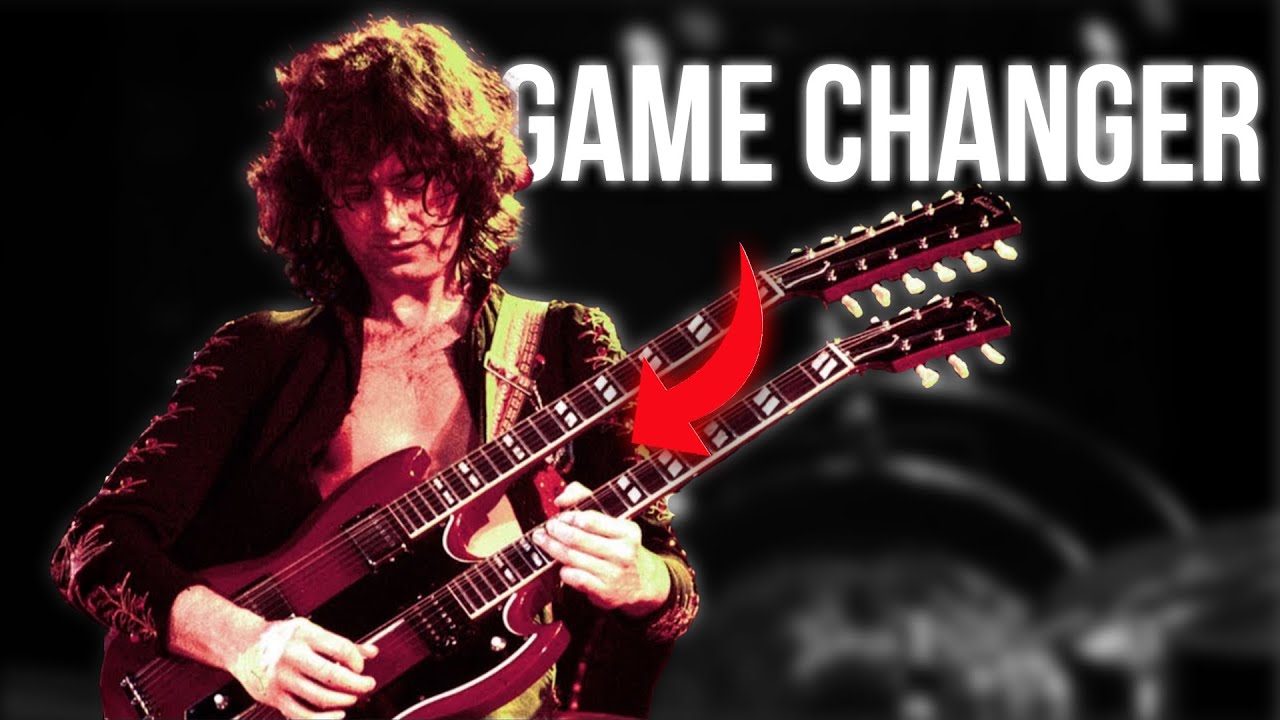
The MAGIC Note In The Stairway To Heaven Solo!
In this lesson
Tap a time to watch that part. loops it, so you can slow it down and play along.
-
Key idea The one key note (Stairway's F)
The Stairway solo is almost all A minor pentatonic plus one note, F, which Page adds exactly when the F chord arrives (Am-G-F, i-bVII-bVI); F sounds crappy held over Am but is the root of F.
-
-
Key idea Scale + key notes beats arpeggio exercise
Over many progressions the same scale works on all chords, but one or two chords have key notes; hitting those makes you sound like you're outlining the changes without the obviousness of an 'arpeggio exercise'.
-
-
Key idea Return of a whole-lick motif
Page recalls his whole 12-note first phrase later, extends it and ends it the same way: motifs are usually 2-4 notes but can be an entire lick.
-
-
Key idea Keep going with solid rhythm through dissonance
Not every note needs to be 'right': a clashing note in a fast line sounds cool as temporary dissonance if you keep going with solid rhythm until you land; the final notes of the phrase should be the consonant ones.
-
-
Key idea Practice solos to change how you improvise
The right way to practice solos is not just memorizing them but extracting what changes how you improvise; Adam learned Stairway as a kid without understanding it until fretboard knowledge showed him why it works.
-
Transcript
YouTube's automatic captions. Tap a time to watch from there.
- To me, the greatest solo of all time is the solo from Stairway to Heaven. And I want to talk about one of the things that's so cool about that solo. See, the thing about this solo is that actually almost all of the notes in the solo literally just use the A minor pentatonic scale, which is kind of hilarious because a lot of guitar
- players almost complain about only knowing the A minor pentatonic scale. But there's one note that Jimmy Paige adds into the solo in multiple different instances that makes all the difference. And if you can understand why he's adding that note in, it'll inspire you to learn how to solo over chord changes
- a little bit better and learn your intervals and your notes across the fretboard. So, the thing that's really cool literally appears in the first phrase of the solo, which goes like this. So right there, that first phrase is literally just coming from the A minor pentatonic scale. And every single note
- of it is in the A minor pentatonic scale, except for literally the last note, this note. This note is an F. And normally the A minor pentatonic scale uses this E note that is on the seventh fret of the fifth string, but he actually plays this note in the eighth fret of the fifth string, which is F. So, the weird part about that F note is
- that actually if we're thinking in the key of A minor and we were playing over an A minor chord, that note would actually sound kind of crappy. And I'll prove it to you. So, I'm going to play an A minor chord on the keyboard and then I'm going to play an F note. And let's see what it sounds like. It's kind of weird like it wants to go
- down here to the E note, which is normally the note that's in the A minor pentatonic scale. So, why does it sound good when Jimmy Paige is using it? This is where actually understanding what's going on with the chord progression comes in and realizing that it depends on what chord you're playing on as to how the notes you're playing are going to sound. So, actually the
- solo section to the song goes like this. So, a lot of us might refer to this progression as one minor to flat 7 major to flat 6 major. And of course, in terms of the actual letters, it's an A minor chord to a G major [music and singing] chord to an F
- major chord. And wouldn't you know that F note is the root of this F chord. And would you guess where he plays that F note? Oh, wouldn't you know it's actually on that F chord. So, like if I sing the first phrase of the solo, I'm not going to sing it amazing. It's very hard to sing. But you'll hear that it actually lines up right where the F
- chord happens. So, like I got to sing it up an octave, but you get the idea. It's funny. He lands on that note not only in the F chord, but literally right when the F chord appears in the chord progression. I think that he knew what notes were in that chord. And that also allowed him to hear that
- phrase and it allowed him to hear like, hey, I can throw that F note in, which normally would sound weird if I just played over the first chord. Although, you'll see later in a second he actually does play it and it actually sounds cool. He knows that definitely it's going to sound good over that chord. So, if we keep going through phrase of the solo, you have the next
- phrase. right there on this part. There's that magical F note again. So, [singing] right there,
- guess what? He plays that phrase on the F chord. Before he gets to the F chord, he never really played any F notes. All this stuff, this is all just a minor pentatonic. And actually this, that's all a minor pentatonic only until he adds that one note F. And actually there technically is a scale be actually
- the D minor pentatonic scale that would actually have that note in it. But I don't necessarily think that he's thinking of switching to the D minor pentatonic scale or anything like that on that F chord. I think that he's thinking of it more as a minor pentatonic. And hey, when I get to that
- F chord, I can use that F and it's going to sound cool. And this is a way that I like to think about soloing over certain chord progressions, too. A lot of times when you solo over certain chord progressions, the same notes will work over all the chords. technically, but there'll be one or two chords in there that have some key notes in them that if
- you can hit, it almost actually makes it sound like you're playing all the arpeggios or something. He could theoretically just play all the arpeggios, but it kind of just makes it too obvious. You're just playing like an arpeggio exercise. rather he's soloing using a scale but making some key
- decisions because of his knowledge of the chord progression. So I want to show you a few other instances in the solo where he uses the same idea. So you have the next phrase. There you go. There he lands on that F finally at the end of the phrase. So he kind of just copies like the first
- phrase of the solo in that and extends it a little bit, but he ends up ending it the same way. By the way, this is such a cool example of motivic development, too. He remembered the first phrase that he played, played some other stuff, and then came back to that original phrase that he played. Motifs a lot of times are usually simpler ideas,
- maybe two, three, four note ideas. But in this case, he remembered a whole entire lick, which is like 1 2 3 4 5 6 7 8 9 10 11 12 notes. So the next phrase is an example of actually him breaking what I'm saying a
- little bit, but it still sounds really cool. So he actually plays over the A minor chord. He's going to play this phrase. So he plays this There's that F. So, he actually just plays like a little snippet of the D minor pentatonic scale because he has that F in there instead of that would be
- a minor pentatonic with an E and instead he has F. So, he goes. So, in that way, even though if he sat on that note, it would sound a little bit nasty. This is an example of how you don't need to overthink every single note when you're playing either because even if you play
- a note that clashes a little bit, if you just keep going with solid rhythm, and there he's playing pretty fast, too. He's playing 16th notes at that tempo. If you just keep going until you land back on some more consonant sounding notes, it may actually kind of sound cool to have that temporary dissonance happening. In other words, not every
- single note in your lines needs to be quote unquote right. What's more important is that the final notes of your phrase are the ones that land on the quote right notes or I think it's better to think of them as consonant notes. And that's exactly why again he lands on the F previously because it's a consonant note on an F
- chord. So even after that phrase happens right here, he hits that F note one more time. So if we skip ahead in the solo a little bit, we have all the stuff that happens like
- and then you have and then you have all that kind of call response happening. There's not really another example of that F until right here. This is one of my favorite parts of the solo where he takes an F and he goes and bends it all the way up a major
- third, which I wish I could say that I use major third bends more in my playing. I should, but I don't. And then he kind of gets out of it into of course a more a minor pentatonic lick. And of course that also happens over the F chord.
- And right [singing] there it switches to the A minor chord. So that is one of the biggest things I learned from the solo actually is that if you want to make something that sounds like it's outlining the chord changes. A lot of times you don't have to worry about hitting every single chord change, you can just play in the key, but find those
- notes that are very important on certain chords that change like that F chord. And it's so cool because I remember when I was a kid, I first learned this solo. I had no idea any of this stuff until I actually started learning the guitar fretboard and I started learning like, oh, this is how that F note relates to the A minor
- chord. That's how it relates to each of the different chords in the progression. And that's why I was able to actually understand why that solo sounds the way that it does. And if you're someone who's been struggling with learning the guitar fretboard and wants to feel really comfortable soloing in any key and be able to understand all these concepts so
- that when you learn solos, you can understand them and apply them to your playing as well, then make sure you head on over to jansville.com and check out the Jansville GPS fretboard fundamentals course, which I made specifically to address that issue forever so that you'll always be able to navigate the fretboard. board in any key and find
- those notes that you want to play instantly. And of course, when you know the fretboard better, you can actually learn solos and extract more information from them that you're going to actually apply in your own playing, which makes you better. And if you want to learn the right way to practice solos, then watch this video where I show you exactly how
- to do that so that you don't just memorize the solo, but you actually change the way you improvise after you learn a solo. If you enjoyed this video, hit that subscribe button, hit that thumbs up button. Until next time, listen, learn, and jam.