
After each pass the video waits as long as the loop, so you can play it back.
Start slower with −, and it climbs to 100%.
Keys: Space play · ← → 5 s · [ ] set start and end · − = speed · L loop
Rhythm · Intermediate
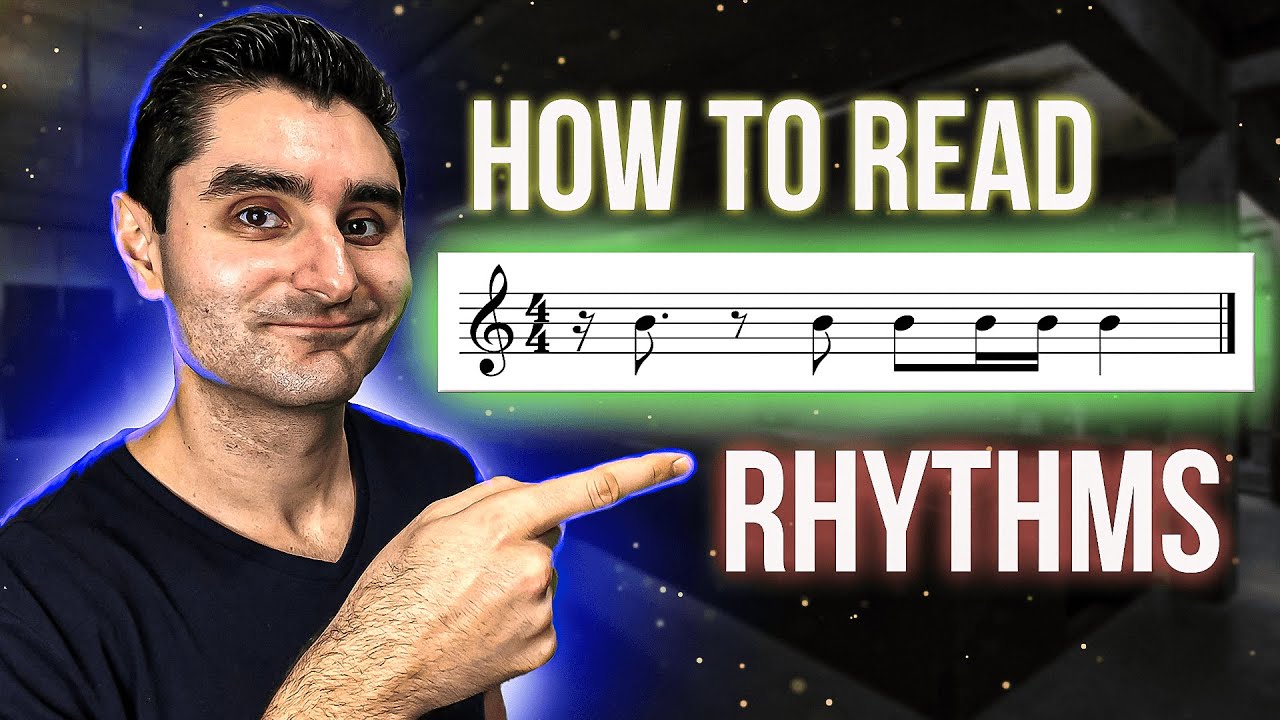
How To Read RHYTHMS (For Guitarists)
In this lesson
Tap a time to watch that part. loops it, so you can slow it down and play along.
-
Key idea Read rhythms even if not reading music
Even if you never read sheet music, reading rhythms teaches how rhythm works and speeds song learning.
-
-
Key idea Subdivisions of two
Rhythm divides time: quarter (1 beat), half (2), whole (4), eighth (counted 1 & 2 &), sixteenth (1 e & a).
-
Key idea Time signatures
Top number = beats per bar, bottom = which note gets the beat; 4/4 common time, 6/8, odd meters like 5/8, 7/4.
-
-
Key idea Rests: where you don't play
One of the most important things in rhythm is where you are not playing; every note value has a rest.
-
-
Key idea notes, ties, middle-of-bar rule
A dot adds 50% of the value; ties join values; never obscure the middle of a 4/4 bar (write quarter tied to eighth rather than a dotted quarter across beat 3).
-
-
Key idea Triplets
Eighth-note triplets (1-trip-let), sixteenth triplets, quarter-note triplets as a 3:2 polyrhythm.
-
Practice it
- The basics of reading music, a free lesson in my fretboard course.From the guide: How to Read Rhythms on Guitar: Counting, Rests and Strumming Charts Open in Jamsville
- A metronome at 80, four beats to the bar. Count quarters, eighths and sixteenths against it.From the guide: How to Read Rhythms on Guitar: Counting, Rests and Strumming Charts Open in Jamsville
- D, A and G, one bar each, with the band. Strum the chart rhythm on every chord.From the guide: How to Read Rhythms on Guitar: Counting, Rests and Strumming Charts Open in Jamsville
The guide
About this video
Reading rhythms is one of the most important things that you can learn how to do in order to improve your musicianship. Even if you don't care about learning how to read sheet music, you should still learn how to read rhythms because it's easy and it will also vastly improve your understanding of rhythm and time.
In this video I will show you how to read rhythms step-by-step from the ground up so that you will know how to approach any rhythms you see with confidence.
Transcript
YouTube's automatic captions. Tap a time to watch from there.
- this video is going to give you a basic understanding of everything you need to know to read almost any rhythm and even if you're not remotely interested in reading sheet music you should still know how to read rhythms because it's going to give you a great understanding of how rhythm works and it's going to allow you to learn songs much much faster so let's get started the first
- thing we're going to talk about is something called subdivisions of two so rhythm is all about essentially taking time and dividing it into different subdivisions and the first subdivision we're going to talk about is called quarter notes and this is the most basic subdivision this is what a quarter note looks like and they're counted by just
- clapping or playing one beat at a time like this one two three four one two three four so in most music the quarter note equals one beat next is the half note the half note is a longer note and then half note
- lasts for two beats so it's the same length as two quarter notes but we hold out the note for that entire time so if i clapped half notes it would sound like this one two three four one two three four one two three four one two three four
- up next we have whole notes whole notes are super simple they're just even longer notes a whole note takes up the space of two half notes or the space of four quarter notes so if i play whole notes it sounds like this one two three four one two three four one two three four one two three four
- so quarter notes half notes and whole notes are the super duper basic subdivisions that you need to know but there's a couple more that we're gonna cover in this video the first one is eighth notes so in the name it's implied eighth notes because it takes up one eighth of a measure and an eighth is a half of a quarter note so
- a quarter note actually takes up the space of two eighth notes and the way that we count eighth notes is a little bit different than the way that we've counted all the other subdivisions before which is just using one beat at a time instead now that we're splitting one beat which is a quarter note into two parts we're going to count it like this one and two and three and four and
- one and two and 3 and 4m and then finally we can divide eighth notes one more time and create 16th notes 16 16th notes fit into a measuring music and four sixteenth notes fit into the space of one quarter note the way that we count sixteenth notes is like
- this one e and a two e and a three and a four e and a one e and a two e and a three and a four e end up okay now let's talk about time signature a time signature is actually one of the most important things in any piece of music because it tells you exactly how we are going to count and how we're
- going to think of all the subdivisions that i just talked about so the most common time signature is called 4-4 and it's actually also referred to as common time because literally almost every single song is in 4-4 time not every single song but almost every song so when we look at the time signature the
- top number means how many beats are going to be in a measure and then the bottom number indicates what kind of note is assigned one beat so in 4 4 time the top number is 4 which means there's going to be 4 beats in the measure and the bottom number is 4 which means that a quarter note equals 1 beat there's
- also many different kinds of time signatures like six eight so six eight means that there are six beats in the measure and eight is on the bottom so that actually means that eighth notes are counted as one beat in that case there's also something called odd time signatures which are things like 5 8
- 7 4 5 16 all kinds of crazy things that are very very uncommon but you should still be familiar with them because you can still see them and actually some odd time signatures are found in many popular songs for example like pink floyd's money or the song take five so we've been talking about how to divide
- up time and how to play different notes like quarter notes eighth notes sixteenth notes etc etc but one of the most important things when it comes to rhythm is actually where you're not playing and that's what brings us to rests rests are a way of indicating where you should not play in a piece of
- music now you need to know what all the different rests look like because for each note value or each subdivision value that we've talked about there's a corresponding rest value so we have whole rest half rest and quarter rest and as you can see the whole rest it kind of looks like an upside down hat the half rest looks like a hat that's
- right side up the quarter rest kind of looks like a weird squiggly three kind of thing it's really hard to draw if you're doing some handwritten stuff and then finally we have the eighth rest and the 16th rest now the eighth rest and the 16th rest look almost identical to each other and the eighth rest it kind of looks like a little seven with a dot
- at the end of it and when we add an extra little flag sticking out that gives us our 16th rest and similarly to our 16th notes and our eighth notes our eighth note has a little flag sticking out of it and the 16th note has two flags sticking out of it so whenever you see rest you do not play for the amount
- of time that's indicated by that rest and you're gonna see this all the time so you really need to have that down okay now we're moving on to dots and ties now dots and ties can be really really confusing for some people but i'm going to explain it to you in the simplest way i know how a dot is simply something you can add to any note that
- adds 50 of the value of that original note so let's take a quarter note a quarter note like i said in 4 4 time is one beat and two eighth notes if we split that quarter note into two parts two eighth notes can fit in the space of that quarter note so if we have a dotted quarter note that note would actually
- span the length of three eighth notes because remember an eighth is a half of a quarter so we're adding half the value or 50 percent of the value to that original quarter note which would give us a note that lasts for three eighth notes next we have ties and ties
- do a very similar job to dots except that ties can essentially join any two rhythmic values together to create one long note that's held for a certain amount of time so for example we could take two quarter notes and tie them together and actually it's the same thing as a half note it's just written
- differently now there's many different reasons why you might use ties and i'll talk about that more in a second but it's just very very common to see different notes that are tied together so that we can hold them out for a very specific amount of time for example you might see like a half note tied to a dotted quarter note which there is no
- other way to write that exact same rhythm here's a couple of examples of some rhythms that have dots and ties in them and actually you're gonna see that a lot of rhythms that you write with dotted notes can be written out exactly the same way with ties they just look different again one two three four
- one two three and a four e end up and the last thing i need to mention about dots and ties is something called the middle of the bar rule so the middle of the bar rule is really important because it actually helps us read rhythms a lot easier and the middle of the bar rule essentially means that we
- don't want to ever obfuscate the middle of any given bar of music so when you have a bar 4 4 or measure 4 4 you have beats 1 and 2 and then beats 3 and 4. you don't want to make it confusing as to where b2 ends and where b3 starts so
- what this means is that you don't want to use for example a dotted quarter note that starts on b2 and have that written so it's bleeding in to b3 instead if you wanted to write that rhythm you would want to make it a quarter note tied to an eighth note so that you can still visually see that middle of the bar and just makes
- things a lot easier to conceptualize and visualize when reading rhythm so all of these different subdivisions that we've been doing are essentially divisions of two or four dividing a b into four parts or dividing a b into two parts or dividing a measure into two parts or four parts but we're going to talk about
- something now called triplets and a triplet is when we divide a beat or divide two beats or four beats or any number of beats into three equal parts so for any one of the subdivisions that we've actually talked about so far half notes quarter notes eighth notes there is a triplet counterpart to that
- so let's start with actually eighth notes so we already know that two eighth notes fit into one beat but if we wanted to make something called eighth note triplets that would essentially be taking one beat and dividing that b into three parts instead so instead of counting the betas
- one and two and three and four and we would count them as triplet triplet triplet it or one two three one two three one two three one two three we can actually do the same thing with sixteenth notes so in this space that two sixteenth notes would normally take up we can actually have three 16th note
- triplets and counting them would sound like this triple triple triple triple triple triple triple triplet trip as you can see it's definitely a really fast subdivision and it's only really possible to play it at relatively slow to medium tempo there's also quarter note triplets which is when we take the space of two quarter notes or two beats
- and we actually fit three evenly spaced notes in that space and quarter note triplets can actually have sort of their whole own entire video dedicated to them but i'll just give you an idea of how they sound it actually creates this polyrhythm that is three to two so you have three evenly spaced notes over two
- evenly spaced notes quarter note triplets would be counted like this three four triple let triple uh okay so now you've learned about all the essential elements of rhythm and i want to talk about a really really important technique now that's going to help you to really understand all these
- rhythms and be able to read them quickly because it's one thing knowing how rhythm works knowing how the subdivision will work the rest ties and all that stuff but it's another thing being able to look at a rhythm or hear a rhythm and know what it is and be able to play it really quickly so the main strategy that you need to employ is something called
- rhythmic chunking now what is rhythmic chunking rhythmic chunking is essentially being able to take a measure of music or two measures of music just a group of rhythms and be able to see beat by beat or maybe even groups of two beats at a time depending on what kind of subdivision it is
- what rhythms are there and be able to see them without having to actually count out each of the notes individually so i want you to look at the example that just came up on the screen and see if you can identify within that measure of music all of the different beats that are in there so you can see that the first beat
- is two 16th notes and an eighth note so that equals one beat that's one rhythm that we can find in one beat then right after that we have a quarter note so that's its own beat right there then we have two eighth notes that's a beat and then finally we have this dotted eighth sixteenth rhythm which is one beat so
- when you're looking at rhythms you wanna be able to essentially chunk up the measure like this and that's gonna help you to really really get the rhythm down quickly in this example sounds like this let's do one more this one has some rests in it now i want you to see if you
- can identify all of the one beat chunks that are in this measure so you should see that the first beat is actually this 16th rest with a dotted eighth note right after that that is the span of four 16th notes which is one beat then the next beat b2 has a rest on the
- downbeat and then it has an eighth note on the end of two so that's one beat there and then finally uh we have on beat three uh eighth note and two sixteenth notes and then beat four has a quarter note so that group of the eighth and two sixteenths is one beat and then beat four is just a quarter note so that's
- its own beat and this is what this example sounds like one two three four the last part of this video is gonna be something that you really really need to know as a guitar player which is called rhythmic notation if you notice all the notes that i showed you in all the
- previous examples are essentially just regular notes that you would see on any piece of music but there are specific note heads that are called rhythmic notation and what this is used for is essentially to be able to give us chord symbols on top of a piece of music and then give us the rhythm
- underneath to play so you don't have to write out the chord with all the different notes and you don't really need to be able to read sheet music in order to play stuff that's written out like this so check out this example that's on the screen here as you can see we essentially have one rhythm that repeats over and over and it's a quarter note two eighth notes another two eighth
- notes and a quarter note and the way that this is counted is like this one two and three and four one two and three and four so what this is telling us is that we need to keep playing this rhythm one two and three and four but we need to change the chords according to the chord symbol that is on
- top of the measure so you can actually pick really any form of that chord that you want so we have a d chord then an a chord and a g chord you can play just your regular d a and g that you already know as an open chord or if you know other different ways of playing d a and g you can play those as well essentially you can play any version of those chords
- you want as long as you're playing the correct rhythm so playing this example would sound like this again this is super super simple to follow because all i'm doing is thinking
- about putting a d chord an a chord and g chord just plugging it in and having that rhythm going over those chords being played with those chords so now that you know all the basics of reading almost any rhythm that you need to as a guitar player the next thing that you need to start to check out is how to put different accents on the
- rhythms that you play whether it's in your solos or your rhythm and guitar parts so if you're interested in taking your rhythm to the even next level check out this video on how to add accents into your guitar playing make sure you subscribe and go to jamsville.com right now and until next time listen learn and jam