
After each pass the video waits as long as the loop, so you can play it back.
Start slower with −, and it climbs to 100%.
Keys: Space play · ← → 5 s · [ ] set start and end · − = speed · L loop
Rhythm · Intermediate
Every Intermediate Guitarist Struggles With THIS Rhythm
In this lesson
Tap a time to watch that part. loops it, so you can slow it down and play along.
-
Key idea The all-offbeats cell (e and a)
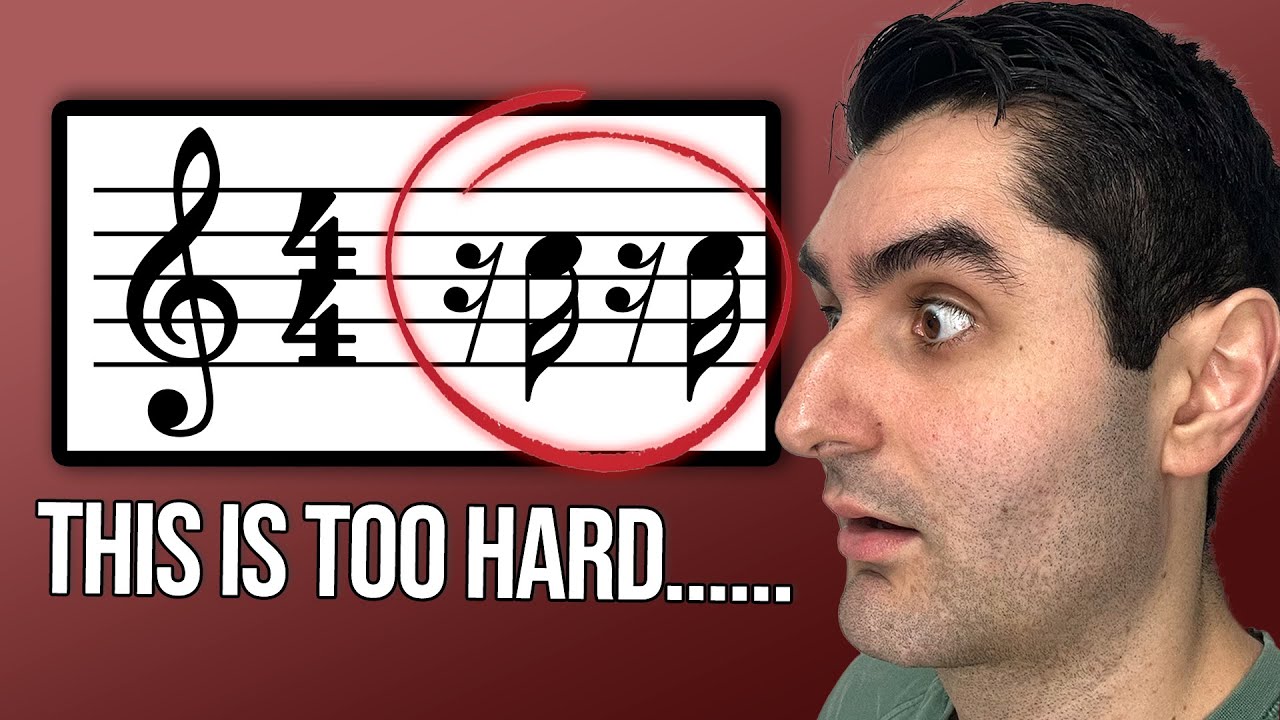
The hardest cell students report: in 16ths, play only the e and a of every beat, never with the click.
-
-
Exercise Slow, count, then target tempo
Start at 50 bpm, first count 16ths confidently, then play the e and a; speed up toward a goal of 100, ideally 120 bpm 16ths.
-
Fix Short bursts when it falls apart
When the rhythm falls apart at speed, play one beat of it, then two in a row, then four, lengthening the burst until endless; hear the click land right after the 'a'.
-
-
Key idea Same rhythm in eighths at double tempo
The offbeat 16th rhythm can be thought of as offbeat eighths at double tempo (16ths at 60 = eighths at 120); pick the reading that fits the song's tempo.
-
Key idea Improvise with the rhythm over I-V-vi-IV
After metronome work, improvise using the cell over a I-V-vi-IV track (~70 bpm), in 16ths or the eighth-note version.
-
-
Key idea Why: upbeat phrase starts and tension
The rhythm improves time, teaches starting phrases on weak parts of the beat (most players always start on strong beats) and creates rhythmic tension with an unpredictable release.
-
Practice it
- Guide How to Read Rhythms on Guitar: Counting, Rests and Strumming ChartsFor “Same rhythm in eighths at double tempo”. You'll be able to count a bar out loud, read it one beat at a time, and strum that rhythm over the chord symbols in a chart. Read it
Transcript
YouTube's automatic captions. Tap a time to watch from there.
- every intermediate guitar struggles with this Rhythm on the screen okay maybe some people don't struggle with it don't leave me a comment saying I don't struggle with it but a lot of people that I've run across struggle with this very Rhythm and it is so important that you learn how to play this Rhythm so
- that you can use it in your playing so let's get right into it and practicing the Rhythm so that we can learn this thing so I like to call this the all upbeats Rhythm and for those of you who have seen my other video it's called the ultimate guitar rhythm exercise this is one of the Rhythm cells that's in that
- video and I've had many students who have said oh this is the hardest Rhythm and on top of that I've gotten some comments on there saying wow I really really struggle with this Rhythm so I wanted to make this video to show you how you can practice this Rhythm so you can get it totally locked in so first I'm going to explain the Rhythm okay so
- let's listen to what it sounds like so this rhythm is playing with the 16th note subdivision in this case and if you see on the screen there the way that it's counted is kind of like this
- if I'm claing my hands e uh e uh e uh e uh e uh e uh so the idea is basically the entire time that we're playing we are never playing at the exact same time as the metronome we're always kind of countering it and playing all the
- upbeats so if you look here in the left hand side you can see this is how we would count one beat of 16th notes and on the guitar one way I like to play is using the picking Direction You see there so 1 E and A 2 E and A 3 E and A for e and all alternate picking so down up down up down up down up so if you
- notice all the time the one is a downstroke the E is an upstroke the and is a downstroke and then the uh is also an upstroke so if we look at example number two when we play this all up each Rhythm we're essentially placing a rest on the one and the end so you see here
- we have this rest and then we have this rest so then we're left with this one e e e e and if we follow that same picking scheme we end up with all upstrokes the entire time now by the way this is just a good place to start this is not to say
- that you should always play with all upstrokes maybe there's a particular lick you're learning where it's not a good idea and it's just easier technically to modify that but this is a good way to start so that you can feel this Rhythm properly so first of all the metronome setting I was using here was 70 beats per minute and if it's hard for
- you to play it at that Tempo well then definitely slow it down so practicing this Rhythm we really need to start slow so I'm going to move the Metrum to 50 and I'm going to make sure first of all that I can count 16 notes solidly along so 1 E and A 2 E and A 3 e and
- four e and 1 e and 2 e and and if I can do that then I just make sure I move my pick up on E and A so 1 E and A 2 E and A 3 E and A 4 E and A 1 E and A 2 e and Up 3 e and up four e and up so once you
- can do that comfortably a whole bunch of times in a row then you should start speeding it up a good goal to be able to play this rhythm is at least 100 beats per minute so 16th notes at 100 ideally like 120 so a big problem that also
- people have told me about is that once you start getting to a faster Tempo it kind of falls apart after a bit so it can start to get kind of confusing playing all these upbeats and your brain never gets to latch on to that downbeat at any any moment at least not with the actual pick now if you're counting
- solidly you should be able to still feel those down beats when they happen so now let's put the metronome at that gold tempo of 100 first of all let's see what it sounds like so we're counting one and to two e and a three and to
- four so what do we do once it starts falling apart here's my best practice strategy for you is make sure you just play a super short burst of the Rhythm remember this is just a onebeat rhythm that's repeating over and over and over on every single beat so chances are you
- might be able to go like this one and a two and a three and a four and a one so you keep doing that over and over really remember what that feels like notice how the uh Falls right before the metronome it's like up you hear that click right after
- the uh so you got to make sure you can hear that rhythm in relation to the metronome even though we are not playing exactly with the metronome we're playing all the upbeats it still relates to the metronome still in time with the metronome so once you can do one then see if you can do two in a row
- e e one e and up two e and up and make sure you feel relaxed too even me sometimes I feel like I'm getting a little bit of tension there like in the middle of my body I'm just kind of trying hard and focusing hard you need to be able to play this also
- and be a relaxed and it shouldn't feel that hard actually it's not really any different than playing a notes not technically harder but mentally it's harder so once you can do it two times then do it four
- times and so on and so forth so that is the best strategy for when you can play the rhythm and it starts falling apart just make sure that you do a short burst and then a long at the burst further and further and further until you can basically do it
- indefinitely without ever having to stop so let's check out example number three because a lot of times example number three you see there it's actually the same Rhythm okay it's all upbeats but it's the eighth note version of the Rhythm so a lot of times you might be playing a song that's at a particular
- Tempo where it's just really really really fast to be playing 16th note and it just kind of doesn't feel good it doesn't feel right for the song in this case you think of the same Rhythm but in eighth notes so instead of like this 1 E and A 2 E and A you think 1 and 2 and 3
- and for and so if you notice there having those two rhythms written right next to each other example two and three here you'll see that for every eighth rest it replaces the 16th rest that was there before so now instead of 1 e and uh we have two beats of eighth notes 1
- and 2 ands so the ns are sort of equivalent to what the E and the O were before and the way that all the stuff works 16th notes at for example 60 beats per minute is the exact same speed as eighth notes at 120 beats per minute
- twice the tempo let's listen to what that sounds like so here's 60 BPM so you'd have one e you'd have one E and A 2 E and A 3 E and A 4 E and A but at 120 beats per minute it would sound still the same da da da da da da da da
- da da da da but now look there's going to be twice as many metronome hits and we're going to think of it in a different way 1 and 2 and 3 and four and 1 and 2 and 3 and four and right so now in this case at this Tempo if I wasn't super comfortable with the idea of playing 16th notes which is like really
- fast and the uh the Rhythm would sound like this at this Tempo that's like it starts to again be very very challenging at that Tempo I might just think of version number three instead and count it in eighth note so
- one and 2 and three and four and 1 and 2 and 3 and four and 1 and 2 and 3 and four and so again it depends on the song that you're playing what the tempo is how you want to think of that so for example let's actually put in the context of something musical here so I'm going to use this backing track which is
- just a typical 1564 four that everyone needs to know what a play over by the way I've talked about this many times in my channel but we're just going to focus on the Rhythm here okay so once you've practiced it with the metronome all that good stuff you need to be able to actually use it like for musical stuff or else what's the point of learning it so step three once you've practiced it
- slow then you've sped it up and you've played the burst if you need to is practice improvising with the Rhythm so let's see how would sound like in this context so here this is about 70 B per minute and you would count it these 16th notes like this 1 E and A 2 E and A 3 E
- and A 4 e and a one E and A 2 E and A 3 E and A 4 E and A [10:58] so so you hear that now if that's too hard then maybe try let's bring this down a little bit if that's too hard maybe try playing eighth notes so I can count like this with the song one and two and three and four and 1 and 2 and three and four
- and 1 and 2 and 3 and four and and of course that still sounds great it's not like one is better than the other [11:44] right so that last thing that I played there I just want to talk about one more thing and then this video is over is it's not just to play that Rhythm by itself so why did we even learn this okay there's three reasons number one it's just going to improve your overall time and Rhythm because it's a rhythmic challenge right number two is I think
- even more important it teaches you to start your phrases on upbeats so sometimes it sounds really cool if you play this Rhythm a couple times and then just go into a straight up line of 16th notes or eighth notes what do I mean by that I'm going to use the Rhythm and then I'm going to break out of it and then just start playing you know my
- normal everyday uh other 16th note rhythms like maybe just playing a line of 16th notes so let's see what that sounds like right so I started it with that phrase and it kind of made it unpredictable when I was going to resolve the [12:57] Rhythm so to me that's actually the most important reason to learn this rhythm is cuz a lot of people when they're more intermediate at soloing what they do is
- they never ever play that Rhythm cuz it's a challenging Rhythm so they're always starting stuff on down beats they're always starting like this instead [13:41] so while that sounds fine it's in time it's like not really as interesting because I'm always starting on da da da da it's always kind of square where it's starting on a downbeat every time and number three it just
- freaking sounds cool because of that okay it sounds more interesting it sounds unpredictable like I said it kind of creates this like rhythmic tension that you don't even know like when it's going to resolve so the listener is kind of grabbed in by this Rhythm and you're wondering when is it going to just
- resolve back to a downbeat at some point so it can be a really good device to build up 10 in your solos so if you want to learn how to master the guitar fretboard so that you can solo over any chord progression and be able to know exactly where all the chord tones are so you can play those changes and make it sound
- super melodic like you know exactly what you're doing make sure you head on over to jamille. comom right now and check out the Jamesville GPS fretboard fundamentals course we've just extended our Black Friday sale to Friday December 1st of 50% off the course so if you've ever been thinking about getting the
- course now is the time also make sure you check out the Jamesville merch store in the link in the description down below for a freaking awesome Jamesville shirt or mug we got lots of different products I love the Jamesville hat I've worn it in videos before not wearing it right now but all of it looks super cool
- and you can rep your guitar community at Jamesville when you're out and about in the world also check the description for my favorite guitar picks for soloing the Dan's guitar store Precision pick they have absolutely unbelievable unmatched grip that I've never felt in any pick before and I
- absolutely love the beveled Edge it cuts right through the strings like a hot knife through butter and I never felt anything like it before make make sure you subscribe to the channel hit that like button it really really helps us get out to more people when you hit that like button and as always until next
- time listen learn and jam