
Rhythm · Beginner
How to Read Rhythms on Guitar: Counting, Rests and Strumming Charts
You'll be able to count a bar out loud, read it one beat at a time, and strum that rhythm over the chord symbols in a chart.

Summary
- Count every bar in beats. In 4/4 a quarter note is one beat.
- Eighth notes are counted 1 & 2 &, sixteenths 1 e & a.
- Rests show where you don't play; a dot adds half the note's value; a tie joins two notes.
- Read each bar one beat at a time, as chunks.
- On a strumming chart, play the written rhythm with the chord above it.
On this page
Reading rhythms is worth learning even if you never plan to read sheet music, because it gives you a real understanding of how rhythm works and it lets you learn songs a lot faster 0:00Watch at 0:00. I say it all the time: rhythm is the most important thing 0:00Watch at 0:00. Everything on this page comes down to one idea. Rhythm is taking time and dividing it into smaller pieces, which are called subdivisions 0:21Watch at 0:21.

Quarter notes, half notes and whole notes
In most music the quarter note is one beat, and you count quarter notes one beat at a time: "one, two, three, four" 0:44Watch at 0:44. A half note lasts two beats, the same length as two quarter notes, and you hold the note out for that whole time 1:06Watch at 1:06. A whole note is longer again: it fills the space of two half notes, or four quarter notes 1:27Watch at 1:27. When I show these, I clap them while I count, and that's a good place for you to start too 1:06Watch at 1:06. Count out loud and clap each one so you hear how long it lasts before you pick up the guitar.
Eighth notes and sixteenth notes
An eighth note is half of a quarter note, so two eighth notes fit in the space of one beat 1:50Watch at 1:50. Because you're splitting each beat into two parts now, you count eighth notes with an "and" between the numbers: "one and two and three and four and" 2:11Watch at 2:11.
Split eighth notes one more time and you get sixteenth notes 2:33Watch at 2:33. Four of them fit in one beat, and sixteen of them fill a bar of 4/4 2:33Watch at 2:33. You count them "one e and a, two e and a, three e and a, four e and a" 2:55Watch at 2:55.
Put on a metronome and count each of these out loud against the click. The numbers should land right with the click every time, and the "and", "e" and "a" fall evenly in between.
Time signatures
The time signature tells you how you're going to count everything in a piece of music 2:55Watch at 2:55. The top number is how many beats are in each bar, and the bottom number tells you which kind of note gets one beat 3:36Watch at 3:36. The most common one is 4/4, which is also called common time: there are four beats in a bar, and the quarter note gets the beat 3:15Watch at 3:15. Almost every song you'll play is in 4/4, though not every single one 3:15Watch at 3:15. In 6/8 there are six beats in a bar and the eighth note gets the beat 3:58Watch at 3:58. You'll also run into odd time signatures like 5/8, 7/4 or 5/16. They're uncommon, but some popular songs use them, like Pink Floyd's "Money" and "Take Five" 4:19Watch at 4:19.
Rests
One of the most important things about rhythm is where you're not playing, and rests show you exactly where that is 4:40Watch at 4:40. Every note value has a matching rest 5:02Watch at 5:02. A whole rest looks a bit like an upside-down hat, a half rest looks like a hat sitting the right way up, and a quarter rest is a squiggle that looks a little like a 3 5:02Watch at 5:02.
An eighth rest looks like a small 7 with a dot on the end 5:24Watch at 5:24. A sixteenth rest adds a second flag, the same way a sixteenth note has two flags where an eighth note has one 5:45Watch at 5:45. When you see a rest, you don't play for the length of time it stands for 5:45Watch at 5:45. You're going to see rests all the time, so they're worth getting down 6:06Watch at 6:06.
Dots and ties
A dot adds half of a note's value to that note 6:06Watch at 6:06. A quarter note is two eighth notes long, so a dotted quarter note lasts three eighth notes 6:28Watch at 6:28.
A tie joins two notes into one longer note that you hold for both values 7:09Watch at 7:09. Two quarter notes tied together sound exactly like a half note; they're just written differently 7:09Watch at 7:09. Ties also let you write lengths that have no other way to be written, like a half note tied to a dotted quarter note 7:29Watch at 7:29. A lot of rhythms written with dots can be written with ties too, and they sound exactly the same 7:51Watch at 7:51.
The middle of the bar
Written music keeps the middle of a 4/4 bar easy to see, so you can always tell where beat two ends and beat three starts 8:36Watch at 8:36. That means a note that starts on beat two and lasts a dotted quarter gets written as a quarter note tied to an eighth note, so the middle of the bar stays visible 8:57Watch at 8:57. Once you know this, rhythms get a lot easier to read, because the two halves of the bar always stay separate on the page 9:19Watch at 9:19.
Triplets
Everything so far divides time into twos and fours 9:19Watch at 9:19. A triplet divides a beat, or a group of beats, into three equal parts 9:39Watch at 9:39. Eighth note triplets put three notes in one beat, and you can count them "one two three, one two three" or say "tri-pl-et" on each beat 10:23Watch at 10:23.
Sixteenth note triplets put three notes in the space of two sixteenths, which is fast enough that you'll only really play them at slow to medium tempos 10:43Watch at 10:43. Quarter note triplets fit three evenly spaced notes into the space of two beats, so you hear three notes against two 11:05Watch at 11:05. They could have a whole video of their own, so for now it's enough to know how they sound 11:05Watch at 11:05.
Read a bar one beat at a time
Knowing how all of this works is one thing, and being able to look at a rhythm and play it right away is another 11:46Watch at 11:46. What helps most here is rhythmic chunking 11:46Watch at 11:46. You look at a bar one beat at a time, or two beats at a time depending on the subdivision, and recognize the rhythm in each beat as a group without counting every note separately 12:08Watch at 12:08.
Here's the first bar I chunk in the video 12:28Watch at 12:28. Beat one is two sixteenth notes and an eighth note, beat two is a quarter note, beat three is two eighth notes, and beat four is a dotted eighth and a sixteenth 12:49Watch at 12:49. Each of those is one beat, and seeing the bar as four chunks like that helps you get the rhythm down a lot faster 13:10Watch at 13:10.
Rests chunk the same way 13:32Watch at 13:32. In the second bar, beat one is a sixteenth rest followed by a dotted eighth note, which adds up to four sixteenths, one beat 13:32Watch at 13:32. Beat two has a rest on the downbeat and an eighth note on the "and" 13:53Watch at 13:53. Beat three is an eighth note and two sixteenths, and beat four is a quarter note 13:53Watch at 13:53.
This gets easier quickly because there are only fifteen ways to fill one beat with sixteenth-note rhythms, so most bars you read are built from the same short list of one-beat pieces 1:41Watch at 1:41.
Reading a strumming chart
As a guitar player, the part you really need to know is rhythmic notation, often called slash notation 14:14Watch at 14:14. It puts chord symbols above the bar and the rhythm underneath, so nobody has to write out every note of the chord, and you don't need to read sheet music to play it 14:56Watch at 14:56. In my example, one rhythm repeats every bar: a quarter note, two eighth notes, two more eighth notes and a quarter note 14:56Watch at 14:56. You count it "one, two and, three and, four" 15:17Watch at 15:17. The chord symbols go from D to A to G, and you keep playing that same rhythm while you change chords where the symbols tell you to 15:17Watch at 15:17. You can play any version of those chords you want: the open D, A and G you already know are fine, and so is any other way you know to play them, as long as you're playing the correct rhythm 15:39Watch at 15:39. All you're doing is plugging each chord into the rhythm 16:23Watch at 16:23.
Try it with the band. Count one bar out loud, then strum the chart rhythm on each chord as it comes around, and keep counting under your breath until the rhythm plays itself.
Getting the rhythms under your fingers
Reading tells you what a rhythm is, and playing the rhythms over and over is what makes them feel natural. The exercise I use for this goes through every combination of sixteenth notes you can fit into one beat, fifteen of them, and repeats each one four times 1:41Watch at 1:41. I adapted it from a drum exercise a good friend of mine showed me, because drummers work on their time and rhythm the way guitarists work on theory 3:49Watch at 3:49.
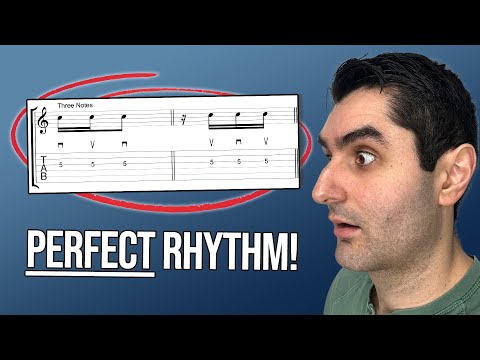
Play it on one note with strict alternate picking that follows the count: the numbers and the "and" are downstrokes, and the "e" and the "a" are upstrokes 3:07Watch at 3:07. The rhythm that plays only the "e" and the "a" is one of the trickiest you can practice 5:37Watch at 5:37. It's a pain to get used to at first, and your time gets a lot better once you do 5:57Watch at 5:57.
When I started, I couldn't play the whole exercise all the way through 9:33Watch at 9:33. I practiced certain rhythms over and over until I had them, and then put them back into the whole thing from beginning to end 9:33Watch at 9:33. If one beat trips you up, do the same: loop that one rhythm slowly, then play it in the full exercise again.
Once the rhythms feel good on one note, put on your metronome, pick one rhythm and start changing the notes while you keep the rhythm the same 10:15Watch at 10:15. I'd pick a key, like C major, and stay in it 10:36Watch at 10:36. Sticking with one rhythm cell gives everything you play continuity 11:19Watch at 11:19. You can also play a chord you like with one of the rhythms, which is a good way to come up with riffs 12:44Watch at 12:44. Get each rhythm comfortable on one note first, to the point where you don't have to think about it, and then move it to different notes, chords and keys 13:54Watch at 13:54. If you never use a rhythm in real music, you'll probably forget it, and it'll feel like an exercise that has nothing to do with the music you play 14:36Watch at 14:36.
You can practice reading without any app at all. Put on the recording of a song you already play and count the beats out loud along with it. Then pick one bar of the strumming and say its rhythm in one-beat chunks.
If you want to see these note values on the staff, the lesson on the basics of reading music in my fretboard course is free.
Once you can read and play these rhythms, the next thing to work on is putting accents on them, in your solos and your rhythm guitar parts 16:23Watch at 16:23.
Questions guitarists ask
How do you count eighth notes and sixteenth notes?
Two eighth notes fit in one beat, so you count them 'one and two and three and four and'. Four sixteenth notes fit in one beat, so you count them 'one e and a, two e and a', and so on through the bar.
Do I need to read sheet music to read a strumming chart?
No. Rhythmic (slash) notation puts chord symbols above the bar and the rhythm underneath. You play any version of the chord you know, as long as you play the rhythm that's written.
What does a dot after a note mean?
A dot adds half of the note's value to it. A quarter note is two eighth notes long, so a dotted quarter note lasts three eighth notes.
What is rhythmic chunking?
Reading a bar one beat at a time (or two beats at a time) and recognizing each beat's rhythm as a group, so you don't have to count every note separately.
Keep going
Keep what you open here. A free Jamsville account saves your boards and sequences to your Practice Library and keeps your progress on every device.
Make your free accountSubscribe to Jamsville on YouTube
Where this comes from
This guide is written from these lessons on the Jamsville channel. The timestamps in the text link to the moment each idea is taught.