
After each pass the video waits as long as the loop, so you can play it back.
Start slower with −, and it climbs to 100%.
Keys: Space play · ← → 5 s · [ ] set start and end · − = speed · L loop
Soloing · Intermediate
FUN Tips and Tricks For Soloing In Minor Keys
In this lesson
Tap a time to watch that part. loops it, so you can slow it down and play along.
-
Key idea Minor pentatonic over everything is a starting point, not wrong
Ripping A minor pentatonic over a whole minor progression is a legitimate approach; the lesson adds a couple more options on top of it rather than replacing it.
-
-
Key idea i - bVII - bVI - V7 and the V7 as the minor-key giveaway
Am G F E7 is i - bVII - bVI - V; the dominant V7 resolving to the minor i is often the dead giveaway that a song is in the minor rather than the relative major.
-
-
Step by step Fundamentals first, then vocabulary
Once scales and fretboard fundamentals let you navigate, the next step is learning vocabulary (licks) so you can actually sound musical with what you already know.
-
-
Key idea One added note, no new scale
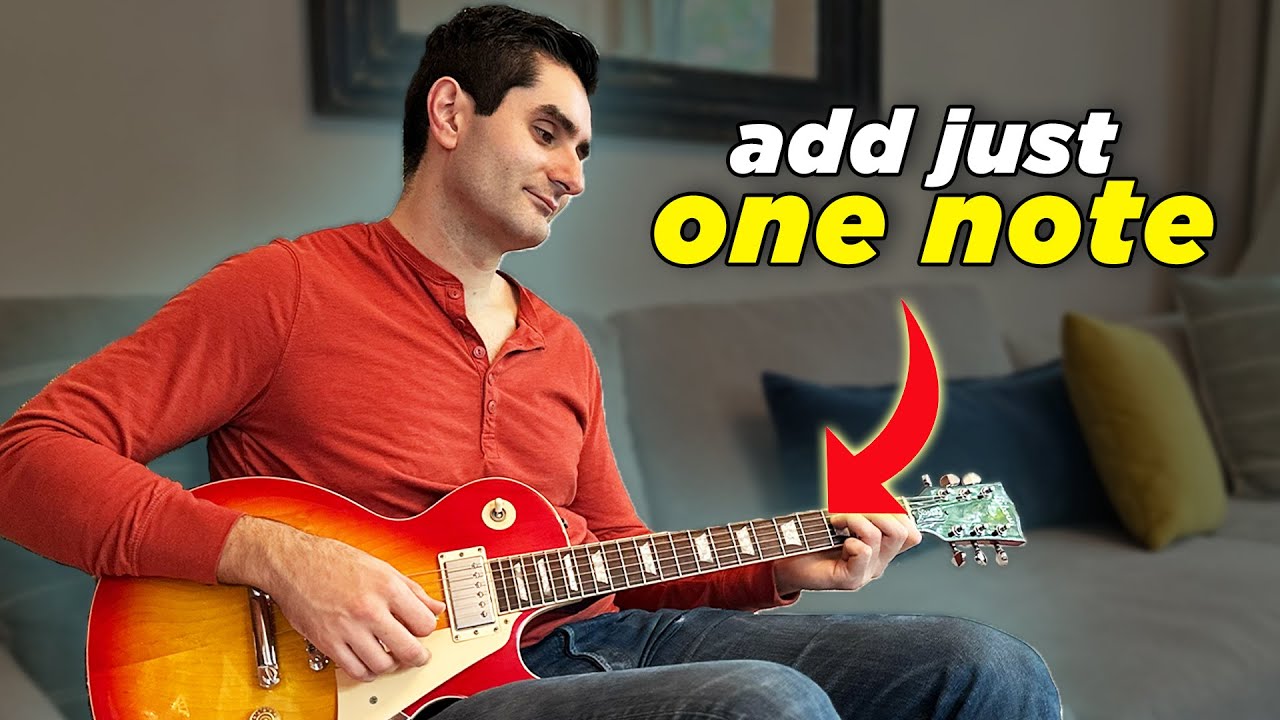
The point is you don't need a new scale or E7 arpeggios: solo with only A minor pentatonic plus one 'key note' (G#) aimed at one chord.
-
-
Key idea Taste, time feel and articulation beat the theory note
Slides, hammer-ons, pull-offs, taste and good time feel are more important than hitting a theoretical note; the target note only makes you sound more legit once those are there.
-
-
How to practice Make a learned lick your own by changing one thing
After learning a lick, change its rhythm, note order, add slides, move it around the fretboard; changing just one thing makes it yours and builds vocabulary. Understanding the lick is what lets you change it.
-
-
How to practice Taking a lick 'to the lab'
Treat a piece of vocabulary as an experiment: dissect it into small pieces and mess with them in real time while soloing; one nugget (e.g. the triad idea) from a lick is enough.
-
-
Key idea One is greater than zero
Knowing the triads in just one spot of the neck is enough to start using the idea; mix it in with the minor pentatonic rather than replacing it.
-
Practice it
- Guide The Pentatonic Scale on GuitarFor “Minor pentatonic over everything is a starting point, not wrong”. You'll build the minor pentatonic from its five note names, play it across the whole neck with one small repeating shape, and make a short solo with it over a blues shuffle. Read it
- Drill Your idea, through the scaleFor “Two-note slide idea moved through the scale”. You'll take one small idea of yours and play it from every note of the scale. Open
Pro A minor licks: the tab, in Jamsville Pro. Five licks in A minor, from slides and hammer-ons in fifth position to bends high on the neck. Learn one slowly, then work it into your own solo.
Open A minor licksTranscript
YouTube's automatic captions. Tap a time to watch from there.
- a lot of people when they play in minor keys they think okay I'm gonna just get my minor pentatonic scale okay let's say we're playing an A Minor I'm just going to rip a minor pentatonic scale over the whole entire chord progression and uh that's definitely an approach so there's
- nothing like completely wrong with that or anything I'm not going to come on here and tell you that there's something wrong with playing a minor pentatonic but with that being said uh we want to explore some different possibilities and it can be a lot more fun when we know just another couple of things that we
- can do besides uh playing the minor pentatonic scale so I've written out a few licks that we're going to be using uh in today's video so we're going to be going over a couple of them and then actually as a separate video um later on I'm just going to upload a short video of me playing through all the licks um
- so you guys can have it for reference uh but we're going to be kind of taking our time and going over some of the ideas from the licks and uh seeing how we can actually apply them to our improvisation so let's go ahead and start with the first [01:27] lick hear it again what is going on here in this uh chord progression first of all so this is a very standard uh chord progression in a
- minor key so uh one thing I like to do by the way if you've noticed um in the past when I put tabs on screen is I like to have the actual chord progression listed over the tabs so that we can actually do a little bit of analysis and comparison to see well what exactly is
- being played over what chord we're not going to delve too deep into all the individual chords but let's just do a quick overview here so we have our a minor chord then the next chord is G so it's like 1 2 3 4 1 2 F and then E7 is
- going to be the last chord and then just kind of Loops back around so we got that just happening over and over um you have probably heard a lots of variations of this chord progression before uh for example just right off the bat I'm thinking about the song Stairway to [02:58] Heaven right there at the end uh that's not the exact same chord progression but it's very similar it say a minor G and an F but it doesn't have that E7 um so this E7 is actually very very common to hear and why is that well that's because the E7 is the five chord
- of the a minor so you notice how when I play that chord E7 your ear really wants to hear this right after it's kind of this tense chord a dominant seventh chord A lot of times that's how we know actually a song is in a minor key by the
- way is that you'll have that dominant seventh chord taking you to a minor one Court sometimes people ask me like well how do I tell uh because there's the relative minor and major how do I tell if a song's in major or minor a lot of times that's a dead giveaway right there is if you have a five chord that's
- taking you back to the one chord anyway so uh last thing I'll say about the chord progression is if you're going to put it in other keys I like to think about this as a one minor minor one major flat 7even so why am I why am I calling it flat 7even by the way uh flat 7even is because normally we think of
- the chords in a major key and the seven chord is normally a half step below the one chord but this is a whole step below so we call it flat 7 so 1 flat 7 Flat 6 cuz if we were to give a major the six chord would actually be an F sharp minor chord but this is f so it's a half step
- lower than what the six normally should be so we call it the Flat 6 so one flat 7 Flat 6 and then five as a dominant chord first of all one thing that's really important to do once you've learned all your scales and stuff like your minor pentatonic scale is then you need to actually like learn some
- vocabulary uh that's going to help you use the stuff you already know but make it sound better have to implement different techniques uh different ways of combining the notes that you may not have thought of before learning vocabulary is the way to go once you've learned all those fundamentals of the
- fretboard so that you can learn to navigate then you need to learn vocabulary so you can actually sound musical you can see that it's really based on this little idea right here okay this little I'm going to take two notes and slide back and forth between them and
- then so what's going on here this is actually all part of the a minor pentatonic scale here so this is part of like the first position and then second position so we're sliding between the fifth fret and the seventh fret just going back and forth
- have you ever done that before if you have congratulations if you haven't congratulations you learned something new so now we're going to go up to the eth Fret of the second string and slide up to the 10th fret and back and then same thing on the first string and then finally up to the 10th
- fret of the first string sliding back and forth okay all right so we got this little bit of L so to one thing that you'll hear me talk about a lot uh on this channel is the idea of being able to take like a simple musical idea and move it around
- within the key within the scale so that's really that whole first measure of the lick is just an example of that okay saying oh I like this idea just sliding back and forth between two notes well what if I just transfer that over to some other notes that I know work in the key I could do it [07:17] anywhere right and it sounds really cool because when a normal person who's not a musician listens to you playing they're going to think oh that's a very clear musical idea it sounds logical it doesn't sound like oh you're just running a bunch of scale stuff over and over and over and over again so you're
- going to notice uh that's a theme here uh that I talk about all the time and uh that we're using here in that lick so that's not even the best part though that I want to talk about yet so I want to talk about the line that happens afterwards so oo that note right there what's that note that note that sounds like a
- note so if you notice if you look at the tabs right there see where the E7 chord is that's where this note that I just played lands the 13th fret of the third string and if you're familiar with reading notation at all you'll notice that there's an accidental right next to that note above the tab there's a sharp
- there that is a gsh note and why is there a gshp note there because that is actually part of that E7 chord and that note sounds really cool so here's a little trick to find that note okay no matter what key you're playing it let's say you're playing an A minor pentatonic
- right you just go a half step down from the root of your key and that's going to give you that note what is that note I'll just tell you really quickly that G sharp note is the third of the five chord so every chord has a root third fifth and maybe seventh if
- it's a seventh chord this is a seventh chord it has a seventh and so the third is one of the most important notes in a chord but particularly in minor chord progressions when you have that five chord it sounds very exotic sounding right but if you add that note in there's different ways to think about it
- you could think of it as the harmonic minor scale but you could even just think of it as hey this is minor pentatonic but if I want to I can just add that note right there and if you time it correctly and you land on it right on that E7 chord
- when we're playing then it's going to sound really cool and it's going to sound like you really know what you're doing and you're really actually playing the chord changes okay now we just took a piece of this vocab a little little snippet of this piece of vocabulary and I realiz oh wait a second I looked from seeing the chords on top
- of the tabs and I saw that note and it real oh wow if I play that note there then that's going to sound cool so if you know nothing else okay we don't even need to learn a new scale or anything like that let's just pretend we're just going to keep thinking about a minor pentatonic scale over the whole thing we
- just add one more little Teensy weeny piece of information which is I say okay I find my A's in the a minor pentatonic scale so I know for sure that if I'm starting here with my pentatonic box I have this one note just one fret below okay and then up here same thing right
- the high e and the low E strings the same thing this note here so what if I practice soloing just with the a minor pentatonic scale but when I hit that E7 chord okay I'm going to make sure that I hit a g Shar of course I don't have to do this every single time okay every new
- thing that we learn guys in Guitar every New Concept it doesn't mean oh you need to forget about all the other stuff you've learned before and now this is a rule you must play the G Shar every single time you hit the E7 no you don't need to do that but it's a cool thing that you can do that helps you sound more legit like you're not going to do that by accident most people I don't
- know maybe there's some guys like wow if I just put my finger on that fret I don't know why it just sounds really good and I don't know any music theory and I I'm awesome because I have amazing ears and I just figure out that you know if I put my finger in a random place it sounds good but anyway I digress so let's try I'm going to just mess around with a minor pentatonic but when I get
- to E7 I'm going to play this note here and then by the way last thing I forgot to mention is you might want to resolve it back up so that note will sound a little crunchy if you're not playing on the E7 chord okay and we can test that out too so let's see what that will sound
- like so there's the G chord F chord and now E7 so you got to keep track of the chords going by so F E7 a minor g f E7 remember on that E7 that's where I'm going to play that G sharp note okay let's try it
- [13:01] right so all I was doing is I was just thinking of playing a minor pentatonic I think maybe I played a b note or something in there that wasn't part of the a minor pentatonic for a second but for the most part all I was doing was playing a minor pentatonic and I was just aware of that one chord and not
- even like oh I need to learn all my arpeggios of E7 and learn all this extra stuff all I just thought of is targeting that one specific what I like to call the key note okay it's the key note in that progression is that G sharp okay so if nothing else guys after this
- stream I just want you to take that concept away is that if you have that five chord on your minor chord progression watch out for that what we call by the way I didn't mention this before it's called the lead leing tone the leading tone because it wants to lead
- up so if you hit that leading tone on that five chord it's going to sound super cool and of course you want to use cool techniques like sliding and hammer on pull offs be tasteful and all that stuff that's all way more important okay I understand all that stuff is more important than some kind of theoretical
- thing where I hit a particular note on a chord but if you have all those things you play with taste and you play with good time feel and you play with cool articulations and stuff and then we add in just that one little Teensy weeny note all of a sudden we sound way more legit okay so with that being said let's
- go ahead and check out another lick this one is a little bit tougher as you can see there's a lot of notes on the page [15:14] all right so what is going on here we're going to check out another concept okay little bit more compcat right so the first concept that we checked out was uh relatively simple right so the whole
- idea that I wanted you to get out of that is hey you can just keep doing all the same stuff you've been doing play a minor pentatonic all over the whole entire thing but uh now we're going to dig a little bit deeper into the actual chord progression that's going on here and this is something this lick you
- would not ever come up with this unless you knew the cord I okay so this is one thing that I have people start working on when they want to really take their solo to the next level is actually being able to understand the entirety of a chord progression on a chord by chord basis so again we're playing the exact
- same chord progression a minor G F and E7 okay so what's going on here so we're going to check out this little arpeggio actually and actually you might have heard this before I can almost assure that you've heard it okay it doesn't
- matter who it is maybe Jimmy pige or Joe Walsh you hear this exact same concept we're actually just playing an A Minor triad so wait a second I'm on an A minor chord well gee I can just play the notes that are from an A minor chord but I don't have to just be like oh here's my a minor and my open a minor chord that I
- know like those aren't the only notes from an A minor chord so I want to understand how to spell it out in order to work out all of my arpegios by the way this is something that I talk about uh and we go in super detail in my course the janville GPS fretboard fundamentals course you can check that out over at jan.com if you're not
- familiar with your arpeggios and stuff like that across the fretboard but we're going to learn some of them right now even if you don't feel like doing that so this is a freaking awesome way to play an A minor chord so this is actually all the way up here in the 20th fret I'm almost about to run out of space that's
- a C note okay so in an A minor chord there's an A C and an e uh that's the Triad and there's also a g if you add the seventh but anyway so we're playing a on the 20th fret uh sorry a c on the 20th fret an A on the 17th fret so we're pulling off and of course this is three Frets away
- ordinarily like if I was playing this down here I'd be using my pinky but when we're all the way up here we can have more flexibility with the fingerings that we want to use because uh well Frets are closer together so I'm pulling off from the 20th fret to 17th fret by the way playing a downstroke okay and then I'm going to play an upstroke on
- the 17th fret of the second string which is an E note so it's literally all the all the notes that are in an A Minor Tri now all we're going to do is transfer that same concept down to all of the different chords that are in this progression so the next part we just go
- like this we repeat that twice and then we do one more pull off we don't play all three notes so 1 2 3 1 2 3 1 2 that's the ideas we're we're taking our peggio we're going 1 2 3 1 2 3 1 2 and then we're going to move to the G chord and guess what we're going
- to play all the notes that are in a G chord which is g b and d well guess what we're not going to play them in that exact order okay this is by the way it's called an inversion okay because the G is not the lowest note and in the a minor arpeg as well the a was not the lowest note but anyway so we're going to play
- this so we're pulling off from the 19th fret to the 15th fret okay and same thing by the way same picking pattern so down pull off Up Down pull off up okay that's the picking pattern that you got to get used to and uh just if you're really having trouble with this then just make sure you play one of these
- over that can be such a cool actually thing if you just practice that you can learn how to shred pretty hard like just learning one of those arpeggios but so we start with this same thing it's the same sort of orientation of all the notes this is actually the third of the chord which is
- B on the 19th fret then the root of the chord which is G on the 15th fret and then the fifth is also on the 15th fret by the way uh you might be a little bit like having a little bit of trouble with this so you want to try to make sure that these two notes that are on the same fret but different string
- you want to make sure that they're not ringing out at the same time like this like like kind of like a chord we want to make sure that we just very slightly roll our finger down like that so also don't try to hop your finger down like this that's not going to work when you're playing really fast now notice that when I do it I'm
- basically just holding my finger over these two Frets and it's just that it's so hard to see when you're playing fast you see my finger shifts so slightly so that I stop hearing the first string and now I can hear the second string okay anyway so now since by the way
- that's a G major Triad the cool thing is that on this particular progression whatever it is that you play like over the G major chord if you work out an arpeggio well guess what you can just move the exact same thing down two Frets so now F major Triad the exact same thing so we
- have same exact shape okay and this by the way I'm definitely playing with the pinky even though we're pretty high up uh it's it's just easier I mean it's theoretically possible but it's a bit of a stretch I I don't like doing it so much okay now getting to the E7 chord so those of you who are a little bit familiar with uh
- seventh chords you should know that a dominant seventh chord actually has a major Triad and the only difference between a dominant seventh chord and a Major Seventh chord is the seventh okay so uh with that being said you can actually play the exact same thing you just played on the F chord F Triad you
- just play an E Triad it doesn't matter if it's a major 7th or anything like this so actually we only need two shapes to play this really cool arpeggio sequence through the whole entire thing we have the a minor shape which is the same shape by the way but since it's a minor chord this first note
- is one fret closer to the second note and then once we get to the G major chord yeah that now the first note is 1 2 three four Frets away from the second note but once we get to that G chord guys we just move that down a fret and then move it down sorry move it
- down two Frets and then move it down one fret so so one thing is you could just play it straight through like that or you could just mess with the notes in it so you could go
- kind of sounds a little bit Cuban or lad by the way those of you don't know uh my last name is Hernandez I'm half Cuban I'm from Miami so maybe that's why that kind of resonates with me a little bit so let's actually try that first of all I'll play the sequence as is I'm not going to play the whole lick I'm just going to play that first half of the Li and then uh I'm just G to mess around
- with those shapes on each chord and change the order of the notes change the Rhythm a little bit this is guys I I want to also always make sure you guys understand this too okay the reason why we learn about music theory and all this stuff is so that when I learn a lick
- like from Jimmy pagee or whatever my favorite guitar players I can actually understand what's going on and I'm not just memorizing like what AB s to play and all that and because of that then here's the thing understanding is fine some people go oh who cares if I understand it I play it sounds good who
- cares well here's the thing is that if you understand it you can actually then change it and make it your own and isn't that really what we're trying to do guys we're trying to right like we want to learn how to sound like us that's what I'm here to help you guys to do I want
- to help you sound like you okay I don't want you to sound like a copy of somebody else obviously we all have our influences and you can hear them coming out but as soon as I take a lick that I learn from somebody else and then I change the Rhythm or I change the order of the notes or I change any number of
- things about it if I change just one little thing about it now all of a sudden it's mine right now it sounds s like me and when you guys practice these ideas okay you are going to play something that sounds different than what I play okay it's like pretty much impossible for two
- people to come up with the exact same idea using a concept right so that's one thing that I want you to understand is that when we learn a lick it's not good enough to just learn how to play The Lick although that can really help it can help your Technique but I want you to then take it in practice practice and then be able to actually change it and
- go oh wow I see that it's using this idea let me mess around with that idea more let me move that around the fretboard let me change the Rhythm uh let me put some slides in there whatever it happens to be changing anything is going to help you start to sound like you and build your vocabulary further
- okay all right so let's try I'm going to play through that sequence and then I'm going to modify it a little bit so now let's try messing with those shapes [26:53] [27:26] and of course that's just doing that in one like little area of the fretboard right so you can see that uh you can have a lot of fun with that so now all of a sudden I took that lick and I changed it okay so did I you know think that was the greatest Solo in the entire world well of course not that's not the point okay the point is that I'm taking
- some time and I'm working in a piece of vocabulary oh this is cool if I use that idea putting the arpeggios over the chord program let me see what other things I can do with it what if I try to play faster let's do one more thing what if I what have I tried to play with 16th note triplets let's see if I totally epically
- fail at this woo that's a little bit different now it sounds really shredd right oh there now I wasn't shredding on all of them I just picked one note from the
- next shape so uh shred one shred oh now I kind of like that more right it's a little bit more balanced it's like a little bit of shredding and then I picked one note on the next chord whatever happens to be so again
- guys I I mean I hope that you can tell that this is like so much fun for this is one of my favorite things to do is to take a piece of vocabulary and I like calling this taking it to the lab okay it's like o I'm taking and I'm doing some experiments with this piece of vocabulary and this is really how you actually get your improvisation better
- you first of all learn your fundamentals right so that I can navigate the fretboard and I can go through that basic process of improvisation and know that if I play all these notes it'll sound good over the chord progression and learn how to play in time then once I got that down learning some vocabulary learning learning a to play a
- lick note for note right that's going to really help because it's going to improve my technique and then though having the creativity and the wherewithal to be able to actually use the fundamentals that I know about analyze the lick that I just learned and then sort of dissect it into like little
- pieces and mess around with those in real time while I'm soloing so to me if I learned this lick uh we haven't even really talked about the end and we probably won't talk about the end cuz the end is just you know it's it's this this sounds cool you know but to me if I
- just get one little nugget of information from that lick which was oh I'll play these Triads and now all of a sudden by the way I didn't even bring this up we weren't playing minor pentatonic scale were
- we just saying okay again nothing wrong with minor penaton skill those of you who have been watching ever since I started the stream nothing wrong with it now you can mix this in with it though so let's actually try that so I'm going to just mess around minor pentaton and I'm going to use all of the
- different things that we've talked about in this stream and then we'll start wrapping it up so to recap uh of course we always start with just ripping minor pentatonic scale over the minor chord progression but we want to sound more legit so we add in a couple things okay number one we learned that if we take the note that's a half step below the root of the key that
- we're in so in this case the root of the key is a so I take that note that's one fret below a g G sh if I play that over the E7 chord it sounds really cool because it sounds like I'm making a chord change and I'm playing a super important key note in the chord playing that movement
- du and then also if I can just even find like one little spot let's just say I don't know any other Triads on the neck well I found one spot to play through them and that's better than knowing zero spots right right one is greater than zero yeah we can all agree on that so I
- I can just mess around with those specific arpeggios that I learned from this piece of vocabulary and then that idea of using the the uh G sharp note on the E7 chord and then besides that just using some cool phrasing and stuff when I'm playing over my a minor pentatonic skill so uh let's give that a go [32:28] a [32:58] n [33:23] uh make sure you check out Jamesville GPS fretboard fundamentals course make sure you download the five awesome guitar looks in the a minor with the practice track you can find the link in the description and you can also find it there in the pin comment in the chat and
- also check out Jamesville merch store the link in the description below we got lots of cool stuff uh available check out my music on Spotify look up Adam Paul that's my artist name and yeah guys until next time listen learn and jam