
After each pass the video waits as long as the loop, so you can play it back.
Start slower with −, and it climbs to 100%.
Keys: Space play · ← → 5 s · [ ] set start and end · − = speed · L loop
Chords and harmony · Advanced
Drop 2 Guitar Chords Masterclass! (They Sound SICK!)
In this lesson
Tap a time to watch that part. loops it, so you can slow it down and play along.
-
Key idea Drop 2: drop the second note from the top an octave
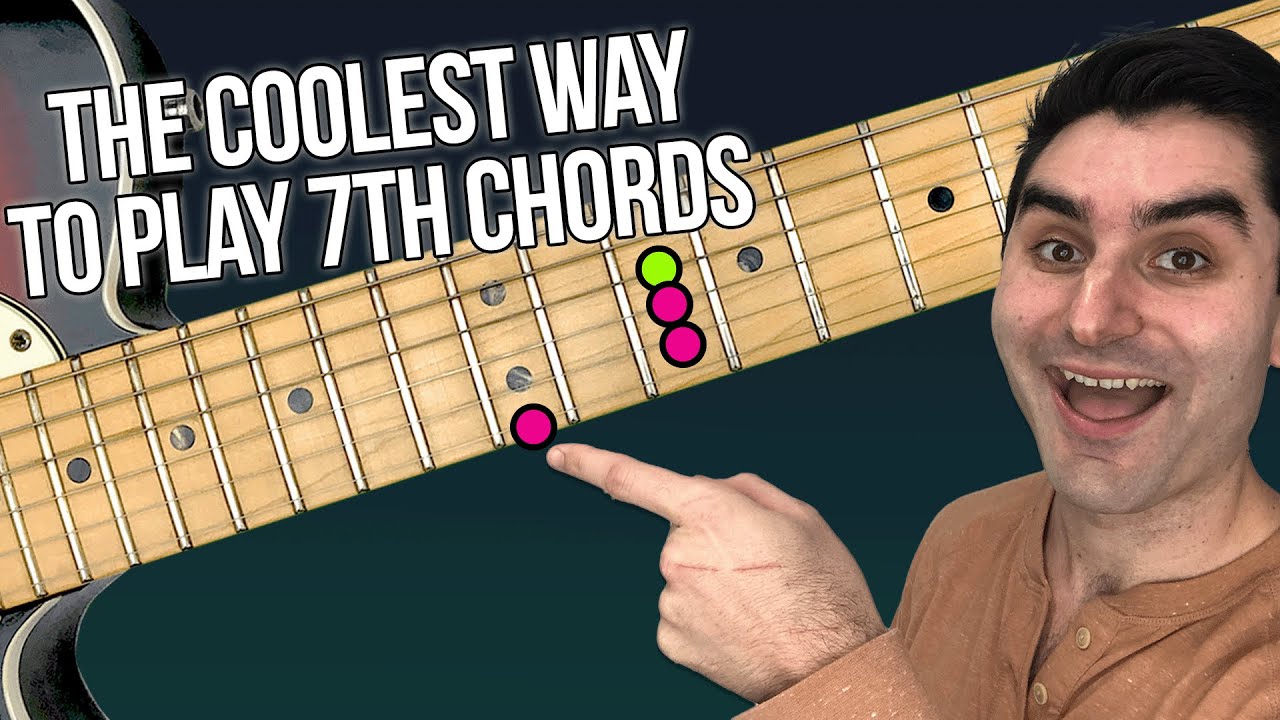
Close-position 7th chords (within one octave) are often unplayable on guitar; drop 2 takes the second note from the top down an octave, making them playable. Drop 2 comes from big-band horn writing.
-
-
Key idea Inversion named by the lowest note
The lowest note determines the inversion: root = root position, 3rd = 1st, 5th = 2nd, 7th = 3rd inversion (new vs triads). Know where the root is in every shape.
-
Exercise Invert by moving every note up to the next chord tone on its string
To invert a drop-2 voicing, move each note up the same string to the next available chord tone (C->E, E->G, G->B, B->C); then derive the four qualities in that inversion; repeat for 2nd and 3rd inversion.
-
-
Key idea Inversions change the sound; listen for the crunch
Same chord, different inversion sounds completely different: the B-C interval gives 1st-inversion Cmaj7 its crunch; 3rd-inversion maj7 has a minor 9th (B to C) between bottom and top and needs a specific context, while dom7 3rd inversion (major 9th) sounds better.
-
-
Exercise Diatonic 7th chords in every inversion
Play I-ii-iii-IV-V-vi-vii(m7b5) of C major in drop 2 for each inversion (root, 1st, 2nd, 3rd), choosing the quality shape per degree; then all 12 keys.
-
Key idea Drop 2 inversions level up fretboard knowledge
Working through drop-2 inversions forces tracking notes on different strings because the root is not always on the bottom; this 'really got my fretboard knowledge super leveled up'.
-
-
How to practice Memorize, then all keys; it takes multiple lessons
Review every section, memorize every inversion and all diatonic chords in C, know the note names in every key, then practice in all 12 keys. In private lessons this takes multiple lessons.
-
Practice it
- Guide Major Triads on Guitar: The Right Way to Learn ThemFor “Inversion named by the lowest note”. Find all twelve shapes of the C major triad by moving one note at a time, move them to any key by the root, and start soloing with them in time today. Read it
Transcript
YouTube's automatic captions. Tap a time to watch from there.
- so these kinds of chords that we're going to be learning about today are called drop two voicings and they allow you to be able to play things like this [00:23] so drop two voicings are actually coming from funny enough writing for horns in big band they're very very common sorts of voicing so if you actually learn this on the guitar you're gonna understand really well how chords are structured and written out actually for basically any other sort of setting that you want
- to write Out chords for when we build seventh chords those you don't know how seventh chords are built very simple they're built sort of like Triads Triads have a one three and a five but then with a seventh chord we add a seventh on top so if you look here on the left you can see uh the text on the top says
- something called close POS so POS is just short for position so closed position what does closed position mean it basically just means that all of the notes in the seventh chord fall within one octave so they have a range that is within one octave now if you're a piano player close position seventh chords and
- all the inversions of them are super duper easy to play but actually if you try to play him on a guitar a lot of them are actually completely impossible to play so that's where this idea of drop 2 comes in and actually makes all these chords that are super duper easy to play so drop two the concept is very simple the number two means the second
- note from the top and we drop it down an octave so if we look here this chord on the left is structured one three five seven and what we do is we figure out the second note from the top which is the fifth and then we drop it down an octave so you see now on the right hand side
- this is the resulting drop two chord that gets made when we take that closed position seventh chord and then drop that second note from the top down an octave so now instead of the order from bottom to top being one three five seven now the order is five one three seven
- and actually we will go over that exact chord voicing but if you look on the fretboard diagram the chord voicing that's written there is going to be this one here on the bottom so when we do this we also want to start with each of the different inversions of
- seven of course now we're not going to do all the inversions of closed position right now we're going to do the inversions of drop two just in a moment here but here's another inversion of a closed position chord here on the left and this one has the fifth on the bottom so if you're familiar with the inversions of Triads it's the same thing when the fifth is on the bottom we call that second inversion so it's actually a
- second inversion closed position voicing but now we turn this into a drop two voicing by taking the second note from the top which is the one and dropping it down an octave so now we have this voicing which goes one five seven three so you see it's just
- changing the order of the notes a little bit by dropping that note down an octave and now if you notice actually right there on the chord diagram we have this chord and this is a C Major seven chord so we want to start by just doing this with C Major seven so you can remember that that's actually
- a really cool way to play C Major seven and for that matter that is a major seven shape that is movable to play any other chord if I move that up two fret that's D major seven or if I move it down two Frets this B flat major seven or another down another two Frets down a flat major seven G Major seven etc etc
- that is a major seven drop to voice it okay so you should get the idea by now drop two voicing is just the seventh chord and we actually drop the second note from the top down an octave and then we arrange the notes on the guitar fretboard so what we need to do is first
- of all we need to figure out the other seventh chord qualities they're going to be commonly used okay so right now this is a Major Seventh chord like I said C Major seven but now if you're not familiar with the different seventh chord qualities because now there's a whole new set of core qualities when we're dealing with that extra note that fourth note in the chord as opposed to
- Triads so we have major sevens which have a one three five and a seven it doesn't matter what order they come in okay when it comes to the naming the chord quality doesn't matter what order they come in what inversion etc etc if there's a one three five and a seven it's just a major seven and that's it and same thing with all the other core qualities but now if we actually go
- ahead and do this we lower the seventh so in this case the seventh is B so the root is C the third is e the fifth is G and the seventh is B so if we lower the seventh that's going to give us a dominant seventh chord
- so now of course same thing you can remember that chord shape that is going to be a dominant seventh chord shape that we can move around if you have to play a G7 chord well there it is C7 right there okay so we wanna see how to figure out all these different shapes and then also this is going to really help your knowledge of how these chords
- are constructed as well and seeing the notes so B turned into B flat so now that's the flat seven now we also have to learn minor seven so if we take the third which is e move that down a half step Bingo now we have a minor seven chord shape so this one people played a couple different ways I personally like
- to just bar with my middle finger those two notes are in the same fret the B flat and the E flat but some people do this they play with separate fingers uh I don't like that way as much but some people like it better uh so that is our minor seven shape so that one is going to be used tons and tons and tons right minor seven chords are incredibly common
- in e minor seven or F sharp minor seven or D minor seven any different minor seven chord okay and then finally the last one we're gonna check out there are some other chord qualities that you can check out but I don't want to get too complicated this is the first video I'm doing on these drop two voicings is actually going to
- be half diminished seven also known as minor seven flat five why is it called minor seven flat five because it's like we take a minor seven chord and now the fifth is G we lowered a half step flat five um also half diminished because it's a diminished chord diminished chords the main characteristic of them is that they
- have that flat five there's also fully diminished seven chord uh which I didn't write down there but I guess I'll just show it to you really quick it's actually has a double flat seven so you actually lower the seventh again uh I don't want to get into that because I could do a whole entire lesson just on fully diminished seven chords comment below if you want me to do a lesson on
- fully diminished seven chords by the way and if I get enough comments I'll do one so if you see let's recap all of those changes so we started with a C Major seven chord okay then we lowered the seventh we had a dominant seventh chord so we I remember that shape then we lowered the third that we made it minor
- seven we gotta remember that shape and then finally we lowered the fifth and we made that a minor seven flat five or half diminished chord so this is super important because we need to remember that process because now what's coming up is we're actually going to play through all of the chords in the
- key of C major and we're actually also going to play through them all in every inversion so once we find a new inversion again this is still actually a root position uh drop to voicing why is it repositioning because the lowest note is the root uh once we get through inversions you're going to need to go
- through that process playing through all those four core qualities so you can figure out all the different chord shapes they're gonna have to play in order to play all the chords that are in a given key so with that being said those of you who don't know let's just go over really quick how we can tell what inversion is what okay so we got this little chart on the bottom here in
- the left and you see that on the left column it just tells you what's the lowest note so the lowest note is the most important thing to tell what inversion we're in so in this case the lowest note is C which is the root so whenever the lowest note is the root we call that root position and if you notice actually in all these um chords the C is going to be the green
- note there because that's the root so I want to kind of highlight that in your head it's really important to know where the root is okay and then if the third is the lowest note so in this case some kind of e note if it's a minor seventh chord or something would be E flat right but in this case it's a major seven chord so it's e natural
- if e is on the bottom we call that first inversion if G is on the bottom we call that second inversion and then finally this is the tricky one is dip that's different from Triads is that if B is which is the seventh if the seventh is on the bottom now we call that third inversion so we have four different ways
- so we have the root in the bottom the third the fifth or the seventh on the bottom so again just try to memorize that little chart in your head okay so with that being said let's figure out how to invert this chord okay inverting is going to be really really important and then we're going to go over all the
- chords are in a different key so when we invert these Chords it's going to be very very simple but yet it might be a little bit tricky for you to execute it okay so every single one of the notes in this chord has to move up on the same string to the next available chord tone so for
- example let's take this C note right here that C note has to move up to an E why because C is the root and E is the third it's the next available chord tone so if we're on taking the third and we want to move up we have to move it up to the fifth or if the node is the fifth and we're going to move it up we have to
- move it up to the seventh so we're going to invert this now and we're going to figure out all the inversions really quickly so we're to move C up to E so we're going to move G is going to move up to B B moves up to C and then finally we're going to move e up to G so e was the third we moved up
- to the fifth so now we have this chord here and what is the lowest note in the chord it's e is e the root third fifth or the seventh it's the third so what inversion is this it's first inversion so this is what it looks like whoops played it off a half step I'm not the
- smartest person in the entire world so what actually we're gonna do for right now is let's go ahead and move this all down an octave so if you notice we're already getting kind of high on the fretboard so that c is kind of currently on the 13th fret let's move it down and now it's going to be on the first fret okay so we can play it all the way down here now
- very very cool sun and chord so before we had that C Major seven root position this C Major seven but now all of a sudden it sounds like quite different right and actually I'll just give you a hint the interval between this B and the C note here is kind of what gives that crud so if I
- play just the third and second strings it kind of sounds bad by itself but then when you add in the rest of the chord it sounds very very beautiful and ominous at the same time so it's amazing it's still the same chord but the inversion just makes it sound completely different right so now that we have figured out
- this inversion let's figure out the different chord qualities so we need to lower the seventh and now we have a c dominant seven now we lower the third and now we have C minor seven this one definitely bar down those two notes on the first fret and then finally we're going to lower
- the fifth and now this gives us half diminished so now you've figured out all of the different notes that or sorry all the different core qualities that are in first inversion with a draw two voicing so now let's invert it one more time actually two more times we need to invert it again because we need to get
- second inversion and then we also need to get third inversion so now we're going to repeat that process that we did before we're going to move e up to the next available chord tone what's next available chord tone is G so we're going to move e up to G now B is going to move up to C C moves up to E and then
- G moves up to B okay so now this is a freaking awesome chord love this one this is now a second inversion why because G is lowest note G is the fifth it's second and version so that's our second inversion C Major seven so before we had the root position one now we then
- we had the first inversion and then now we have the second inversion one right so now let's do the same thing we need to figure out all our different core qualities so we're going to lower the seventh which is B so now we got C dominant seven now we're going to lower the third which is e we're moon to E flat so now it's C
- minor seven and now we're going to lower finally to get half diminished we're going to lower the fifth and then we end up with C half diminished right so if you notice by the way once we get to the half diminished voicing it's literally just every single note moves down to half step except for the root so kind of interesting so
- that's all of those and all those core qualities in second inversion we're gonna Circle right back around and use all of these in a second because we're gonna play different chords we're gonna play C minor uh sorry we're gonna play C Major seven D minor seven E minor seven all the diatonic chords in the key of C and then we'll be done with this lesson
- so one more inversion for us to figure out of C Major seven and then we'll actually have figured out all the inversions okay so now G is the fifth we gotta move that up to B which is the seventh C is the root we gotta move that up to e which is the third e is the third we're gonna move that up to G which is the
- fifth and then B is the seventh we gotta move that up to C which is the root so we're going to get this chord which is C Major seven third inversion that one that one crunchy and I'm and one I don't use so much it's got to
- be a very very sort of specific context to use this third inversion specifically third inversion major seven why does this kind of sound so crunchy well look if it boils down to actually the bottom note and the top note so this and this uh interval here if I play just the fourth string and the first string
- that's what we call a minor ninth interval so just in a vacuum B going up to C which is an octave higher no normally C is just a fret higher than b right but now it's going all the way to the C it's an octave higher it's a very very unstable sound but you'll see that
- some of the other third inversion ones sound really cool so let's figure out the other core qualities so we got to lower the seventh and now we get C dominance of them that one sounds a little bit better because now we don't have that minor ninth interval because now it's B flat to C that's actually a major ninth interval now this one's really neat
- we're going to lower the third which is e to E flat and now check this out it's literally a minor seventh chord and it's just just barring down all the nodes on on one fret four notes zero one fret so this is probably the easiest of all of the drop twos is this this chord
- right here by the way also one thing that's kind of easy about the third inversions is that the root is the top note in this particular case so if you just pay attention to where you're placing the top note of the chord that's where you can figure out you know to place it for G minor seven or something let's just make sure oh there's G on the
- first ringer there's e on the first string or there's an A or a minor seven so last one we got to figure out is going to be the half diminished chord so we're going to take the G and move it down a half step G flat and now that's our half diminished voicing okay so that's all of the inversions and all
- the core qualities starting from C so now what we're going to do is we're going to go all the way back to root position and now we're going to figure out the last thing we're going to do is figure out all of the seventh chords that are in the key of C major and then also this is going to be the same thing
- for every other key you're just going to have to plug in the different root notes for the different Keys like G major all 12 Keys you should practice everything in all 12 keys so if we analyze and build all the seventh chords in the key of C major we're going to end up with these chords here so the
- one chord is going to be C Major seven the two chords gonna be D minor seven the three chord is going to be E minor seven so the two and the three are both minor seven chords again we got to go over this because you might know it for Triads but with Triads you just think minor or manger but now we got to think what kind of seventh is it so it's minor
- seven is two and also minor seven is three and then four is going to be major seven so normally Triads four is just major so it's major seven and now here's where things get a little bit tricky is the five chord so normally with Triads the V chord is just a major Triad but in this case it's a dominant seventh chord which is if you
- remember from what we just did it's actually a major Triad with a flat seven on it okay so the five is always dominant seven chords and then the six is going to be another minor seven and then finally the seventh that's where that half diminished chord comes in that's the little symbol for a half diminished it's a uh it's just like a
- circle with a slash through it so if you ever see that in a chord chart that's what that means it means uh half diminished okay so we're gonna run through this so if we remember let's just review our shapes for each of these chords and then we're gonna move them okay so we had C C Major seven so for
- both the one and the four chord this is the shape that we're gonna use okay so we're gonna have this is an F major seven two also and then we're gonna have this shape for once we get to the five chord this is the only dominant seventh chord and the key is the five chord and then for that two three and six so D minor seven E minor seven and a minor seven we're gonna be using this shape
- and then for be half diminished it's going to look like that okay so there's another way that we could also figure out all these chords we're not going to think about it like this right now but if you actually just take each of these notes in this chord and move it up to the next note in the key you'll actually automatically figure out all the shapes but anyway let's move these up now so
- we're actually going to do that so now we're going to make this a D minor 7. look that's the same that's the same exact chord same exact chord shape as when we figured out the C minor seven so we C Major seven then D minor seven now for just the sake of Simplicity let's go ahead and move this
- down an octave so we could move it all up we can move it up an OCT or sorry up to Frets let's just move it down an octave because we don't want to start to run out of space so there's an E minor seven that's the three chord and then we're gonna move everything up and you actually see here I'm moving up
- everything in the in in the chord we're just moving each thing e up either a whole step or a half step it's moving up a diatonic step so I'm just moving up to the next note that's in the key and it's automatically giving you the C shape so there's our F major seven the four chord
- same major seven shape as before then we're going to move this up and now we got G7 the V chord and then we're gonna move up to the six chord a minor seven so it's going to be the same exact shape as before the minor seven Shape Up what do you know look there's that minor seven shape
- and then finally one more chord left the seventh chord or the seven chord I don't know if I just said seventh but there's B half diminished seven and then we just go back up to C Major seven and we are back exactly where we started so if you notice actually
- this is a really great way for you to learn your fretboard too and actually this is one of the things that really got my fretboard knowledge super leveled up is by working through these chords as well uh because now once we start doing inversions we're gonna have to like keep track of the notes on different strings because the root is not always going to
- be on the bottom string so there we go so if I just run through all of them again if you want to review these just rewind and go look at it so C Major seven D minor seven D minor seven F major seven g seven eight minor seven b half diminished C Major seven so now we actually have to do this for
- all the different inversions so if we remember now we had first inversion so let's just review the chord shapes so there's dominant seven with the flat seven there's minor seven with the lower third and then there's half diminished with the lower fifth I should be able to move faster now because you guys should
- be starting to get it now I shouldn't have to you know all the the third and the seventh no you should remember by now because we already went through this video so now we're going to move every single note up and we're gonna play D minor seven so you're gonna see all the different exact same shapes that we played before there's D minor seven so
- it's the same shape but now all of a sudden that note there in the second string is on a d okay so there's e seven so we'll play that same exact shape that we played for D minor seven of course and now we gotta play F major seven and what do you know it's going to be the exact same shape that we played for the C Major seven before but now the
- root note is on an F and then we're gonna move everything up a diatonic step and we're gonna get G7 same exact dominant seven shape from before now let's move it up and we're gonna have a minor seven there we go there's a
- minor seven and then finally we're gonna have B half diminished so all of those all those first inversion diatonic chords C Major seven D minor seven E minor seven F major seven g seven a minor seven b half diminished C Major seven okay so we're
- gonna go all the way back now to if you remember our our second inversion drop two voicings so let's just review so we had that that's major seven then that's dominant seven then minor seven and then finally we had our our uh half diminished okay so there's D
- minor seven and now we're gonna play that exact same shape the the fun thing is that every single time we have the two chord we just move the exact same shape up a whole step for the three chord so there's the three chord E minor seven and then we're gonna have the four chord
- now we're gonna have the V chord which is G7 and then we're gonna have the six chord of J minor seven we're gonna actually move that one down so we're gonna move it here we don't wanna have that uh all super duper High maybe you're playing this on acoustic guitar if you're playing an acoustic guitar it might be hard by the way just
- a fun fact at a minor seven is found in the song Stairway to Heaven It's actually an A minor seven drop two voicing just thought you might want to know that and then uh we're gonna move this up and we're gonna have B half diminished you notice that all the shapes are correlating with what we had
- before and then back to C Major seven the original second inversion we had so he let's just run through all those C Major seven D minor seven E minor seven F major seven g seven E minor seven d half diminished C Major seven and then finally we're just gonna do one more and then this lesson is done I know it's a
- lot but it's super duper important and super duper useful for you guys to know this stuff it's Gonna Make You way better and you're gonna know like a bazillion different chords you literally just learn four different versions of each of these different chord qualities so you actually just learned 16 different courts in this lesson 16
- different chords that's kind of ridiculous okay so there's our third inversion major seven then we have the dominant seven then minor seven and then half diminish seven okay so let's run through all of them so there's our one chord C Major seven then we have our two chord which is D minor seven
- super duper easy one right we're just making sure it's a D in the top it up two Frets and we're going to get E minor seven and then we're gonna move each of these notes up we're gonna get that major seven shape we had before and we're gonna have F major seven
- you could also Place one down an octave there kind of sounds really nice and crunchy when you move it down an octave but now let's go down an octave for the G7 so G7 is going to be that same dominant seven shape from before boom there's G7 the five chord and then we're gonna move everything up we're gonna get a minor seven
- same thing there that super easy chord shape there's a minor seven and then finally B half diminished and then finally back to C Major seven so all of those third inversions C Major seven D minor seven E minor seven F major seven g seven a minor seven b half
- diminished seven C Major seven my advice to you is go back and practice and review every section of this video particularly that last part where we ran through all the diatonic chords I know that I'm going fast because if not I mean this video could easily take two hours okay I've spent multiple lessons
- with people like teaching them this stuff so I know that this video might have actually gone a while but believe it or not it's actually really fast compared to most of the time how long it takes people to learn including myself by the way so go back play through and memorize every single one of the inversions and all of the diatonic
- chords in the key of C major and then once you figure that out by the way if you're practicing this you should know the names of all the notes in every key but once you've figured that out then practice them in all 12 keys so if you all want to learn how to master the guitar fretboard make sure you head on
- over to jamesville.com and check out the jamzel GPS fretboard fundamentals course all right everybody until next time listen learn and jam