
After each pass the video waits as long as the loop, so you can play it back.
Start slower with −, and it climbs to 100%.
Keys: Space play · ← → 5 s · [ ] set start and end · − = speed · L loop
Soloing · Intermediate
What Notes Should You NOT Play In Guitar Solos?
In this lesson
Tap a time to watch that part. loops it, so you can slow it down and play along.
-
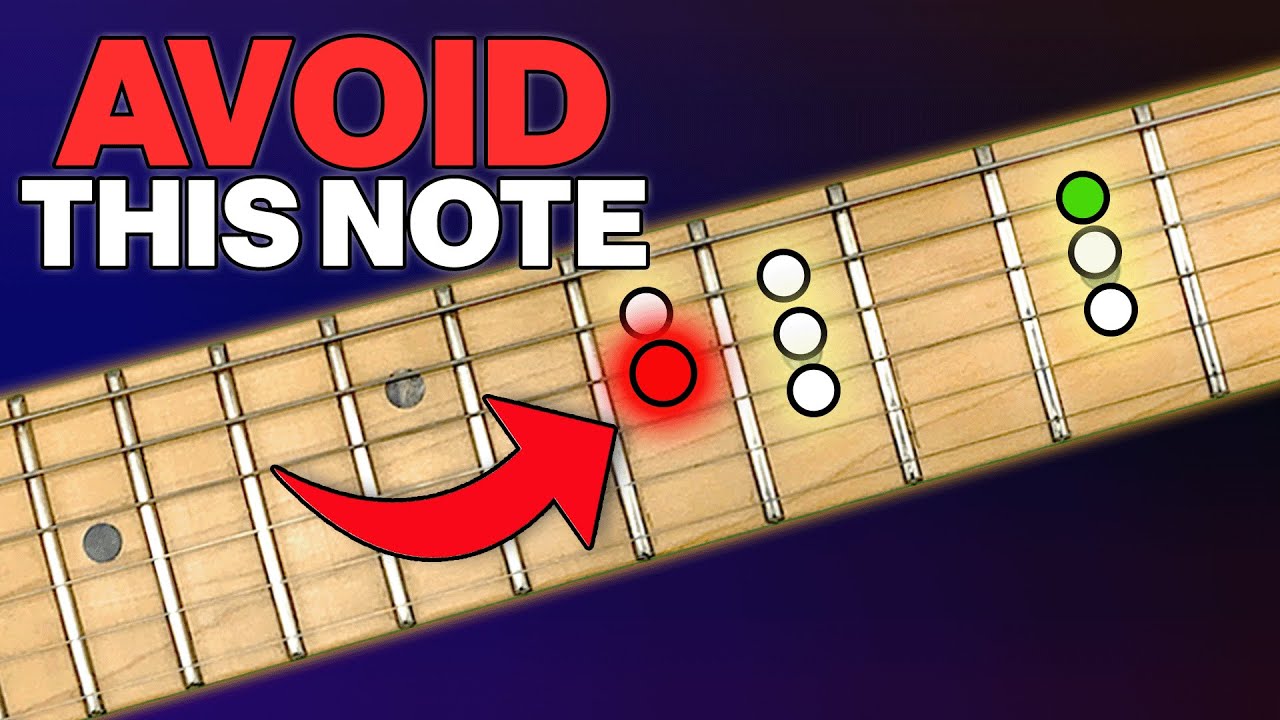
Key idea Avoid-note rule: half step above a chord tone
Any note in the key that is one half step above a chord tone of the current chord will sound dissonant; be careful with it.
-
-
Key idea Arpeggios cut to chord tones, but other notes sound great too
Learning the arpeggios of the progression cuts right to chord tones that never sound bad, but many non-chord tones (e.g. F#, A over Em7) also sound great and colorful.
-
-
How to practice Three options for a clashing note
(1) Avoid it over that chord; (2) use it carefully, don't sit on it, resolve down a half step to the chord tone; (3) replace it (C -> C# over Em7 = E Dorian) only over that chord.
-
-
Key idea In key does not mean consonant
Just because a note is in the key doesn't mean it fits the current chord; start delineating notes chord by chord.
-
-
Key idea Root can sound uninteresting over maj7
Over a major 7 chord the root is not bad but not very interesting; E minor pentatonic over Cmaj7 never plays the root, which is fine.
-
Practice it
- Drill Arpeggios through the key ProFor “Arpeggios cut to chord tones, but other notes sound great too”. You'll see every chord of the key hiding inside the one position you know. Open
- Guide Chord Tones: How to Solo Over Chord ChangesFor “Root can sound uninteresting over maj7”. Solo over two chords and hear the changes in your lines, by landing on a chord tone each time the chord changes. Then take the same idea to a ii-V-I. Read it
Transcript
YouTube's automatic captions. Tap a time to watch from there.
- okay so in today's lesson we're going to be talking about how to know what notes to avoid when you're playing a solo in a given key now this is probably a problem that has come up with you and you're
- playing because it's definitely come up with me which is that okay I'm soling over given chord progression and I know that it's in this certain key let's say it's in a major key or it's in a minor key and I know I'm nailing all the notes of the key I'm playing the whole scale correctly but why the heck do some notes
- still sound bad when I'm playing my solo that is exactly what we're going to be taking a look at today and it's an issue that I've addressed before in other videos but we're going to take a little bit of a simple ified approach all right so let's take a look at this track that we're going to be playing over and how
- do we figure out what notes to avoid in the key so first of all the chord progression is going to be E minor for one bar and then it's going to be a C major actually a C major 7 chord and then it's going to be a a minor 7
- doesn't really matter actually if there're seventh chords or not but that is the chord that's being played and then there's an E minor 7 as well there's are actually both uh E minor 7s so how do we know first of all what notes to play so I'm just going to tell you right now it's in the key of E minor
- slash the key of G major if you're aware of of course uh the idea of relative Miners and so on and so forth so let's write out the names of the notes that are in the key and then we're going to start to figure out how do I know what are the notes to avoid in the key so of course right there there are all displayed for you on a fretboard diagram
- but let's just write the basic seven notes that are in the key really quick so those are going to be e and then fshp and then G and then a and then B and then C and then D now there are E minor scales there's the E melodic minor scale there's also the E harmonic
- minor scale but we're going to start with this as our Baseline which is the eal minor scale that's what everyone kind of learns at first uh besides of course the good old like E minor pentatonic scale okay so the E minor pentatonic scale will actually work uh pretty well over this of course that
- would work work but what if we want to use the whole entire key that's where sometimes you can run into some problems so with that being said we have to figure out on a chord by chord basis What notes in the key clash with what
- chords in the progression and I'm going to give you a little trick that's going to show you what exactly to look for in order to know before beforehand without even like necessarily listening to it whether or not a note is going to clash uh with a given chord that you're playing over so with that being said
- let's actually write out all the notes that are in the chord progression that we're playing over so first of all we have E minor 7 e GB and D then we have C major 7 c e g and B and then we also have an A Minor 7 chord and that's going to be a c e and G over the E minor 7
- chord first of all one exercise that I like to do is to Simply drone each of the chords in a progression if you can if you have a way of looping and you've have your track or whatever it is set up in this manner is to simply just play over each chord and see like okay which
- note is the one that clap es if there are any sometimes there's chords that actually don't have any notes that are clashing over it and then seeing which ones clash and taking note of them okay so with that being said let's actually try doing that so we're just going to play over the E minor 7 chord okay and
- we're going to go very slowly one by one and I want you to decide for yourself whether or not a note sounds good over the course so let's try with E minor 7 so first I'm going to play E I think you should be able to tell
- that sounds pretty good it's the root of the chord so what about F SHP we're just going through all the notes in the scale so that FP that one sounds nice I don't think it clashes it sounds very colorful let's go to G what about G to me that one still sounds sounds very
- good let's go up to a I like that one what about B so so far the first five notes of the key work great they all work great over that chord so now B what about
- c ooh yikes that c kind of sounds a little bit hairy okay so let's take note of that that c is a note that I kind of want to avoid now it doesn't mean that I can't play it I would just probably want to resolve it
- down a half step to the B so but I don't think I'd want to sit on that note C so I'm going to take a mental note of that one what about d m d sounds very nice over that chord okay and then now we're back to
- e so right away just like literally using our ears and some basic logic we just figured out that over that E minor 7 chord all of the notes in the key sound really good actually except for that C note that C note is the note that
- we have to pay attention to okay now what is it exactly about that C note and basically any other note that you're going to find in a key that clashes with a chord it makes it sound hairy like that it's very simple okay it is one has
- Step Above one of the chord tones okay whenever you find a note that is one half Step Above one of the chord tones and the chord you're playing over you have to be very very careful with that note it is going to sound dissonant it
- just is so let's remember that rule of thumb any note that's a half step above a chord tone is going to sound dissent so let's write that down okay so that's really all you need to remember is that you need to watch out for notes in the key that are one half Step Above one of
- the chord tones in the chord that you're playing over now this is something I've talked about a whole bunch of times this is why it's important to learn the arpeggios of the chord progression you're playing over because you learn the arpeggios of the chord progression you're playing over you're going to cut right to all those cord tones and those are never going to sound bad but there's also lots of other notes that are not in
- the chord that also sound great to play over like for example if we look at the notes that the E minor 7 e g b and d well guess what also F SHP sounded really good a also sounded really good so the only one that was really giving us an issue was actually that Cote there
- okay and we're going to actually talk in a second about first of all we can do two things about this okay number one is we can just avoid that note so I can just say okay whenever I'm playing over the E minor chord I'm just not going to play C okay so let's see what that sounds
- like so I'm just not playing any C's everything sounds really good okay now
- if I want to I can use that c but I just need to know I need to be careful with it so so I don't want to sit on that c for a long [09:54] time so this is at least getting me in the basic realm of starting to like delineate between different notes in the key and realizing that some of them sound different over a chord and not just assuming that they're all going to sound good just cuz it's in key doesn't necessarily mean it's going to sound
- consonant and fit well with the chord that you're playing over now there is one other thing that we can do actually this is a little bit more advanced okay which is to instead of playing C we could play C sharp instead so this would be sort of implying only I would
- only do it over that E minor chord out of all the chords in the progression I would only do it on the E minor chord it's going to playing a C is going to clash over the other chords in the progression why because the other chords in the progression if you look at the C major 7 and the a minor 7 they both have
- C Naturals in them so actually just by using our logic we should be able to tell that actually over that C major 7 and an A Minor 7 that c is actually going to sound good it's part of the court so how's it going to sound bad if it's not if it's part of the court so I wouldn't want to play a C Shar over the C major 7 or the a minor 7 chord but I
- actually can play a C sharp over the E minor 7 chord let's see what that would sound like okay so I just take my C and move it up by a half step now I got a C sharp this is actually using what we call the E Dorian mode not going to get into modes right now if you already know about modes great I have
- other videos that I've made on modes but let's just see what that sounds like
- so you hear that c actually it uh it brings like a different character to what I'm playing over that E minor 7 chord it also kind of sounds very
- colorful in a way but at the same time it doesn't actually clash as much as the C natural does let's actually compare both of those really quick so here's C Shar and here's the C [12:45] natural this would be using C so that's one thing that you can also do so I would either say I'm going to avoid it or I'm going to be careful with that note I can still use it you can
- actually use any note that's not in the key too if you resolve it correctly or I could say hey let me actually literally change basically the scale that I'm playing over that specific chord when I get there in the progression so now let's check some of the other chords and
- let's see if there's any other clashes that happen so what about the C major 7 chord okay so C major 7 we have c e g and B so we could do exactly what we did in the beginning and just say okay I'm going to play the C major 7 chord I'm going to play over it and I'm going to pay very careful attention to how each
- note sounds that's something you should do to attune your ears and just make your ears better but if we go back to the bottom of that little diagram here or the iPad you should remember I said that the rule of thumb is that any note that's a half step above a chord tone is
- going to sound dissonant it's going to really sound dissonant and you have to be careful with it so now we have to ask ourselves are there any notes that are half step above a chord tone over C major 7 well there's c and e and G and B and C major 7 is there any note that's a half Step Above C in the key no no
- there's no C and that's why I was saying earlier don't use the C Shar over the C major 7 chord what about e well no there's a note that's a whole step above it that FP there that note should sound good it should it should be totally fine what about G there's no G sharp or a
- flat in there so we should be good there too we don't have any notes there in the key that are a half step above and then what about B well actually there's a c that's above the B but that's the root of the C major 7 chord so that's a little bit different now I will say sometimes if it's a major seven chord sometimes I might actually not like
- playing that route too much uh the root it's not that it sounds bad it just doesn't sound super interesting so let's actually hear now what I was talking about so we're going to play over the C major 7 chord so let's start just like we're thinking about the scale we're not even going to think about every chord tone right now or whatever let's just see if
- they sound good so here's e that one sounds really good what about F SHP sounds colorful but it still sounds nice what about G that one sounds good that one's a chord tone that's in the chord what about D sorry what about [15:55] a that one sounds fantastic so sounds very colorful doesn't clash with anything what about B that one sounds very nice you can even hear that in the chord voicing being played in the track what about C now it sounds pretty good it doesn't sound super interesting it's the root of
- the chord what about d i one sounds nice sounds very colorful and now we're back at e so actually in this particular chord progression in this particular key over the C major 7 there's no notes that we
- have to avoid they all sound good so you know if I want to I can you know play different things I could play E minor pentatonic E minor pentatonic takes out the C and FP I can play that over the C Major seven chord no problem it'll sound good I'll never end up playing the root of the chord that's not the worst thing in
- the world cuz the route like I said is not super duper interesting but that's what an E minor pentatonic would sound like over that chord so you'll find sometimes guys that there's certain chords in the progression that
- don't have any notes that are going to clash with them cuz there's no notes like that that have are a half step above of one of the notes in the chord like our rule of thumb goes and now let's just check the last chord here in the progression it actually goes back to E minor 7 of course is technically the
- last chord but it's also the first chord but the last unique chord a minor 7 so I'll just tell you right now actually if you look at a minor 7 a c e and G it is a very very very similar chord to C major 7 a minor 7 and C major 7 are very very heavily related and things that
- sound good over C major 7 are probably going to sound good over a minor 72 because literally three of the notes in the chord are the same but let's just do our due diligence and check so are there any notes in the key that are half Step Above one of the chord tones let's see let's check a no there's a b in it not a
- B flat so there's no note that's halfs up above uh C there's a d That's a whole Step Above C we're good there there's e there's a FP that's a whole Step Above we're good there and then G there's an a that's a whole Step Above So theoretically without even listening to
- anything we should actually already know that there are no notes in this key that are going to sound bad over the a minor 7 chord you know it's kind of funny this is an E minor scale and the only only chord in the whole progression that has any notes that sound clashing over it is the E minor chord the other chords the C major 7 and the a minor 7 chord they
- don't have any clashes but let's just double check with our ears cuz at the end of the day our ears are King so here's e here's F Shar that one sounds colorful what about G
- sounds great what about a that's the root of the chord that one sounds really good what about B that one sounds colorful but it sounds fantastic what about C it's in the chord sounds great what about D that one sounds colorful it sounds really good and now we're back up to
- E so there you go all you need to do is remember check the key and the chords that you're playing over and check for
- any notes that are a half Step Above one of the chord tones in the chord that you're playing over so we'll do one more thing I'm going to play over the whole entire backing track again and so I'm going to do just really one modification to playing all the notes in the key
- which is that over the E minor chord I'm going to try to avoid a little bit that Cote okay and if I do play that Cote I'm going to try to get right off of it and go down to a beat other than that on all the other chords I'm straight I don't need to do anything on the C major 7 and
- the a minor 7 I'm totally fine so let's see what that sounds [21:23] like there was the seat I went down [21:50] so if you want to learn how to master the guitar fretboard so that you can learn all keys and also learn your art arpeggios in all keys so that you can find those chord tones in any chord progression that you're playing over so you can more easily cut right to those notes that are going to sound totally
- consonant and fit perfectly with the chord then make sure you head on over to jamille. right now and check out the janville GPS fretboard fundamentals course this course is going to be the best course that you've ever taken if you've never never learned about any of this stuff before and you are just kind
- of Meandering with the same old pentatonic shapes in your solos also make sure you head on over to the Jamesville merch store in the link in the description below check out the awesome Jamesville t-shirts and other goodies that we have this t-shirt's freaking awesome it fits really well it's super comfortable it looks great so
- make sure you wrap the Jamesville Community out in the World also make sure you check out my new song that I dropped it's called My Divine Link in the description down below that's what you happen to be listening to right now make sure you head on over and check that out so you can support my music also make sure you like the video and
- subscribe to the channel and as always listen learn and jam