
After each pass the video waits as long as the loop, so you can play it back.
Start slower with −, and it climbs to 100%.
Keys: Space play · ← → 5 s · [ ] set start and end · − = speed · L loop
Practice and technique · Advanced
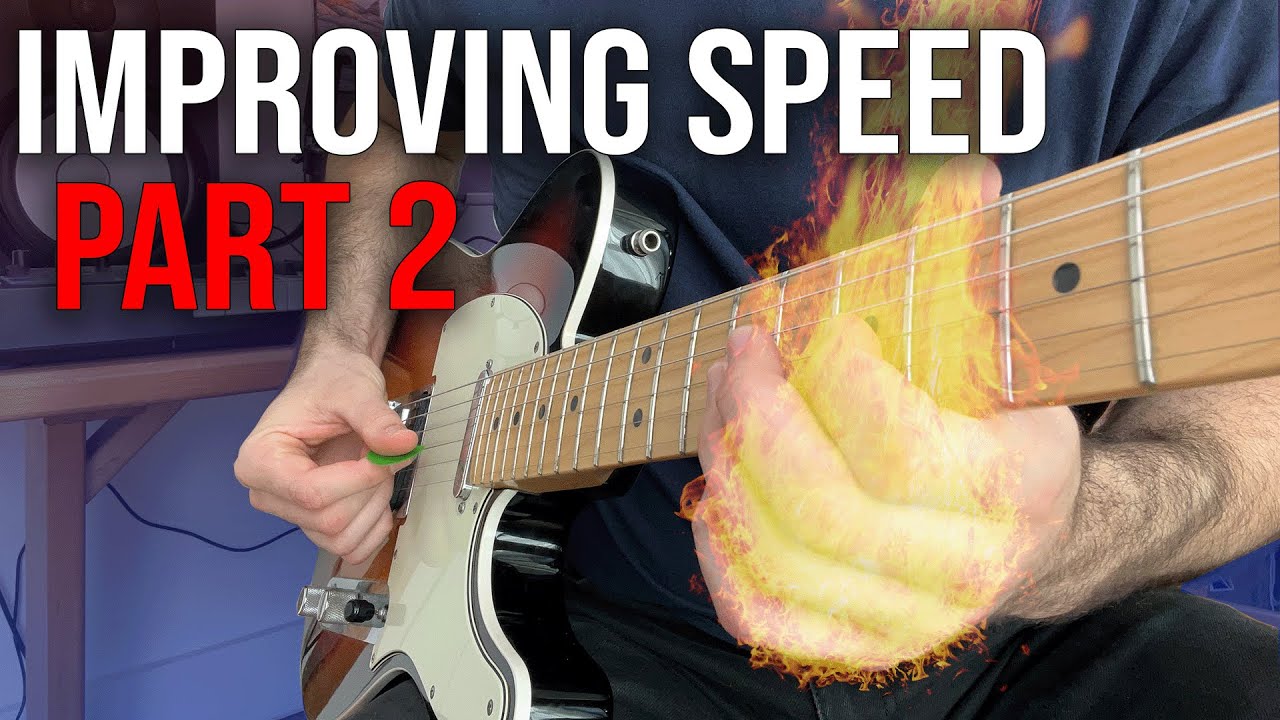
The EASIEST Way To Improve Guitar Speed (Part 2)
In this lesson
Tap a time to watch that part. loops it, so you can slow it down and play along.
-
Exercise Three-note groups shifted through the key
Take three adjacent scale notes on one string up and down (D E F with 1-3-4), then shift the group up the key (E F G with 1-2-4; F G A with 1-2-4 stretch); these few fingerings make up every major-scale pattern. Practice picked and legato (pick only the first note), up and backwards, up to 16th-note triplets.
-
-
Key idea Use the easiest way to play it
Don't wait to be a beast at alternate picking before playing fast; at 16th-triplet speed legato sounds smoother and is easier, so take advantage of whatever is the easiest way to play what you want.
-
-
Step by step Pick speed -> one-string speed -> across strings -> scale
Speed sequence: pick speed on one note, finger speed on one string, then two-string 3+3 groups without stopping, then the full three-notes-per-string scale, which is built entirely from the same blocks; then improvise with it (skip middle notes, skip strings) and use bursts with breaks to reset the hands.
-
Transcript
YouTube's automatic captions. Tap a time to watch from there.
- okay so that's enough of the two note combinations now the next thing we're going to get into is three note combinations so let's go back to d e and f so when we figure out something like this now we're let's start on D so we're gonna go d e f and then back to e so we're just gonna play them up and then down
- so whenever you're doing this you want to think of okay where's my first finger and then don't do any kind of wacky stretching if you don't need to so we skipped this fret we're skipping over the fourth fret so skip that finger two skip your second finger so we have the first finger the third finger and then
- the fourth finger so you need to practice that combination that's a super duper comment actually it's kind of like the beginning of a minor scale so there's that combination then now you think okay we're in this key we can keep moving up so instead of d e and f let's take e f and g so now we're starting
- there on the fifth fret so now the finger combination is slightly different we still have the first finger and we have the third finger sorry the first finger and the fourth finger but when now we have the second finger instead so every single like major scale pattern that you see in all stuff even if it's
- going across all strings it's gonna have like a whole bunch of this exact same finger combination on every string the first two this d e f those two shapes like you're gonna see these shapes all the freaking time guys so you gotta make sure that you practice these again that's why I think this is
- so important to make a video about let's try this with the drums so here's d e and f and then do Legato and then now uh e f and g
- and then actually if you want to get really crazy see if you can just keep it going without having to pick at all like this pick only the first note that can be really really challenging so
- now I think you get the idea we're just gonna keep sort of taking that group of three notes and shifting it over within the key so now look we're going to use f g and a so this is pretty much going to be the only actually other finger combination you're gonna see because the one from d e and f which is the
- first third and fourth that's one of them then you get the first second and fourth and then actually this one is gonna be kind of tricky as well because it's more of a stretch there's a fret skip between each note f g and a now I've seen some people technically you could pick um multiple different ways to do this
- but 99.9 percent of the time that I play this I actually use my first second and then fourth finger so I find it a bit easier to stretch between the first and second finger then for example between the third and the fourth finger that's like out really really tough on the pinky but we need to uh practice this
- one too because this one's gonna come up all the time all the all the time so let's try this one so FG and a with the first second and fourth finger and then if you get really crazy start trying some 16th note triplets it's like this triple a triple a triple A Triplet like
- that so uh and then do it backwards all these make sure you do them upwards and backwards so starting on a so a G and F yeah and like I said once you get to that
- 16th note triplet speed that's where like I could pick it but I actually don't even like how it sounds as much like it up a little bit there in the beginning but even once I'm starting to hit it it
- doesn't sound quite as good as if I uh just play it Legato yeah it's just way easier and way smoother to do it so that's why that Legato stuff is uh so important I use it all the time don't feel like you need to wait until you're this absolute beast at alternate picking uh before you can actually end up playing fast
- stuff um you gotta be able to just take advantage of whatever's the easiest way to play the thing that you want to play right so that's basically it for the single note stuff okay so we got a couple more things that we're going to cover because now we do need to get through crossing over strings and sorry I said single no I mean it's a single
- string stuff so combinations of two fingers and then combinations of three fingers and I highly recommend doing this as part of the major scale in that string so that you actually get usable finger patterns instead of just random like chromatic stuff that you're not really going to actually use in any music so for those of you who actually know the notes on the fretboard
- you should be able to know what notes on the Json string by the way if you don't know the notes on the fretboard make sure you check out my video the best way to memorize all the notes on the fretboard and then this will be super easy for you but let's uh now start taking a look at the third Trend so we're gonna take some of these finger combinations and then we're gonna expand it to a second string so actually right
- here for example we have all of these notes on the third string that are available for us to use so if we say okay let's take three notes that are on the second string and then three notes that are right next to it on
- the third string now of a sudden we're actually getting what is starting to resemble one of these major scale patterns that we have that go across positions that's literally all these patterns are is saying okay what notes are in a major scale and uh let's find all those notes that are in that
- position so we can take e f and g on the second string and then c g and e that's on the third string so actually with those I'm going to use the same fingers because I told you whenever I have that big the one that
- has all the skips in between each of the nodes I like to use my first second and fourth finger so actually you can play all these so let's try now doing that so we're gonna play one two three and then one two three on the third string
- so now we're practicing actually we have to keep that going across the string and not be able to stop [07:50] and then of course if you want to start improvising a little bit try to change the order so you see there now all of a sudden
- we're implementing that last piece of the puzzle which is we developed the speed with our pick we developed a speed with our fingers on one string and now we're developing transferring that and being able to do that across strings without stopping so actually let's try another one that doesn't repeat any notes because there we actually had
- these two e nodes on the pattern let's try e f and g on the third string now and then we're actually going to have a b and c on the second string so if you look there in the diagram you see e f and g in the third string so the ninth tenth and 12th fret third string and
- then the 10th 12th and 13th on the second string so let's try that one so now that's alternate picking now this is with Legato now backwards
- so first was alternate and then legato so fast [09:44] so you see there all of a sudden these are literally starting to turn into a whole entire scale pattern okay so let's take a look at this scale pattern here so now this is actually one that's very commonly used it's what's called a three note per string pattern and if you notice the whole entire thing is literally made up of all those building
- blocks that we've already covered in this lesson so on the six strings you have the same exact pattern the entire time c d e and then f g a so those skipping a fret in between each note then in the middle two strings the fourth and uh third you have BCD and
- then e f g so there's that one two and four finger combination where they're you got the uh half step between one and two and then finally the last two strings a second and first you have ABC and then d e f see again you see the logic behind this
- is we figured out all the possible combinations that we're gonna end up having on just one string and then we expanded it to being across the strings and now you can throw on a drum track and try to play through this whole thing so I like to play through these Legato because you just pick the first note on
- each string and then hammer on the rest of them if you're going up or pick the first note and pull off the rest of them if you're going down let's actually start from the top that's a much less commonly heard things when people play a scale starting from the top and going down so let's try that [11:30] there you go and now let's try doing it from uh the bottom bottom to top of course you can try to pick the whole thing but you see now I'm already comfortable with this idea because I've already
- worked on all these finger patterns and then of course once you get really comfortable just playing the scale up and down like that maybe just improvise a little bit take each string and go back and forth like this and again you can always use that burst
- technique where you go and then give yourself a little break that break can do wonders for resetting everything in your hands and then finally like all the stuff that I talk about try to improvise with a little bit [12:36] and that's where when you're improvising those other two no combinations come in like a lot of times I'll skip the middle note like for example in the third chain I'll go from E to G
- and then try to skip some strings [13:18] so if you want to learn how to master the guitar fretboard so that you can take all of these ideas that we talked about in this video and be able to apply your new found guitar speed to be able to play in any key over any chord progression and be able to understand how to do these things in every single possible place on the fretboard
- instantly then make sure you head on over to gemsville.com and pick up the gemsville GPS fretboard fundamentals course for literally the price of less than one guitar lesson with any guitar teacher basically on the face of the planet you can learn how to master the guitar fretboard playing any key learn
- all the chords you need to everything so make sure you subscribe to the channel hit the like button it really really helps out and until next time listen learn and jam