
After each pass the video waits as long as the loop, so you can play it back.
Start slower with −, and it climbs to 100%.
Keys: Space play · ← → 5 s · [ ] set start and end · − = speed · L loop
Soloing · Advanced
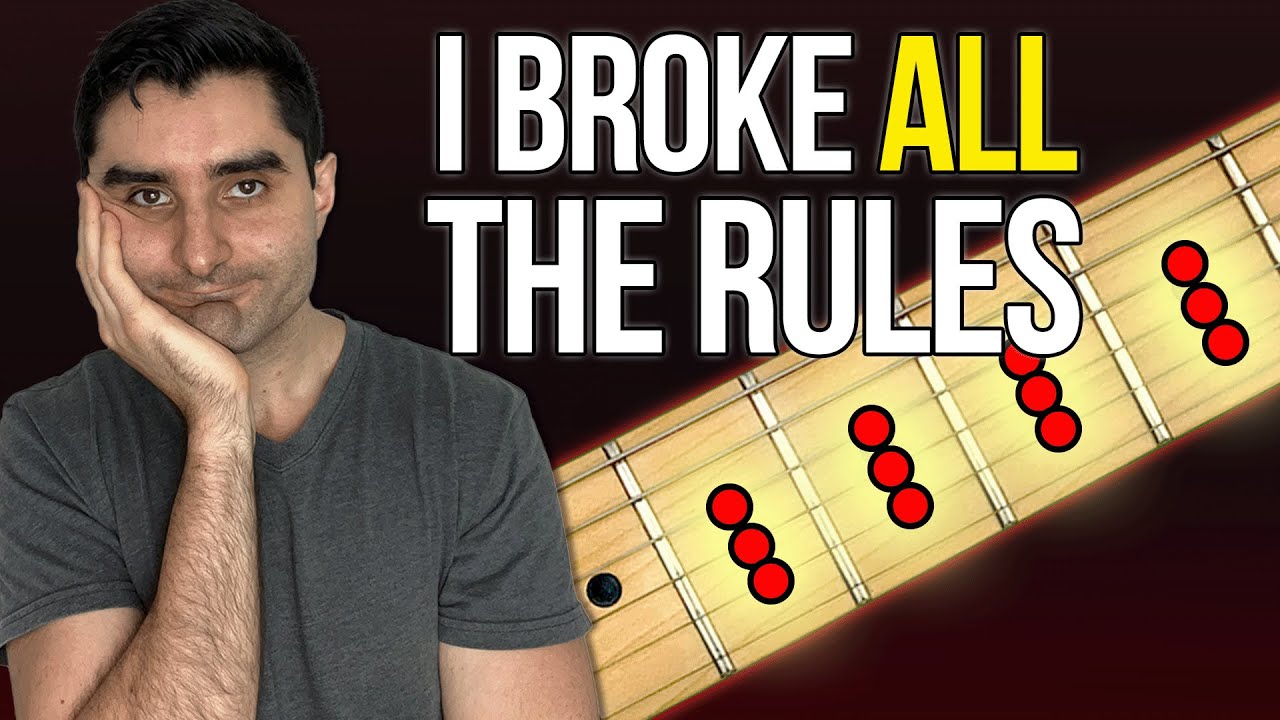
How To BREAK THE RULES In Guitar Solos
In this lesson
Tap a time to watch that part. loops it, so you can slow it down and play along.
-
Step by step The rules come first: scale, then chord tones
Usual rule ladder: play notes from the scale; then, because random scale notes don't always cut it, target chord tones/arpeggios of the current chord. You must know the rules to know which ones you break.
-
-
Key idea Your ear is the guide
Using your ears without knowing the rules is fine; at the end of the day the ear is the guide.
-
Key idea Break the note rules with good rhythm
Out-of-key notes played randomly sound nasty; the same notes work when the rhythm locks into the track. The rhythm rule is the one you never break; it is the most important element.
-
Exercise Any note, but land on a chord tone
Allow yourself literally any note over the chord, keep good rhythm, and make the last note of the phrase a chord tone (pick one green note in your mind as the destination).
-
-
Exercise Re-orient the targets when the chord changes
Over a two-chord vamp (Fm to Bbm), the scale stays the same but the chord tones change; re-orient so every phrase lands on the current chord's tones.
-
Key idea Freedom = confidence you can always get back
Being free to play any note while always confident you can go back to the rules is one of the most powerful things a soloist can have.
-
Practice it
- Guide Chord Tones: How to Solo Over Chord ChangesFor “The rules come first: scale, then chord tones”. Solo over two chords and hear the changes in your lines, by landing on a chord tone each time the chord changes. Then take the same idea to a ii-V-I. Read it
- Drill Land on a chord tone ProFor “The rules come first: scale, then chord tones”. You'll land on the note that spells each chord, right on the change. Open
Transcript
YouTube's automatic captions. Tap a time to watch from there.
- so in today's video we're going to be talking about how to break the rules in your guitar solos so when it comes to breaking the rules in your guitar solos first we have to know what the rules are right so most people kind of know when they learn how to play guitar solos what are the rules first you kind of get
- taught hey use scales for your guitar souls and if you notice here well we're going to be using an F minor back in track for this lesson and on this diagram on the screen we have the notes from the F minor scale written out the F natural minor scale actually which
- happens to be the same notes as the a major scale by the way so a lot of people just get taught okay well the rules are just play notes from the scale right and life is going to be good but then you realize that just r randomly playing notes from the scale isn't quite
- cutting it cuz sometimes stuff doesn't sound great so then the next rule you kind of learn how to follow is to Target chord tones and use the arpeggios of the actual chords in the progression you're playing on so for example if I'm playing over an F minor chord I'm kind of singling out those
- notes that you see there on the screen which are the green notes and those three notes are green because guess what those are the chord tones so if you notice all the FPS the A's and the C's on the diagram there are all green because I know if I'm playing over an F minor chord all of those notes are going
- to sound good let me actually just give you an example of that so here's our F minor chord and I'm going to play any of those green notes and I know that all of those notes are
- going to sound good because they're literally part of the court right so those are the kind of rules is basically hey let's stick to the notes that sound good right because the notes that are not included in this are not going to sound good right they're not in key or they're not in the chords right so we're going to see though how we're going to break the rules so breaking the rules
- now Step One is well we should know what the rules are right because if we don't even know what the rules are well how the hell do we know we're breaking the rules right how do we know what rules we are breaking and not breaking if we don't know what the rules are we're just you know kind of using our ears and by the way there's nothing wrong with that uh at the end of the day your ear is the
- guide and that's what we're going to be talking about in a second so step two is that if we do want to break Break The Rules let's say I want to use some of the notes that are not in this diagram that you see here okay I can actually use all of those notes for example like
- over here in the second string you got e and then you got F you got G sharp right well what about all these like little spaces underneath here in between rather not underneath these notes well guess what I can use use those notes but there's a couple other things I want to keep in mind when I use those notes okay
- so let's see what happens if I start using some of those notes in between the E and the FP and in between the FP and the G sharp in this key okay well that note right it kind of sounds like a it's definitely breaking
- the rules right what about this one the G those notes kind of sound nasty right and if I kind of just play them and go like that doesn't sound very good right so I'm breaking the rules but it doesn't sound good I don't want to do that so
- rule number two of breaking the rules is Break The Rules with good Rhythm okay so if I play those notes I can make it work if I have good Rhythm that locks into this track I'm playing over so [04:49] like so you see there it works because I'm playing good Rhythm so I'm breaking the rules of the notes but there's another rule that I ain't breaking which is the rule of playing good Rhythm right so that actually just in of itself to me that's
- the most important element of breaking the rules is when we do break the rules and play notes that clash with the key or clash with the chord we're playing over let's make sure that we follow just one other rule which is that hey the rule is that you have to play with good
- Rhythm right so last thing number three is when we break the rules we want to go back to following the rules so if you notice a lot of times when I played those notes that were not fitting with the diagram that you see here in the screen the last note that I played would
- be one of the notes that do does fit in a diagram on the screen particularly one of those green notes the cord tone so if I make sure I'm playing in Rhythm and then make sure that at the end of the whole thing I kind of come back home and end up on one
- of those chord tones you could end up on one of those notes that's not in the chord and it could work it might not work that's the thing about that uh it might still sound a little bit dissonant like for example in this F minor chord the D note is going to kind of sound a dissonant and we'll play that one so you
- can hear what it sounds like but basically it's breaking the rules and then going back to following the rules as long as it's some point you go back it all works so let's see what this sounds like now we play over The F minor chord and I'm going to literally allow myself to use any note that I want okay
- I'm going to try to get a little bit crazy but I'm going to make sure my last note that I play is going to end up being one of those green notes that you see there I just almost played every wrong note in the
- book all the wrong notes but it had good Rhythm and I ended up boom landing on that's an F Noe there this is an A and this is a c Shar any of those notes if I just highlight one of those in my mind
- Hey I want to land on that note after I play whatever the heck notes I want it'll end up sounding good in all likelihood so I want to just show you a couple of
- other cool ways to kind of make like a little pattern with breaking the rules so what I like to do is something called an enclosure so for example let's pick one of these chord tones let's pick actually this a here on the fifth fret of the first string so if I play that a I can play
- either of the notes that's right next to the A and just make sure I land on that a at the end of the thing and honestly I don't even care what those notes are that are next to a it doesn't really matter what those notes are next to a because I know I'm going to end up landing on a which is a chord tone let's
- see what that sounds like and again I'm playing real solid 16th notes with the right hand I could do the same thing with another chord tone here's a c sh
- here so that's just a cool little strategy too besides just kind of randomly playing wrong notes and breaking the rules is to actually find those chord tones and then practice playing all the wrong notes that are like right next next to the chord tone and then Landing back on the chord tone and that'll really teach you too to
- again be able to go back to quote following the rules once you're kind of done breaking the rules so now this is all well and good to do this over just one chord like this but ideally we should be able to do this through a chord progression so we're going to go
- down here and now we're going to listen to the full full backing track which is yeah it's in the key of F minor however actually the backing track is going to be um going to a B minor chord which is in the key of F minor also so
- when we switch to the B minor chord we need to kind of reorient ourselves so to speak the rules are kind of going to change so look I'm going to put on now on this screen boom all you see now is the exact same notes that we were looking at before it's actually still the F minor scale
- however now there's different notes that are green in the thing so the notes that are green are the notes from the B minor chord and if you notice here on the left hand side here is all the notes in the F minor scale on the top with the chord tone circled F A and C so I'm aware of
- what those core tones are and then the B minor chord it's actually the same notes didn't change any notes just rearrange them starting from a b note because now we're thinking in sort of a different world here where B is our one so we have to reorient our thinking a little bit so
- let's listen to here with a B minor chord so now it's a different chord so now we have our chord tones are b d and f sharp but I can still play all the same scale [11:49] notes so I can do the same thing I'm going to break the rules now make sure I'm playing good Rhythm and I'll land on one of those bees deser F [12:12] Sharps even there that that starts to get a little bit wild just like holding one of those notes for several times in a row so there I liter just played over and over sometimes the same wrong note
- like four times in a row but I just kept going until boom I landed on one of those chord tones so now we need to know what it's going to sound like when it's actually switching so you got to kind of get those two worlds in your head this particular
- backing track only has two chords in it but when we're playing over any chord progression has more chords every time the chord changes we kind of have to be aware of how the rules change so that we can break the rules and then we can go back to following the [13:27] rules so land in a cord tone core tone cord
- tone broke the rules and landed on a cordone [14:10] landed on a cortone landed on a cortone landed on a gone
- Corone Corone so you see first of all I mean that's just like so much fun right when you have the freedom to be able to literally play whatever notes you want and always have the confidence that you can go back after breaking the rules is
- one of the most powerful things you can have as a guitar soloist so if you want to learn how to master the guitar fretboard so that you can learn all of the different quote rules that there are when it comes to playing an any key and any chord and knowing where those cord tones are so that you can freely break
- the rules and figure out how to get back to the rules make sure you head on over to jamille. comom right now and check out the Jamesville GPS fr board fundamentals course and by the way if you're watching this video right when it came out we are doing a Black Friday sale that is right we are doing a Black
- Friday sale for 50% off the course so the course is only going to be $35 with the Black Friday sale this is such a ridiculous deal I hope that you're watching it right when the video comes out because if you're watching it after Thanksgiving weekend the courses
- sale is gone so make sure you take advantage of the sale right now and pick up your copy of the jville GPS fretboard fundamentals course also make sure you check in the description to get your awesome Jamesville merch which is going to just keep you playing guitar in style
- also check the link in the description for my favorite guitar picks the Dan's guitar store Precision pick they have the best grip and the best tip for playing awesome guitar solos that I've ever used make sure you smash that like button hit that subscribe button so you never miss any videos and until next time listen learn
- and jam