
After each pass the video waits as long as the loop, so you can play it back.
Start slower with −, and it climbs to 100%.
Keys: Space play · ← → 5 s · [ ] set start and end · − = speed · L loop
Fretboard and scales · Beginner
How PRO Guitarists See The Fretboard
In this lesson
Tap a time to watch that part. loops it, so you can slow it down and play along.
-
Key idea Camera lens: aware of all, focused on a part
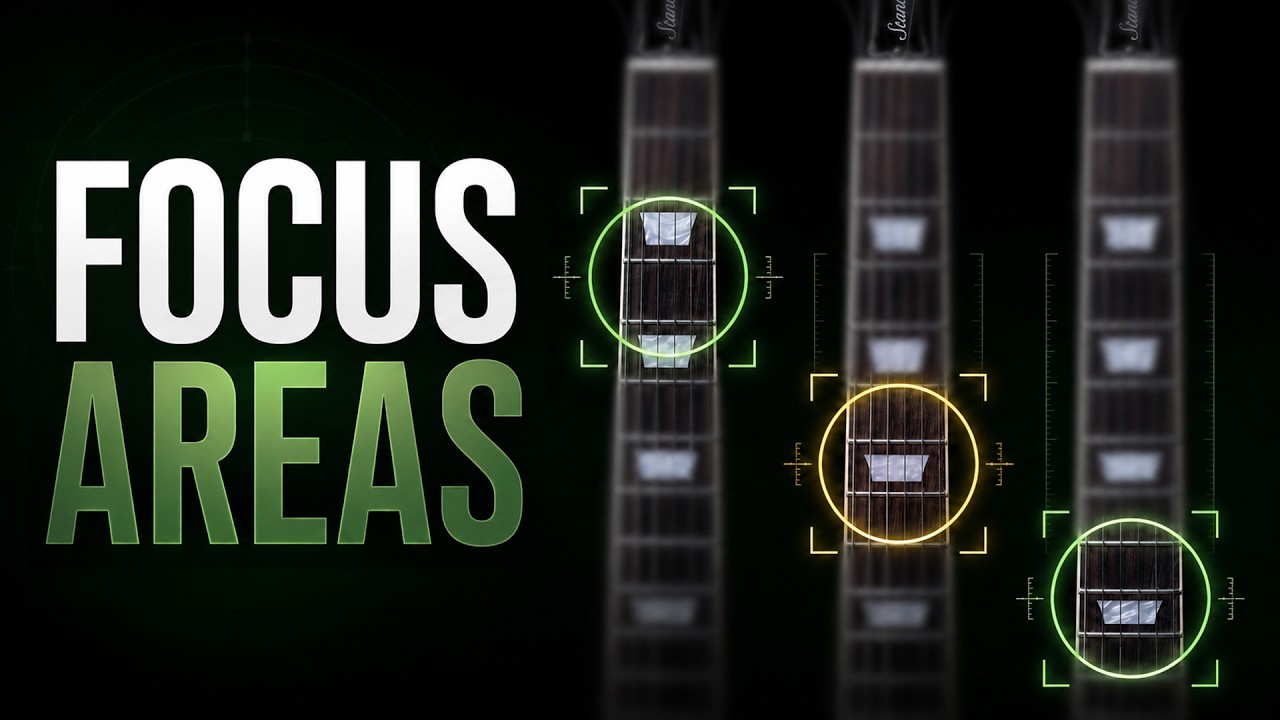
Pros don't see the whole fretboard at once; like a camera they are aware of the whole key on the neck but focus on a smaller area, and they know many ways (lenses) to organize the big picture.
-
-
Key idea Show the out-of-focus key notes
Whatever position is shown, the rest of the key's notes should stay visible but translucent, because that's how he thinks: the rest is out of focus, not gone.
-
-
Key idea 4NPS = switching single-string scales
He can visualize CAGED and 3NPS shapes without a guitar but not 4NPS shapes, and doesn't need to: 4NPS is playing up one single-string scale then switching to another; one-string awareness glues the picture together.
-
-
On the neck 3NPS pentatonic = 4NPS major minus 4 and 7
Remove the F's and B's (4 and 7) from a C major 4NPS pattern and you get a three-note-per-string pentatonic pattern.
-
Key idea Lenses suggest playing styles; focus on fewer strings
You don't need all the notes in a pattern; focusing on a smaller area (hide strings) helps. Different lenses lend themselves to different playing: 3NPS to triplets, 3NPS pentatonic and 4NPS to slides.
-
-
How to practice Take a pattern into the lab
What developed his playing most was not running and memorizing scales but taking a pattern 'into the lab' to find all combinations, with a mindset of experimentation; Jam Mode feedback lets him explore without looking at his hand, thinking of sound.
-
-
Key idea Many views of one picture
Don't try to see everything at once; keep a holistic picture but learn as many ways as possible to look at the same thing; the more views the better.
-
Practice it
- Drill Scale in groups of 3For “Take a pattern into the lab”. You'll hear the scale as little three-note ideas instead of a straight line. Open
About this video
In this lesson, I’ll show you how professional guitarists think about the fretboard and why seeing connections between patterns is far more important than memorizing more shapes.
Transcript
YouTube's automatic captions. Tap a time to watch from there.
- Most people think that pro guitarists see the whole entire fretboard all at once and that's why they feel comfortable soloing anywhere in the neck. But that's not really the entire truth. When I'm thinking about the fretboard, and I think when most other pro guitar players are thinking about
- it, yes, they have an awareness of the entire fretboard, but it's kind of like the way a camera works. A camera can take a big picture, but it focuses on a smaller area while still not completely blocking out the rest of the image. It's very similar on guitar. You might have
- an awareness once you know a whole entire key all over the neck of all the different options available to you, but a pro guitarist knows many different ways to organize that massive picture and focus on little areas kind of like the lens of a camera does. So, if we go
- over to the brand new free Jamsville app, which you all can check out by going to jamsville.com, either in your desktop or phone, you don't even have to download it. You can see that what we start off with is we actually start off with a C major scale and we see the whole entire picture of the fretboard. And this is a place that we'd like to
- get to at some point. But if we go over here to the position type menu, you can see these are kind of what I like to think of as different lenses. So like we have the cage positions. All of these cage positions are just little chunks of that massive picture. By the way, that's one of the reasons why I think it's very important in the app that no matter what
- position you're looking at, you can actually see all of the notes in the rest of the key outlined in translucent form because that's really how I'm thinking. It's like, okay, well, all of those notes that are translucent right now are like out of focus on the camera and what we're focusing on is this
- particular little spot of the fretboard. So that's one of the reasons why it's important to know many different ways of focusing your attention in the fretboard. Like then you would have three notes per string. That's another different way that you can focus on the notes that are in the neck. And of course uh that one just so happens to enable certain kinds of playing. Like
- it's really nice to play triplets when you're playing three note per string. but it's just another way of focusing. So, the really cool thing about the Jansville app is that you have another way of focusing which most people don't really check out, which is four notes per string. Now, four notes per string
- is kind of like the way I'm thinking of it is there's different chunks of each string. And I'm just taking four notes of them. So, one thing that I always highly recommend actually is learning your scales on one string at a time, too. So, like if you go back to the full fretboard section, you can actually click over here and you can hide strings. And if you go through different
- keys, learn them on one string at a time. It's really helpful for learning how to connect all these different cage patterns because you'd be like, "Oh, okay. Well, I have this cage pattern. Hey, but I also know that I have all these notes here on the string that are available to me." And so on and so forth. So, the four notes per string, I kind of think of it as just being like
- uh literally like, oh, okay, I'm playing up a single string scale, and now I'm just going to switch and play up another single string scale. And I almost don't even have these shapes like memorized, per se. Like, I could easily visualize a lot of the caged and three note per string patterns in my head, like without a guitar. These I kind of can't, but I
- don't need to because because as I'm playing through them, I kind of have an awareness of the notes on one string at a time and that helps me kind of glue the last pieces of the picture together. By the way, along those lines, uh, some of you probably checked out your cage
- positions, of course, for the pentatonic scale. Now, this would be C major pentatonic, which is the same thing as a minor pentatonic. But any of your pentatonic patterns, and you can check those out in the Jamesville app for free, gives you actually you can make three note per string patterns. But if you notice, it's kind of like the same thing as the four note per string patterns we were just talking about, except you just take out all the Fs and
- B's from the pattern, and you're actually left with a three note per string pentatonic pattern, which allows you to play some really cool stuff. And of course, even all these different position types. This is why I love that
- you can hide the strings. By the way, if you're on your desktop, you just press the number keys there in your keyboard. So, if I want to hide the six string, I just uh press six and it hides it or shows it. So, I'm press four, five, and six to hide those. And a lot of times I don't think of the whole entire pattern either. Like that's another common misconception. Like you don't need to play all of the notes that are in the
- scale. Like just because they're there like sometimes it can be really helpful to just focus on a smaller area. And a lot of these different ways of organizing and viewing the fretboard
- through different lenses, like I was alluding to earlier with the three note per string uh major scales, they actually kind of lend themselves towards different types of playing. So to me, this kind of uh three note per string pentatonic scale or the uh before we looked at the four note per string major scales,
- they kind of lend themselves to playing a lot more slides, right? Because you actually can't uh keep your hand in one position. Like uh if I just look at this string right here, like if I want to play those four notes, I can't really I mean I I could I guess write a stretch I kind of can do it, but that's not
- really the preferred thing to do, I think, most of the time. Like, I'm going to make a mistake like I just did there. Uh, sometimes you can, it can be really cool, but it's more natural to be like, okay, well, I can do two possibilities here. I could play the G and slide up to A and then play C with my pinky, or I
- could play G and A with different fingers and then slide up. So there's a lot of different possibilities that are available to you in different lenses of looking through the fretboard. And so the Jamsville app has all the stuff in it totally for free among lots of other things. But I want to show you guys something really, really cool. And this
- is in the Jamsville Pro app, which is included as part of your membership to the Jamsville community. You'll get access to the Jamsville Pro app. So, in a Jamville Pro app, we have jam mode. So, now I can turn on jam mode and it's going to actually track what I'm playing through the scale pattern.
- And this can be really useful for practicing because to me what it allows me to do better is it allows me to explore
- the actual pattern and lens that I'm looking at on the guitar without having to worry about actually looking at my hand. It's kind of nice to be able to like look at something that's giving you feedback, but uh you're not actually having to look your hand and you're just thinking of more of the sound and the
- way that you're organizing this pattern. And that's one of the things that has helped me the most to develop my playing. It's not just running scales up and down and going like, cool, I memorized that scale. rather it's about actually being able to take something into the lab and find all the different
- combinations you can play with and just actually explore and have a mindset of experimentation. Now, I will say that jam mode doesn't really work in the full fretboard mode or any diagrams that have repetitions of the same note. For example, there's many different ways to play the exact same note on the guitar.
- And uh right now it cannot detect uh between them, but most of the time you're going to be practicing with something like a caged position or one of these even four note per string or three note per string major scale positions or whatever. And it's not going to matter that much. Now, we're definitely working on improving it. I
- hope that one day we can get it so that it can animate wherever you want. But for right now, it's still incredibly fun to play with. I love practicing improvising and soloing and just experimenting through different lenses and patterns of looking at the fretboard. So, if you want to learn to navigate the
- guitar fretboard better, don't try to see everything at all at once. Yes, you want a holistic picture of the fretboard and the Jansville app, the free version will really help you do that, but you need to think about how many different ways can I look at the same thing. It's all the same thing, just that one picture of the fretboard, but look at
- how many different ways we can look at it. And the more different ways we can look at it, the better. So, go check out the Jamsville app. And if you want jam mode, go check out the Jansville Pro app, which is included as part of the Janville community. It's exclusive to Janville community members. So, click
- the link in the description to check out the app and hopefully come join us in the community and have some fun practicing around with the Jansville Pro app. And in the Jamsville community, it's not just about the Pro app. This is where I'm posting exclusive lessons every single month. and practice sequences that you can load into the
- Jamsville app to get the most progress out of your playing every single month. And it's all structured to all work together as one complete musical ecosystem. So, if you're really serious about improving your musicianship, improving your guitar playing, you got to come join Jamsville. All right,
- everybody. Until next time, listen, learn, and jam.