
0:00
Each repeat
After each pass the video waits as long as the loop, so you can play it back.
Speed up 5%
Start slower with −, and it climbs to 100%.
Keys: Space play · ← → 5 s · [ ] set start and end · − = speed · L loop
Soloing · Intermediate
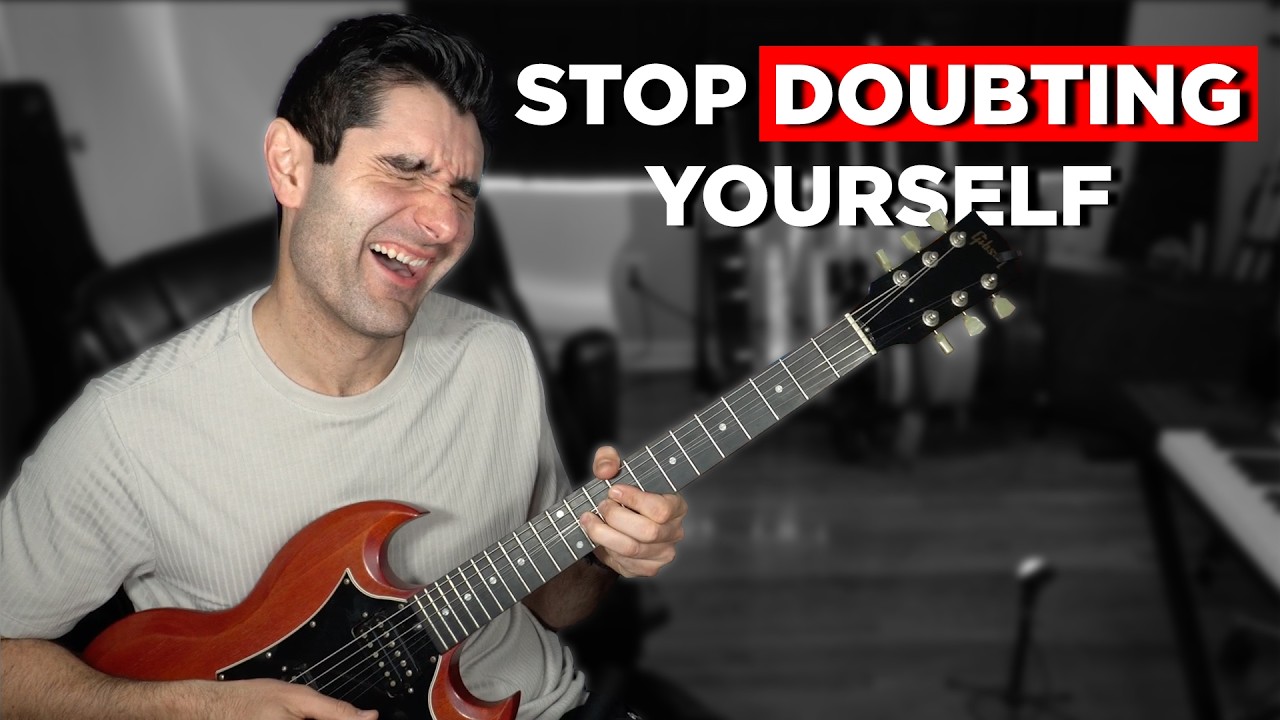
You're Too Afraid To Sound Good
In this lesson
Tap a time to watch that part. loops it, so you can slow it down and play along.
-
Key idea Belief problem, not technique problem
Many players lack belief that their notes deserve to be heard; mindset determines what percentage of raw skill comes out.
-
-
Key idea Time is everything (stated in passing)
Adam restates that time is everything and great rhythm solves all problems.
-
-
Key idea Give yourself permission to be confident, sound bad, take risks
Give yourself permission to believe in yourself now; keep confidence through wrong notes or rhythms; best players aren't afraid of mistakes or risks.
-
Transcript
YouTube's automatic captions. Tap a time to watch from there.
- Most guitar players don't have a technique problem. They have a belief problem. They literally don't believe the notes that they're playing deserve to be heard. And the craziest part is that you can actually practice fixing this. So, I want to give you a thought experiment for a second. Imagine you
- took your favorite guitar player. Let's say your favorite guitar player is Jimmyi Hendris or Eddie Van Halen. Anybody. It really doesn't matter who it is. And you make a clone of them with all the exact same skill level, but now this other clone doesn't believe in themselves, has a fearful mindset when
- playing guitar, and just in general still lacks confidence. Even though, of course, this clone still has the same skill levels and really doesn't have an actual rational reason for lacking the confidence. Of course, I think you can already see where this is going. If we took the super unconfident version of
- Eddie Van Halen or the super unconfident version of Jimmyi Hendris, it would by definition make them worse at the guitar because that lack of confidence and that lack of belief just doesn't allow their full skill level to actually shine out. And this is a big problem for people and
- it's something that has taken me a lot of work and is still not perfect. And I think that for a lot of people, it's not a perfect aspect of their playing. And it's okay. Nothing is supposed to be perfect. But I've seen this many times, people who are actually very good. Like I listen to them and they actually sound
- good and they have all of the raw skills that they need. Like they even have really good technique. They have good time. I know I always talk about how time is like everything and time will solve all your problems and great rhythm will solve all your problems. They even have great rhythm and they know all their scales and they know songs and
- they know all the stuff that you're supposed to know, but they don't believe in themselves and that is like the last mental hurdle slash roadblock that they just can't get through. And that's why it hampers their playing. And I've seen this so many times and it's gotten me
- thinking, is there a way that you can actually start to overcome this issue? Like if we took Jimmy Hendris's unconfident clone, how could we get Jimmyi Hendris's unconfident clone to start to be as confident as the real Jimmyi Hendris to believe in himself as
- much as the normal Jimmyi Hendris that we all know and love does. Fortunately, there are definitely ways to practice it, but unfortunately, I don't think I found the perfect way to practice it yet. And because it's kind of like an esoteric thing, it's just difficult to
- work out any mindset problems that we have as guitar players. In a way, they're the easiest and the hardest problems for us to solve. They're the easiest problems to solve because all you need to do is just start thinking a different way. But they're the hardest problems to solve because one of the hardest things to do for human beings in
- any way, shape, or form is to get them to think differently than the way that they do automatically and by default. This phenomenon can also be found in many many other different areas of life like sports. It's like imagine if you took like Kobe Bryant or Michael Jordan and they had all the exact same skills
- that they possess, their ability to shoot threes or free throws or dribble a ball or whatever it happens to be, the actual raw skills that go into that and suddenly if you take their confidence away, it's all going to just make things worse. And think about it like this. Everybody has a certain raw level of
- skill and the mindset that you have is what determines what percentage of that skill can actually be translated into real life. So ideally, we want to have the mindset that allows 100% of all the raw skill that we possess to be utilized
- when we're playing guitar. And we may, if we have the wrong mindset, only be using 50% of it or even 70 or 80% of it. If you're only using 80% of it, that kind of sucks cuz you still have 20% that you can get way better. And all it requires is you changing the way you're
- thinking. So, how can we practice this? Some of these things are going to sound kind of funny, but hear me out. The first kind of interesting way to practice it, I think, is to play, and this works even better if you're playing like a cover song from someone who you really enjoy or maybe playing a solo transcription, and pretend you're
- actually that person when you're playing. So, like if you want to play a Jimmyi Hendris solo from The Wind Cries Mary, how can I get into the headsp space that Jimmyi Hendris might have been? Like, it's almost like a child's game. Like playing Makebelie. Make believe Jimmy Hendris. Like if Jimmyi
- Hendris is playing, I want to actually take advantage of
- that and be like, what would Jimmy Hendris not just sound like, but what would Jimmyi Hendendricks actually feel like? What would his demeanor be when he's playing? And see if you can actually embody that. Now, of course, the goal isn't to copy Jimmy Hendris in this case. The goal is to take that
- level of confidence and take the mindset. And that's one thing that I don't think gets talked about enough when it comes to guitar lessons just in general is your mindset around practicing, but specifically like can you actually not just learn a solo from
- a great player, but can you actually learn that player's mindset when they're playing? If you can do that, that is one of the most powerful things I think that you can do to improve your own playing and ironically discover the confidence and the belief in yourself that will
- allow your unique voice to shine through when you're doing something like improvising. Now, don't get me wrong. It actually can definitely help you improve your confidence for sure when you actually practice more and you actually learn more raw skills. Like for example, if you learn how to master the guitar fretboard and you get called to solo in
- the key of A flat, for example, and you can easily find those notes anywhere on the guitar neck. Or maybe the song changed keys suddenly to the key of E and now all of a sudden you can find those notes.
- That definitely definitely helps. And by the way, that's why I made the Jamsville GPS fretboard fundamentals course, which is designed to give you an easy to follow stepbystep system that will take you from where you are to feeling confident in all 12 keys. all over the whole entire guitar neck. And that is a
- super duper valuable skill that everybody should have if you want to maximize your potential on the guitar. So, if you're interested in that, go to jansville.com or click the link in the description down below. So, here's the real way I think to practice your confidence though, and it's this mindset shift. And to me, this makes the biggest
- difference between an intermediate guitar player and a really, really, really good guitar player. And it's this. Give yourself permission to be confident. Give yourself permission to believe in yourself. You might not have all the skills that you want yet, and you might think you need to practice more, and you might actually need to
- practice more. But even if you do need to practice more and even if you don't feel like you're anywhere near as advanced as you should be, give yourself permission to believe in yourself and see how it feels. See if you can make yourself feel the same way with the level of skill you have that you would
- feel whenever it is you reach that magic moment that you finally learned enough and you can finally be confident in yourself. By the way, that pretty much never ends up happening. You don't just like wake up one day magically and you're like, "Yay, now I'm good enough to be kind of happy with my playing and be confident." That's not really how it
- works. But, ironically, you need to give yourself permission. And that includes, by the way, permission to sound bad and still keep your confidence. If you're playing a solo and you play some wrong notes or even some wrong rhythms, make it your goal to say, "I don't care what happens. I'm going to keep that belief
- in my mindset like no matter what." Give yourself permission to take risks. That is one of actually the most admirable qualities of all the best guitar players that I love. They are actually not afraid of making mistakes or taking risks. and that ironically
- makes them sound way better. So, this is just such a huge topic that I really wish I would have known when I first started playing guitar. And also, that's why I made this video, which is going to give you 22 years of guitar advice in 11 minutes. And it's all stuff that I've learned over the past 22 years of
- playing guitar that I really, really wish someone would have told me when I first started. And I think I would be so much better right now if somebody had. Also, if you're interested in a free consultation for one-on-one lessons with me, there's a link in the description for that. If you enjoyed this video, subscribe to the channel, hit that thumbs up button, and until next time,
- listen, learn, and jam.