
After each pass the video waits as long as the loop, so you can play it back.
Start slower with −, and it climbs to 100%.
Keys: Space play · ← → 5 s · [ ] set start and end · − = speed · L loop
Rhythm · Intermediate
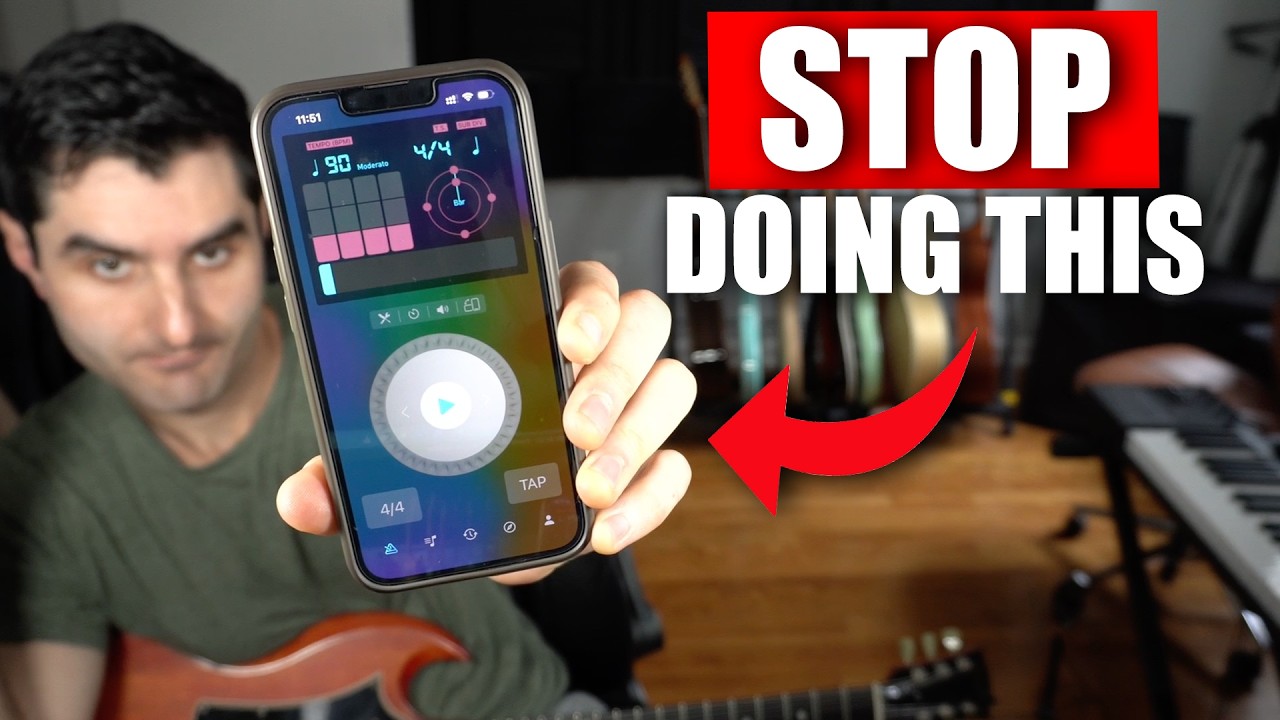
What Everyone Gets Wrong About Metronome Practice
In this lesson
Tap a time to watch that part. loops it, so you can slow it down and play along.
-
Key idea Metronome goal: sound good with a band and alone
The metronome's goal is better time both with others/recordings and alone; good time with a click doesn't guarantee time alone, where dependence on the click is exposed.
-
-
Key idea Metronome as training wheels
Think of the metronome as training wheels you gradually raise and phase out to develop an independent internal clock (though you never throw it away entirely).
-
-
Key idea Strong internal clock locks you to records and bands
After this work, playing with records or a band feels solid because you match a locked internal clock to the time you hear.
-
Practice it
Transcript
YouTube's automatic captions. Tap a time to watch from there.
- So, everyone gets told that it's very important to practice with a metronome because practicing with the metronome is going to get your rhythm and your time better and it's going to make you sound as good as possible. But there's one thing that everyone gets wrong about practicing with the metronome that is
- super duper important we got to talk about right now. Because if you don't fix this, the metronome is never going to actually fully fulfill its purpose. And watch all the way to the end to see the absolute most important thing you need to practice in order to get your time better. The goal of playing with a
- metronome is to be able to make yourself sound better when you're doing the following two things. Number one, playing with a band slash other people slash playing with a recording of a band. And number two, when you're playing by yourself. And here's the problem is that every single time you
- practice with a metronome, you are not doing both of those things. And specifically in this lesson, I want to talk more about the second thing I mentioned, which is playing by yourself. Practicing with a metronome is good for improving your rhythm. But what happens when you want to play by yourself and
- all of a sudden you don't have the metronome to help you anymore and all the rhythm just kind of starts to fall apart? Even if it's like a basic rhythm guitar part, you need to be able to play by yourself and keep time without rushing or dragging. And even if you're
- pretty good at playing with the metronome, there's no guarantee that you're going to be able to do this successfully.
- And see the problem is that when we play by ourselves, we can actually get exposed in the fact that we we're depending on the metronome when we're practicing with it. We want to be good at practicing with the metronome, but we don't want to be dependent on the metronome to have time. So, with that
- being said, that brings up the question of how do we bridge this gap between practicing with the metronome and then kind of not knowing what to do when it comes time to play by ourselves. So, we need to think of the metronome in a different way. I want you to start thinking of the metronome less as
- something that you should be relying on in order to be able to play in time and think of it more like training wheels on a bike. So most of you probably know how to ride a bike and you probably remember that when you first try to ride a bike, you cannot keep balance by yourself. So what do you do? You put training wheels
- on the bike and they make it so that you can't fall off the bike no matter what. And you're extremely dependent on those training wheels, but as you get more comfortable sitting on a bike and pedaling and getting used to how everything works, you raise the training wheels up a little bit. And that makes
- it so that now you have to balance a little bit. You might be swaying a little bit back and forth, but you're never going to fall completely off. The training wheels are still there. So, the whole goal is to remove the need to use the training wheels in the first place. Now, it's not quite the same with the metronome. I'm not saying that one day
- your time is going to be so good that you never need to practice with a metronome again and you can just throw it all away. But it's more so to say that we need to start to figure out ways to kind of raise the training wheels up, so to speak, or actually gradually phase out the metronome so that we can
- actually attain the goal of being able to play in decent time all by ourselves and have an independent internal clock. So, I want to show you one of my favorite ways to do this, and it's very simple. So, what you're going to do is get your metronome out and you're going to put it on 80 beats per minute. Now,
- depending on what metronome app you're using, you could do this with any tempo, but I want to do it at 80 beats per minute. You'll see why in a second. So, I'm going to turn my metronome on 80 beats per minute. And I'm just going to practice with the metronome for a second here and play that groove that I was playing before, that E minor, D, A
- minor, Groove. Okay, excellent. So, I feel pretty decent playing that particular groove.
- So, now we are going to gradually phase out the metronome. So, that's great that I can play it with the metronome at 80 beats per minute, but that doesn't mean I'm going to be able to play it by myself and have it sound anywhere near halfway decent. So, I am going to cut the metronome in half from 80 beats per minute to 40 beats per minute now. And
- I'm going to try to play the same thing. So, instead of me having a click on 1 2 3 and four, I'm going to have a click only on beats one and three. So, like this. 1 2 3 and four.
- So, now we're going to cut it to 20 BPM. And now we're going to think of the exact same groove, but we're only going to have the click on beat one. 1 2 3 4
- So now that's where it's starting to get real hard because you have all this time in between clicks. I really dare you to try to do this. Another really good thing to do is improvise a solo instead. So, you don't even need to make sure you're making changes or anything like
- that. We're focusing on our rhythm right now. So, really, the piece of material that we use is pretty arbitrary. So, I can just like pick an E minor pentatonic scale and see if I can actually keep time with that. Maybe I'll improvise quarter notes. 1 2 3 4.
- So actually in this case, the slower you go, the even more challenging it's going to be. So I want you to try doing those different things. Try playing a groove over the metronome this slow and try improvising a little bit. Improvise some quarter notes, some eighth notes. But
- here's the last exercise that you're going to do. So, this is really the absolute most important thing that you need to practice. And it's actually playing the new quarter note with this metronome. So, technically, the metronome doesn't know that it's on beat one. It just thinks it's playing 20 beats per minute. So, I want you to only
- play with the metronome and you have to completely keep time in your head slash with maybe the movements of your hands a little bit in between each of these quarter notes. You're going to see this takes an insane amount of focus, but it's so good for you. Let me show you what I mean. 2 3 4. That's what I'm
- thinking. 2 3 and four and two. Trying to subdivide, but I'm still playing quarter notes. That one was rushed. That one's good.
- Ah, that was super rust. You can see this is still really hard for me and especially to try to explain what I'm thinking while I'm actually doing this. It's super hard and in a way making this video is fun for me because it's actually even good practice for me to do this. This is one of the absolute
- best most important things you could do. I guarantee you, you spend like 10 minutes a day doing this and then all of a sudden you play with records or play a packing track, your time is just gonna feel like so insanely solid because now you're going back to like playing with a record or something that you hear the time going on the whole entire time. You
- can really listen and match your like super locked in internal clock with that recording or the band maybe that you're playing with. This just makes your internal clock look so good. And it's honestly something that once you kind of realize how good of an exercise this is, you never stop practicing for the rest
- of your life. Like you might take breaks from practicing it, but you're always going to end up coming back to it over and over because it's that valuable to be able to work on your internal clock. So, I hope you see that's why like people get metronome practice wrong because they think, "Oh, I'm just going to play with the metronome on beats one, two, three, and four all the time." Yes,
- that's cool. But you got to be able to do this where you're actually deliberately giving yourself less and less and less help from the metronome. You're stripping the metronome away until basically what you're doing there is like almost the whole entire time you're not hearing any metronome. You need to keep count by yourself. And if
- you mess that up even a little bit, you're going to rush or you're going to drag and you're going to immediately notice it cuz you're just going to think like, "Oh, here's beat one." And then boop, it's not there. It's either early or it's late because you weren't on time with your internal clock counting. So working on this exercise to me is one of
- the biggest things that got me from an intermediate level in my playing to an advanced level in my playing and specifically a practicing improvising like I was showing you earlier. It really helped my solos get way better rhythm. But I want to talk to you about something else that pretty much every intermediate guitar solo is missing. And
- that's why I made this video right here. So, go ahead and watch that next. If you're interested in mastering a guitar fretboard, go to janzil.com. If you're interested in one-on-one lessons with me and want a free consultation, go to the link in the description down below. If you enjoyed this video, hit that subscribe button, hit that thumbs up button, and until next time, listen, learn, and jam.