
After each pass the video waits as long as the loop, so you can play it back.
Start slower with −, and it climbs to 100%.
Keys: Space play · ← → 5 s · [ ] set start and end · − = speed · L loop
Practice and technique · Intermediate
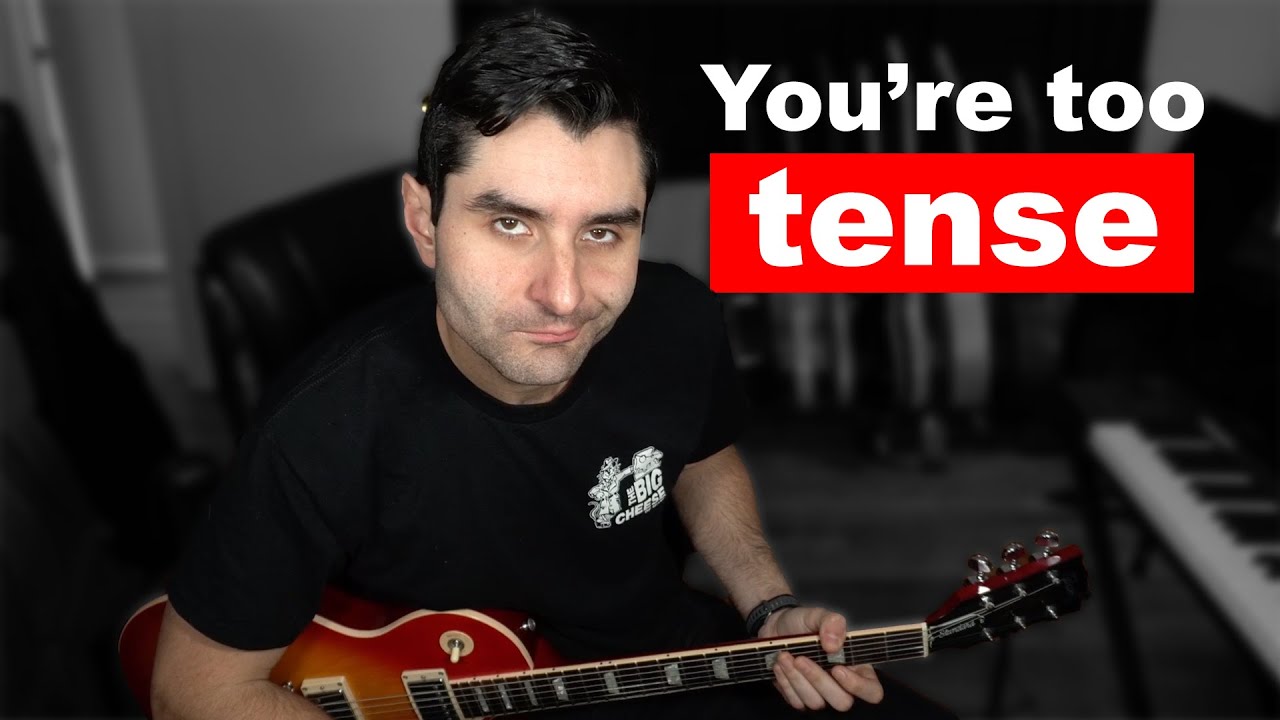
Trying Hard Is RUINING Your Guitar Playing
In this lesson
Tap a time to watch that part. loops it, so you can slow it down and play along.
-
Key idea Trying hard locks you up
Trying as hard as possible not to mess up increases tension in hands, body and mind, which reduces precision; precision comes from being as relaxed as possible. The standard is to play it perfectly AND effortlessly, and if you focus on the effortless part first, precision comes faster.
-
-
Exercise Least-effort repetition with a body scan
Play a cell trying hard and notice tension (stomach, neck, arms, grip, sore fingers); then play the same thing asking 'what's the absolute least effort I can put in?', aware of the whole body, deactivating every muscle you can, deliberately doing it without trying. Expect a few more mistakes short-term; don't let that bring tension back; the relaxed state becomes the default and precision follows.
-
-
Key idea Panicking blocks learning
Gripping with tension makes the nervous system treat practice like a life-or-death situation and associates guitar with panic; a calm nervous system learns faster (like studying math calmly). Trying hard is practicing being fearful.
-
-
Key idea Detach from outcome: lower the stakes, not the standards
Waiting anxiously for the magical first perfect take is a Chinese finger trap. Focus but detach from the outcome: a mistake just means play it again. Lower the stakes of each repetition, keep long-term standards high, and let correctness be a byproduct of the right mindset and process. Relaxing harder, not trying harder, fixes mistakes.
-
Transcript
YouTube's automatic captions. Tap a time to watch from there.
- A lot of times when we're practicing something with good intentions, we try as hard as possible to play whatever the thing is that we're practicing perfectly. And when we can't play it perfectly, we try again and we try again and we try again. And we think that if we try harder, we're going to eventually be able to play that thing that we're
- practicing perfectly. Now, the thing, of course, is that you do kind of need to try in order to get good at guitar. You obviously can't just not try because that would be just not practicing, right? That would kind of be like laziness. But the thing is that we need to make sure that our mindset is directed in the right place when we're
- practicing so that we know what are the things we should be trying hard at and what are the things that we should actually be deliberately trying not to focus on. So, for example, one of my favorite things to practice to play faster is to just take a pentatonic scale and take these little four note box shapes on adjacent strings and
- practice playing them fast. But the thing is, especially when you start repeating something over and over, if I'm trying really hard to make sure that I'm nailing that, what's going to end up happening is I'm going to actually start increasing the amount of
- tension that's both in my hands and my body and also in my mind. And the higher amount of tension that I have in my hands, body, and mind, the less likely I'm going to be able to to actually execute that thing correctly. In other words, trying not to mess up is actually
- making me lock everything up, lock up my body, and lock up my mind. And that in turn produces the exact opposite effect. And I'm never going to be able to play something perfectly or play it consistently if I'm always trying super hard when I play it. The thing that you have to remember is that playing guitar
- and especially playing with any kind of speed, but even guitar playing that's not all that fast by most people's standards requires a lot of precision. And actually the state of mind and state of being that's going to put you in the best position to have the highest amount of precision is actually being as
- relaxed as possible. So when you're practicing something, the goal shouldn't just be to try to play it correctly at all costs and play the notes correctly. Just no matter what, by hook or by crook. Your standard should actually be you should be able to play the thing
- that you're practicing perfectly and effortlessly. And actually, if you focus on the other part of that first, if you focus on practicing without the effort and focus on staying in that relaxed state of mind, you're going to find that the precision will come way faster. And
- so for most people, including myself, by the way, speaking completely from experience, the main thing that's bottlenecking your progress isn't even that you're not practicing enough or that you're not even practicing the right way. Because you might still be practicing the right way. You might be isolating things. You might even be practicing them slowly. But if you're
- isolating things and practicing them slowly and doing them in a logical way and you're doing so with way too much tension or you're just not practicing getting to that state, which is what is the least amount of effort I can possibly put in to playing this. So, for example, I'm gonna play one of these little cells here, and I'm gonna try
- really hard to play it perfectly. Like, I can do it, but it doesn't feel good at all actually when I'm doing it. Like, I literally feel all this tension in my body. Like, even in my stomach, in my neck, in my arms, I'm gripping the
- strings too hard. I'm pressing down too hard. It's making my fingers start to hurt more. But now I'm gonna say, let me try playing that same thing, but what's the absolute least amount of effort that I can put into it? I'm gonna try to be aware of my entire body and say, I'm going to deactivate all the muscles I possibly can, and I'm going to just
- deliberately try to do it without trying. So, that felt a lot better. For some of you, if you've never tried something like this before, you may actually find if whatever lick or scale or whatever it
- happens to be you're going to apply this to, you may find that initially, you're going to actually make a couple of more mistakes than you ordinarily would have. And that is going to trigger you to go, you know what, forget this. I need to try hard again. and I need to bring that tension back into the mix. But here's
- the thing that a lot of times what happens actually is that in the short term because you're just not used to relaxing that much and you haven't practiced getting into that state of mind enough, you're going to kind of get a little bit sloppier, but only in the short term. It's only a super temporary
- setback. So, you can't let that freak you out. You have to think of it as I'm gonna try to get into that relaxed, effortless mindset. And the more time you spend in it, the more you'll get used to it and it'll just become your normal default way of playing instead. And then once it becomes your normal default way of playing, then you'll
- really notice all of those gains in your precision and you'll start to be able to do both to be super precise and play even better than you were playing before and stay relaxed and it's going to feel really easy when you're doing it. So I want to bring up a second point about this, which is that panicking blocks
- learning. So, when you're trying really hard to play whatever lick it is or exercise or scale, it doesn't matter what it is, and you're using almost tension, your subconscious mind actually thinks that you're kind of like in a life and death situation. I know it sounds kind of crazy, but you're kind of
- making your nervous system panic and you're associating guitar with that feeling. And the more and more times you do that, you're going to associate guitar with kind of this crappy feeling, honestly. Like, who wants to feel like that? You don't want to feel tense. You don't want to feel panicked. You don't want to feel like all of this just locking up. Like I
- said, I think that probably some people end up quitting guitar because of that. But at the very least, it's just not a good feeling. And if you're always in that state of mind, your nervous system is also not primed optimally to learn. You're not going to learn as fast because your nervous system needs to be calm in order for you to learn. If you
- try to learn anything else, like if you were opening up a math textbook and trying to study math, you don't want to be like freaked out like scribbling everything down and ripping all the pages apart. You want to be like super calm and focused when you're doing that. And it's easier in a situation like that because you don't have to actually physically execute things in real time.
- You can sit there and think through them a lot more than you can when you're performing something on a guitar. So, it doesn't trigger that response as much. But you need to keep that in mind that you're kind of practicing being fearful when you're playing actually when you try so hard. And this is going to bring me into my third point about this, which
- I think is the most important element to the whole thing, which is that ironically, you need to detach yourself from the outcome of your playing. What do I mean by that? So when you're practicing something, the reason that you get so tense and the reason you try so hard is
- because you want desperately to be able to play the thing that you're practicing perfectly. And a lot of times I feel like this too. Like I'm like, man, I want to just be able to practice this thing for five minutes and have it down and not have to practice it anymore. And we get this like anxiety about like, is this going to be the time that I play it perfectly? Like we think, okay, I keep
- playing it over and over and over, and then boom, there's going to be that magical first time that you play the thing perfectly, and then you're going to keep playing it perfectly over and over. And we're like desperately waiting for that magical first time. We're going to play that thing perfectly, and it just doesn't come because we're trying too hard to get it. It's kind of like
- one of those Chinese finger traps or like the harder you try to yank your fingers out, the more stuck they get. So if you detach yourself from the outcome, it allows you to relax and then you don't worry as much when you do make a mistake. You make a mistake and you go, "Okay, I'm just going to play it again. I just need to keep practicing. It's
- fine. I don't need to constantly be searching for that perfect take." And then once I relax, ironically, that perfect run through of it will come way faster. So the key here is to focus but detach yourself from the outcome and be relaxed while you're focusing. That is
- the ideal state of mind to be in to get the most accurate version of you, the guitar player, when you're practicing and when you're performing. The last thing I want to mention about this is I want you to think about this idea. Lower the stakes, not the standards. So, what do I mean by this? Sort of like we were
- talking about detaching yourself from the outcome. Don't put the stakes of you playing that thing up on a pedestal. The less we need to play perfectly, but the more that we sit there and do the right things that will facilitate us playing perfectly, the closer we will be able to get to that as fast as possible. And so
- we're not so worried about playing everything perfectly, which allows us to relax, which ironically is going to help us play perfectly a way higher percentage of the time. And it's because we lowered the stakes of every single time we do a repetition in our practice.
- We're not desperately searching for that perfect take and anxiously awaiting for its arrival. But in the long term, we still have high standards cuz we do want to play perfectly. We want to be the best guitarist that we possibly can be. We just understand that that's something that occurs in the long term and that
- there's never going to be this magical moment in the practice room. and you're like cross this threshold and we're just trying to look for that moment every single time we sit down to practice. Let correctness be a byproduct of staying in the right mindset and going through the right processes when you're practicing
- whatever it is you're practicing on the guitar. So, the moral of the story is that trying harder isn't going to fix your mistakes. relaxing harder is going to fix your mistakes. And if you're someone who wants to know how to navigate the guitar fretboard in any key all over the fretboard in the most
- natural way that's going to facilitate that kind of relaxed mindset when you're soloing because you're so confident in knowing where you are all over the guitar neck, then head on over to jansville.com and check out the Jansville GPS fretboard fundamentals course. relaxing, like we've been talking about, is one of the hallmark
- traits of great guitar players. When you see them play, you see how effortless they are and how they're just not trying that hard. And that's one of the things that if you practice it, it's going to take your solos from being amateur to being prolevel. And there's many other things that also go into that. And
- that's why I made this video, which is talking about the real difference between amateur solos and pro guitar solos. So, go check that video out next. If you're interested in a free consultation for onetoone coaching with me, click the link in the description below. If you enjoyed this video, subscribe to the channel, hit that thumbs up button, and until next time, listen, learn, and jam.