
After each pass the video waits as long as the loop, so you can play it back.
Start slower with −, and it climbs to 100%.
Keys: Space play · ← → 5 s · [ ] set start and end · − = speed · L loop
Chords and harmony · Advanced
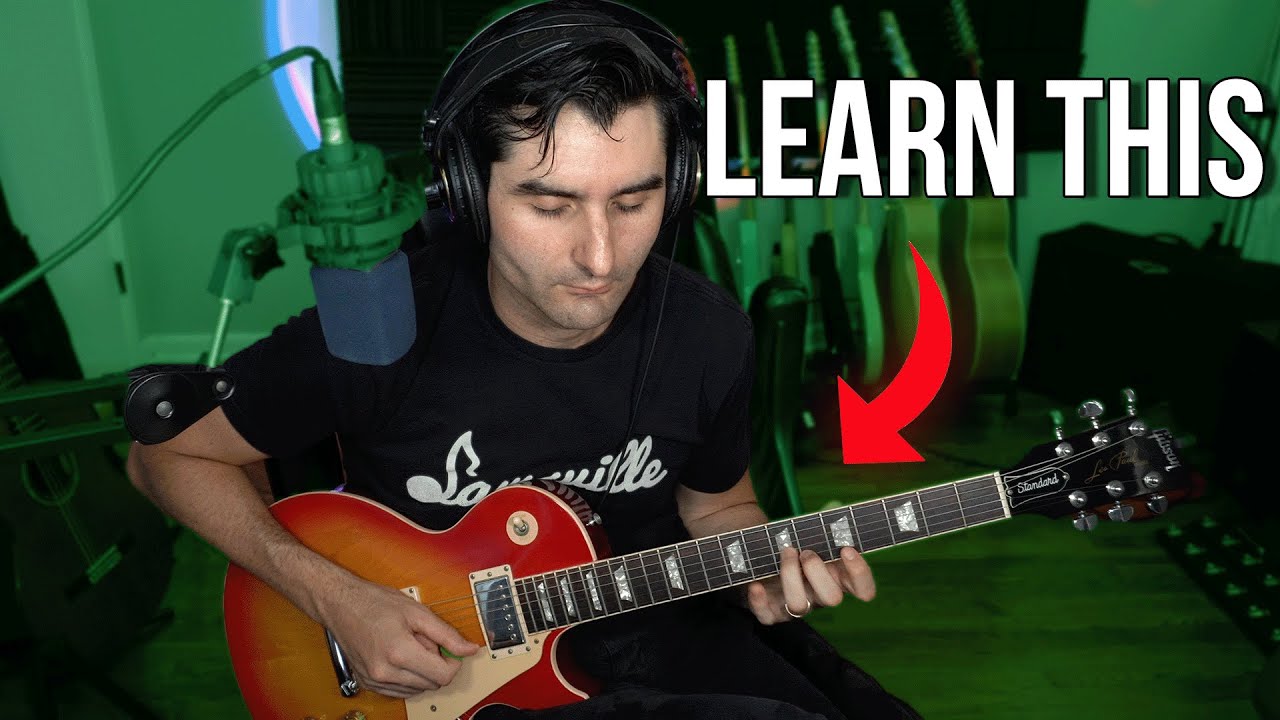
This Exercise Will LOCK IN Your Sweep Picking
In this lesson
Tap a time to watch that part. loops it, so you can slow it down and play along.
-
Key idea Next arpeggio = move only the notes that change
Each next chord's arpeggio is found by changing only the notes that differ: Dm7 to Fmaj7 just moves every D up to E; Fmaj7 to Bbmaj7 moves C to Bb and adds D. That shared content is also why Fmaj7 over Dm gives a Dm9 sound.
-
-
How to practice Slow, then metronome, toward 16ths at 60
Learn it slowly so you can copy it, then work it up with a metronome; the goal is sixteenth notes at 60 BPM.
-
-
Key idea Adam's own bottleneck: big sweep shapes
Adam is comfortable sweeping small shapes (an 'X' shape on the top three strings, half the Dm7 shape) but practices this because bigger shapes are less smooth; fixing them will unlock more in his playing.
-
Practice it
- Drill Arpeggios through the key ProFor “Positional arpeggio = every chord tone in the position”. You'll see every chord of the key hiding inside the one position you know. Open
About this video
Listen to my new single "Never A Perfect Time":
Transcript
YouTube's automatic captions. Tap a time to watch from there.
- Hey everybody, what's up? My name's Adam
- and welcome back to the Jansville YouTube channel. I want to show you guys this really cool exercise that I've been working on the last couple of weeks and I still need to keep working on it some more, but it's really really helpful for your sweep picking and for your knowledge of arpeggios on the guitar neck. So, let's check it out really
- quick. Okay, so this exercise is going to be based on the chord progression to one of my original songs. It's called My Divine is out on all streaming platforms. Go check it out. I'm alone right here. Stay with me. Don't smile. Looks right after me. But the chord progression is very simple. It goes from D minor 7 to F
- major 7 and then it goes from B flat major 7 to A minor 7. So if you're thinking it's actually in the key of F, it's the six to the 1 to the four to the three over and over again. So this arpeggio shape that you see on screen now, this is the first chord of that
- progression, D minor 7. But you might be wondering, well, why is it starting from an A then if it's supposed to be a D minor 7? That is because these arpeggio shapes that we're going to be using, the whole idea is that we're actually trying to find every single possible note that fits in that chord in the particular
- position that we're in. So, you can actually do this in other positions, but we're just going to stick to this fifth fret to eighth fret position here. So, the notes that are in a D minor 7 chord are D, F, A, and C. But the lowest one of those notes of those letters that we can find is A. So
- we're actually going to start in A. So we have A and C on the six string, then D and F on the fifth string. Now before we continue, this is a sweep picking exercise. So the whole idea is that we're going to start on the first note with a downstroke. And if there's another note on the same string and
- we're moving up the arpeggio, so we're going higher in pitch and we're moving from the six string down in the direction towards the first string. We are going to hammer on the other note that is on the same string. So we're going to pick down and then hammer onto the C onto the A fret. And then we're
- going to pick down on the D that's on the fifth string. And we're going to hammer to F. So, down hammer, down, hammer. Then, we're going to hit this A here on the four string with our uh ring finger. By the way, we always want to try to keep our fingers assigned to a fret. So, everything that's going to be on the fifth fret is going to be played
- with the first finger, and everything that's on the sixth fret is going to be the second finger, and so on and so forth. These fingers are always going to stay on those frets. So we down, hammer, down, hammer, down, and then we down again on the C, hammer to D, down on F,
- down on A, hammer on C. And then when we turn around, we're actually going to pull off. So we have this at the top of the arpeggio on that first string. And then now we do the opposite. So, we're going to use all up strokes and pull off. So, up on F, up on D, pull off
- to C, up on A, up on F, pull off to D, up on C, pull off to A. So, we are going to play through that arpeggio exactly one time like that. And then we are going to move on to the next arpeggio in the song, which is F major 7. So really
- slowly, this is what that looks like. And then now right there, I just hit that A. Actually, I'll give you a a
- little spoiler alert. Every single one of the arpeggios in this exercise is going to start with that A on the fifth fret of the six string. So now we're going to move to F major 7. So F major 7 actually has F, A, C, and E in it. And if you notice,
- actually this D minor 7 already has F, A, and C in it. So the F major 7 arpeggio is really interesting because we're just going to move all the D's up to E. And so now here's our F major 7 arpeggio. So actually it's very very very similar. And that's one of the reasons, by the way, just getting a little off topic, that I could actually
- play the F major 7 arpeggio over a D minor chord and it would give me like a D minor 9 sound. But that's beyond the scope of this lesson. I want to focus on this exercise. So now we're going to do the exact same thing. We're going to sweep through it. So all downs when we're going up the shape and all ups when we're going back down the shape and
- hammer ons on the way up and pull offs on the way down. So down hammer on A and C. Down hammer on E and F. Down on A, down on C, then down hammer on E and F on the second string. Down hammer on A and C on the first string. And the same thing we're going to pull back off. So,
- and then now up pull off up pull off up pull off. So, so far we have this. Here's the first D minor 7 shape I showed you. Then I switch.
- Now, actually, I forgot to mention one thing is actually when I switched to the next arpeggio, like when I was coming down that D minor 7 arpeggio and I hit that A, I actually pulled off to the A. So, actually the next arpeggio is actually starting with a note that's all pulled off already pulled off. So,
- we actually just go and then now I'm on the F major 7 arpeggio. I just showed you. So, actually both ends of the arpeggio, uh, once you get into it after the beginning, you're going to have this, uh, either a hammer and then a pull or a pull off and then a hammer. Again, the
- whole idea of sweep picking, too, is that it's like the most efficient way to play these things fast. Okay, so we're going to move on to the next arpeggio, and that's actually going to be B flat major 7. So B flat major 7 has the notes B flat, D, F, and A in it. So we actually already have A here, but we're
- going to move this C to B flat here. And then we're actually going to have D here instead. So this is what the arpeggio shape looks like. And as you can see, my software there is calling the B flat A sharp, but it is B flat. It's the same same note. So here is our B flat major 7 shape.
- very very cool sounding especially when you play through it faster. So we just approached from that F major 7 shape that we're on. So we go F E and
- then C A and then now like I said before we just pulled off to that A. So now we're just going to go straight up to the B flat there. It's on the sixth fret of the sixth string. So we actually end up starting the B flat major 7 like that. From the eighth fret of the six string
- to the fifth fret to the sixth fret. And then down hammer down hammer down down hammer pull off up pull up pull up pull. That's the picking and sweeping pattern for that B flat major 7 shape. And then now we just
- finally got back down to this A. So now the last chord, remember it was D minor 7, F major 7, B flat major, and then A minor 7. So now actually a lot of you should know this shape already. This kind of comes from your A minor pentatonic scale. this arpeggio shape
- right here, a minor 7. Now, this one actually, funny enough, it's very easy to visualize, but uh there's a tricky thing that I'll show you here, which kind of messes me up, and I still need to keep practicing it for this reason. So, we just pulled from the B flat to A. So, now we're gonna hammer to C. And
- then we're going to down an E down hammer on from G to A. And then now we're going to down down on C and E. And this you need to bar or finger roll. So you don't want to hold this down like this cuz then it sounds like a chord. It sounds like you're playing multiple
- notes at the same time. We want to keep it separate so that it makes a line. You have to figure out how to play this and subtly rock your finger to the second string so that now the third string's muted. Very tricky thing about uh sweeping when
- you are actually using the same finger on multiple strings. And so then now we get to the E and we go down, hammer, down, hammer, pull, up, pull, up, up, pull, up, up, pull. And that is the full arpeggio exercise. So let me just show
- it to you slowly so that you can copy what I'm doing and then you can work it up with a metronome. And I'll show you what it sounds like with a metronome. [11:01] Hey, hey, hey. [11:30] Now we're back at the beginning. Now I would go back to the D minor 7. And then so if you play it faster, it'll start to sound really cool. So the really difficult thing about this too is the fact that there's these big sweeping shapes. And I feel pretty comfortable sweeping like smaller shapes. For example, there's this really cool like
- little X shape that I like to play a lot in my solos that looks like this. So, this is actually like half of that D minor 7 shape. It's basically like taking off the six, fifth, and fourth strings. Like, I'm super comfortable doing this kind of thing because it's kind of less information to
- deal with. But that's one of the reasons why I want to start doing this exercise cuz I realize I need to go back and get those bigger sweeping shapes down a little bit more smoothly and it'll unlock some more stuff in my playing. So eventually you want to try to work this up so you can play as 16th notes. And this is what it sounds like at 60 BPM
- with 16th notes. So you got a one E and a two E and a. [12:56] And that's the beginning. All right, guys. Well, I hope you enjoyed that quick little lesson. I hope that
- this helped you get your sweet picking down and go check out my song, My Divine. That's the chord progression that this came from. I'm trying to figure out a way to start integrating my original music more with this channel. So, if there's any suggestions that you guys have as to how I can do that, uh, please drop a comment below. And also,
- if you want to learn how to master the guitar fretboard, make sure you head on over to jamsville.com and pick up the Jamsville GPS fretboard fundamentals course. All right, everybody. Thanks for watching and until next time, listen, learn and jam.