
After each pass the video waits as long as the loop, so you can play it back.
Start slower with −, and it climbs to 100%.
Keys: Space play · ← → 5 s · [ ] set start and end · − = speed · L loop
Rhythm · Beginner
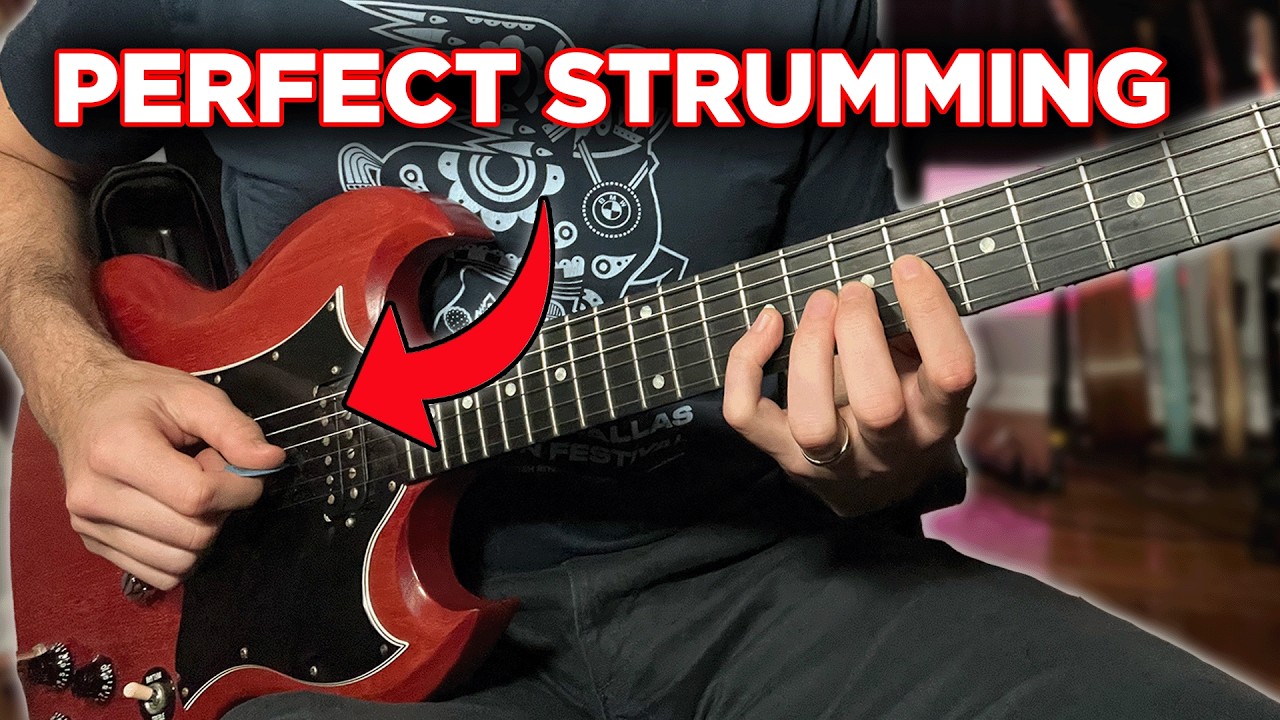
The Trick To PERFECT Strumming Patterns
In this lesson
Tap a time to watch that part. loops it, so you can slow it down and play along.
-
Key idea Constant hand motion decides strum direction
Keep the strumming hand moving the whole time on the 16th grid; pick direction follows the subdivision (numbers and ands down, e and a up), so the right direction is automatic.
-
-
Key idea Isolate rhythm with muted strings or one note
Most guitarists' chord knowledge outpaces their rhythm because they never study rhythm by itself; mute all strings (guitar as a drum) or use one note to focus your whole mind on rhythm.
-
-
Key idea Muted strums disguise chord changes
In Can't Stop's chorus (G D Bm C barre), fingers slide without lifting while strumming continues, producing muted strums that cover the transition.
-
-
Key idea Feel placement without counting
Once understood, you needn't consciously count; you feel where the beat is placed relative to the tempo.
-
Transcript
YouTube's automatic captions. Tap a time to watch from there.
- In this video, I'm going to show you how you can figure out the perfect direction for your strumming patterns and make sure that all your strumming patterns in your rhythm guitar playing feel as perfect as possible. So, a great example of a song that I like to use for this is the song Smells Like Teen Spirit by Nirvana. So the song goes like this and
- it has this strumming pattern. And if you notice when I'm playing that strumming pattern, the big key to being able to make it feel good is that my hand is moving the whole entire time.
- And what this allows me to do is it allows me to actually automatically figure out what is the correct direction that my pick should be moving when certain rhythms are played. So if I just take for example the first little rhythm from the riff, this
- the reason that riff is strummed down up down is not just an arbitrary thing cuz I could theoretically go like down and uh that wouldn't feel as good or I could go up down up and that also wouldn't feel as good or I could go down up up that wouldn't feel good. The reason why it's specifically down the
- bound is because of the actual rhythm that is being played and the actual concept of the rhythm. So that rhythm is da da da. So it's actually based on a 16th note subdivision. And if I was to count that out, it would be one and a two. So one a
- two, one a two. It is the one and then it's the uh in the 16th note subdivision because when you count 16th notes, you have 1 e and a 2 e and a three e and a four e and a. And so when our hand is consistently moving, what it does is it makes sure that on the same parts of the
- beat, my hand is hitting in the same direction. So, if I slow down the strumming for just regular 16th notes like this, 1 e and 2 e and 3 e and 4 e. And notice actually there I put a little bit of an accent on the numbers. 1 2 3 4 1 e and 2 e. And that actually is
- another little tip that can make your strumming patterns feel a lot better. But notice I go one e is an up and is another down and then uh is an up. So that is always going to be the case. We want to try to keep that consistent all the time. So if I ever have to play a
- note that is either on the e or the uh I want to be playing that with upstrokes. And actually a cool little exercise that you can do too is tap your foot on the ground like 1 2 3 4 or just count it and [snorts] actually strum only the ease and the odd. So if I did this slowly, it
- would be like 1 e and uh 2 [clears throat] e and uh 3 4 1 2 3 4 1 e and 2 e and you should be able to transition to like 2 e and 3 e and four.
- So, it allows you to start getting that feel of that exact syncupation because really every rhythm that you're going to end up playing is going to be a combination of downbeats and those syncupations. Like going back to the example from the Nirvana song, one E and [clears throat] a two.
- So now, like if I just wanted to repeat that rhythm, I would always use that same strumming pattern down up down up down up down. So if [clears throat] we keep going, you actually have da da da. And then you have these muted strums. And so those are counted one e and a 2 e and a 3 e. So same thing, it's
- the and of the two. So 2 e and a 3 e. And so notice how my hand is moving the exact same way. And uh and is always going to be a down. You got 1 e and uh so when I play it and the 3 e that's what happens.
- Now this might sound convoluted like ah it's all this counting you know why do I got to think of one and a two and a three but the thing is that once you go through a couple of examples like this and you do understand accounting you don't need to always be like consciously thinking about it once you just get how
- it feels to keep your hand moving and always hit those syncupations with the correct strumming pattern with the correct pick direction rather. Then you're just going to automatically hear [snorts] the strumming pattern that you want to play and you're just going to allow the pick to hit when it's supposed to. So your
- hand just turns into this thing that's always moving and you just decide whether you're actually going to allow it to hit the strings or not. like this.
- By the way, what I'm doing right there, that can be a super fun thing to practice cuz you don't even have to actually like play a chord or anything. You just mute all the strings and uh it's almost like turning the guitar into a drum. It's actually a fantastic way to practice because most guitarists spend very little time isolating the concept
- of rhythm. This is a very very important thing to understand guys. Like for most people that aren't drummers, their knowledge of chords and stuff and can be like up here, but their knowledge of rhythm isn't on that same level because they haven't actually studied rhythm by itself. So, I do think it's a very good
- thing to actually do some different exercises that involve either playing one note or just using muted strings to strum so that you can focus your entire mind on rhythm only. I actually have a video called the ultimate rhythm exercise if you guys want to check that out. And that's going to show you every
- possible actually rhythm you can play with 16th notes. And that's actually a really good way to practice your strumming patterns as well. So if you want, click and go ahead and check that video out. So the whole thing goes like this. One and a two e and a 3 e and four. So there those last two strums
- there and four. They're both downstrums. You see that? Really slow. Down. And that's because it goes and four. So there's nothing happening on an E or an O there. And that's exactly why it automatically just falls into place. I hope that you're starting to kind of understand that. So let's go through one
- other example really quick. This is another kind of uh ' 90s late 90s 2000s song. Uh the song Can't Stop by Red Hot Chili Peppers. So, we want to get into this part, the actual riff from the song, which you need to be able to use this concept I'm talking about as well for that, but it's more of a single note context.
- Notice how my hand keeps moving there as well. But if you play like the chorus to the song, it's the same thing. I got to keep my hand going.
- And notice there's those muted strums happening. I will say with that song, a lot of what makes those muted strums happen is actually to disguise somewhat the chord transition. So while I'm transitioning, for example, in this case, I have a G bar chord to a D bar chord to a B minor bar chord to a
- C bar chord. When I'm transitioning from the G to the D, I'm actually, look at my fingers. I'm actually just kind of having them slide along the strings. I don't pick my fingers up. So, as I'm sliding my hand and kind of reconfiguring it into the next chord
- shape, I'm still strumming and I get some muted strums. See that? That's what it looks like in slow motion. So, that's kind of a similar rhythm, too. One end up to the end. you
- can start to hear even without counting. Like a lot of times I'm not the best at just instantaneously like counting something like this out loud, but I can just feel how the beat is placed in relation to the tempo.
- those uh uh that's where your E and your H's are or that kind of thing. That's a very common move too. Actually, last little exercise I'll give you to help with this is to play [snorts] a chord with quarter notes. So, 1 2 3 4
- All downstrokes, right? And then put a muted upstroke right before. So 3 4 and 1 2 a 3 4 1 2 3 4 Do it with a metronome. You'll see that it's a lot harder than it seems to get it feeling consistent and feeling really good. Now, pretty
- much all the songs that we just went over were using like power chords and bar chords and stuff like that, but there's some other songs that use really cool triad shapes that only use three notes at a time. And I made this video which is going to show you a bunch of famous riffs that only use triads. So,
- you should watch that video next so you can learn more about playing some really cool rhythm guitar parts with triads. Also, if you're interested in learning to master the guitar fretboard, go to jamsil.com, check out the Jamzville GPS fretboard fundamentals course. If you want a free consultation for one-on-one lessons with me, click the link in the description down below. If you enjoyed
- this video, hit that subscribe button, hit that thumbs up button, and until next time, listen, learn, and jam.