
After each pass the video waits as long as the loop, so you can play it back.
Start slower with −, and it climbs to 100%.
Keys: Space play · ← → 5 s · [ ] set start and end · − = speed · L loop
Practice and technique · Beginner
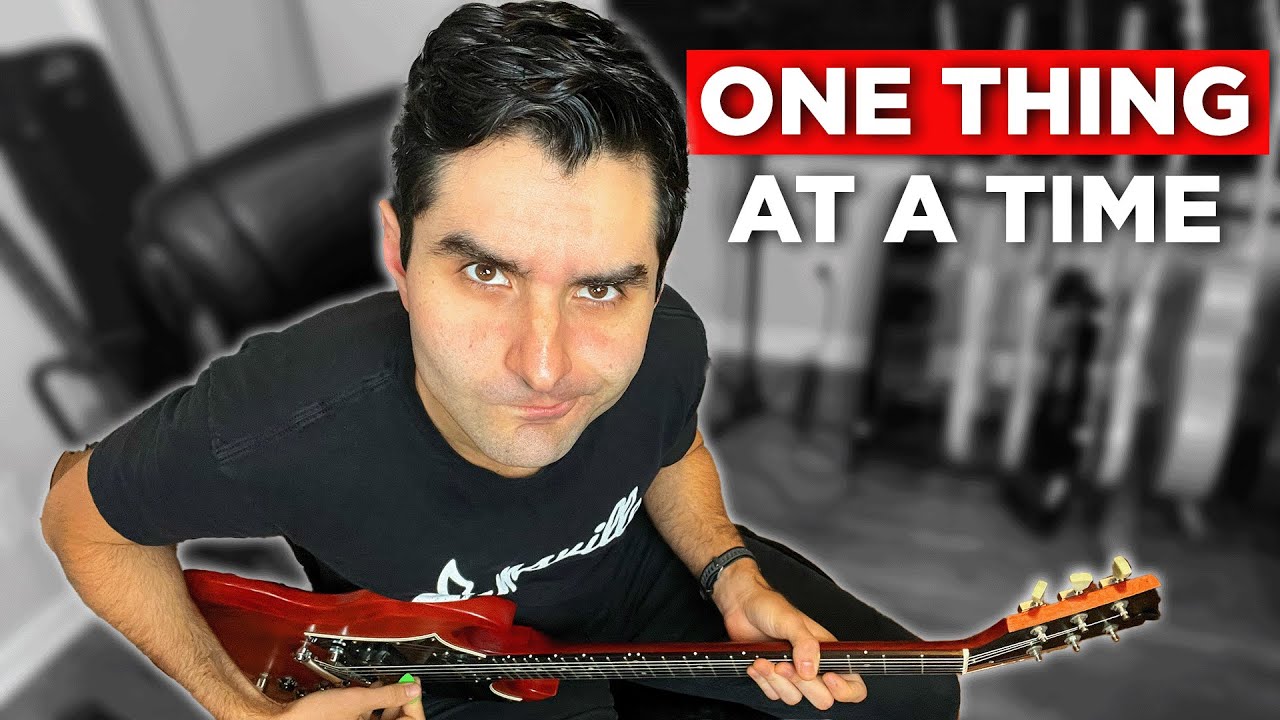
Stop Trying To Fix Everything In Your Guitar Practice
In this lesson
Tap a time to watch that part. loops it, so you can slow it down and play along.
-
Fix Stopping the new strumming pattern for a chord mistake
A third/fourth-lesson beginner on Free Fallin' knew the chords, but while drilling a new strumming pattern she stopped and restarted whenever a chord flubbed, letting a non-priority mistake interrupt the real focus (the strumming hand, not yet at 100%).
-
-
Key idea Choose which mistakes you're allowed to make
Practice should have a priority, not a checklist; prioritizing one element is also a permission slip for temporary mistakes elsewhere (e.g. picking direction while working a left-hand-heavy solo). Good practice is choosing which mistakes you're allowed and which to avoid at all costs. Don't let non-priority mistakes kill momentum.
-
-
Key idea You don't practice music by interrupting it
Momentum locks in neural pathways: keeping the target pattern going no matter what makes it automatic, and other mistakes or distractions (like talking while playing) even make it more robust, executable in suboptimal conditions.
-
Transcript
YouTube's automatic captions. Tap a time to watch from there.
- So, a lot of times when we're practicing something, let's say it's a song or riff or even a lick or a scale exercise, we try to make sure that everything involved with what it is that we're playing is perfect. And because of that, when we're doing run-throughs, sometimes we're trying to fix everything all at
- the same time. And that can actually really kill a lot of the progress we could be making when we're practicing. So, to give you an example of this, I had a beginner guitar student the other day who's only on maybe her third or fourth lesson, something like that. And she's working on the song Free Fallin'. And the first thing you usually learn is
- just to play the riff in a very basic form, like this. And so, she got that down completely and started working on a kind of more advanced strumming pattern. Cuz if you listen to that song, there's kind of some other strumming things going on. There's layers of guitars. And she's
- working on something that's going to sound kind of like this. And she had it pretty close. We had slowed it down, made sure that everything was good on the strumming hand side. And then we're trying to do some run-throughs of it. And I noticed that she fell into a trap that almost
- every beginner falls into and many intermediate and advanced guitarists still fall into, including myself for a very long time until I finally realized that it was so bad, which is that she would mess up one of the chords, let's say maybe play this. And as a result of that, she would stop
- the strumming pattern and kind of start all over again. And it's no groundbreaking like advice to say like not to stop when you're playing a song and try to play the song all the way through. But I was thinking about this some more and I realized there's something more going on here besides just telling someone not to stop when
- they're playing. And it's this, she was trying to get everything perfect all at the same time on those run-throughs, when in reality what she should have been thinking of is, "Hey, I already got those chords pretty much down already when I was just learning the basic version of the riff, and now my priority
- and focus needs to be completely shifted to getting this now more advanced strumming pattern down. And until I have that strumming pattern completely down 100%, I'm going to only focus on that and I'm only going to finally try to put everything all together once I feel
- really good about the strumming hand." And while she was successfully playing through the strumming pattern, it wasn't very comfortable. She was having to think about it a lot, and it definitely wasn't to 100% yet. If that strumming pattern isn't at 100% and then you allow something that really doesn't have to do with the strumming
- pattern at all, the chords going in the left hand, to now interfere with your ability to practice the actual focus of what we should have been practicing, that is going to at least slow down if not possibly stop your progress. So, really what was going on is that this person was splitting her attention too
- much and not really weighting the priority as much as it should have been in that situation. So, really this is an extension of another concept I've talked about on here before, which is that focus is such an important thing when we're practicing, and that can manifest itself in many different ways. Focusing
- on one thing on a more macro scale for, let's say, a few weeks at a time. But, in this case, it's more on the micro level, on a minute-by-minute basis, or just a practice session-by-practice session basis, are you focusing on what needs to be focused on, and literally
- getting your mind in the right place, too? Cuz even if you know your focus is supposed to be the strumming hand, if you're not really clear on what that's supposed to look like, what is focusing in the strumming hand even entail when you're practicing, then it can still get a little bit messed up. So, this brings me to the next point, which is
- applicable to anybody. It doesn't matter if you're a beginner, intermediate, or advanced player, which is that practice should have a priority, not just like a checklist to fill out. In this case, there is a clear priority because we're literally working on a strumming pattern from a song to prioritize that strumming
- pattern, and prioritize it virtually above all else. And the other thing is we need to see it from the other angle, which is we're not just prioritizing the strumming hand, but when we say that we're prioritizing something, we're also kind of giving ourselves a permission slip as to other mistakes that can be allowed temporarily in order to maintain
- our focus on the main thing that needs to be focused on. To put it succinctly, good practice is choosing what mistakes you're allowed to make, and which ones you really want to avoid at all costs. In this case, we're trying to avoid a mistake with our strumming hand, but if
- mistakes happen in other places, that's okay for right now. Of course, it doesn't mean that we want to keep those mistakes in there permanently, but in this exact moment we're going to allow it temporarily. So, the last point to this is that trying to fix everything is going to kill your momentum. As soon as
- you start getting momentum with the strumming hand or whatever it happens to be in your case. Let's say you're trying to learn a complicated solo and your left hand is the issue, then don't worry about mistakes with your right hand. Maybe you picked a two downs in a row should have been a down and an up, but we're working on something that has a
- lot of left hand sophistication. So, we need to focus more on the left hand. It doesn't really matter, but if I allow the mistake in the non-priority section of everything that's going on when I'm practicing to stop what I'm doing, it's going to kill my momentum.
- And the momentum is what helps me really lock in those neural pathways that need to be locked in. When you want to learn a strumming pattern, if you can keep that strumming pattern going and nail it over and over and over no matter what, it's going to teach your brain to execute that strumming pattern without even having to think about it and just
- have it be automatic. And actually, in a way it's a good thing when possibly other mistakes happen because it will make those connections even more robust. Think about it. Whenever you see like somebody doing something. Let's say they're playing guitar and maybe they're talking to someone at the same time. That person talking to them is really
- distracting them from the main task at hand, which is playing guitar, but if they can still play guitar even when something else is going on. It's not a perfect circumstance for playing guitar. It's just going to make it even that much stronger because it can be executed even in suboptimal conditions. In other
- words, you don't practice music by interrupting it. So, if you, like most of us other guitar players, feel that urge to stop whenever every little tiny mistake happens, then watch this video because this video is about why trying hard is actually ruining your guitar
- playing and how ironically you need to stop trying as much. And as soon as you stop trying so much, your guitar playing is going to get way better. If you want to learn to master the fretboard or you want free consultation for one-to-one coaching with me, click the links in the description below. If you like this video, subscribe to the channel, hit that thumbs up button, and until next
- time, listen, learn, and jam.