
After each pass the video waits as long as the loop, so you can play it back.
Start slower with −, and it climbs to 100%.
Keys: Space play · ← → 5 s · [ ] set start and end · − = speed · L loop
Practice and technique · Advanced
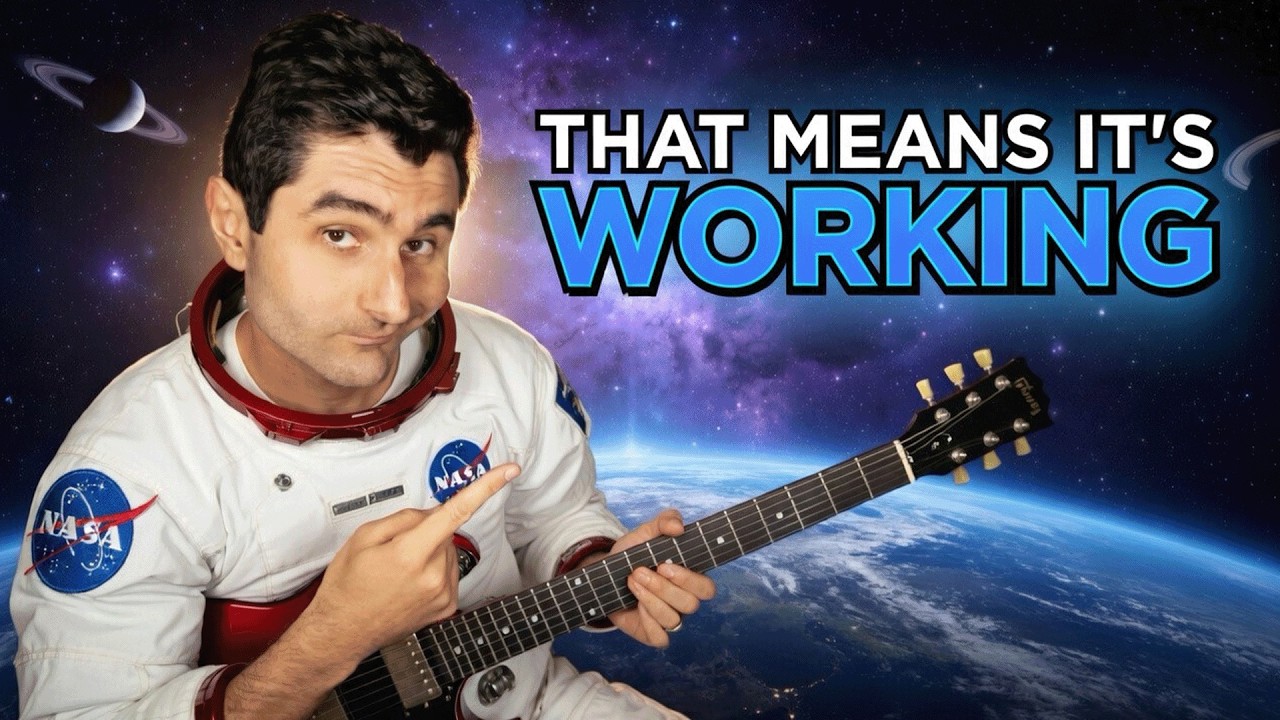
Sometimes Guitar Practice Makes You WORSE!?
In this lesson
Tap a time to watch that part. loops it, so you can slow it down and play along.
-
Key idea Getting worse before better when assimilating
Implementing a new technique (hammer-ons for a picker, economy picking) or new concept in improvisation often makes you temporarily worse: it's still conscious and half-formed when it starts appearing unbidden, like a body adapting to a transplant, or muscles fatigued after a workout. It's the sign the practice is working; a few more months and it comes out naturally. Same with learning fretboard note names.
-
-
Exercise Prompted solos: one focus, anything else allowed
Prompt yourself before improvising: 'play a solo whose only focus is playing really quietly and softly; wrong notes or any notes are fine', or 'economy pick the entire time and invent as much as possible'. You must keep thinking about a concept even after you've got it, until you no longer have to.
-
Transcript
YouTube's automatic captions. Tap a time to watch from there.
- Hey, everybody. What's going on? Today, I wanted to talk about how sometimes when you're practicing a lot and you're practicing something that's brand new and trying to incorporate it into your playing, you actually get a little bit worse temporarily before you get better. And I want to talk about why this
- happens and how this is actually a normal thing and you shouldn't worry about it and it's actually a sign that you're about to get better at guitar. So, first of all, what situations does this typically happen in? In my experience, it happens when we do one of the following things. Number one, we try
- to implement a brand new technique into our playing that we've never really used before. Uh let's say you are trying to incorporate hammer-ons and pull-offs into your playing and you've never really used them before. You've just picked every note. If you start focusing on that new technique a lot, you're
- going to just be really unfamiliar with it and even once you start getting to the point where you can actually execute that new technique fairly cleanly and consistently, you'll find that you still have to think about it a bit too much and that actually holds it back from
- coming out naturally in your playing. So, the other situation more specifically that this ends up happening in is when you're trying to work new concepts into your improvisation. So, those two situations, implementing a new technique or implementing new concepts
- into your improv, they're not so different because the common denominator is that you're implementing something that was previously completely out of the realm of what you were playing earlier and now you're assimilating it into your playing and it's funny because
- now that I think about it, there's many other sorts of ways that this phenomenon kind of manifests itself. If you think about like when people get like shoulder replacements or they get transplants or things like that, right? This is a totally different world we're talking about here, but in that situation, it's like, "Oh, when you take something from
- outside of the body, like initially, your body kind of wants to reject it and it takes a while to actually get used to having that new joint or the new organ in your body. And to me, I think of my guitar playing as a very similar type of thing, especially after you've been playing for a little while and you're
- not a blank slate anymore. We develop some tendencies. We develop tendencies to maybe play with a certain amount of tension in our playing or use a certain technique or play certain licks. And oftentimes, what is required to be able to kind of break us through plateaus is
- to actually take a step back temporarily in order to implement something that's brand new. Or the only other situation where you're not implementing something that's brand new is when you realize that you have to clean up something that you have a tendency to do. For example, I'm the kind of person that when I would
- try to play stuff, I really have a tendency to just play too hard. Like right now when I'm doing that, like that doesn't feel good at all. Whereas I could play louder and be relaxed. So, I had to really kind of take it to the other extreme of like, "Okay, well, if I want to play relaxed, I need to practice
- like going like this." Like And kind of as a result, when I would actually practice improvising, I would not just randomly solo, but I might actually prompt myself kind of like an AI. I guess that's the only other context
- we're using that word prompting in nowadays. But I would prompt myself say, "Okay, Adam, you're going to play a solo, but what your main focus is going to be is playing really quietly and playing really softly. And other than that, uh it doesn't matter what else you do. So, you can play wrong notes or play
- whatever notes you want." I don't really care. All I want you to do is just play softer. And in that way, like just focusing on that new aspect of my playing, it kind of does break the ideal situation, which is you shouldn't
- be thinking at all when you're playing, right? But when we're actually practicing, we might need to think about a concept for a long time and actually keep thinking about it even after we've gotten it down quite a bit in order to actually get it to the point where we don't have to think about it anymore. I
- thought about making this video, too, because right now I'm in the process of actually incorporating a pretty new technique that I haven't never really incorporated seriously into my playing, which is economy picking. And I feel much better about it cuz I've been working on it quite a bit and I've gotten certain things down and I'm
- actually starting to develop certain tendencies with my economy picking. Like for example, one thing I really like to do is this lick here. Like to me, that feels really, really good to do that. Let me try that again with my tone higher. Kind of sounded underwater before. Maybe
- roll it back down slightly. Yeah, I like hearing the wood of the guitar a little bit. But anyway, so I've just noticed now especially after working on and coming up with lots of different alternate picking exercises that have helped me a lot, now all of a sudden, I'm actually starting to work it
- into my improvisation. And I don't even really want to show you a video of that right now cuz I'm not really happy with it. And similar to what I was saying before, I will give myself a prompt and be like, "Okay, Adam, you need to play solo, but you're just going to like constantly economy pick the entire time. And just try to
- come up with as many different things kind of on the spot that you can possibly muster up with economy picking." And I've noticed that whenever I've implemented anything else like that in my playing, uh at first, my playing is going to get worse cuz then also, if I go back to saying, "Okay, I'm not going to think about anything anymore." in a way, it's
- kind of hard for me to do that because now I got so used to incorporating this alternate picking and sort of and sort of jamming it into my playing that now when I go back to not thinking about it, because the practice is working, I'm doing some economy picking without
- thinking about it. But since it's still too new and it's kind of in this transition phase that it's actually like assimilating with the rest of my playing, I feel that sometimes when I'm playing some economy picked things, I just am not executing them the way that I want to and in a way that's making my
- playing paradoxically feel worse in the short term. Is this making any sense whatsoever? Essentially, I'm focusing so much on one thing, implementing it into my playing, then now when I just don't think anymore, that new element is being
- incorporated into my playing, but it's still not fully formed yet. So, in a way, it feels like my playing is taking a step back. But in my case, because I've been playing guitar long enough and because I've gone through this process many times with other aspects or
- incorporating new sounds or new techniques into my playing, I understand that it's actually a temporary thing and that in a way, now I know that the practice has been working of implementing this new technique, in my case, economy picking. And I know
- probably in another few months if I keep it up, now more fully fledged ideas are going to start to naturally come out when I stop thinking about it in my playing. And I thought that this is a really important discussion to have with all of you because often times, I see this in students where they'll implement
- a new concept and this phenomenon will happen to them. They feel like all they're doing is concentrating on this one concept and now it's kind of like shaking things up in their normal playing and almost making it um without think about it, more naturally play things that aren't necessarily
- comfortable to them. And this kind of starts becoming disconcerting and then they're wondering like, "Gee, should I even be practicing this? Like oh my god, economy picking's making my playing worse." But it's not making your playing worse. That's actually the sign that it's working. And another great way to think about it is it's kind of similar to the
- process that you go through if you're into fitness at all, getting in better shape. When you do workouts, you actually break down the muscle, right? And then afterwards, you're like tired. You're like, "Oh, wait a second. How am I getting in better shape by making myself tired?" You would think I can perform more physically demanding things if I'm not tired after a workout. But,
- it's okay to be tired after a workout because you know that that means the workout you did earlier actually worked, first of all. And second of all, the whole point is that eventually you're going to recover and then you recover stronger. So, in that way, when you implement a new technique into your playing, it's going to kind of make you
- fatigued, so to speak, guitar fatigued. But, eventually you're going to recover from that guitar fatigue strong as hell with a brand new concept under your belt that you're going to start to be able to use as fuel for more ideas in your playing, in your composing, and you're just going
- to be overall a better guitar player. You also see this, too, when it comes to people like learning the notes in the fretboard. They find like, "Oh, they're thinking so much about the notes in the fretboard." And in a way, it's like confusing them more now that they know the notes in the fretboard because now they're thinking of this extra piece of information, but it's the same idea.
- Eventually, you just know like, "Hey, this is a C. This is a G. This is a C sharp. This is an E. This is an F. This is an A flat, etc., etc., etc." Just by repetition, and eventually they just seep into your subconscious like anything else that you learn. And by the
- way, if you're interested in learning how to master the guitar fretboard, which is really useful, by the way, for implementing new techniques like economy picking, whenever I come up with like a little exercise like this, then I'll be like, "Okay, well, this is in the key of B flat. Hey, let me move it up a note in the key of diatonic scale.
- And then I can figure out how to kind of make my practice more interesting because I understand how to play on all strings, all 12 keys on the neck. Of course, if I want to work on my economy picking and do that same pattern, I can just be like, "Hey, let me do it in the
- key of D flat instead." Whatever happens to be. And And actually, it helps my practice be a lot more interesting because I can actually navigate the guitar fretboard in all 12 keys, among all the other benefits of just, of course, sounding better in all
- 12 keys and be able to play over whatever song you want, no matter what key it's in. But, if you're interested in improving that aspect of your playing, make sure you head on over to jamzville.com, check out the Jamzville GPS Fretboard Fundamentals course, which I designed specifically to do that for you. And it's very, very reasonably priced, I might add. Now, by the way,
- one of the reasons that I've been working on my economy picking is cuz I realized that alternate picking certain things is just like way too hard. Like, for example, this is something I came up with earlier. And like, I would literally never be able to play that if I was alternate picking it. And even if I could play it,
- it would sound way choppier than economy picking. And I just realized like, it's unlocking so many doors for me in my playing. And so, I made this video, which is going to show you some really fun ways to work on your economy picking that you may not have thought of before. And it's going to teach you the principles of economy picking, so you
- can actually come up with your own ways of practicing it rather than just copying exercises from me or other people out of books and stuff like that. So, go ahead and watch that video. If you enjoyed this video, hit that like button, subscribe to the channel, and until next time, listen, learn, and jam.