
After each pass the video waits as long as the loop, so you can play it back.
Start slower with −, and it climbs to 100%.
Keys: Space play · ← → 5 s · [ ] set start and end · − = speed · L loop
Practice and technique · Intermediate
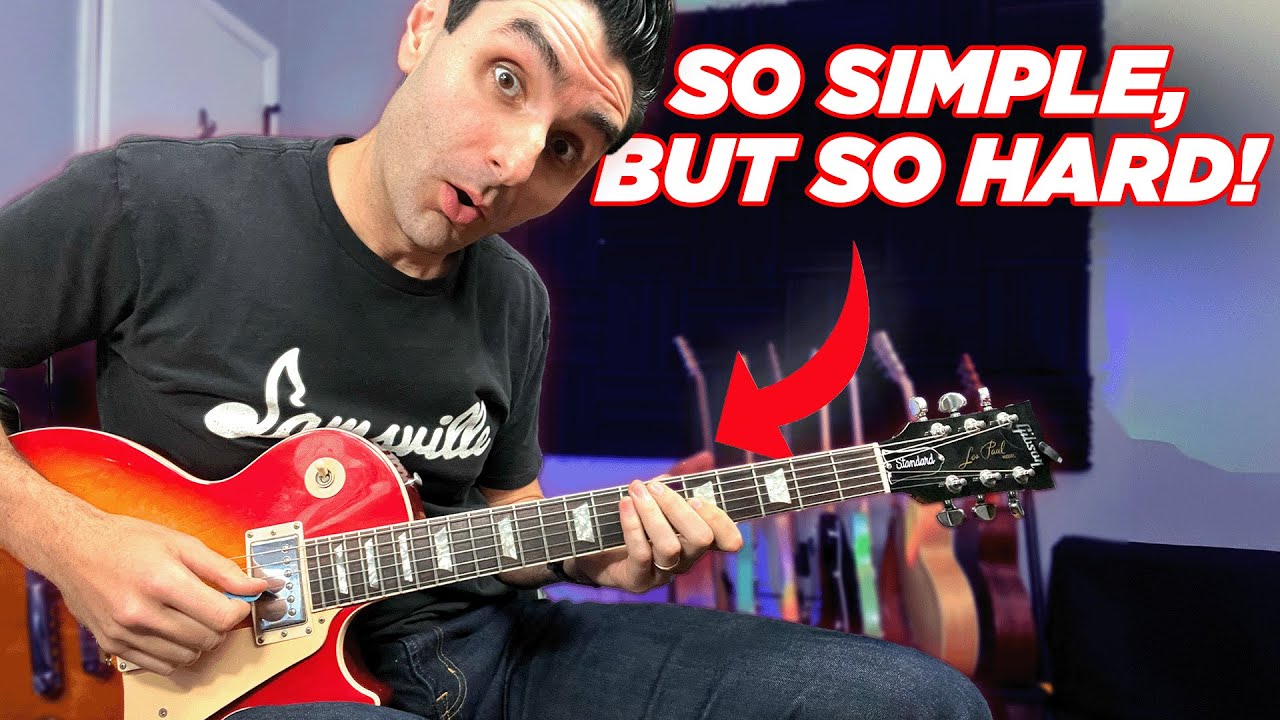
My Guitar Playing SUCKED Until I Did This Exercise
In this lesson
Tap a time to watch that part. loops it, so you can slow it down and play along.
-
Exercise Record quarter notes against the click in a DAW
Record one note in quarter notes against a click (80 bpm) in a DAW and compare each waveform attack to the beat markers down to the millisecond; then listen back for flams. Quarter notes you think are easy are often slightly off; locking them in makes everything sound better.
-
-
Key idea Not robotic, but ears for nuance
Real music doesn't need machine-perfect quarter notes; the point is developing ears that hear microscopic nuances in how your notes line up with the drummer, bassist and band, so you can lock in with the people you play with. You start hearing it in real time, which lets you fix it.
-
-
Exercise Five minutes a day; scale and half-tempo variations
5-10 minutes a day of this improves your time everywhere. Variations: record a slow one-octave scale (e.g. D major) in quarter notes; then halve the click to 40 bpm while keeping the 80 feel in your head, which is harder because the click helps less.
-
About this video
Listen to my new single "Never A Perfect Time":
Transcript
YouTube's automatic captions. Tap a time to watch from there.
- What's up everybody? My name's Adam and welcome back to Gemsville. In today's lesson, I'm going to show you an exercise that I used to really freaking suck at. It's unbelievably simple. You're going to see it actually doesn't get any simpler than this. But you better be able to do this exercise or
- else you're going to have big problems with all facets of your guitar playing. So without further ado, let's jump into the lesson. Okay, so in order to do this exercise, you're going to need a digital audio workstation. I am using Logic, but if you have GarageBand or if you have I think it's called Audacity is a free
- one, you should be able to do it on there. But what we need is we need the ability to be able to record ourselves along with a click track and be able to compare exactly what our waveform looks like in relation to the click track. So the exercise is unbelievably simple.
- What we are going to do is we are going to practice playing quarter notes along with a click track. But we need to make sure that we get them absolutely exactly on the money when we play them. I actually discovered that I majorly freaking sucked at playing quarter
- notes, even though I thought that I was good at playing quarter notes. After all, quarter notes are easy. It's just 1 2 3 4 1 2 3 4. Right? Wrong. Guess what? There's a major difference between playing quarter notes that are actually locked in completely to a metronome
- versus playing quarter notes that are slightly off and slightly sloppy. And if you start to develop your ears to be able to hear the difference, if you improve this aspect of your rhythm, you are going to just sound better across the board doing everything on the guitar. Let's go ahead and try it out. I actually have my metronome or click
- track set at 80 beats per minute here in my Logic session. And I'm going to record myself playing one note on one string. I'm just going to play this C note here in the third string, fifth fret. And let's see how close I can get it to being exactly on the money with a metronome down to the millisecond.
- Okay. So, I definitely heard a couple that were slightly off. So, now you can see that actually these first two notes
- were pretty much on the money. Now, how can I tell? I want to make sure that this part here, which was actually technically slightly behind, is lined up as closely as I possibly can with right here is one beat on Logic. And you can see those little note or those little
- beat markers on top. That is exactly where that click is lining up when it plays. And the whole goal is I want to get it as close as possible. By the way, I want to caveat this with saying no, when you're playing real music, you don't need to be like absolutely on the money like that, like machine robotic
- quarter notes. But it's not about that, guys. It's about developing the ears to be able to hear these little microscopic nuances in how your notes are lining up with, for example, the drummer you're playing with, the bass player you're playing with, the whole entire band you're playing with. And the more finely tuned you can get your ears and your
- sense of time, then you can lock in way more with the people who you're playing with. Okay, so you can see those first two. I'm pretty happy with those. So the third one here you could see is slightly ahead. See that? That note. It started back here, but really that is where the beat was. So you could see there's
- little tiny variations. Let's keep going. I want to see exactly how I did here down to the note. This one, beat four was pretty good. I like that one. Beat two, that one's very slightly rushed. A lot of times if you're really off of this, you may be off by like an entire 32nd note or a 16th note. So you
- want to try to get as close as possible, but it's not going to be absolutely machine perfect. There's one here. That one I I remember feeling that one. That one was rushed a lot. That one I'm not happy with. That one I'm very upset and embarrassed with to show you that I played that nearly off by a 30 secondond note. That would be like a 30 secondond
- note. I was off by about like a 64th note, I would say. Uh, so the next one here, that one was a little bit ahead. Uh, I got into a little thing here where I was playing very slightly ahead of the beat. That one was ahead. So, I started off really good and then you can see I kind of started maybe cuz I'm recording
- this video or cuz I just suck. Uh, I started rushing a little bit on uh like a whole entire measure here. Let's see if this ends up getting fixed. This is rushed. This is rushed. These are all only slightly rushed, thankfully. Uh probably wouldn't be able to hear it that much. By the way, you can go back and listen to it, too. So,
- now if I play this, so it doesn't sound too bad when you actually listen to it. Those ones that uh that sounded rushed or that looked rushed, those ones that looked rushed, they weren't too bad. I think this one here is probably going to be particularly egregious. Yeah, you you hear that flam, guys?
- So, you can hear that is exactly what we want to avoid. So, ironically, I'm kind of glad that I made that mistake because I want to show you what it sounds like incorrectly versus correctly. So, here, let's actually listen to it. Now, we we looked at this whole segment. I played four
- measures of quarter notes, basically. Let's go back and listen to it one more time. So, those were all pretty good. This one right here, you can hear, was audibly slightly ahead.
- So, those last few notes were better over here. They started getting better. Uh but yeah, that that third measure was particularly bad. So, but again, no, ordinarily somebody might listen to that and go, "Yeah, that's totally fine. It's quarter notes." No, it's not fine. The whole
- point of this exercise is that we want to figure out exactly what it's supposed to sound like when that thing is totally totally totally locked in. remember that sound and then go ahead and get that more consistent in our playing. So, let's just for fun, I want to try that one more time and let's see if I can do
- any better this time. I can already tell that that last one uh was a little bit early.
- And let's see. Yeah, that last one was pretty early. So, you guys you guys could see this is hard. And if you can get this perfect, man, congratulations to you. You got amazing rhythmic talent. If you can do this absolutely perfect on the first try and even just get one straight take of four bars of quarter
- notes, it's not easy. We're talking milliseconds here. We're talking the tightest possible tolerances that we can hear, but again, it's not really about actually getting it perfect. to be very nice to get it perfect, but it's more about getting our mindset in the right place that first of all, when I play rhythms, this is what I'm thinking
- about. I'm trying to actually get it that close and that locked in with the people I'm playing with or the recording I'm playing or whatever it happens to be, whatever part I happen to be playing. But on top of that, it just gets my ability to perceive rhythm to be way more finely controlled. So, let's see what happened. It looks like that first one was pretty good.
- Those were all pretty good. I like that. Those the first four. Let's see. Number two. That one looks a hair early. How's it sound? Those all sounded pretty good. I like that. So, you can see like it maybe visually looks like it's slightly off, but you see like wait a second, it's only like maybe 10% of a 16th note off.
- That's a pretty good margin of error. I'm pretty happy with that. So there I started right it's getting now maybe that's like 15% of a 16th note off that one right there. That one was pretty much on the money.
- And then of course I already I heard it. See that's the cool thing about this is like you start hearing it actually in real time which allows you to fix it. I heard maybe because I knew it was the last note or something. It could be any number of things, but that last one there uh was was really early. So, first of all, that exercise just doing that
- alone. It's very hard, but it's the most simple like possible thing you can do. And I swear guys, it takes so much focus. I guarantee you that if you do this for like 5 or 10 minutes a day, then go play whatever else you want to play, you're going to notice your times better. Period. End of story. So now I
- want to give you a couple of variations that you could do. Okay. So first of all, what you should start doing is incorporating some notes. So you could be just like practicing a scale. For example, it could be anything, your pentatonic scale or let's just say a major scale. Here's like a D major scale.
- Well, like actually record yourself doing that into a DAW and do it really slow with quarter notes and see if you can actually get those suckers absolutely 100% locked in. So, let's try that. I'm going to play just a quick one octave D major scale and see how locked in I can get that.
- I always like rush the last note for some reason. But uh see I'm learning by doing this lesson for you guys as well. So let's see here. That first note. Oof
- man, it was really close to being rushed, but for some reason, I've been doing well on the first note. The first note's been my friend. The last note has not been my friend. So, let's see here. That second note a little ahead. So, almost every time I'm off, I'm ahead. So, that's something that I really need
- to keep in mind when I'm playing is that maybe it's because I'm an anxious person or maybe I'm having fostering too much tension in my body or something, but I tend to rush a little bit when I am off. I haven't seen a single note actually that's dragged yet. [12:21] Yeah. So that one that last one there again was was not great. So but that's the whole entire point guys of me showing this to you is that this is uncomfortable stuff. It's super simple but it's super uncomfortable and it really exposes you and you you think, "Oh, I know how to play quarter notes.
- That's easy." But do you really know how to play quarter notes? Like absolutely perfectly. Now, I'm going to give you one more variation, and that is we're going to make this even harder. So, the thing about this exercise is that the slower you go, the harder it is. So, what we're going to do is I'm actually going to cut the tempo in half to 40
- beats per minute. And now, I'm going to play quarter notes, but I'm going to try to keep that same first tempo in my head. That uh uh uh uh somewhere around there is where the 80 BPM was. And now I'm gonna hear 40 BPM and I'm gonna try to hit those quarter notes on the money. It's going to be even harder because
- there's kind of more time that I have to wait and there's more margin for error. The metronome is actually not helping me as much when I slow down. So let's see what happens there. [13:47] All right. So, I'm only going to do four there because we're at half the tempo. Let's see how I did there. So, that was that was tough. Uh, looks like this one probably was a little bit rushed cuz I can't see that tail of the uh the attack there. So, that one was slightly rushed. This one again, all of my notes I I I'm
- exposing myself, guys. I'm exposing my musical personal. Ooh, this one. This one was technically slightly behind, but this one was pretty much on the money. Let's hear that one. See how you can hear it exactly lining up with the metronome. So, some of these Yeah, now they're
- starting to get rushed again. So, I just exposed how poor my time is to all of you and how much I rush. So, those last two were pretty good. So, I'm pretty happy with those. So, I hope that you guys see the value in this. Just so you know, guys, I practice stuff
- like this all the time. I am always trying to look for how can I practice the most fundamental elements of music and get super super good at them? Because think about it, if you can't play quarter notes like absolutely perfectly, well, how are you going to play eighth notes perfectly? How are you going to play a fast 16th note run or
- sweep or any of these things perfectly or a crazy riff? It's going to be very difficult, if not impossible, if you can't do the most fundamental things. And that's also why I created the Jansville GPS fretboard fundamentals course. In case you're someone who isn't comfortable navigating the guitar fretboard in all keys and being able to
- solo all over the neck freely, then you need to check out the Jansville GPS fretboard fundamentals course cuz I made a course just for you. If you take that course, you will be able to navigate the fretboard absolutely effortlessly in all 12 keys with no BS shortcuts, no tricks. I'm not going to tell you you don't need
- to learn any theory whatsoever cuz you do. But it's showing you all the information and how to apply it in the right way, which will deliver you lasting results. So, I hope you all enjoyed this video. Try this exercise and let me know how it goes for you in the comments down below.