
After each pass the video waits as long as the loop, so you can play it back.
Start slower with −, and it climbs to 100%.
Keys: Space play · ← → 5 s · [ ] set start and end · − = speed · L loop
Songs and solos · Intermediate
Jimmy Bruno's Guitar Practice Advice Is WILD
In this lesson
Tap a time to watch that part. loops it, so you can slow it down and play along.
-
Key idea Practice is repetition until no mistakes
Adam agrees with Jimmy Bruno: there's no shortcut or cheat code; practice is repeating something over and over until you can play it with no mistakes, and people can't comprehend how many repetitions that takes.
-
Fix 'I know it' but can't play it
Students often say they know something and then can't play it once without a mistake; if you can't play it at least sometimes without mistakes, you don't know it.
-
-
Key idea Vary licks instead of copy-pasting them
After learning a lick in different positions, improvise with it and change it (rhythm, start point in the beat, notes): copy-pasting licks is stressful; varying makes it your own and you learn it better, since varied practice beats identical repetition.
-
-
How to practice Key signatures instantly, away from the guitar
Memorize key signatures so you recognize them like a color (Eb = 3 flats, E = 4 sharps, B = 5 sharps); drill on musictheory.net, even away from the guitar, e.g. in a traffic jam.
-
Transcript
YouTube's automatic captions. Tap a time to watch from there.
- It's easier than knowing the multiplication tables. You know, if you don't if you can't if you don't do that, how you going to learn? That's why you need tab. Oh, dude. He just called out. He just called out people using tab. Hey
- everybody, what's up? My name's Adam and welcome to the Janzil YouTube channel. In today's video, I want to show you some practice advice from one of the great jazz guitar players, Jimmy Bruno, who actually started a YouTube channel recently. And uh this is great stuff. You guys got to check it out. So, the name of this video is called How to Practice. It's not rocket science. So,
- uh let's see what he has to say. Sometimes I get this question, how to practice. Well, okay. First of all, I mean, it doesn't get any more old school than that. Uh, he's literally smoking a cigarette in his living room in his house. I mean, you don't really see that too often anymore. So, you know
- that this is real old school practice advice. So, I think that we're going to get a little bit of a different perspective here from Jimmy Bruno. Well, it's not rocket science. For some people it is rock and science I think. But uh I agree practice is repetition
- whatever whatever you're trying to learn not repetition. In other words you keep practicing it over and over again. Keep repeating it repeating it repeating it until you can play with no mistakes. Sometimes people I think they're looking for like some kind of shortcut or cheat code to like kind of get around the fact that you just have to play stuff like
- over and over and over and over again. I think that people just kind of can't even comprehend like how many repetitions it takes to even get something down like what he just did there. He was just playing like a C major scale. And actually, you're gonna see later, you know, he's making a couple of mistakes and stuff, too, when he's
- playing some of these things. And uh that in a way, it's almost impossible to get some of the stuff like absolutely perfect. Practice. Keep doing it until you get it right. Is that hard? It It definitely is hard. It's definitely uh It's simple. And uh but it's definitely hard. I mean to do
- that a thousand times, 10,000 times to be able to do that uh to be able to play even just a basic scale without any mistakes actually at the speed that he did it. I mean it wasn't blazing fast but uh it's not slow either to go like that's probably about 200 BPM eighth
- notes I would say what he just played. Uh and of course to have to do that in all 12 keys all over the neck. Uh that's no joke. Nice. Not that hard to figure out. That's how you practice. You do it till
- you get the right. Till you can play with no mistakes. See, this don't count. You don't know the fingering. Oh, yeah. But I I know it. Yeah. Yeah. I I Yeah, I've definitely I've definitely seen that plenty of times with students like, "Yeah, I know how to do that thing." And then like proceed to not be
- able to do it, you know, even one single time without a mistake. Yeah, you don't know it. If you can't play it, at least sometimes without any mistakes. But yeah, you can't play it. Uh, I mentioned yesterday or whatever day it was that video, the fingerings are symmetrical. Does anybody know what that
- means? I do. Same notes, same finger, same sound. Watch. Let's say I go. Watch how similar these fingerings are. Find another D. Nothing looks the same to me.
- Okay. So, what he's kind of doing is he's playing like this little D minor scale fragment. He's actually not including that A there, but he's going like D, E, F, G, and then E back to D. And he's kind of trying to say like, hey, even though sometimes the fingerings are not identical, they're actually very similar in different places in the guitar. If you know the names of the notes and you take some
- licks that you've learned and actually try to find multiple places to play them, that can be super beneficial for your playing. So, for example, actually, you can take that same thing and play it over here. And that's actually the exact same fingering or you can play it over here, for example, and it's not going to be
- exactly the same, but it's going to be very similar. So, over here, I started the same thing from the third string. And you see that even though the fingering is slightly different, uh, it's actually generally the same because you still have three notes on the string that you're beginning the lick on. And then you have another note. You have two
- notes from this little scale fragment. Again, he only played the G out of the scale fragment, but it's still kind of similar. It's you got three notes and then two notes. That's really the fingering that he's deriving that lick from. same. Yeah, there's another couple other
- another. Okay, so now you did the exact same thing down an octave here. So, yeah, basically what he seems to be trying to say is like, hey, when you learn a lick or a piece of vocabulary, you should actually try to find it in as many different places as you possibly can on the neck. And that'd be super
- beneficial. It takes a little bit of extra time, but what it does is it kind of makes the whole entire neck look the same. And that's really how you learn the whole entire neck. Rather than thinking of every single thing as a different position and it's all different, you need to start to learn to see the similarities in all of the
- positions on the guitar neck. Okay. So now he's actually using like a different fingering structure for the exact same lick. So this is also very helpful. So now he's playing this.
- And now he's just kind of figuring out all those different places where you can play a similar looking structure. For example, you can do it here. You can do it there. Let's take this A off just for the sake of simplicity since he's not playing it. So, you can also do it there and you can also do it there. See how many different places you can find basically the exact same thing or very
- similar shapes on the guitar neck. Very, very cool stuff that he's showing. You're not going to see it until you can do this in all 12 keys. Five positions, all 12 keys. Otherwise, you won't see it.
- Practice. It's true. It's true. Uh I've definitely uh been able to kind of figure out some of the stuff that he's talking about by just practicing all those five major scale positions in all 12 keys. And then when you actually learn vocabulary, you see how it fits into those positions.
- That's why it's so important to actually like learn the notes on the fretboard and actually learn how to play in all 12 keys. Because even though actually learning music and learning musical vocabulary is super important, you're never really going to be able to apply it unless you actually know where that musical vocabulary is coming from. Keys. Four keys, no good. Five keys, no good.
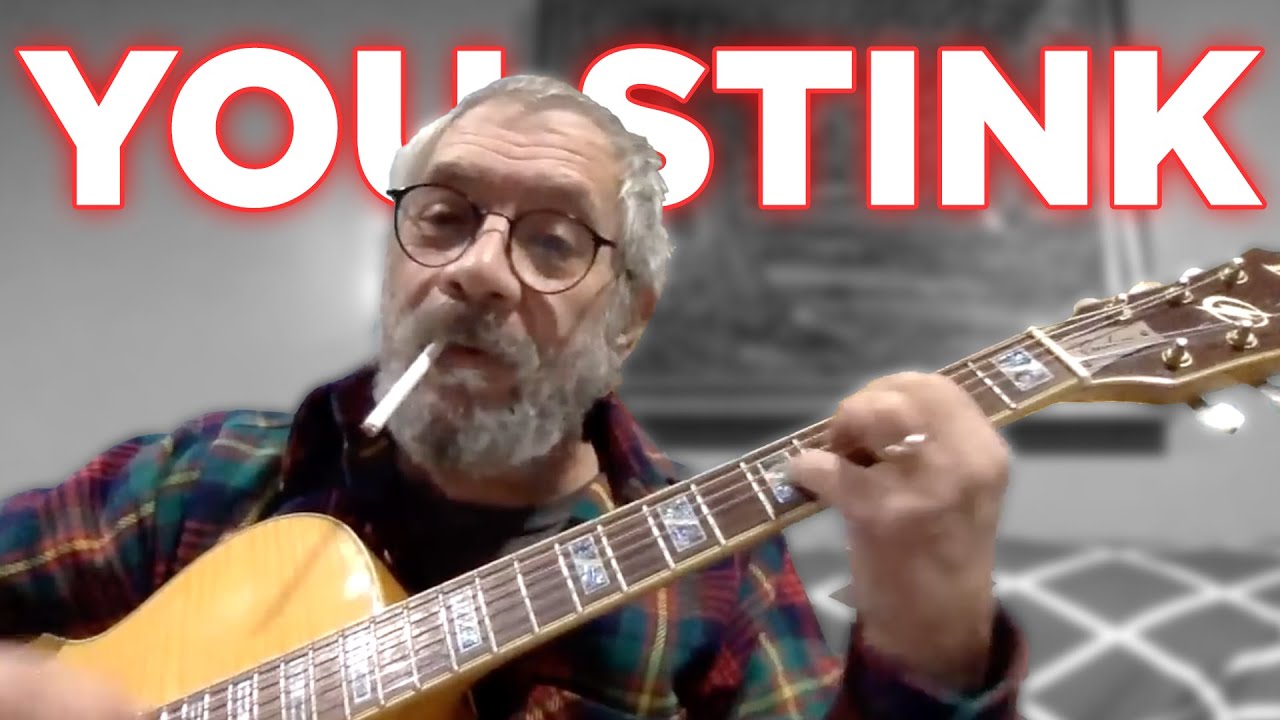
- You st You stink. More That's why it's called practice. I take that. Uh, you guys heard it. I didn't say it. He said it. If you don't practice in all 12 keys, you stink. Kind of the same, huh?
- It's exactly the same. Now, you get a line like that. Start moving the beats around. Change the rhythm.
- Yeah. Now you're starting to make music. Nice. Yeah, that's definitely something that I like doing a lot. And I've talked about before on this channel is like when you learn a lick, not only should
- you actually learn it in different positions, but then you need to actually practice improvising with it and changing it because it doesn't really work super well for you to just like copy paste licks in your playing. That's kind of too stressful actually. But once you actually start changing it, first of all, now you're not copying the player that you got it from and you're actually
- making it into your own thing. And that's actually going to strengthen your understanding of that piece of vocabulary even more than if you just repeated it over and over again verbatim. It's been proven that whenever you have variations of a task that you're working on, you're going to learn it better than just practicing it the
- exact same way over and over and over again. But especially for music, that's even more applicable, I think, because we don't want to be playing same thing over and over again in our solos. We need to be interesting and have variations.
- Yeah, super fun stuff. And also, by the way, that's going to make your phrasing way better. when he was talking about taking the same lick and actually changing the rhythm specifically. He changed some of the notes too, like he got into some arpeggios and things like that, but changing the rhythm, changing
- where you're starting it within the beat, making sure you're not always starting on beat one. This is all great stuff from Jimmy. There was a couple people that seem to get everything. Oo, that's a nice diminished major 7 voicing.
- Wrong. Not a lot. Few. One guy says, "Boy, you play really good, but you're really bitter." Bitter. Not bitter. Disappointed maybe the way the music business turned out. [clears throat] You know, doesn't I I don't have to deal with it anymore. You know, I have plenty of you money. Tommy Dedesco used
- to call that. Dude, you just got to love his vibe. Like, it's just so different than like almost anything you see on YouTube where it's all kind of trying to be perfect and uh you know, all polished. No, he's just like, "Dude, I'm going to tell you how it is and I'm going to play some
- stuff and I'm going to explain the way that I feel and I just have this camera set up in my living room. No fancy mics like I have and cameras or any of this crap. It's just straight up real guitar talk. The key signatures, what key, what key has flats, sharps, etc.? Yeah, there's all kind of memes at the word.
- Those things. Yeah, memes. How about this? Memorize. I haven't seen any any key signature memes, but if you guys found any key signature memes, please send them to me. I definitely want to see them. Is that the word for those things? How about this? Memorize them, mother. Key of C, no sharps or flats. Key of F, one
- flat, B flat. Key of B flat, B flat and E flat. Memorize them. Gez, it's, you know. Yeah. Honestly, actually, this might be the best piece of advice from the video. And he doesn't even mention it, but the thing about what he's talking about there, memorizing your key signatures, is first of all, you should have them
- memorized to the point where like you don't even have to think about it. Like boom, the key of E flat's three flats. Boom, the key of E is four sharps. The key of B is five sharps. The key of G is one sharp. Like you need to be able to rattle them off that fast. Like you need to be able to look at a key signature like it's a color. Like if you look at the color blue, you don't have to think about whether it's blue or green or black or brown. You just look at it and
- you're like, "Oh, okay. That's G. Oh, that's B flat. Oh, that's D flat. D flats five flats. E flat, three flats, A flats, four flats." By the way, a really great tool for you to actually memorize your key signatures for totally free is go to music theory.net. And the thing about this kind of practice, too, is that this is one thing I talked about a bunch of times. You don't even need to
- actually be like with your guitar to do this practice. You could be like sitting in a traffic jam getting better at guitar. So, there's really no excuse for you to not have these things memorized and be practicing them. It's easier than knowing the multiplication tables. You know, if you don't if you can't if you don't do that, how you gonna learn?
- That's why you need tab. Oh, dude. He just called out. He just called out people using tab. Man, I wonder if when Jimmy was like first learning guitar if tab was even a thing. I know that tab has technically existed for like hundreds of years in various
- forms, but I'm pretty sure that like back in the day there just wasn't anywhere near as much tab that was prevalent and easy to access. I heard that. I think it was Jackie Kugan on Little R. By the way, he's playing that tune uh
- Just Friends there. That's a great tune. Great tune. Yeah, just friends. All right, guys. So, you should go check out Jimmy Bruno's channel. He's got like 28,000 subscribers. He should have a lot more, but
- it's just uh really refreshing to see someone talking about practicing like this. I totally agree. You got to put the time in. You got to really do tons of repetitions, way more than you think. And uh if you want some help to learn how to play in all 12 keys like he's saying where I really break it down step by step, then make sure you head on over to jamsville.com and check out the
- Jamsville GPS fretboard fundamentals course. And again, subscribe to my channel, subscribe to Jimmy Bruno's channel, Bruno online school. Go watch more of his videos. Watch the rest of that video. It's also fun to just like listen to him talking about this stuff while you're doing other things. All right, everybody. Make sure you hit the subscribe button, hit the thumbs up
- button, and until next time, listen, learn, and jam.