

After each pass the video waits as long as the loop, so you can play it back.
Start slower with −, and it climbs to 100%.
Keys: Space play · ← → 5 s · [ ] set start and end · − = speed · L loop
Practice and technique · Beginner
If I Had To Start Guitar From Scratch, I Would Do THIS.
In this lesson
Tap a time to watch that part. loops it, so you can slow it down and play along.
-
Step by step Step 1 from scratch: one-minute rule
Starting from scratch, first follow the one-minute rule: guitar is a habit, and deciding to pick it up every day is the most important skill; that alone gets you ~80% of the way by making guitar part of your lifestyle.
-
Step by step First song immediately: Free Fallin' or Seven Nation Army
Learn a first song immediately and build technique from it: Free Fallin' (D and A, pinky Dsus movement, no capo); if chords take too long, Seven Nation Army on one string with one finger, giving time to build finger strength for chords. Under ~7 years old, start with piano or ukulele.
-
-
How to practice Play with the recording ASAP, slowed and looped
Beginners should play everything in time, preferably with the recording rather than a boring metronome, as soon as possible; slow it down on YouTube or loop sections at 5% speed increments (looper.tube). He didn't do this enough when he started; now every beginner does it.
-
Key idea Nail the rhythm even if the chord isn't clean
Good rhythm matters more than clean notes and chords: if your hand won't reach a chord cleanly in time with the recording, who cares; nail the strumming and rhythm as top priority and the fingers soon figure out the clean chords.
-
Step by step Record daily and perform from the start
From the beginning, record yourself every day (recording is itself a skill), and perform for others as soon as possible, even family (often more nerve-wracking than strangers), and find people to play with; he waited four or five years and regrets it.
-
-
Step by step After 1-2 months of songs, 5-10 min/day theory and improv with it
Songs for the first one to two months to establish habit and fun; then add 5-10 minutes a day of theory: major scale one string at a time, how chords are constructed (so you can find them elsewhere on the neck), pentatonic; and immediately improvise with each concept (e.g. combinations of C major notes on one string over a C backing track) since scales and chords are palettes for melodies and progressions.
-
The guides
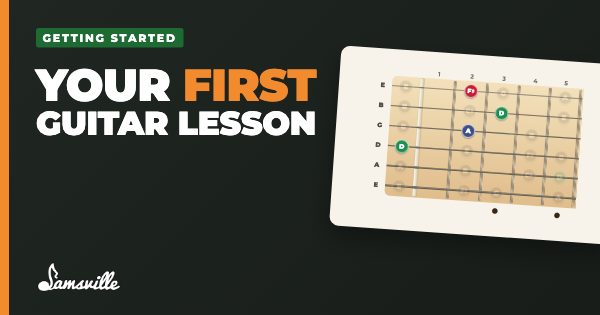 GuideYour First Guitar LessonGet set up, play your first notes and chords, strum D, G and A in time, and make up your own strumming rhythm over a chord.
 GuideYour First Jam SessionYou probably won't feel ready, and that's normal. Here's what happens at a jam, how to get up and play, and how to go anyway.
In the learning path Start Playing Guitar.
Transcript
YouTube's automatic captions. Tap a time to watch from there.
- If I had to start guitar all from scratch, this is exactly what I would do. The first thing that I would do is that I would follow what's called the one minute rule. So, most people think of playing guitar as something you just do and you get better at somehow. But really, playing guitar is actually a habit. The only way that you get better
- at something is by turning that thing into a habit. And the easiest way to turn anything into a habit is by following the one minute rule. The one minute rule just means that you have to do the thing that you want to do every single day for exactly one minute at least. Now, why would I just play guitar
- for one minute? It's not even about the one minute that you spend playing the guitar. It's about the fact that every single day you are now making the decision to pick up your guitar and play it. And that is actually the most important thing in our brains to establishing a habit. We want guitar to be a thing that we do every single day.
- And just that alone will get you like 80% of the way to where you want to go because you're going to ingrain guitar as a part of your lifestyle. I've also used this to start other habits such as journaling and reading. It's super awesome and you'll be super surprised as to how far you've come after just a few
- weeks of following the one minute rule. I have to caveat it by saying ideally you would play guitar for way more than one minute of course but what we're doing is we're actually practicing the most important skill to playing guitar which is practicing actually picking up the guitar every day. And that only takes one minute to make that decision.
- And the best part about it is that no matter how busy you are, you pretty much have no excuse for not doing it. The second thing I would do if I was to learn guitar from scratch is I would learn my first song immediately and use that as the basis for building my technique. I usually teach people one of two songs for their first song depending on how easily they pick it up. I either
- teach them the song Freef Fallen by Tom Petty which is supposed to have a capo but without a capo it sounds like this. And it's basically two chords. It's D and A. And there's a little pinky movement on a D chord where you go to a chord called Dsus, but you don't really think of it as a different chord.
- Now, if it takes you too long, I would recommend learning another song such as like Seven Nation Army, which you can learn just on one string with only one finger as well. And that way, it gives you a little bit more time to develop the finger strength that you need to play chords. Some people have no problem playing chords right away. Some
- people do have more of an issue playing chords right away. Personally, when I actually started playing guitar, I learned chords right away, but it was a giant headache and it took me a few weeks to be able to actually play them cleanly and I just kind of powered through it. But if I was to start all over again, I'd probably do it the little easier way and just learn some songs that are just one finger because I
- didn't really have the finger strength at the time when I started learning guitar. And keep in mind that I was like eight or nine years old when I first started playing guitar, too. So, that is a factor to consider. While I'm along those lines, I wouldn't really recommend trying to play guitar if you're less than about 7 years old. I know that there's some kids guitars and there's a
- new kind of guitar called the Lug. At some point, I might try to get my hands on one, but if you're younger than seven, I would recommend probably just learning piano instead. or if you really want to get a head start on guitar, you can start learning ukulele, which has a lot of the same skills and actually some of the same chord shapes as the guitar. The third thing that I would do if I was learning guitar from scratch, is that I
- would take all of the stuff that I practice, especially those songs that I just referred to, and I would practice them in time. Now, one of the first things that comes to mind when people think about playing in time is using the metronome, but that may be too boring for some beginners. So, what I really want you to do actually is try to play with the recording as soon as possible.
- That's one thing that I definitely didn't do enough when I actually start a guitar. And now, whenever I teach beginners, I have them try to play either of those songs I just showed you with the recording as soon as possible. And that way, they're actually playing in a time. And that way, you're actually just doing the thing that guitar is meant to do as soon as possible, which
- is to play songs, right? That's the whole point of learning guitar. Now, it might be too hard to play with the song at full speed. And that's why it's really great that you can look up songs on YouTube and you can actually slow them down. Or a pro tip is you can use a website. It's called looper.tube tube and you can take any YouTube video of a
- song that you're working on, paste it in there, and you can actually create loops of different sections that you're working on so that you don't have to keep having to rewind and so on. And it lets you adjust the speed in 5% increments, which is really, really great for practicing. I also use that website all the time to practice stuff. Now, the reason I would practice
- everything in time as soon as possible is because you want to pride yourself on having good rhythm. Good rhythm is actually way more important than even getting notes clean and chords and stuff like that. Yes, that's obviously important, too. But what I would say is that like if you're playing a song with the recording and maybe you feel like
- your hand's not quite getting there to hit a chord on time and you don't think it's going to be clean, who cares? Make sure that you nail the strumming and make sure that you nail the rhythm and make sure that's at the top of your priority list. And you'll find actually that if you just prioritize the rhythm enough, then very soon your fingers will
- figure out how to hit those chords cleanly and how to hit those notes cleanly and then you'll have the whole thing pretty much perfect. The fourth thing that I would do if I had to start guitar from scratch all over again is I would record myself every single day. And this is something that almost no beginner ever does. And if you did it as soon as possible, ah gee, you would just
- have such a cheat code over other people who are not doing it. And it's so beneficial because especially if you don't have a teacher, you need to record yourself because then you can actually listen back from an outsers's perspective and hear all the mistakes that you're making and then turn around and fix them. Not only that, but you're going to get better at the skill of
- recording yourself, which is actually a skill in and of itself. The reason most people don't do it is because they get nervous and so on, but it's really that they just need to practice the skill of recording themselves more. And if you start that right from the beginning, then after you've been playing for like a year, you're going to record yourself all the time and you're going to feel
- totally comfortable doing it. And there's going to be other people who have been playing for way longer than you who are still uncomfortable with recording themselves and you're going to be ahead of them because of that. And so in that way, it actually kind of helps you be your own teacher. Of course, by the way, the best thing to do is actually get a teacher. And if you want me to actually be your teacher and you
- want a free consultation with me, absolutely no risk to you whatsoever, then click the link in the description below and fill out the form and we can actually set up a free one-to-one consultation. I guarantee you that you're going to have a ton of fun in it and you're going to walk away feeling like you know exactly what to do next in your guitar journey. The fifth thing
- that I would do if I had to start guitar from scratch all over again is that I would perform in front of others as much as possible and as quickly as possible. So along the lines of recording, this is another thing that gets people incredibly nervous. But if you start doing it right away, you're going to get good at it and you're going to have a massive advantage over other people who are not good at it. So even if you're
- just playing in front of your family members, a lot of times actually I get more nervous playing in front of my family members than I would like literally playing a gig in front of a bunch of other people because well the people at my gig, I don't really know them and therefore I might not actually care about their opinion quite as much. But some people who are like my friends and my family, I actually kind of value
- their opinion a little bit more. So it actually is even more nerve-wracking. So it's actually good practice to even just perform at your house in front of some of your family members on a regular basis. You'll have a massive advantage if you do that. And along those lines, if you can find some other people to play with as soon
- as possible. Oh man, I really wish that I would have done that when I started playing and I wouldn't have waited like four or five years. Gez, it would have really, really, really helped my guitar progress. So, if I had to start from scratch, I would definitely be playing in front of people as much as possible and be playing with other people as much
- as I possibly could. So, the sixth thing that I would do if I had to start learning guitar from scratch all over again is after I've done all that other stuff, then I would actually start to finally learn some music theory on the side. Up until now, I would be focusing on songs for the first like one to two months because I want to establish that
- habit and I want to just have as much fun as possible playing the guitar. But at some point, you're gonna have to learn your theory if you want to maximize your long-term abilities as a guitar player. So, I would start by learning the major scale on one string at a time so that I could start to map out the notes on the guitar fretboard. I
- would start learning about how to construct chords. What makes these different chord shapes actually sound good? Why do they actually sound like that? How are they constructed conceptually? because there's lots of other ways to play each of these chords. Like if you have a C chord, you can also play it here, you can play it here, you can play it here, you can play it here. There's lots of different ways to play
- the same chord on guitar. And you have to kind of know conceptually how those things are actually built in order to be able to figure them out. You need to know where your notes are in the guitar next so that you can start to actually improvise a little bit and come up with your own melodies.
- and be able to actually improvise guitar solos. And I would start to learn about the pentatonic scale as well. You definitely want to focus on songs first and then as you get a little bit better, start to add in maybe 5 or 10 minutes a day of theory practice. Whether it's watching a video, learning about a concept, actually applying it to the
- guitar. This is going to be some of the highest leverage practice that you can do, especially in the beginning because you're going to knock this stuff out of the way in the beginning and you're not going to have to worry about it later. By the way, this is exactly what my course, the Jansville GPS fretboard fundamentals course is designed to do is to show you step by step every single
- one of the theory things that you need to know on the guitar to be able to maximize your long-term potential. and it teaches them to you in the right way, not using shortcuts. There's no kind of gimmicks here. It's the right way of learning it that I wish I would have had when I first started learning the guitar. So, if you're interested in that, click the link in the description
- down below. So, the seventh thing that I would do if I had to start learning guitar from scratch again is that when I learned my music theory concepts, I would then start to learn how to improvise with them. That is actually the best way to learn them and it's the best way to start to actually learn the skill of improvisation. So when you
- actually learn like the C major scale on one string, for example, like this. Okay, cool. Now I know that. Well, even if it's out of time, you should do it in time. Find like a backing track in the key of C major or something. But even if you didn't do that, you could say, "Oh, let me see if I can like make different combinations of these notes.
- Even just kind of messing around like that, it's going to teach you those notes way better. And you're actually going to start using them to make music on some level rather than just doing it the boring way, running all the scales
- up and down and just doing it as some kind of exercise. We don't want it to be an exercise. We want to take these concepts that kind of seem like exercises, but the reason we're actually learning them is cuz they're pallets to be able to make music from. We learn about chords so then we can learn how to make our own cool chord progressions.
- And we learn about scales because they're the pallet from which we create awesome melodies. So, you got to actually use them to create awesome melodies. And that makes it more fun to actually practice. and it makes you want to actually practice it more and that's going to make you better. And the eighth thing that I would do if I had to start guitar all over again is I would just
- keep doing all that stuff over and over again and learning more songs and completing my picture of the fretboard and learning all the theory I need to know in all 12 keys with the Jansville GPS fretboard fundamentals course. Of course, it's really that simple. The people who get super good do all the things that we just talked about and
- they just do them for a long period of time and suddenly before you know it you have learned dozens and dozens and dozens of songs. Your technique is a lot better and you have total command over the guitar fretboard. So then whenever you play a song and someone says, "Hey, you want to play a solo over it?" you can actually find the notes and you can actually play something that sounds good
- over the song and actually invent your own music. So, if you are starting to get into improvising and you're kind of struggling with your ability to navigate the guitar neck, then once again, you got to go check out the Jenzville GPS fretboard fundamentals course. And if you want to know how to get good at guitar so fast that it feels like cheating, then watch this video here
- where I show you exactly how to do that. And if you enjoyed this video, hit that subscribe button, hit that thumbs up button, and until next time, listen, learn, and jam.