
After each pass the video waits as long as the loop, so you can play it back.
Start slower with −, and it climbs to 100%.
Keys: Space play · ← → 5 s · [ ] set start and end · − = speed · L loop
Practice and technique · Intermediate
How I Warm Up On Guitar (Get Ready To Play!)
In this lesson
Tap a time to watch that part. loops it, so you can slow it down and play along.
-
Key idea Warm-up goals: precise hands, calibrated clock
His warm-up has two goals: precise control of both picking and fretting hands, and calibrating his internal clock so it is synced with both hands.
-
-
Exercise Slower-and-slower quarter notes, tiniest motion
Play quarter notes on any single note with a metronome at 80, then go slower and slower, trying to make the pick hit exactly with the click using the smallest possible picking motion; the slower you go the harder it is because you must count internally.
-
Exercise Four-note bursts, rising tempo
Play one-beat bursts of four 16th notes with a metronome starting at 80 and raise the tempo (120, 160...) until very fast; bursts are far easier than continuous streams and teach the feeling of playing fast while staying relaxed. Then improvise by changing the note on each burst.
-
Exercise Two-finger hammer/pull trills with metronome
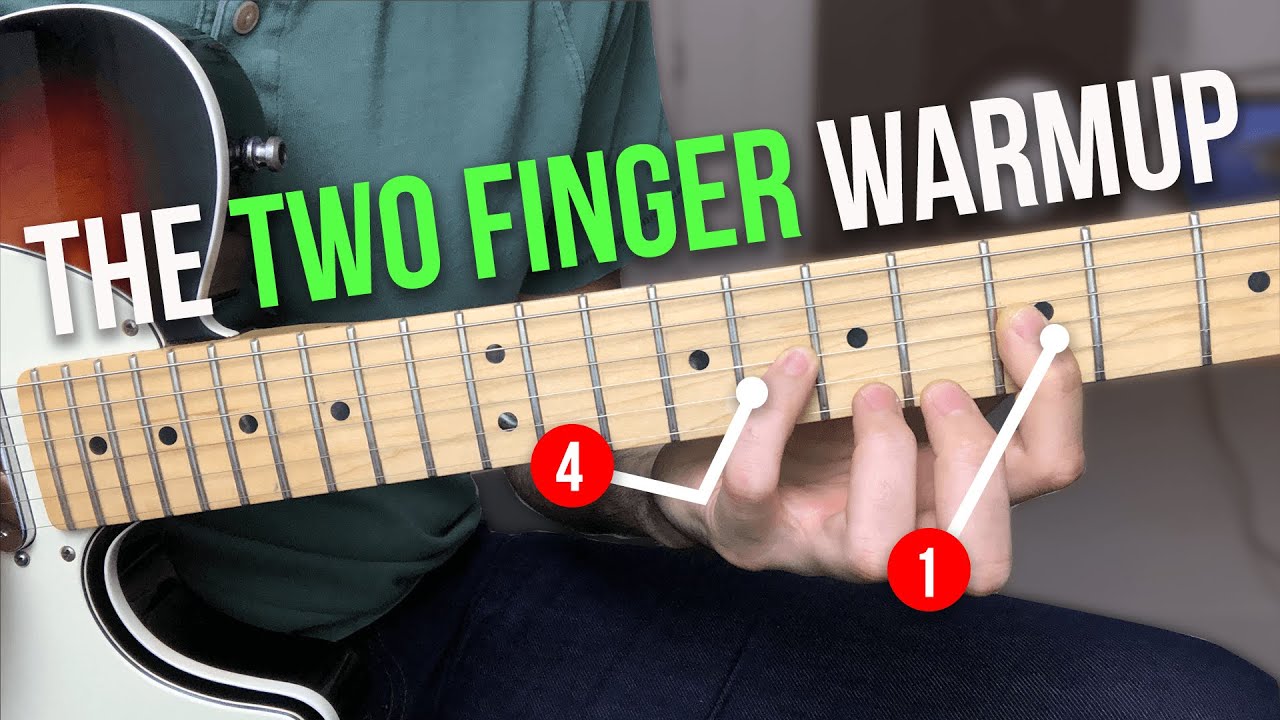
Fretting-hand warm-up: with a metronome or drum track, play continuous hammer-on/pull-off trills (or bursts) on every two-finger combination (1-3, 1-2, 1-4, 2-4, 2-3), moving anywhere on the neck; also good with a very slow metronome.
-
-
How to practice Make up exercises from a concept
Much of his warm-up is creative: he makes up his own exercises as he goes, based on a concept he wants to work on, adding a little improvising.
-
Exercise Awkward voicing switch drill
Pick a chord voicing that still feels awkward (e.g. a movable Cmaj7) and switch back and forth with a comfortable chord (e.g. Dm7) or through its inversions, getting quicker as it feels comfortable; then move to a drum track.
-
Step by step Warm-up to full practice
After warm-up he goes into full practice: a solo or lick he is focusing on, or a drum track in a chosen key improvising with patterns all over the fretboard.
-
About this video
Warming up is one of the most important parts of your day as a musician. When you first pick up your guitar, you need to get your hands and your mind working together in the best way possible to ensure that you will be able to perform at your best.
In this video I'll show you a super simple and easy warmup that will prepare you for just about anything you are going to do on guitar.
Transcript
YouTube's automatic captions. Tap a time to watch from there.
- in this video i'm going to show you a super quick and simple warm-up that's going to perfectly prime you for a day of practicing or playing the guitar and i actually haven't warmed up yet today on guitar so this is going to be a real warm-up exactly what i do so i have two goals in mind when i warm up the first
- goal is that i want to make sure that i can control very precisely both my right hand my picking hand and my left hand my fretting ham and the second goal is that i want to sort of calibrate my time and make sure that my internal clock is properly synced up with both of my hands so let's start off by warming up the picking hand the first thing that i'm
- going to do is i'm going to play just quarter notes with a metronome at 80 beats per minute and then i'm going to keep having it and actually going slower and slower and trying to make my pick hit the string at the exact same time as the metronome try to make it super duper precise and also try to use as small of
- a picking motion as i possibly can so this is what that looks like one two three four one two [01:36] so you get the idea actually the slower you go the harder it gets because you need to keep counting in your head and the metronome's not helping you out as much but it's really really helpful because again you want to try to use this tiniest motion that you possibly can with the pick and be ultra ultra precise and you can do this with any note that you want just any note on any
- string just see how precise you can be with that picking hand like almost no motion whatsoever the pick is just crossing over to the other side of the string now we played really slow but i also want to be able to play fast so the next super duper simple thing that i do is playing a four note burst and i go
- faster and faster and faster with the metronome so i'm going to start back at 80 and play a burst of 16th notes and then i'm going to keep raising the tempo over and over until it gets really fast now this is really good to just do a burst of four notes because you're gonna see that it actually gets way harder if you try to just play a continuous stream
- most of you could probably play really really fast if it's just a small burst of notes and it gets you used to the feeling of playing fast and staying relaxed with all the stuff you need to make sure you stay relaxed so here's 80 dpm [03:05] now let's go up to 120 bpm now let's go up to 160 bpm one thing i also like to do is maybe start improvising a little bit and changing the note on each burst this is
- what that would sound like okay so after all that it was actually super duper simple and easy to do anyone can do this but right now my right hand feels pretty warmed up feels pretty good
- so now it's time to warm up the fretting hand which for me is the left hand so i like to do the first exercise is to just put on a metronome or you can put on a drum track and practice every single combination of two fingers that i can find and just playing hammer-ons and pull-offs with that so i'm gonna start
- off with my first and third finger and i'm just gonna play this kind of infinite hammer on and pull off or you can also do some bursts this is 80 bpm again the first and second finger [04:36] now the first and the fourth finger now the second and the fourth finger now the second and the third finger
- also that exercise can be really good to do with the super slow metronome i'm not going to do that because i don't want this video to take too long but you can see that actually a lot of my warm-up is some creative stuff trying
- to just experiment with different combinations of fingers or adding a little bit of improvising here and there i like to kind of make up my own exercises as i go along that are sort of just based on a concept that i want to warm up or work on and you can also just move that all over the fretboard the cool thing is that with just the
- metronome you don't have any chords or anything so you can just move all over the place and just kind of play random notes it doesn't matter what string you're on or what fret you're on just work those different combinations of your fingers and the second thing i like to do even though it doesn't necessarily have to do with soloing is to play some chord voicings that i find kind of
- challenging to play so for example this is a chord voicing that i've known for a very very long time but it's still a little bit weird for me to play because of the shape that my fingers have to make it's the c major seven voicing and actually this voicing i could just move it all over the place this could be e major seven
- or it could be g major seven but what i'll do is i'll take that chord and then pick some other chord that i'm a little bit more comfortable with and just practice switching back and forth as quickly as i can getting quicker and quicker as i feel comfortable so even just moving between this c major 7 and
- this d minor 7 that's here or moving through different inversions of c major seven and also i putting up another video on
- how to practice chords i'll put on a drum track and practice the chords with that then i just get into full practice mode and i'll start working on a solo or lick that i'm really focusing on at the time or i'll throw on a drum track pick a key
- that i want to solo in and then just start improvising with some different patterns to make sure that i'm getting comfortable going all over the fretboard so that whenever i practice improvising on a song i feel comfortable wherever i am on the fretboard [07:57] patterns are one of the best ways to make your solo sound better and more logical if you want to learn some really cool patterns check out this video right here and make sure you subscribe and go to jamsville.com until next time listen learn and jam