
After each pass the video waits as long as the loop, so you can play it back.
Start slower with −, and it climbs to 100%.
Keys: Space play · ← → 5 s · [ ] set start and end · − = speed · L loop
Fretboard and scales · Beginner
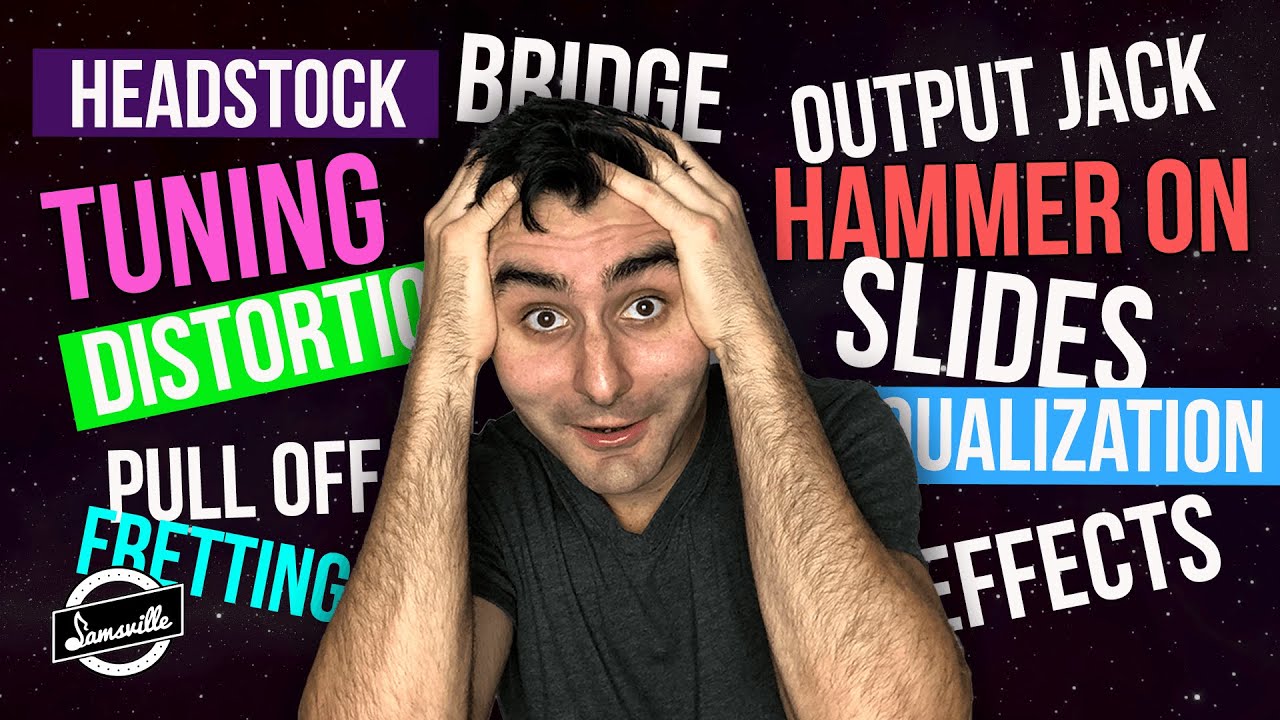
23 Guitar Terms You NEED To Know! (For Beginners)
In this lesson
Tap a time to watch that part. loops it, so you can slow it down and play along.
-
Key idea Beginner guitar vocabulary
A beginner needs the basic parts and terms: pickup, amp, cable, output jack, neck, fretboard, frets, fretting hand, pick, bridge, nut, tuning, headstock, action, truss rod, volume and tone knobs, EQ, effects, bend, hammer-on, pull-off, slide.
-
-
Key idea Volume knob by feel for band playing
Being able to feel and ride the volume knob without thinking is important for controlling levels when playing with a band; rolling it down also changes the tone.
-
-
How to practice Bend target check
To get bends in tune, first play the target note higher up the same string, then bend up to match it.
-
The guide
In the learning path Start Playing Guitar.
About this video
In this video you will learn the meaning of 23 different guitar terms that you need to know and understand well in order to play guitar successfully.
Transcript
YouTube's automatic captions. Tap a time to watch from there.
- in today's video we're going to be going over 27 guitar terms that you need to know and if you're a beginner and you're brand new to the guitar then make sure you stay tuned to the end because you need to know every single one of the things in this video all alright let's get started the first thing you need to know is the pickup now the pickup is
- exactly what it sounds like it's the thing that picks up the sound of the strings and sends it to the amplifier now on most guitars there's two pickups a neck pickup and a bridge pickup and if you don't know what the neck and the bridge are then keep watching because we're gonna cover that in just a second number two is the amplifier the
- amplifier is what we plug an electric guitar into to make the sound loud hence the word amplifier it amplifies the sound i would say having a really good amplifier is actually more important than having a really good guitar because the sound that you hear is only going to be as good as the amplifier that you plug it into
- number three is the quarter inch cable the quarter inch cable has been the standard for decades for plugging an electric guitar into anything else including an amplifier having good cables is important because if your cables are bad they can start to make crackling noises and they can just break and stop working and you really don't
- want that to happen while you're playing on stage do you number four is the output jack the output jack is exactly where we plug our quarter inch cable into on the guitar now this sounds fairly trivial but it's actually really important to have a good output jack on your guitar because like with the cables there can actually be some problems that
- happen with output jacks like them getting loose or connections coming off and if you have a problem with your output jack that can completely destroy everything you're trying to do number five is the neck of the guitar the neck is this part that sticks out of the guitar and basically has everything that goes on with the guitar happening on it
- that's where the strings go over and where all kinds of other awesome stuff happens also going back to the pickups we call the pickup that's closest to the neck of the guitar the neck pickup next we have the fretboard slash the fingerboard now these are pretty much interchangeable terms and this is just the surface of the neck where the
- strings run over and where you press your fingers down on to play the guitar next we have fret frets are these metal wires that are inlaid and hammered in to the fretboard and that's exactly what helps us to find where different notes are on the guitar and helps us place our fingers correctly to play the things
- that we want to next we have fred ing and all that means is when you push your fingers down on a string on any fret so that you can play a note or chord next is the fretting hand so for right-handed guitarists the fretting hand is almost always going to be your left hand and for left-handed guitar it's going to be
- the opposite it's going to be your right hand next is the pick now it's this little plastic thing here and this is what most guitarists use to pick and strum the strings of the guitar to get it to make sound also in britain they call it a plex room i don't call it a plex room however i just call it a pick
- next we have the bridge of the guitar the bridge is the part that holds the strings in place on the body of the guitar so on this guitar the bridge is located right here and you have these bridge saddles where each string goes through and the strings actually are fed through the back of the guitar body
- and right through those holes and through these bridge saddles where they're supported nicely there's tons of different types of bridges that you can find in different guitars particularly acoustic guitars they're far different than the bridge on an electric guitar next we have the nut of the guitar the nut is the part at the end of the neck
- that supports the strings and has slots that the strings are fed through the nut actually seems like it's something that's pretty inconsequential but the nut is actually super duper important when it comes to the tuning of the guitar that brings us to tuning the tuning is the pitch or note that each
- string is set to so standard tuning of a guitar sounds like this and that's what your guitar should sound like when you strum all the strings open like that one thing to note is that tuning is a very fine and precise adjustment that
- needs to be made every single time you play your guitar and if your tuning is off just by a little bit that can be enough to make everything that you play on the guitar sound bad next we have the headstock the headstock is the very end of the guitar which houses the tuning pegs and tuning knobs the headstock is
- also critically important actually to the aesthetic of the guitar because every single guitar company has their own signature headstock that they like to use on the overwhelming majority of their guitars next is the action this is a really really important term to remember because action is the distance between the strings on your guitar and
- the fretboard and a higher action means that the strings are further away from the fretboard and a lower action means that they're closer and most of the time people want to set their action as low as possible without getting problems with the sound of the guitar because if you set it too low you can actually have
- buzzing of the strings being too close to the frets of the guitar but the lower your action is the easier it's going to be to play the guitar because you don't have to push your fingers or apply as much pressure to play each note or chord that you want to play the action of the guitar is determined by a few different things but one of the main things that's
- involved in it is our next term which is the truss rod of the guitar the truss rod is actually a rod that runs through the center of the neck and the purpose of it is to create counter tension against the strings which are pulling the headstock of the guitar forward so the truss rod helps keep the neck nice and straight and not
- let it get bent by the strings the way you adjust the truss rod is going to be different on a lot of different guitars on this guitar it's actually this hole by the nut where you can actually stick an allen key in there turn it and adjust the truss rod some other guitars though are a bit harder to adjust it and chances are you won't really have to
- adjust it you should get a professional to do that for you next we have the volume knob this guitar has two knobs this one here is the volume knob so if i turn this all the way to the right we're at full volume and then i'll play a note and start
- rolling it down you'll see that it will get quieter now one thing to keep in mind is that actually rolling down the volume knob does change the sound of the guitar a bit as well it doesn't purely lower the volume but being able to feel where the volume knob is on your guitar without
- thinking about it too much is pretty important for being able to play with a band where you need to control your levels next we have the tone knob the tone knob on the guitar controls what is called the tone and this can be a little bit confusing essentially the tone setting on the tone knob controls how
- much of the high frequency sounds are let through the pickups as you make the toe knob lower and lower it'll actually kind of sound like the guitar is underwater and it'll sound much more muddy let's take a listen [08:37] so i hope that you can hear that it sounds much more muffled and like i said kind of sounds like it's underwater and when the tone knob is all the way up it sounds much brighter so talking about the tone knob and the high frequencies being let through is a great way to segue into our next term which is eq and eq is short for equalization
- and equalization is essentially the same type of thing that we're talking about with the tone knob manipulating the sound and how many frequencies are let through and how loud they are except that we can adjust it for the whole entire frequency spectrum typically this is done on your amplifier or in a pedal or it can be done in computer software
- after you record guitars the most basic type of eq is found on most amps which is having a low middle and a high knob and for me personally i think that the best idea is to try to get a balance of all three of those however the way the different guitarists are going to set
- the eq is going to be totally different depending on who it is and what gear they're playing on and how they play and touch the instrument and it's a very important aspect of your own personal sound as a guitarist next thing we have are effects effects
- change the sound that comes out of the amplifier when you play something in the guitar the overwhelming majority of the time effects are going to be added to your sound by using something like effects pedals effects pedals you plug your guitar into the pedal and then it does its magic adds the effect to the
- sound and then it sends that sound out of the pedal and into the guitar amplifier some super common effects are distortion reverb [10:42] and delay effects are obviously one of the coolest parts about playing the guitar some amplifiers also come with built-in effects and that could be a really great option if you're just starting out to
- get an amplifier like that next is bending bending is a technique for playing the guitar and it's one of the really cool unique things that we can do on a guitar and it's when we play a note and then push the string upward to make another note sound like this
- now bends can be really challenging for a while because you need to be able to get them in tune and just like how i was talking about with the tuning of the guitar if it's off by just a little bit it can result in a note sounding bad so a quick tip for practicing bends is you could play a note and then play another note on the same
- string that's higher up the guitar fretboard and by the way higher means this way towards the pickups of the guitar because the pitch is going higher and then bending up to that note next is a hammer-on a hammer on is when
- you play a note on a string by picking it and then play another note on the same string by striking one of your fingers down and it looks like this you're hammering your finger on the string next we have pull-off pull-off is
- like the opposite of hammer-on where instead of hammering on her finger to the string on a higher note we're actually pulling one of our fingers off and landing on a lower note while only picking the string one time like this [12:54] now one thing that's really important to know about pull offs is that the name is a little misleading because it makes it seem like you just pull your finger off the string something like this i'm just lifting my finger off the string but that's not actually how you really want to play them what you want to think about is actually pulling
- downwards so that you actually almost like pick the string with your finger not with the guitar pick that way you actually get a very clear sound on the second note if you just lift your finger off you're not going to get a clear sound and the next note is going to sound way quieter than the
- first one and the last thing we'll cover in this video is a slide so a slide similar to the previous techniques only requires one pick on the string but we just take the same finger and move it up the fretboard so we take advantage of the fact that
- the string is still vibrating and we can just move our finger wherever and it sounds really cool because it sounds like the two notes that you're playing are connected so if you're looking to get a jump start on your guitar playing and learn right from the start how to navigate the fretboard with ease and make sense of it all and master it
- eventually then make sure you head on over to jamesville.com and check out the jansville guitar performance system fretboard fundamentals course this course provides you everything you need in a step-by-step easy to follow system so that by the time you're done with it you're gonna feel complete confidence
- and mastery over the guitar fretboard alright everybody until next time listen learn and jam